QUAERITUR: TLM and celiac people receiving only Precious Blood

This question came in from e-mail:

Father, I thought you might be some aid here. We had a person today at Mass unable to receive even a low gluten Host, so she needed a separate "mini chalice". Since the Mass was 1962 Father and I did not know what to do exactly in giving Communion to her. My thought was that it would be changing only the elements you need to change (she knelt at the altar rail of her own accord). So I thought you would just put Sanguis for Corpus in the prayer, make a sign of the cross over her with it, and then hand it to her (since we have neither fistula or intiction spoon).

My question is two fold. Was this even allowed (the Mass on EWTN with Fr. Wolfgang had it)? And if so, is the way I described correct?


I don’t see any problem with a separate mini-chalice.  Also, you would simply change the words from "Corpus  D.N.I.C…" to "Sanguis D.N.I.C…"

Some people might quibble with the person touching the sacred vessel with bare hands.  This is a touchy point.

I believe this to be allowed and the way it was done was correct.

Posted in SESSIUNCULA |
19 Comments

Portland, OR: TLM news

News from my e-mail:

I thought your readers out west might like to know that since last December a Low Mass in the Extraordinary Form has been offered monthly by Father Gerard G. Steckler, SJ, pastor of St. Anthony’s Catholic Church in Waldport, Oregon, in the Archdiocese of Portland, Oregon. 

Their next Tridentine Low Mass will be Monday, May 26 at 8:00 am (Memorial Day).  St. Anthony’s is at 685 Broadway in a tiny town on the central coast of Oregon located at the crossroads of highways 101 and 34.  (Due to summer, the next Mass after May will be in August.)

Visitors should not expect an FSSP-style extravaganza such as seen on EWTN.  This is a small parish with fewer than 100 families, although the Extraordinary Form Mass has a consistent attendance of about 30 people.  It’s a simple Low Mass with no music and one server.  However, it is done beautifully and correctly.  Father Steckler was ordained over 50 years ago and, although he’s a Jesuit, has forgotten neither his rubrics nor his Latin.

Excellent.  Summorum Pontificum is indeed starting to produce its effects.

Brick by small brick.

Posted in SESSIUNCULA |
7 Comments

D. of Gaylord: TLM update – an amazing attitude of restriction continues

Do you remember the very weird story that came from the Diocese of Gaylord some time ago?

Last August, it was announced that all Masses in the Diocese of Gaylord must be in English.   So, much for the Summorum Pontificum, right?   Then there was a clarification from the Director of Communications for the diocese (where do they get these people anyway?) saying that, "of course we are not against Summorum Pontificum!  But there can’t be Masses in Latin without permission of the bishop, and you can’t have Masses with English and Latin, and no, this doesn’t mean you can’t have Masses in Spanish," blah, blah….  Effectively it sounded as if perhaps someone was trying to prevent a mixture of RITES, and the people involved had a hard time grasping that the Novus Ordo is also to be celebrated in Latin.  You know the drill. Anyway, there was a lot of confusion.

Now we get this news.  This is posted on the website of the Diocese of Gaylord.

Extraordinary Form of Mass
 
Bishop Patrick R. Cooney has announced that the extraordinary form of the Mass will be offered publicly beginning on Pentecost, May 11, 2008. Fr. Donald Libby will be the presider [That means "celebrant" for most of us.] for a weekly celebration of the Mass according to the 1962 Roman Missal, often [incorrectly] referred to as “the Latin Mass.” [This is what got them into trouble in the first place.  Proper terms can really help.] The Mass will be offered at Holy Rosary Church in Cedar on Sundays at 12:45 p.m. unless Fr. Libby is away or unavailable. Fr. Libby is currently the only priest qualified to offer the Mass publicly in the Diocese of Gaylord.  [Who says he is the only one " qualified"?]

In July 2007, Pope Benedict XVI issued his Apostolic Letter addressed restrictions on the use of the Latin-language liturgy that predates the Second Vatican Council. The Mass from the post-Vatican II Roman Missal remains the ordinary form of the Mass, while Mass according to the 1962 Missal is the extraordinary form.  [Two things.  First, Summorum Pontificum didn’t just "address restrictions".  Interesting choice of language, no?   SP lifted restrictions.  Also, set in the context of the bizarre approach to Latin they showed last year in Gaylord, note that the writer seems fixated on the issue Latin.]

“There were some logistical things to work out to make this possible – including being sure we had a priest prepared to properly celebrate this Mass,” said Bishop Cooney. “I believe the Holy Father’s intention is to try to bring healing to those who have felt hurt because of their devotion to this earlier form of the liturgy.”  [In that case His Excellency should spend some time in a closer reading of Summorum Pontificum and the accompanying letter.  He is not taking into account that there are people who simply prefer the older form of Mass.  They also have rights and Summorum Pontificum is as much about them as anyone.  I also have firmly in mind what Card. Castrillon Hoyos has said recently, namely, that the older form of Mass should be used in parishes, even if a request has not been made.  Also, remember that priests do not need permission to use the 1962 Missale.  Summorum Pontificum is for priests as well as lay people.]

The major differences between the ordinary and extraordinary forms of Mass individuals will notice are the priest’s orientation during the liturgy and the use of Latin.  [Unbelievable.  This is wrong.  First, the normative language of the Novus Ordo is Latin.  No priest needs permission to say Mass in the language of his Rite.  Also, the Novus Ordo rubrics presuppose that the Mass is celebrated ad orientem.  At the same time the older, TLM form of Mass can also be celebrated versus populum.  The major difference between the forms of Mass are the texts of the prayers and some of the prescribed actions of the priest and sacred ministers, as well as the greater space for silence.]

Prior to the Second Vatican Council, a church’s altar was placed against the wall at the back of the sanctuary. The Second Vatican Council decreed that a church’s altar should be placed in a central location in the sanctuary, allowing a priest to face the congregation. (GIRM, 2002, paragraphs 299-301)   [No.  This is false.  It is unbelievable that this is still going on.  The Congregation for Divine Worship issued an official clarification about GIRM 299, which was (probably purposely) mistranslated in the USCCB’s BCL’s document Built of Living Stones.  WDTPRS has covered this here.]

Some other differences include the role of altar servers, the liturgical calendar, what Scriptures are proclaimed, and possibly the vestments worn. In the extraordinary form, Communion is distributed only under the species of Consecrated Bread, usually at a communion rail.
A few months ago, Fr. Duane Wachowiak, Director of the Secretariat for Worship and Liturgical Formation, arranged for a priest from Chicago who is trained in Latin and the extraordinary form of Mass to come to the area for five days to train priests who wished to celebrate this Mass publicly.

“Dioceses throughout the country were faced with the same dilemma,” said Fr. Wachowiak. “Not many of us ministering now are skilled in Latin and in this form of the Mass. The focus of these trainings being offered nationwide is to certify that those offering the Mass publicly know Latin, the rubrics of the Mass and are able to “pray” the Mass and not simply recite the Latin words.”

“It is important that whoever offers this Mass knows what it is he is saying and praying,” noted Bishop Cooney.  [A laudable aspiration.  I would not want to try to test this, however.  You might wind up with the conclusion that many priests have no idea what the English texts mean.]

Any priest may celebrate the extraordinary form of Mass in private, even with others in attendance, but that is his private Mass. Times of private Masses are not announced. The Mass being offered at Cedar starting on Pentecost will be a public Mass and may be announced through bulletins and other means that it is available for those who wish to attend.
|
Along with the announcement of the availability of the Mass, a set of guidelines was published by Bishop Cooney. [It would be very good to see these guidelines.] Some of the entries in the norms for this diocese remind the people who attend that they have the obligation to be registered and participating parishioners in a Roman Catholic parish, either Holy Rosary or another.  [HUH?  Does this mean that some person who is, perhaps, a follower of the SSPX and therefore not registered in a parish is NOT WELCOME?  What about a young non-practicing Lutheran who might be curious about what is going on?   This in incredible.  What are they going to do?  Check ID cards and match them against a database?  Dein Auweis, bitte!]

Another norm is that the extraordinary form is to be offered in addition to the ordinary form of Mass celebrated in the parish because the post-Vatican II form of Mass is still the one that takes precedence. In this context, the term “extraordinary” is meant to mean “other” rather than to place it as being of higher rank.   [Good heavens.  Who writes this stuff?  If "Extraordinary" means "other" (and it doesn’t) then it means neither "of higher rank" nor "of lower rank".]

“Regardless of which form is being used, it must follow the guidelines for that particular Missal,” added Fr. Wachowiak. “A priest cannot use some of one and some of the other in a single Mass. He has to follow either the ordinary or extraordinary form.”

In addition, procedures for the financial aspects are also addressed in the norms. For example, an individual attending the extraordinary form of the Mass in Cedar may deposit their own parish envelope in the collection and it is to be forwarded to the respective parish. Any loose collection will be channeled through Holy Rosary’s bookkeeping system as it is the parish of Holy Rosary who pays the priest’s salary and benefits and maintains the building to hold the Mass. [Oh my.  This is going to stir some conversation.]

The complete set of norms may be viewed on the diocesan website at www.dioceseofgaylord.org.

“While I was attending the training held for Fr. Libby, I was able to see the many connections between the ordinary and the extraordinary forms of Mass,” stated Fr.Wachowiak. “I was able to better understand some of the terms and phrases used by many older folks who grew up attending the Mass that began with the Council of Trent.”

Fr. Michael Janowski remains pastor of Holy Rosary along with St. Mary, Lake Leelanau, St. Phillip Neri, Empire and St. Rita-St. Joseph, Maple City, and Fr. Libby remains associate pastor of the same parishes. Fr. Janowski is supportive of both Fr. Libby’s willingness to serve the diocese in this capacity as well as those who wish to attend the Mass.

For more information, please contact Fr. Duane Wachowiak at the diocese at 989.732.5147.

 
I looked for the "norms" on the diocesan website but couldn’t find them.

Posted in SESSIUNCULA |
33 Comments

QUAERITUR: Priest singing more during TLM

This question came via e-mail.  I am against pressed for time, so I will let you all take care of it.

Good question, though!

Fr. Z.,

Please help, if you deem this question worthy of a broader audience.

The priest who celebrates the extraordinary form for us has a beautiful singing voice and knows by heart much of the plainchant.  He is newly come to the Tridentine rite and wonders why it should be the case that the priest intones the Gloria but does not continue to stand at the altar to sing the remainder of the prayer.  He has the same question in regard to the Credo.  For the Kyrie, Sanctus, and Agnus Dei, he knows that this is not practicable because of the many prayers the priest is offering at the same time.

My question to you: Has there ever been provision or permission for the priest to sing the Gloria and the Creed from the altar, with the choir, rather than taking a seat on the side and waiting out the choir?  And if there has been no provision, is there a particularly convincing theological or rubrical reason why he should not do so?

I am reminded of a story told by the late Msgr. Richard Schuler.  He knew an old German priest at a rural parish who liked to get the higher stipends for High Masses.  Problem: no choir.  No problem!  He would do all the parts himself! 

He would from time to time let the people know, "Und now I am ze chvior", and then would sing for a while.  Then, "Und now I am ze priest."  And so forth.   Funny and really not to be done. 

In the words of the immortal Gracie Allen, "People are funnier than anyone."

Posted in SESSIUNCULA |
34 Comments

iphone news

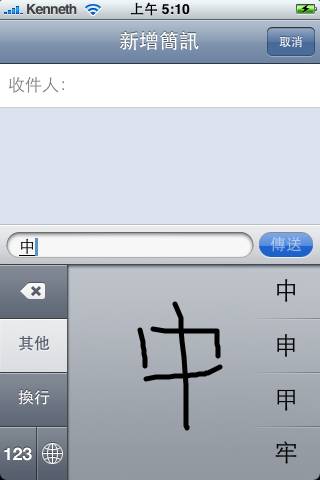
Very cool.  Iphone is adding Chinese character recogition.

iphone news

Screen shots posted on Chinese site wretch.cc allege that iPhone firmware 2.0 has added support for Chinese handwriting recognition in addition to a revamped (albeit non-recognition) Japanese interface. While that’s still light years from an Apple admission that not everyone is in love with the on-screen keyboard, it’s one small step toward functionality that seems to make boatloads of sense — in any language — given the phone’s generously proportioned touchscreen and its reluctant but unavoidable nomination as the Newton’s spiritual successor. What isn’t clear is how folks are expected to draw characters, seeing how there’s no provision for an on-board stylus, the entire interface is designed for finger use, and we don’t see many owner rushing out for a Pogo. However Apple intends for this feature to be used, the implementation looks pretty hot, capable of operating in both portrait and landscape modes. Sadly, it seems that Chinese is the one and only language supported at the moment; sure you don’t want to let everyone in on the Graffiti-esque retro fun here, guys?


Posted in SESSIUNCULA |
13 Comments

Thanks for a day brightener

The sight of the FedEx truck coming up the drive did make my day.

Many thanks go out to AJ who sent me some very nice Chinese white tea, from the amazon wish list.

I am most beholden and it is delicious.

PENG JING UPDATE:

The peng jing is doing very well now.  I have been able to set it in the sun, now there is some. 

And it is going to bloom! 

Posted in SESSIUNCULA |
2 Comments

D. of Charlotte: TLM training for priests

This is an interesting report:

The Catholic News & Herald, May 2, 2008
Back to the ‘old Mass’
Several parishes now offering Mass in extraordinary form
by KATIE MOORE
staff writer

CHARLOTTE — In December 2007, 14 priests from the Diocese of Charlotte participated in a five-day training session on the 1962 Roman Missal, providing them with the background needed to offer the Mass in the extraordinary form.
Now, four-months later, having completed the diocesan training, some of those priests have begun celebrating at their parishes, Latin-language liturgy that predates the 2nd Vatican Council. [Brick by brick, people!]
The first was Father Eric Kowalski, pastor of Holy Angels Church in Mount Airy, who began celebrating the low form of the Latin-language Mass [NB: The Novus Ordo is also Latin language.] at his parish on January 5.
“When the Holy Father released the ‘motu proprio,’ that’s when it really began,” said Father Kowalski.
In his July 2007 apostolic letter, “Summorum Pontificum,” Pope Benedict XVI eased restrictions on the use of the 1962 Roman Missal, which was standard before the new Order of the Mass was introduced in 1970. The papal decree was issued "motu proprio," a term that reflects the pope’s personal initiative in the matter.
The Mass from the Roman Missal in use since 1970 remains the ordinary form of the Mass.
After inserting copies of the “motu proprio” and the pope’s letter to the bishops in his parish bulletin, [Another use of the parish bulletin.  Excellent.] Father Kowalski opened the issue up to his parish and hosted a general meeting to talk about the Mass in the extraordinary form.
“The people were very open and very interested,” he said of the approximately 50 parishioners who came to the meeting.
Soon he began offering refresher seminars for those who wanted to work on Latin pronunciation and familiarize themselves with the prayers.
Now, Father Kowalski celebrates the Mass in extraordinary form every Saturday at 6:30 p.m. [Let us hope for more.]
“It fits very seamlessly into our liturgical life here,” he said.
By adding the Latin-language Mass to the weekend Mass schedule, it fulfills the Sunday obligation for the 40 to 60 parishioners who typically attend.
In terms of execution, the extraordinary form of the Mass requires a great deal of preparation on the part of the priest.
“It’s a bit intimidating at first because you want to do it with attention and devotion and you want to offer it properly,” said Father Kowalski, who typically spends about two hours a week preparing for the liturgy.
“It’s become a great joy for me,” he added. “It really has deepened my own spiritual growth and faith.”  [When younger priests learn the older form, it changes them.]
Another church in the diocese where the Mass in the extraordinary form is now offered is St. Joseph Church in Asheboro.
For Father Christopher Davis, pastor of St. Joseph Church, the Latin-language Mass was particularly appealing.
“I had studied renaissance and medieval music,” said Father Davis. “It was right up my alley and part of my own personal spirituality.”
Father Davis celebrates the Mass at his parish every Wednesday at 7 p.m.
One of the things he enjoys most is the structure and silence of the extraordinary form.
“It allows time for contemplative prayer,” he said. “You really get that sense of reverential silence upon entering into the mystery of the Eucharist.”  [The whole point of Mass is that encounter with Mystery.]
He also mentioned the noticeable similarities between the two forms of the Mass.
“To me it’s been beautiful to see how much of the ‘new Mass’ is still retained from the ‘old Mass,’” he said. “You can see the progression of what the church has now and what we can go back to.”  [Continuity.   And again, the priest learned more about what Holy Mass is.]
In a letter to bishops, Pope Benedict stated, “There is no contradiction between the two editions of the Roman Missal.”
“In the history of the liturgy there is growth and progress, but no rupture,” he said. “What earlier generations held as sacred remains sacred and great for us, too, and it cannot be all of a sudden entirely forbidden or even considered harmful.”
The pope noted, however, that the ordinary form of the Mass must not be neglected.
“Needless to say, in order to experience full communion, also the priests of the communities adhering to the former usage cannot, as a matter of principle, exclude celebrating according to the new books,” the pope said.
“The total exclusion of the new rite would not in fact be consistent with the recognition of its value and holiness,” he added.
Anyone who remembers the pre-Vatican II form may notice a few changes.
Now, the congregation is more involved in dialogue and responses and the readings are said in English.
“It’s just easier for everyone,” said Father Davis, who noted that all of the changes have been approved by Pope Benedict. [Though "easier" isn’t necessarily "better".]
Later this month, Father Timothy Reid, pastor of St. Ann Church in Charlotte, will begin celebrating the Mass in extraordinary form at his parish.
Father Reid will offer an introduction to the extraordinary form at St. Ann Church on Wednesday, May 21 at 7 p.m. He will begin celebrating the Mass in extraordinary form on Saturdays at 8 a.m., beginning May 31.

Contact Staff Writer Katie Moore by calling (704) 370-3354 or e-mail kmmoore@charlottediocese.org.
WANT MORE INFO?
Catholics interested in attending a Mass in extraordinary form should contact the office of their vicar forane — a priest who coordinates pastoral activities among groups of churches — to find out Mass times and locations.
For a complete list of vicars forane visit www.charlottediocese.org/agencydirectory_post.html and click on vicars forane.

Posted in SESSIUNCULA |
5 Comments

Holy Smoke: Pope wants the Latin Mass everywhere

Damien Thompson at Holy Smoke on the Daily Telegraph, snarks some English bishops … again.

This seems to be a follow up on what we posted here, namely that Card. Castillon Hoyos is saying that the Holy Father wants the older form of Mass to be in parishes and that priests shouldn’t wait for requests (and therefore don’t have to wait for requests).

Pope wants the Latin Mass everywhere
Posted by Damian Thompson on 05 May 2008  at 17:54
Tags: Catholicism, Pope Benedict, Latin Mass

Bishops Hollis and Conry, if you have ever thought of jumping ship to the C of E, now might a good time to do so. According to a senior Vatican cardinal, Pope Benedict wants the old Latin Mass celebrated in parishes even where the people have not asked for it.

English bishops take note: this is what the Mass looks like

Well! That will certainly drive a horse and cart through the English bishops’ shameful attempts to ignore Summorum Pontificum, last year’s papal letter removing their power to block the 1962 (Tridentine) Missal.

According to the Catholic News Agency, Cardinal Dario Castrillon Hoyos, head of the Pontifical Commission
Ecclesia Dei, let the cat out of the bag in an interview for a DVD instructing priests on how to celebrate the Extraordinary Form.

Here’s the money quote: “The cardinal said that parishes and priests should make available the Extraordinary Form so that ‘everyone may have access to this treasure of the ancient liturgy of the Church’. He also stressed that, ‘even if it is not specifically asked for, or requested’ it should be provided.  Interestingly, he added that the Pope wants this Mass to become normal in parishes, so that ‘young communities can also become familiar with this rite’.”

(Incidentally, I can think of one parish that NEVER celebrates the old Mass on Sundays. It’s called Westminster Cathedral. Perhaps Cardinal Castrillon Hoyos might raise the subject when he visits it in June.)

The idea of young people discovering the ancient Mass, said entirely in Latin with zero opportunity for congregational showing-off, will truly horrify with-it bishops and their Sandalista worship leaders. And what will Bobbie (“Cry me a river”) Mickens have to say?

I do wonder, however, whether the Pope realises that if he wants the classical Mass celebrated widely in this country he will have to make one extra provision. New bishops. Lots of them. And fast. [His Hermeneuticalness for Westminster!]

Posted by Damian Thompson on 05 May 2008 at 17:54


Posted in SESSIUNCULA |
31 Comments

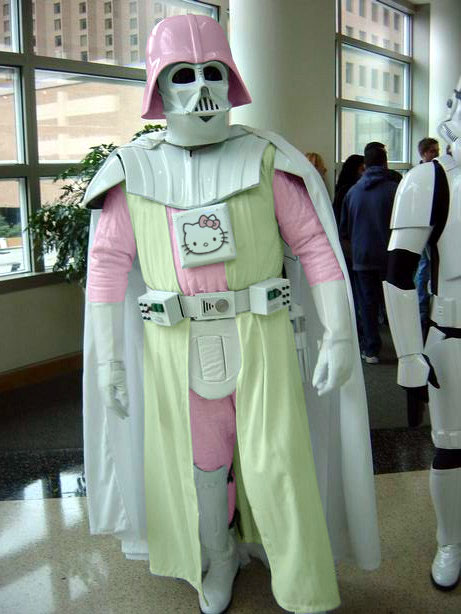
That’s just… wrong…

Oh… no no no no no

That's just... wrong... 

I am reminded a little of this:

(This video is no longer available.)

Posted in SESSIUNCULA |
35 Comments

What squirrels will do for a meal

It will not come as a surprise to WDTPRSers that I hate squirrels.  They are, to my mind, cuter versions of rats.

I how they analyze ways both to attack the bird feeders and even get into the house.  A squirrel in the house is a bad thing.

So, here is a little video to show us what we are up against.

(This video is no longer available.)

Posted in SESSIUNCULA |
16 Comments