NatReview: Rich Lowry – editor on “Dictatorship of Relativism”

Here is a piece by Rich Lowry, editor of the National Review.  My emphaes and comments.

Dictatorship of Relativism
The pope bears important truths about the roots of our experiment in liberty.

By Rich Lowry

When President Bush and Pope Benedict XVI stood together on the White House lawn in a majestic welcoming ceremony, it symbolized the growing rapprochement of American evangelical Protestantism and the Catholic Church.

It was West Texas meets Rome; plain-spoken man of faith meets intellectual of great depth; representative of America’s awesome secular power meets representative of the spiritual power of Christianity. Even so, more united them than separated them, with President Bush approvingly quoting Benedict and the pope delivering — for such a reserved man — a notably warm blessing of America.

The Catholic Church long was suspicious of America as a freewheeling Protestant nation that rejected the state support for religion seen in Europe. Not anymore. The separation of church and state as practiced in America has given religion the space to flourish and the respect necessary for it to inform public discourse. Thus, faith — and the Catholic Church — retains its vitality.

In the wake of the French Revolution, in contrast, many European nations developed what Benedict calls a “conflictual” separation of church and state. A godless state sees its role as chasing the vestiges of Christianity from the public square.  [As WDTPRS has said a zillion times, Benedict is striving to reinvigorate Catholic identity (the ad intra dimension) so that Catholics have something to contribute in the public square.  It is one thing to have a voice.  It is another thing to have a voice and something to say.] As it has succeeded, Europe has been robbed of its civilizational vigor. “Europe seems hollow,” Benedict has said, “as if it were internally paralyzed by a failure of its circulatory system.”

If Benedict reflects the Catholic Church’s new attitude toward America, evangelicals in turn have warmed to the church. It’s not the “Whore of Babylon” of yore, but an ally in a deep-seated cultural struggle. As Benedict himself has said of evangelicals, “They have come to see Catholicism as a defender against the pressures of secularization and an upholder of the same ethical values that they themselves profess.”

He might as well have been speaking of President Bush, a man famous for his impatience for pomp and circumstance who went all out — from a 21-gun salute to a four-tiered, lemon-flavored birthday cake — for the pontiff. Bush told Benedict, “In a world where some no longer believe that we can distinguish between simple right and wrong, we need your message to reject this ‘dictatorship of relativism.’ ”  [From an American President.  I was pretty proud of him in that moment.]

The phrase is one of Benedict’s signature lines. It was featured in his homily at the 2005 Mass for the papal conclave that so impressed his fellow cardinals before they selected him as pope. [Someone did homework.] Benedict’s point was that if relativists consider any claims of moral truth as inherently oppressive, they feel justified in attempting to muzzle those who make them. In Benedict’s words, they “seek to subordinate all religions to the super-dogma of relativism.”

This tendency is particularly well-advanced in Europe, where the European Union is a relativist superstate hostile to traditional Christian morality. One of Benedict’s missions in his trip here is to provide Americans a common vocabulary for resisting an aggressive secularism. [well said] This accounted for the extraordinary spectacle of a pope on the White House lawn — itself unimaginable a century ago — explaining the fundamentals of American civil religion.

The foundation of our freedoms isn’t a thoroughgoing skepticism, but a profound, “self-evident” moral truth: that we have inalienable rights. “America’s quest for freedom has been guided by the conviction that the principles governing political and social life are intimately linked to a moral order based on the dominion of God the Creator,” Benedict said. The Holy Father quoted the Father of Our Country for the proposition that morality and religion are the “indispensable supports” of our political order.

Of course, Benedict wasn’t at the White House to bless any political agenda. If he appreciates Bush’s pro-life commitment and his fight against AIDS in Africa, he opposes the Iraq War and “cowboy” diplomacy. [But he supports military intervention when require to help people free them from opporession and regain the most fundamental groundwork for true peace.] Nor is all well with the American Catholic Church. Benedict has been insistent in his condemnation of the child-abuse scandal and its handling.

But the pope came bearing important truths about the roots of our experiment in liberty, from which all Americans can benefit.

Well done!   This was very good commentary!

Posted in SESSIUNCULA |
48 Comments

A friendly how to e-mail Fr. Z reminder!

o{]:¬)

Folks, I literally get hundreds of e-mails a day.  o{]:¬/

If you write to me, please keep a few things in mind.

1) If you don’t get a reponse, that is not a slight. o{]:¬)
2) If you don’t put anything in the Subject line, I will delete it unopened. o{]>:¬(
3) Do not put something vague in the Subject line, such as, "Hi!" or "I have a question" – I will delete those unopened. o{]>:¬(
4) If you send news that comes from the internet, please send a description of it, a link, and why you think it is important. o{]:¬)
5) If you send a document, and it is either a photo or scan of a page, or a pdf, please send a transcript – for the love of God and me, your neighbor. o{]<:¬(
6) If you send it, I can post it.  o{]:¬)   I usually try to edit out things that could identify you too easily.
7) I won’t help you do your homework, or pick a confirmation name.  o{]:¬x   If you want "name your baby" advice, pick a saint, spell the name normally, and go with it!

Your e-mails help keep people informed.  You make a good contribution.  But, I simply have too many to deal with, so help me out a little.

Posted in Classic Posts, SESSIUNCULA |
13 Comments

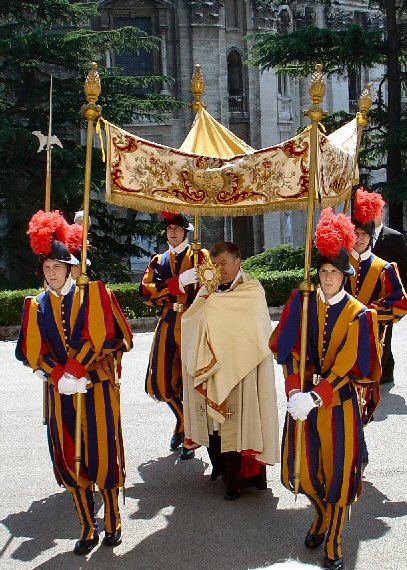
Excellent Eucharistic Procession … is there any other kind?

Our friend Diogenes deserves a tip of the Z biretta    o{]:¬)   for alerting us all to this nice collection of photos of a Eucharistic procession at Notre Dame.

Excellent Eucharistic Procession ... is there any other kind? Anecdote:  One day in May I was hanging around outside the Paul VI audience hall (Vatican) during a plenary of the Italian Bishops Conference waiting for my bishop to emerge, chating with fellow journalists and the bishops’ drivers and secretaries a couple bishops who had simply fled the hall in desparate boredom.  I had just been to a Eucharistic procession the day before held by the Teutonic College that went through the Vatican gardens, Swiss Guards carrying the canopy, … stunning.  Deep in his chest this one old bishop rumbled "Meno chiacchiere – più processioni. … Less jabbering – more processions." 

Pretty much says it all.   This could be another WDTPRS motto. Liturgy really becomes the "tip of the spear", as I call it, when you take the Blessed Sacrament into the streets.

I digress… check out  Na Zdrowie! The Kloska Family Blog.

How about you WDTPRSers go visit and make their stats spike in a way they have never seen!

Here are a couple samples.

Excellent Eucharistic Procession ... is there any other kind?

Excellent Eucharistic Procession ... is there any other kind? 

Excellent Eucharistic Procession ... is there any other kind? 

Excellent Eucharistic Procession ... is there any other kind? 


Posted in SESSIUNCULA |
19 Comments

Brick by brick… ring kiss by ring kiss

RealClearPolitics has an interesting piece by E.J. Dionne which I share with you along with my usual emphases and comments.


April 18, 2008
The Pontiff’s Counterculture
By E. J. Dionne

WASHINGTON — The most jarring word that Pope Benedict XVI is using during his visit to the United States is "countercultural." The American sense of that term is shaped by the 1960s: free love, drugs, hippies, rock music and rebellion. Needless to say, that’s not what Benedict is preaching.  [I find it interesting how Papa Ratzinger has always been willing and oh so very able to appropriate concepts and terms of very inimical positions and convert them to his own uses.  For example, he did so with a certain dimension of Liberation Theology as a starting point for a liturgical theology.  Brilliant.]

That word is the key to understanding how Benedict’s message runs crosswise to conventional liberalism and conservatism. Benedict came to the United States as a quiet but forceful critic of "an increasingly secular and materialistic culture," as he put it during Thursday’s Mass. Almost any American who paid attention to his sermon had to be uncomfortable because all of us are shaped by the very forces he was criticizing.  [How frank!]

Benedict directly challenged an assumption so many Americans make about religion: that it is a matter of private devotion with few public implications.  [Well said!]

Not true, said the pope. "Any tendency to treat religion as a private matter must be resisted," he told the country’s Catholic bishops on Wednesday. "Only when their faith permeates every aspect of their lives do Christians become truly open to the transforming power of the Gospel." [Ergo, the bishops must shore up their subjects, their public political subjects. And this reminder came in a televised meeting, not behind closed doors.]

That is a demanding and unsettling standard for the right and the left alike. Benedict asked a pointed question: "Is it consistent for practicing Catholics to ignore or exploit the poor and the marginalized, to promote sexual behavior contrary to Catholic moral teaching, or to adopt positions that contradict the right to life of every human being from conception to natural death?"

This is the thinking of a communitarian counseling against radical individualism. "In a society which values personal freedom and autonomy," he said, "it is easy to lose sight of our dependence on others as well as the responsibilities that we bear towards them. … We were created as social beings who find fulfillment only in love — for God and for our neighbor." It is this attitude that Benedict described as "countercultural."

There will be much pious talk among Catholics (I speak from the inside) about how marvelous Benedict’s words were, how warm and gentle he proved to be. Parodies [pious talk and parodies] that paint him as a heartless enforcer are, of course, false. He seemed determined to confess the church’s great sin in the sexual abuse scandal, and he asked again and again for forgiveness. He took the extra step Thursday of meeting with a group of victims of abuse.

It was a good and necessary act of penance.

Yet there is a radicalism underlying Benedict’s view (he spoke on Thursday of "a disturbing breakdown in the very foundations of society") rooted in a rather different spirit from the one animating the church at the time of Pope John XXIII and the Second Vatican Council in the 1960s.

John saw it as imperative for the church to discern "the signs of the times" and was critical of excessive gloom about modernity. "Distrustful souls," John wrote in 1961, "see only darkness burdening the face of the earth."

Benedict is certainly not without hope. Indeed, his November encyclical on hope — to which he has made frequent references this week — is a moving and intellectually powerful argument on behalf of an often forgotten virtue. Yet Benedict is more inclined than John was to see the church as beleaguered. [He is in this, perhaps, a bit more Augustinian in his perspective.] He is less eager to seek "the signs of the times" than to worry about Christians who "are easily tempted to conform themselves to the spirit of this age," as he put it this week.

For this reason, I suspect that American Catholics of all political hues will find themselves struggling with his message. For myself, I admire Benedict’s distinctly Catholic critique of radical individualism in both the moral and economic spheres, and his insistence that the Christian message cannot be divorced from the social and political realm.

Yet I do not see the "spirit of this age" as being quite so threatening to faith or human flourishing as Benedict seems to think. As the pope has acknowledged in the past, Catholicism has been enriched by its encounter with enlightenment thought. The church should not now close itself off to what our age has to teach about the equality of men and women or the virtues of more democratic structures in its internal life.  [I don’t believe that this is so.  I don’t think Benedict wants to close off to the world or modern thought.  I think he is taking it head on and shaping it.  He is making his contribution, a contribution entirely formed in the very root of all ages, yesterday, today and tomorrow.]

Perhaps it is the task of the leader of the Roman Catholic Church to bring discomfort to a people so thoroughly shaped by modernity, as we Americans are. If so, Benedict is succeeding.

postchat@aol.com

Dionne’s comments about the way Benedict has provoked bishops to do their duty also with their politician subjects draws my mind back to the image of Speaker Nancy Pelosi (D-CA) kissing the Holy Father’s ring on Papa’s first day in the USA. 

I cannot begrudge her the desire to do so or the opportunity seized.  Catholics, good – not so good, will desire to do this, I think.  It is in our Catholic DNA.  Many non-Catholics do this on sincere impuse.  It is the right thing to do, not only for the office, but especially for the estimable men who have held that office. 

But the fact remains that many of our Catholic pols betray a weak inner core in their Catholic identity.  Papa Ratzinger has a long term vision, his "Marshall Plan" as I call it, to revitalize Catholic identity. 

This must be accomplished brick by brick.

Ring kiss by ring kiss.

Posted in SESSIUNCULA |
27 Comments

Slate article on how the right sees Benedict XVI.

There is a useful article at Slate.  Nota bene: this was from before the Pope’s visit.  I wonder how it stands up in the wake of the Pope time in the USA.

My emphases and comments.

"God’s Rottweiler" Becomes the Church’s "Beloved German Shepherd"
How Pope Benedict has disappointed the right.   [I’m not disappointed.  I think I would be considered by many to be part of "the right", though I really think I am fairly close to the true center.]
By Michael Sean Winters
Posted  Friday, April 11, 2008, at 5:15 PM ET  [Before the papal visit.]
 
For more on the pope’s visit, read "On Faith," a blog on religion produced by the Washington Post and Newsweek.  Religion professor Donna Freitas makes three wishes for the Catholic church.  On Faith’s Sally Quinn interviews clergy-abuse victim Barbara Blaine. Anthony Stevens-Arroyo discusses the pope as a defender of faith. And "Campus Catholic" Elizabeth Tenety writes on faith, hope, and love.
 
When Cardinal Joseph Ratzinger was elected Pope Benedict XVI on April 19, 2005, Catholic conservatives in America were licking their chops. "The ‘progressive’ project is over," Catholic neocon George Weigel triumphantly announced. William Donohue, the eccentric, right-wing president of the Catholic League, said of Catholic liberals, "We expect that the weeping and gnashing of teeth will begin soon."  [Ehem… it did!  It is still going on.]
 
Three years later, as American Catholics prepare for the pope’s visit next week, [This dates this piece.] those same conservatives in the United States have been disappointed. They had hoped Benedict would confront liberal tendencies in the church. Some, like Weigel, sought to purge the presbyterate of gays whom they blamed for the sex-abuse scandal. [And probably rightly.] They wanted the ecclesiastical equivalent of court-packing, with the pope appointing only conservatives to major posts. But Benedict has defied them [Puhleeze] in his appointments, in his views on capitalism and the war in Iraq, and even in his approach to other faiths. "No one would call Benedict the darling of the left, but he has been moderate, pastoral, tolerant, nuanced," says Monsignor Lorenzo Albacete, a theologian and U.S. leader of the Catholic group Communione e Liberazione. 
 
Conservative distress began almost immediately after Pope Benedict took over, when in May 2005 he named San Francisco Archbishop William Levada to fill his old job as the prefect for the Congregation for the Doctrine of the Faith, a position that amounts to being the Vatican’s doctrinal watchdog. Levada had been suspect to conservatives since 1996, when he worked out a compromise on same-sex partner benefits with San Francisco Mayor Willie Brown. Under Levada’s proposal, employees at Catholic institutions could designate anyone with whom they were legally domiciled as their beneficiary: an aunt, a cousin, a same-sex partner. The proposal avoided the culture war that some Catholic conservatives were hoping for. In a controversial article in February 2006, Father Richard John Neuhaus cited the Levada appointment as one of the reasons for "a palpable uneasiness" among "those who greatly admired Cardinal Ratzinger and were elated by his election as pope."  [I don’t think people really get why Card. Levada is in that position.  Consider: Papa Ratzinger sort of revolutionized the role of Prefect of the Congregation: he workedit out with JP2 that he could remain a working theologian. The role of the Prefect of CDF is not so much to be a theologian yourself, but rather to make sure, along with the Secretary, that the work of the Congregation is getting done!  So, since there were many cases concerning priests coming from the USA, there was a backlog, someone needed to get the work moving.  Also, no one could lie to Card. Levada: he know what the real situation was in the USA.  Also, Papa Ratzinger knew him to a certain extent.  Moreover, Card. Levada has put his signature on some documents that have had the lefties tearing their hair.]
 
The next year, when Benedict had to appoint a new archbishop for Washington, D.C.—his first major stateside appointment—neocons hoped he would redeem [NB the skewed language] himself. They championed three archbishops who had publicly urged denying communion to pro-choice politicians during the 2004 election: Charles Chaput of Denver, Raymond Burke of St. Louis, and John Myers of Newark, N.J. Instead, Benedict chose Pittsburgh Bishop Donald Wuerl, a moderate who has opposed turning the communion rail into a political battle station. Benedict further disappointed conservatives hellbent on denying communion to pro-choice politicians when he named as cardinal Boston Archbishop Sean O’Malley, who refused to order Sen. John Kerry out of church. Benedict’s choices shouldn’t have surprised anyone, though. According to one American present during a spring 2004 Vatican meeting with U.S. bishops, then-Cardinal Ratzinger laughed [The writer doesn’t get what laughing can mean, I think.] when he heard of denying politicians communion based on their political views. After all, popes have, over the years, given communion to Communist mayors, gay legislators, and countless pro-choice politicians. 
 
But appointments weren’t the only area where Benedict failed to live up to expectations. Conservatives took heart when then-Cardinal Ratzinger denounced the "filth" within the church at Good Friday services just weeks before his election as pope in 2005. They understood him to refer to sexually active gay clergy whom right-wing Catholics blamed for the sexual abuse of minors. But the first victim of Benedict’s purge was the founder of the ultraconservative Legionnaires of Christ, Father Marcial Maciel, who under John Paul II had long avoided being suspended despite credible allegations of sexual misconduct. [Why is that a left-wing triumph?]  Benedict also removed John Paul II’s closest collaborator, Cardinal Angelo Sodano, whose ties to Chilean dictator Augusto Pinochet had severely compromised the church’s image in Latin America. Sodano’s American secretary was also sacked from the Vatican diplomatic corps late last year.  [Yes, however a) it took a long time for Papa to make that move and b) Card. Sodano is not exactly beloved of the right in many ways.]
 
Pope Benedict shares virtually none of the core political beliefs of American neocons. [Really?  I wonder.] In his book Jesus of Nazareth, he warned against "capitalism that degrades man to the level of merchandise." [Warning about something doesn’t mean he is therefore against capitalism.] He has consistently spoken out against the Iraq war. [But read the 2006 Message for the World Day for Peace about what it takes to help establish true peace.] And the whole reason Benedict is coming to America is to address the United Nations, which is not the neocons’ favorite organization. [But can’t one talk and correct and guide? ] Even when Benedict has endorsed a part of the conservative agenda, he has done so with none of the rigidity that characterizes the writings of American Catholic conservatives. [I think we have to reject the premise: I don’t think conservatives are rigid.  As a matter of fact, I think the left is far more rigid.] Throughout his career, first as theologian, then as bishop and cardinal, and now as pope, Benedict has emphasized the centrality of the person of Christ in the salvation of the world. Yet he has been adept at making profound interreligious gestures, meeting with Muslim diplomats at the Vatican to soothe relations after an unfortunate remark in a speech, reaching out to Eastern Orthodox Christians at every opportunity, and even framing the central section of his book Jesus of Nazareth as a response to a book by his friend Rabbi Jacob Neusner. [So?] When Benedict brought back the traditional Tridentine Mass, he changed certain prayers from the Good Friday liturgy that were offensive to Jews.  [And put in new prayers that make our dependence on Christ even clearer.]
 
Still, Pope Benedict is no liberal. [D’ya think?] One of the problems with most press coverage of the Catholic Church is that the left-right template doesn’t fit very well. [Now we are getting somewhere.] The right tends to ignore or water down the church’s teachings about social justice, [This is simply untrue.  Take a look at the work of Acton Institute, for one example.] while the left frequently minimizes the church’s teachings on sexual ethics. A pope can’t side with either group but must love them both and try to communicate the church’s teachings in their entirety and integrity. 
 
The difference between Ratzinger the cardinal—the man conservatives saw as an answer to their prayers — and Benedict the pope — who has disappointed those same Catholics [has he?  Do we have to admit this premise?] — has less to do with any changes within the man himself. He has, by almost all accounts, always been brilliant, concerned about overly hasty theological change, personally kind, prayerful. What has changed is his job. For 23 years, Cardinal Ratzinger’s job was to protect the deposit of faith from distortions or manipulations which, even if well-intended, might alter the content of what Catholics believe was given them by God when He founded the church. [That sounds like an affirmation of faith.] This was a difficult and often controversial task, and it was a desk job. When he was elected pope, he became a pastor. Albacete says, "He is committed to exploring how faith and reason work together to lead man to the truth about himself. Benedict would never diminish himself, or his office, fighting tired ideological battles." The change in roles can be found in another way: Until he was elected pope, had anyone ever seen a picture of Joseph Ratzinger embracing children?   [Ridiculous.  Anyone who was around the Curia saw Card. Ratzinger work with people, for example, visiting choirs who wanted to sing him a song as he left his office, etc.  Absurd.  The writer shouldn’t have gone where he knows too little.]
 
All popes have three central tasks: to lead the church in prayer, to teach the truths of the faith, and to govern the universal church. To watch Benedict preside at Mass is to see someone whose interiority, whose depth, is almost tangible. Liturgies are never rushed. The sermons are always exquisite. As a teacher, Benedict has used his weekly general audiences to revisit the teachings of the fathers of the church, those early writers and thinkers who shaped Christian theology before the divisions between East and West. His writings are accessible and profound, and his best-selling book may reach people whom traditional methods of evangelization miss. Some quibble about his governance of the church—that appointments take too long, that he is not accessible enough to this group or that. But Benedict has gone from being known derisively as "God’s Rottweiler" to becoming the church’s "beloved German shepherd."   [A good assessment.]
 
Cheering the pope in Washington and New York will be those Catholics who look to their church for comfort and challenge, for solace and strength, people who are more concerned about loving their pope than they are about any ideological battles within or without the church. Joining in the cheers will be many of those who greeted his election with trepidation. And if there is any gnashing of teeth, it will be coming from the bleachers on the far right.
 
In 2005, Jack Miles reacted to Benedict’s election as pope. Later that year, William Saletan argued that Benedict has anti-gay tendencies, and Michael Sean Winters wrote about the stupidity of banning gay priests. In 2006, Christopher Hitchens responded to a controversial remark about Islam from the pope.

Michael Sean Winters is the author of Left at the Altar: How the Democrats Lost the Catholics and How the Catholics Can Save the Democrats, which will be published in July 2008.


The upshot seems to be that pretty much everyone is wrong… right? 

Posted in SESSIUNCULA |
Comments Off on Slate article on how the right sees Benedict XVI.

Nashville, TN: “Priests receive training in celebrating Tridentine rite”

Great news was sent to me from Nashville!  This is on the website of the Diocese of Nashville.  My emphases and comments:

April 18, 2008

Priests receive training in celebrating Tridentine rite

Andy Telli, Tennessee Register

Father William Fitzgerald’s interest in the so-called Tridentine rite of the Mass began when he was a boy in Australia serving as an altar boy and singing in the choir.

“My preference is for the revised rite, but I see great beauty in the traditional rite,” said Father Fitzgerald, a Norbertine priest who was invited to come to Nashville recently by Bishop David Choby to instruct four priests – two from the Diocese of Nashville and two from the Diocese of Knoxville – on how to celebrate the rite that was used for more than 400 years before the new order of the Mass was implemented by Pope Paul VI in 1970, following the instructions of the Second Vatican Council.

In 1987, Pope John Paul II gave local bishops the authority to permit the celebration of the Mass according to the 1962 Roman Missal, or Tridentine rite, under certain circumstances. Last July, Pope Benedict XVI liberalized the rules governing the use of the rite, now called the extraordinary rite, to allow parish priests to celebrate the 1962 Mass when a group of the faithful requests it.

“I don’t believe there has to be warfare over these things and there doesn’t have to be division,” said Father Fitzgerald, who is the former director of the office of worship for the Diocese of Covington, Ky., and the former director of liturgy at the Pontifical College Josephinum seminary in Columbus, Ohio.

In making the traditional rite more available, Pope Benedict’s vision, [Excellent language! "Vision" is good.] Father Fitzgerald said, is “that the modern liturgy and classical rite will inform each other.”

As he explained how the traditional rite is celebrated to the four priests – Father Stephen Gideon and Father John Sims Baker of the Nashville Diocese and Father Brent Shelton and Father Patrick Resen of the Knoxville Diocese – Father Fitzgerald also tried to explain why things are done the way they are, he said.

Much of the church’s history of liturgy can be seen in the Tridentine rite, Father Fitzgerald said, because even as new elements of liturgy were added over the years, the older elements remained.

“It was kind of the living historical record of worship of the Catholic people from patristic times, really,” said Father Fitzgerald, who served as the chaplain of the Dominican Campus in Nashville from 1997-98.

Part of the reforms of the liturgy, Father Fitzgerald said, “was a certain simplification.”

The rubrics of the Tridentine rite – or the rules of ceremony and form – are more exact and complicated than the revised rite.

One of the most obvious changes was to have the priest face the people rather than the tabernacle. Many people perceived the stance in the traditional rite as the priest turning his back on the people, Father Fitzgerald said, but the original symbolism was that the priest and people were facing the same way as they looked toward God.

“In the revised rite, it’s become a dialogue over the altar,” Father Fitzgerald said.

“It was very educational,” said Father Gideon, pastor of St. Christopher Church in Dickson, said of the training session with Father Fitzgerald. “It was really like a history lesson of liturgy, very interesting and also a bit overwhelming. It will take me a while to perfect celebrating the liturgy. …

“I realized how much I have to learn before I can celebrate it well,” Father Gideon added. “If I do it, I want to do it well.”  [And, Father Gideon, you will learn a lot about yourself, too, and deeper things about Holy Mass beyond history!]

Both Father Gideon and Father Baker grew up in the Episcopal Church and had no or little experience with the extraordinary form of the Mass. “I had never attended Mass in the extraordinary form before, or even seen it,” Father Baker said.

At the conclusion of Father Fitzgerald’s training session at Assumption Church in Nashville, he celebrated a low Mass according to the Tridentine rite.

“I was pretty excited by the end of the day, more excited than I was going into it actually,” Father Baker said. “One of the things that surprised me, was at least for low Mass, I don’t think it’s going to be that hard to do.”

Father Baker has studied Latin extensively so the language won’t be a problem, he said, and the rubrics, though more complicated than the ordinary form of the Mass, weren’t as complicated as he feared they might be before the training.

“A great deal of the Mass was quiet,” Father Baker noted. “I was wondering what that would be like. I was kind of intrigued by it.” [Yes…. yes…]

Studying the extraordinary form of the Mass “has brought out some things I really like about the ordinary form too that I just took for granted,” Father Baker said, particularly the participatory aspect of the revised rite.

Bishop Choby asked both Father Gideon and Father Baker to learn to celebrate the Tridentine rite so he could meet the pastoral recommendation of Pope Benedict to make the rite available for people who desire it, Father Gideon said.

When they start celebrating the Tridentine rite will be up to the bishop, Father Gideon said.

“This is an extraordinary form of the Mass but is an important part of our tradition and should be available,” said Father Baker, the Catholic chaplain at Vanderbilt University. “I don’t think it’ll ever be the only thing, and I don’t think it should be.”

At St. Andrew Church in Sparta, Father Fred Schmit, S.D.S., celebrated on Sunday, April 13, the first of what is planned to be a regular celebration of the Tridentine rite at 11 a.m. on the second Sunday of each month.

“We had a pretty good crowd. I’d say close to a hundred people,” said Father Schmit, St. Andrew’s pastor.

Some of the people attending the Mass were from Kentucky, the Chattanooga area, and Smyrna, he said. “They’re coming from a great distance. We had very few from our own parish,” Father Schmit said. “It’s up to the people. If they want to come, they can come.”

Photos by Rick Musacchio
Father John Sims Bakers watches Father William Fitzgerald demonstrate the rubrics of celebrating a Tridentine Rite Mass at Assumption Church in Nashville. Father Fitzgerald conducted a training session for Father John Sims Baker and Father Stephen Gideon of the Diocese of Nashville and Father Brent Shelton and Father Patrick Resen, both of Knoxville.

Father William Fitzgerald leads a Tridentine Rite training session for Father John Sims Baker and Father Stephen Gideon of Nashville and Father Brent Shelton, and Father Patrick Resen, both of Knoxville, at Assumption.

Posted in SESSIUNCULA |
31 Comments

Dublin: TLM “goes from strength to strength”

I got this piece of news via e-mail:

Dear Fr Z.,

The chaplaincy set up in the archdiocese of Dublin to cater for those attached to the Mass and sacraments in the extraordinary form goes from strength to strength.

Daily Mass is celebrated in the church assigned to the chaplaincy namely St Kevin’s Harrington Street.Sung Mass is celebrated every Sunday and holy day.

There have been quite a number of baptisms and first Holy Communions. Yesterday it was announced that His Grace the Archbishop will preside at Solemn Mass on 29th June and will administer Confirmation in the old rite on that occasion.

This will be the first time since the 1960s that Confirmation will be so administered in Ireland.

Numbers attending continue to increase.

The music is of a very high quality. Yesterday Lassus Missa Octavi Toni was sung. On Pentecost Palestrina’s Missa Papae Marcelli will be sung whilst on Trinity Sunday Victoria’s Missa O Quam Gloriosum will be sung.

Pope Benedict has made his mark in Dublin!

Thank you for your excellent blog which I read every day. It is a mine of useful information and commentary.

God bless your work.


Brick by brick… a fine tradition in Ireland:TLM hodcarriers doing their part! 


Posted in SESSIUNCULA |
7 Comments

Hilarious left turn at The Shrine

The Whapping Shriners have a really funny pic:

Hilarious left turn at The Shrine

Posted in SESSIUNCULA |
9 Comments

Benedict XVI’s stained-glass image at St. Patrick’s: Nathaniel Hawthorne

Many years ago, when I was at first in Rome, when I strove to acquire Italian, learn a new home, and fight terrible loneliness in exile from my patria, living with Italians only, I was desperate to hear or read English.  In that time before the English had taken over Trastevere, before internet connections or cellphones, when a transatlantic call was an insurmountable task and mail took weeks, I found a used copy of Nathaniel Hawthorne’s notes on travels in Italy and his work The Mable Faun.

It was from The Marble Faun that Benedict drew his starting point for the use of the stained-glass windows in St. Patrick’s Cathedral in NYC. 

A brilliant move… using an American author like that, but with perfect – seamless connects with Rome.  A protestant author reflecting on the Catholic Church in curiosity and wonder.

Here is the chapter 33 of The Marble Faun, written in 1859, which contains the passage used by Pope Benedict.

I want to give you a long section of text so you can get the important continuity of thought.  If you want to move quickly, however, I will emphasize the appropriate text below in dark blue.

My emphases throughout.

Savor!

Pictured Windows   

    AFTER wide wanderings through the valley, the two travellers directed their course towards its boundary of hills. Here, the natural scenery and men’s modifications of it immediately took a different aspect from that of the fertile and smiling plain. Not infrequently there was a convent on the hillside; or, on some insulated promontory, a ruined castle, once the den of a robber chieftain, who was accustomed to dash down from his commanding height upon the road that wound below. For ages back, the old fortress had been flinging down its crumbling ramparts, stone by stone, towards the grimy village at its foot.

    Their road wound onward among the hills, which rose steep and lofty from the scanty level space that lay between them. They continually thrust their great bulks before the wayfarers, as if grimly resolute to forbid their passage, or closed abruptly behind them, when they still dared to proceed. A gigantic hill would set its foot right down before them, and only at the last moment would grudgingly withdraw it, just far enough to let them creep towards another obstacle. Adown these rough heights were visible the dry tracks of many a mountain torrent that had lived a life too fierce and passionate to be a long one. Or, perhaps, a stream was yet hurrying shyly along the edge of a far wider bed of pebbles and shelving rock than it seemed to need, though not too wide for the swollen rage of which this shy rivulet was capable. A stone bridge bestrode it, the ponderous arches of which were upheld and rendered indestructible by the weight of the very stones that threatened to crush them down. Old Roman toil was perceptible in the foundations of that massive bridge; the first weight that it ever bore was that of an army of the Republic.

    Threading these defiles, they would arrive at some immemorial city, crowning the high summit of a hill with its cathedral, its many churches, and public edifices, all of Gothic architecture. With no more level ground than a single piazza, [public square] in the midst, the ancient town tumbled its crooked and narrow streets down the mountainside, through arched passages, and by steps of stone. The aspect of everything was awfully old; older, indeed, in its effect on the imagination, than Rome itself, because history does not lay its finger on these forgotten edifices and tell us all about their origin. Etruscan princes may have dwelt in them. A thousand years at all events, would seem but a middle age for these structures. They are built of such huge, square stones, that their appearance of ponderous durability distresses the beholder with the idea that they can never fall–never crumble away–never be less fit than now for human habitation. Many of them may once have been palaces, and still retain a squalid grandeur. But, gazing at them, we recognize how undesirable it is to build the tabernacle of our brief lifetime out of permanent materials, and with a view to their being occupied by future generations.

    All towns should be made capable of purification by fire, or of decay, within each half-century. Otherwise, they become the hereditary haunts of vermin and noisomeness, besides standing apart from the possibility of such improvements as are constantly introduced into the rest of man’s contrivances and accommodations. It is beautiful, no doubt, and exceedingly satisfactory to some of our natural instincts, to imagine our far posterity dwelling under the same rooftree as ourselves. Still, when people insist on building indestructible houses, they incur, or their children do, a misfortune analogous to that of the Sibyl, when she obtained the grievous boon of immortality. So, we may build almost immortal habitations, it is true, but we cannot keep them from growing old, musty, unwholesome, dreary, full of death scents, ghosts, and murder stains, in short, such habitations as one sees everywhere in Italy, be they hovels or palaces.

    "You should go with me to my native country," observed the sculptor to Donatello. "In that fortunate land, each generation has only its own sins and sorrows to bear. Here, it seems as if all the weary and dreary Past were piled upon the back of the Present. If I were to lose my spirits in this country–if I were to suffer any heavy misfortune here–methinks it would be impossible to stand up against it, under such adverse influences."

    "The sky itself is an old roof, now," answered the Count; "and, no doubt, the sins of mankind have made it gloomier than it used to be."

    "Oh, my poor Faun," thought Kenyon to himself, "how art thou changed!"

    A city, like this of which we speak seems a sort of stony growth out of the hillside, or a fossilized town; so ancient and strange it looks, without enough of life and juiciness in it to be any longer susceptible of decay. An earthquake would afford it the only chance of being ruined, beyond its present ruin.

    Yet, though dead to all the purposes for which we live today, the place has its glorious recollections, and not merely rude and warlike ones, but those of brighter and milder triumphs, the fruits of which we still enjoy. Italy can count several of these lifeless towns which, four or five hundred years ago, were each the birthplace of its own school of art; nor have they yet forgotten to be proud of the dark, old pictures and the faded frescoes, the pristine beauty of which was a light and gladness to the world. But now, unless one happens to be a painter, these famous works make us miserably desperate. They are poor, dim ghosts of what, when Giotto or Cimabue first created them, threw a splendor along the stately aisles; so far gone towards nothingness in our day that scarcely a hint of design or expression can glimmer through the dusk. Those early artists did well to paint their frescoes. Glowing on the church walls, they might be looked upon as symbols of the living spirit that made Catholicism a true religion, and that glorified it as long as it retained a genuine life; they filled the transepts with a radiant throng of saints and angels, and threw around the high altar a faint reflection–as much as mortals could see, or bear–of a Diviner Presence. But now that the colors are so wretchedly bedimmed–now that blotches of plastered wall dot the frescoes all over, like a mean reality thrusting itself through life’s brightest illusions–the next best artist to Cimabue or Giotto or Ghirlandaio or Pinturicchio will be he that shall reverently cover their ruined masterpieces with whitewash!

    Kenyon, however, being an earnest student and critic of Art, lingered long before these pathetic relics; and Donatello, in his present phase of penitence, thought no time spent amiss while he could be kneeling before an altar. Whenever they found a cathedral, therefore, or a Gothic church, the two travellers were of one mind to enter it. In some of these holy edifices they saw pictures that time had not dimmed nor injured in the least, though they perhaps belonged to as old a school of Art as any that were perishing around them. [!] These were the painted windows; and as often as he gazed at them the sculptor blessed the medieval time, and its gorgeous contrivances of splendor; for surely the skill of man has never accomplished, nor his mind imagined, any other beauty or glory worthy to be compared with these.

    It is the special excellence of pictured glass, that the light, which falls merely on the outside of other pictures, is here interfused throughout the work; it illuminates the design, and invests it with a living radiance; and in requital the unfading colors transmute the common daylight into a miracle of richness and glory in its passage through the heavenly substance of the blessed and angelic shapes which throng the high-arched window.

    "It is a woeful thing," cried Kenyon, while one of these frail yet enduring and faceless pictures threw its hues on his face and on the pavement of the church around him, "a sad necessity, that any Christian soul should pass from earth without once seeing an antique painted window, with the bright Italian sunshine glowing through it! There is no other such true symbol of the glories of the better world, where a celestial radiance will be inherent in all things and persons, and render each continually transparent to the sight of all."

    "But what a horror it would be," said Donatello sadly, "if there were a soul among them through which the light could not be transfused!"

    "Yes; and perhaps this is to be the punishment of sin," replied the sculptor; "not that it shall be made evident to the universe, which can profit nothing by such knowledge, but that it shall insulate the sinner from all sweet society by rendering him impermeable to light, and, therefore, unrecognizable in the abode of heavenly simplicity and truth. Then what remains for him, but the dreariness of infinite and eternal solitude?"

    "That would be a horrible destiny, indeed!" said Donatello.

    His voice as he spoke the words had a hollow and dreary cadence, as if he anticipated some such frozen solitude for himself. A figure in a dark robe was lurking in the obscurity of a side chapel close by, and made an impulsive movement forward, but hesitated as Donatello spoke again.

    "But there might be a more miserable torture than to be solitary forever," said he. "Think of having a single companion in eternity, and instead of finding any consolation, or at all events variety of torture, to see your own weary, weary sin repeated in that inseparable soul."

    "I think, my dear Count, you have never read Dante," observed Kenyon. "That idea is somewhat in his style, but I cannot help regretting that it came into your mind just then."

    The dark-robed figure had shrunk back, and was quite lost to sight among the shadows of the chapel.

    "There was an English poet," resumed Kenyon, turning again towards the window, "who speaks of the ‘dim, religious light,’ transmitted through painted glass. I always admired this richly descriptive phrase; but, though he was once in Italy, I question whether Milton ever saw any but the dingy pictures in the dusty windows of English cathedrals, imperfectly shown by the gray English daylight. He would else have illuminated that word ‘dim’ with some epithet that should not chase away the dimness, yet should make it glow like a million of rubies, sapphires, emeralds, and topazes. Is it not so with yonder window? The pictures are most brilliant in themselves, yet dim with tenderness and reverence because God himself is shining through them."

    "The pictures fill me with emotion, but not such as you seem to experience," said Donatello. "I tremble at those awful saints; and, most of all, at the figure above them. He glows with Divine wrath!"

    "My dear friend," said Kenyon, "how strangely your eyes have transmuted the expression of the figure! It is Divine love not wrath!"

    "To my eyes," said Donatello stubbornly, "it is wrath, not love! Each must interpret for himself."

   [!] The friends left the church, and looking up, from the exterior, at the window which they had just been contemplating within, nothing was visible but the merest outline of dusky shapes. Neither the individual likeness of saint, angel, nor Saviour and far less the combined scheme and purport of the picture, could anywise be made out. That miracle of radiant art, thus viewed, was nothing better than an incomprehensible obscurity, without a gleam of beauty to induce the beholder to attempt unravelling it.

    "All this," thought the sculptor, "is a most forcible emblem of the different aspect of religious truth and sacred story, as viewed from the warm interior of belief, or from its cold and dreary outside. Christian faith is a grand cathedral, with divinely pictured windows. Standing without, you see no glory, nor can possibly imagine any; standing within, every ray of light reveals a harmony of unspeakable splendors."

    After Kenyon and Donatello emerged from the church, however, they had better opportunity for acts of charity and mercy than for religious contemplation; being immediately surrounded by a swarm of beggars, who are the present possessors of Italy, and share the spoil of the stranger with the fleas and mosquitoes, their formidable allies. These pests–the human ones–had hunted the two travellers at every stage of their journey. From village to village, ragged boys and girls kept almost under the horses’ feet; hoary grandsires and grandams caught glimpses of their approach, and hobbled to intercept them at some point of vantage; blind men stared them out of countenance with their sightless orbs; women held up their unwashed babies; cripples displayed their wooden legs, their grievous scars, their dangling, boneless arms, their broken backs, their burden of a hump, or whatever infirmity or deformity Providence had assigned them for an inheritance. On the highest mountain summit–in the most shadowy ravine–there was a beggar waiting for them. In one small village, Kenyon had the curiosity to count merely how many children were crying, whining, and bellowing all at once for alms. They proved to be more than forty of as ragged and dirty little imps as any in the world, besides whom, all the wrinkled matrons, and most of the village maids, and not a few stalwart men, held out their hands grimly, piteously, or smilingly in the forlorn hope of what ever trifle of coin might remain in pockets already so fearfully taxed. Had they been permitted, they would gladly have knelt down and worshipped the travellers, and have cursed them, without rising from their knees, if the expected boon failed to be awarded.  [Remember how Benedict emphasizes the necessary and logical move from interior faith to outward expressions in charity.]

    Yet they were not so miserably poor but that the grown people kept houses over their heads. In the way of food, they had, at least, vegetables in their little gardens, pigs and chickens to kill, eggs to fry into omelets with oil, wine to drink, and many other things to make life comfortable. As for the children, when no more small coin appeared to be forthcoming, they began to laugh and play, and turn heels over head, showing themselves jolly and vivacious brats, and evidently as well fed as needs be. The truth is, the Italian peasantry look upon strangers as the almoners of Providence, and therefore feel no more shame in asking and receiving alms, than in availing themselves of providential bounties in whatever other form.

    In accordance with his nature, Donatello was always exceedingly charitable to these ragged battalions, and appeared to derive a certain consolation from the prayers which many of them put up in his behalf. In Italy a copper coin of minute value will often make all the difference between a vindictive curse–death by apoplexy being the favorite one–mumbled in an old witch’s toothless jaws and a prayer from the same lips, so earnest that it would seem to reward the charitable soul with at least a puff of grateful breath to help him heavenward. Good wishes being so cheap, though possibly not very efficacious, and anathemas so exceedingly bitter–even if the greater portion of their poison remain in the mouth that utters them–it may be wise to expend some reasonable amount in the purchase of the former. Donatello invariably did so, and as he distributed his alms under the pictured window, of which we have been speaking, no less than seven ancient women lifted their hands and besought blessings on his head.  [Distributed alms under the stained-glass window… outside the church, under the dark window.]

    "Come," said the sculptor, rejoicing at the happier expression which he saw in his friend’s face. "I think your steed will not stumble with you today. Each of these old dames looks as much like Horace’s Atra Cura as can well be conceived; but, though there are seven of them, they will make your burden on horseback lighter instead of heavier."

    "Are we to ride far?" asked the Count.

    "A tolerable journey betwixt now and tomorrow noon," Kenyon replied; "for, at that hour, I purpose to be standing by the Pope’s statue in the great square of Perugia."

If only I could write like Nathaniel Hawthorne.  What a pen.

What the Holy Father said in St. Patrick’s:

The first has to do with the stained glass windows, which flood the interior with mystic light. From the outside, those windows are dark, heavy, even dreary. But once one enters the church, they suddenly come alive; reflecting the light passing through them, they reveal all their splendor. Many writers – here in America we can think of Nathaniel Hawthorne – have used the image of stained glass to illustrate the mystery of the Church herself. It is only from the inside, from the experience of faith and ecclesial life, that we see the Church as she truly is: flooded with grace, resplendent in beauty, adorned by the manifold gifts of the Spirit. It follows that we, who live the life of grace within the Church’s communion, are called to draw all people into this mystery of light.  

This is no easy task in a world which can tend to look at the Church, like those stained glass windows, "from the outside": a world which deeply senses a need for spirituality, yet finds it difficult to "enter into" the mystery of the Church. Even for those of us within, the light of faith can be dimmed by routine, and the splendor of the Church obscured by the sins and weaknesses of her members. It can be dimmed too, by the obstacles encountered in a society which sometimes seems to have forgotten God and to resent even the most elementary demands of Christian morality. You, who have devoted your lives to bearing witness to the love of Christ and the building up of his Body, know from your daily contact with the world around us how tempting it is at times to give way to frustration, disappointment and even pessimism about the future. In a word, it is not always easy to see the light of the Spirit all about us, the splendor of the Risen Lord illuminating our lives and instilling renewed hope in his victory over the world (cf. Jn 16:33).

Posted in SESSIUNCULA |
10 Comments

National Catholic Prayer Breakfast – Keynote by Bp. Robert Finn (Kansas City-St. Joseph)

During a recent visit to Kansas City, MO, I had the privilege to chat briefly with H.E. Most Reverend Robert Finn. Though the conversation was short, his bearing and comments impressed me.  I have also read some of his things.  He is definitely a man worth watching.

Bishop Finn was chosen to give the keynote address at the National Catholic Prayer Breakfast on 18 April.

Let’s have a look with my emphases and comments.  Alas this came out of the hated PDF format and I don’t have the energy to fight with it.  (Folks… please send read transcripts.  I just don’t have time or energy to fight with these vexations!)


Most   Reverend     Robert   W.  Finn
Bishop Kansas  City ~ St. Joseph (MO)

Keynote  Address—National  Catholic Prayer Breakfast
A Celebration of the Visit of Pope Benedict XVI To the United States
Washington, DC
April 18, 2008

 These days – this extraordinary week – we are living in the heart of the Church. “Ubi Petrus; Ibi  Ecclesia” Where Peter is, There is the Church. The Vicar of Jesus Christ is living and moving  in our midst, in our country, and the talk around this breakfast table is rightfully about Pope  Benedict XVI.

 Though the venues are crowded and the security and waiting lines are significant, the response to the opportunity to see the Pope is nearly universal. One person told me, “It was electric to see the Holy Father and be in the crowd with him!”

 Yes, The Holy Spirit works through this man, the Successor to Peter, in an extraordinary way.

 With you, I pray that his visit will have its full Providential impact as a moment of New Evangelization in our country.

 What does Pope Benedict XVI, as Vicar of Jesus Christ on earth, bring to the United States and the United Nations? In the weeks and months ahead we will reread his words and understand his purpose more fully. [Truer words were never spoken.] But as I finalized these thoughts last week, I wanted to prepare  for the visit of the Holy Father by taking a few cues from his writings and Papal ministry; not to  anticipate what he might say, but rather to see what he has already been saying to us. How  will the Pope convey the presence of Jesus Christ – the Way, the Truth, and the Life, in the space of these days?

 The Pope is Vicar of Christ, the Way

 In two encyclicals Pope Benedict has laid down reflections on Charity and Hope. In these letters the Pope brings the Petrine charism to bear on that which may be seen as a “Way,” in Christ for our progress as a nation and world.

 In Deus Caritas Est, God is Love, his encyclical on Christian love, he notes the substantive experience of Judaism and Christianity, and some other religions as well: God made man as the  effusion of His love, and His relationship with His creatures is one of love. The fact that God is  author of life and love signals man’s infinite value and requires respect for individual human life  from its beginning until its natural end. As important as the individual is, man’s ultimate meaning is discovered in relationship. God’s plan for humanity is revealed in the complementary  fashioning and pairing of the man and the woman  and their vocation to bear and nurture children.

 Pope Benedict recently chose this theme of the family to guide his reflections for the 2008 New Year’s World Day of Peace. Starting from the primacy of the family as the necessary unit of  society, the Holy Father notes that this Way of love and mutual responsibility is fundamental to  human nature. It cannot be ignored or set aside without obscuring the truth about man, and weakening the very foundations of peace. [1]

 Again and again Pope Benedict has stressed that when the revelation of this extraordinary  love is experienced, it changes us – it makes possible a response, and this response is so significant as to constitute a new “way of life.” It is an interior way, and according to the Pope, this  interior Way is manifested in at least two regards: First – we receive it interiorly as a law written  on our human heart; and second – we live it or pass it on to society from within, as a leaven.[2]

 In Spe Salvi, on Christian Hope, Pope Benedict looks at the substance of our faith, the most  significant article being perhaps that Jesus Christ died, rose from the dead, [If Christ did not rise, our faith is in vain!] and opened for us  a path to eternal life. The Pope explains that this positive reality: that we have a future – an  eternal future because of the Resurrection – is so powerful, that it is not just “informative,” but  “performative.” It changes us from within and empowers us to act or perform differently.[3]

 The pastoral visit of the Pope is a work of evangelization which flows from the experience of  Jesus Christ which is capable of changing the way the world and our country “does business.”  As Vicar of “Christ the Way” he addresses the meaning and dignity of the human person, the  integrity and centrality of the family, the principles of justice, the value of peace, and the necessity of religious freedom, all through the lens of Christian love and hope.

 His method is simple. He comes as an agent of quiet, interior transformation, looking for every  tiny sign of hope, and knowing that the Gospel itself has power to save from within.

 Pope Benedict XVI is the Vicar of Christ, the Truth  Our country’s primordial Declaration of Independence announces “self-evident” truths. But is it  not clear that the very notion of objective and transcendent truth has lost its foundational place  in our American culture? As the Vicar of “Jesus Christ the Truth,” Pope Benedict XVI comes  with a well-established reputation as a teacher of doctrine, to a world which tends to be doctrineless and, indeed, antagonistic to doctrine.

[What follows is excellent.  Watch how he addresses what has happened in certain sectors of American life and the life of the Church America.]

[Education] The system of education in the United States, for example, has been deeply influenced over  the last half-century by John Dewey’s rejection of the whole notion of liberal arts. [Excellent.] His pragmatic  “learn by doing” creed dismisses the discipline of academic subjects, the systematic study of  art and literature, and even the use of classic books. Dewey argues that traditional notions of  human nature, of the structure and process of democracy, and of the nature of truth itself have,  in his words, retarded human progress and all must be reworked.[4]

 The result of this wholesale suspicion and ultimate rejection of the substantive canon of human  learning, which has been so widely embraced in both public and private schools, is that our  schools are oriented almost exclusively toward measurable “outcomes,” instead of the intellectual, moral, and spiritual formation of the student.

[Jurisprudence] In the legal sphere, our society has been similarly crippled by a neglect of the fundamental  texts on which our country was founded. As the United States crossed into the 20th century, the  dean of Harvard Law, Christopher Langdell posited a kind of Darwinism in jurisprudence  whereby law must evolve. In a methodological shift, he recommended that students look at  judges’ decisions rather than the Constitution. This case-law approach became prominent under Roscoe Pound, who served as Professor in four different law schools and Dean at both  Harvard and Nebraska, influencing a whole generation of jurists. He promoted a sociological  legal science, and helped to institutionalize a positivistic approach which displaced legal interpretation. The new goal: to directly shape the development of society.[5]

[Magisterium] Within the Church itself, too often the important writings of the Second Vatican Council have  been incompletely read or misappropriated. “The Spirit of Vatican II,” has been invoked as justification for both the neglect of tradition, as well as a creative evolution of liturgy and pastoral  practice. In his letter accompanying the Motu Proprio Summorum  Pontificum, on the use of the  1962 Roman  Liturgy, Pope Benedict recalls the “hopes and confusion” that followed the Council, and the hurtful “deformations of the liturgy” that took place when “celebrations were not  faithful to the prescriptions of the new Missal.”  [Look at that!   He did it.  He used  Summorum Pontificum on the part of some to show how the attitude expressed in their other spheres enters the common life of the Church as well.  Ironically, this is how Summorum Pontificum is treated by many, so the citation was very apt indeed.]

 The Holy Father comes before the world as herald of an immutable and transcendent reality.  He dares to say, “There are truths. There is right and wrong, and it is written indelibly in the  heart of man.” As Vicar of “Christ the Truth” he is charged to represent the One who is the same yesterday, today and forever. The truth of Jesus Christ is offered in the Way of love: not  seeking to impose the Church’s faith upon others, but at the same time, not allowing God and  Christ to be left aside.[6]

 If we, in the structures of our institutions and spheres of influence:[I like this phrase: our spheres of influence.  I use this expression fairly often myself in relationship to how people live their vocations.  It can also be extended past the micro into the macro: if Catholics more collectively regain a footing in the public square, and do so with a strong revitalized identity, with something to say, the we will extend our sphere of influence.] schools, the courts and political life, journalism and communication, science, economy, and culture have been inclined to  neglect or reject the cumulative wisdom [And the Church is the greatest expert in humanity that the world has ever seen.] of our human experience and the fundamental tenets  of the natural law, in favor of an arbitrary and evolving set of choices, the Pope’s presence and  words will offer us a grounding in principles of faith and human reason, and inspiration for embracing truth anew.

 At the Mass of his inauguration three years ago, Pope Benedict reflected on his ministry as  Chief Shepherd who, like St. Peter, is commanded by Christ to “Feed my sheep.” The Pope  insisted “Loving means giving the sheep what is truly good, the nourishment of God’s truth, of  God’s Word, …”[7] Accompanied by the power of the promised Holy Spirit, and speaking in  the person of Jesus Christ, he will confirm the Church in the faith and desire to move the world  toward the Father.

 He is Vicar of Christ the Life

 Some may be inclined to dismiss the challenges of the Catholic Pope to the world as inflexible  or intolerant. They will perhaps urge him to be open-minded. Maybe they will lecture him on  “civility” – very popular these days.

 As successor to Peter, he is “rock,” and he is a living rock. He is Vicar of “Christ the Life.” At  the Mass of his inauguration, the new Pope greeted the millions who were listening throughout  the world, “The Church is alive! The Church is alive and we are seeing it… The Church is alive  because Christ is alive, because He is truly risen.”

 Time and again the Holy Father has shown a burning desire for unity: among Catholics, among  Christians, between religions. But he does not wish merely to “make mankind happier by bringing religions together.” He offers rather an authentic ecumenism: [Ooooo… this is good!   He makes distinctions, in public, in front of people, about authentic ecumenism, suggesting that some ecumentical efforts are perhaps authentic.] which rests in the New Covenant established in the living and life-giving blood of Jesus Christ; and which alone perfectly  fulfills the eternally valid covenant of Abraham.[8] In whatever words he shares with us  these days, the Pope will represent to Catholics, to other Christians, to the Jewish people and  to all men and women, “believers and non-believers alike,” a living and life-changing proclamation.

 When Pope Benedict preached to the young  people of the world in Cologne in 2005, he described the salvation event, Christ’s death and resurrection, as something so powerful that it  could be compared   to “inducing nuclear fission in the very heart of being.” It is this victory of Christ, the Pope  said, “the intimate explosion of good conquering  evil, that triggers off the series  of transformations that little by little will change  the world.”[9]  [Brick by brick… gravitational pull… But what a great image: "intimate explosion"  "fission" in the heart" "triggers off the series".  Brilliance.  What a Pope.]

 It is fair to say that this conviction of the Pope  is a helpful key for us in understanding his message. The  Pope  is full of hope because  this change, which  is “built into” the encounter with the  living Christ, has already begun. The  explosion has occurred and its saving effects are intended  to fill the world. We  must dare to hope  that the presence of the Vicar of Christ these days in our  country will be a vehicle for authentic moral conversion in individual hearts and for our culture.

 Friends: these days, this extraordinary week,  we are living in the heart of the Church. Where   Peter is – There is the Church. Let us pray for the Shepherd  and for the flock: that these will be  days  when  the joy and power of the Risen Lord is released on the world, as the Vicar of Jesus  Christ – the Way,  the Truth, and the Life, comes  to confirm us in our faith.

Something might be wrong with the notes.

[1]Pope Benedict XVI, World Peace Day Message, January 1, 2008. no. 4
[2]Pope Benedict XVI, Deus Caritas Est. no. 31
[3]Pope Benedict XVI, Spe Salvi, no. 2
[4]Henry T. Edmundson, John Dewey and the Decline of American Education. ISI: Wilmington, 2006. p. 7.
[5]David Barton, Original Intent. Wallbuilders:Aledo, 2005. p. 228)
[6]Deus Caritas Est, no. 31
[7]Pope Benedict XVI, Mass for the Inauguration of the Pontificate, April 24, 2005. St. Peter’s Square cf. Stephen Pinnentel, “The Master Key: Pope Benedict XVI’s Theology of Covenant.” Homiletic and Pastoral    Review. Oct., 2007. Pp. 16-20.
[8]Pope Benedict XVI, Homily at Cologne-Marienfield, XX  WYD, August 21, 2005.


His Excelleny Bishop Finn gets the very highest WDTPRS Attaboys for this keynote address.

Posted in SESSIUNCULA |
9 Comments