Daily Rome Shot 606

Meanwhile… is this nuts?

Black to move and win.

NB: I’ll hold comments with solutions ’till the next day so there won’t be “spoilers” for others.

Interested in learning?  Try THIS.

The sisters have their shop open for two more days, today and tomorrow. They close on the 17th so they can focus on the final stage of Advent.

Welcome to new registrants:

karkar
OnlyTheTruth
Marigold

Posted in SESSIUNCULA |
5 Comments

YOUR URGENT PRAYER REQUESTS

PLEASE use the sharing buttons! Thanks!

In your charity would you please take a moment look at the requests and to pray for the people about whom you read?

Continued from THESE.

Let’s remember all who are ill, who will die soon, who have lost their jobs, and who are afraid.

I get many requests by email asking for prayers. Some are heart-achingly grave and urgent.

As long as my blog reaches so many readers in so many places, let’s give each other a hand. We should support each other in works of mercy.

If you have some prayer requests, feel free to post them below.

You have to be registered here to be able to post.

I ask prayer for myself.  I’m dealing with TWO serious challenges right now.   I also want to thank all of you who pray for me.

Posted in SESSIUNCULA |
10 Comments

Daily Rome Shot 605

Meanwhile…

Black to move and force mate.

NB: I’ll hold comments with solutions ’till the next day so there won’t be “spoilers” for others.

Watch a great movie, co-directed by Noel Coward and David Lean!

In Which We Serve

US HERE – UK HERE

Has anyone used the “Watch Party” feature in Amazon?

Please remember me when Christmas shopping online. Thanks in advance.

US HERE – UK HERE

Lastly, I see that a few of you have bought things from Chess House and someone got a course pack from Remote Chess Academy.  I can’t see who got what, but I hope you enjoy them!  “Giving chess”, especially to a child, can be a lifelong gift.

Posted in SESSIUNCULA |
12 Comments

Building a spectacular new altar for Our Lady of the Rosary

I recently wrote about a book:

Copies should be obtained and given to priests, especially those who lean toward traditional, and to bishops perhaps along with a spiritual bouquet.

What book?

Does TRADITIONIS CUSTODES Pass the Juridical Rationality Test?

by Fr. Réginald-Marie Rivoire FSVF and Fr. William Barker FSSP

US HERE – UK HERE

You perhaps recognize “FSSP”. But do you know “FSVF”?

This is the Fraternity of Saint Vincent Ferrer in Chémeré-le-Roi, France – HERE  They have a Dominican spirituality.

I’ve written about them before. They had a series of videos on the Mass.

I post today because I received an email from them about a spectacular altar they are making for their chapel. You really should have a look at what they are doing. They are proving that, in this day and age, churches and our worship can, in fact, have beautiful appointments.

HERE

A taste…


Posted in Just Too Cool, Our Catholic Identity, Our Solitary Boast | Tagged
5 Comments

Advent Ember Week and the pivotal Feast of St. Lucy, the “darkest day”

13 December was the darkest day – with the least sunlight – of the old Julian calendar.

Today in the Gregorian calendar is the feast of St. Lucy, whose name from the Latin lux, for “light”, reminds us who dwell in the still darkening northern hemisphere that our days will soon be getting longer again.

Lucy will usually be depicted in art with a lantern, or with a crown of candles, or – most commonly – with her own eyes on a platter.  The photo, above, is from the Church of St. Lucy in Rome.

Some accounts have Lucy slain by having her throat thrust through with sword.

Other accounts say that to protect her virginity she disfigured herself by cutting her own eyes out and sending them to her suitor, a plot likely to discourage him.

St. Lucy is therefore the patroness of sight.

St. Lucy shows up fairly often in Dante’s great Divine Comedy.  She is first in the Inferno.  It is Lucy who asked Beatrice to help Dante.  In Purgatory the eagle that bears Dante upward in a dream is actually Lucy who is bearing him to the gate of Purgatory.  Eagles, of course, are “eagle-eyed” and see very well.  In the Paradiso she is placed directly across from Adam in the Heaven of the Rose.  She can gaze directly at God.

St. Lucy was something of a patroness for Dante and that he was devoted to her because, as we glean from various works, he may have had a problem not just with his eyes but also struggling with sins of the eyes.

This week we also have Ember Days, which in Advent come after the Feast of St. Lucy.   Do you remember the little mnemonic poem?  “Lenty, Penty, Crucy, Lucy”, or else “Fasting days and Emberings be / Lent, Whitsun, Holyrood, and Lucie.

Ember Wednesday will be the Missa aurea.

In the meantime, let’s have a look at Lucy’s Collect in the Ordinary Form.

This prayer was not in the pre-Conciliar editions of the Missale Romanum. It is based on a prayer in the ancient Gelasian Sacramentary for St. Felicity (VIIII KALENDAS DECEMBRIS).

Intercessio nos, quaesumus, Domine, sanctae Luciae virginis et martyris gloriosa confoveat, ut eius natalicia et temporaliter frequentemus, et conspiciamus aeterna.

First, you will have immediately caught the elegant hyperbaton, the separation of intercessio and the adjective that goes with it, gloriosa.

There is also a nice et… et construction.

Confoveo is “to cherish, caress, keep warm.”  It is a compound of foveo which essentially is “to be hot, to roast”.  It obviously deals with heat, flame, light.  This is a good word for this time of year in the northern hemisphere (unless you are in, say, Florida).

Conspicio is “to look at attentively, to get sight of, to descry, perceive, observe”. We are obviously dealing the seeing and sight.  This word should ring mental bells for the throngs of you readers who attended Holy Mass in the Novus Ordo celebrated in Latin.  Conspicio is in the Collect for the 3rd Sunday of Advent, used in a an extremely clever way juxtaposed to exspecto.  They share a common root.  But I digress.

Natalicia refers to birthdays.  In the Christian adaptation of this word, we are always referring to the saints being “born” into heaven.

OBSOLETE ICEL (1973):

Lord, give us courage through the gracious prayers of Saint Lucy. As we celebrate her entrance into eternal glory, we ask to share her happiness in the life to come.

Here is the usual clunky parataxis we know so well from the dreadful obsolete translation.  As usual, the translation is dumbed-down.  Do you see anything of the concept of vision?  Sight?  Is there anything in there that harks to the time of year?

Can you believe that some people want this back?

CURRENT ICEL (2011):

May the glorious intercession of the Virgin and Martyr Saint Lucy give us new heart, we pray, O Lord, so that we may celebrate her heavenly birthday in this present age and so behold things eternal.

We are obviously much closer to the Latin in this new version.  Also, that behold at the end is consoling.

Reason #7569320 for the new, corrected translation.

Perhaps you might say a prayer today to St. Lucy, that she will intercede with God and implore Him, for us in the vale of tears, to open the eyes of so many of our elected officials – and voters – and our Church leaders too, while we’re at it.
Posted in Liturgy Science Theatre 3000, Saints: Stories & Symbols | Tagged
1 Comment

Daily Rome Shot 604

Meanwhile,…

Check it out for gift ideas!

Black to move and win material.

NB: I’ll hold comments with solutions ’till the next day so there won’t be “spoilers” for others.

Priestly chess players, drop me a line. HERE

Interested in learning?  Try THIS.

The sisters close their shop on 17 December. There’s still time!


Your use of my Amazon affiliate link is a major part of my income. It helps to pay for insurance, groceries, everything. Please remember me when shopping online. Thanks in advance.

US HERE – UK HERE

Posted in SESSIUNCULA |
3 Comments

ASK FATHER: Did John the Baptist never sin?

From a reader…

QUAERITUR:

At Mass yesterday the priest said that St. John the Baptist never sinned his whole life due to the absolution he received from the Lord during the Visitation (‘ . . . and he leapt in the womb’).

Never heard this before. Is this Church teaching?

While this has never been taught officially by the Church, our tradition has it that at the moment of the Visitation, when he leapt in Elizabeth’s womb at the approach of the unborn Savior within Mary, that was when John was cleansed of the guilt of Original Sin. Hence, he was born without the guilt of Original Sin. He, like everyone else except the Blessed Virgin and Our Lord, suffered the effects of Original Sin. He would have had to deal with his passions, disordered appetites, concupiscence, etc. He was not “immaculate”, like the Blessed Virgin.

That said, we can suppose that John the Baptist was a deeply holy man, if not immaculate. After all, Our Lord Himself said of John:

I tell you, among those born of women none is greater than John; … (Luke 7:28)

Imagine the implications of that, coming as it does from the mouth of Christ.

But the second part of that verse is:

…yet he who is least in the kingdom of God is greater than he.”

Since only the sinless can see God in Heaven, one might conclude from this that John, while amazingly holy, is nevertheless not without sins, without some attachment, or without the debt in justice of temporal punishment due to sin.

Holy Church recognizes the greatness of John the Baptist also by the fact that we celebrate his birth day. In general when we use the term “birth day” for a saint, the dies natalis, we mean the day of the death of the saint and their “birth” into Heaven. However, we celebrate the Nativity of John the Baptist, as we do that of Our Lord and of Mary. A singular honor!

If I recall rightly, Anne Catherine Emmerich thought that John the sinless in life. Maybe, but that’s not the teaching of the Church and, frankly, I have a strong dubitation about that.

Posted in "How To..." - Practical Notes, ASK FATHER Question Box, Saints: Stories & Symbols | Tagged
6 Comments

Daily Rome Shot 603

I’m pretty sure that this is the oldest representation of Our Lady of Guadalupe in Rome, with some of the first gold brought from the New World.

Meanwhile, …

Your use of my Amazon affiliate link is a major part of my income. It helps to pay for insurance, groceries, everything. Please remember me when shopping online. Thanks in advance.  US HERE – UK HERE

I created a search link at wdtprs dot com slash shop dot htm

Enter anything and search.  You might get a window that “The information you’re about to submit is not secure”. Ignore that and “send anyway”.

Do you need to move? Need a real estate agent? This group helps you find someone who will give part of the fee to a pro-life group.

Posted in SESSIUNCULA |
2 Comments

Contemplating mysteries in the face of Our Lady of Guadalupe

I had posted about this some years ago, but on this wonderful Feast of Our Lady of Guadalupe it gives us something to think about anew.

Gazing at an image crafted by a true master who intended to open us up into mystery can, over time, produce great fruits.

For example, the 6th c. Byzantine icon of The Christ Pantocrator reveals two attitudes, in the two halves of His face.  On the right side He holds the Gospels and His attitude is that of the severe Judge whom nothing shall escape.  On the left, His hand blesses and his face is gentle.

If this treasury of ongoing spiritual dividends is true of images made by man, how much more might it be true of images made by God?

First and foremost, we contemplate Christ Himself, the Eternal Word made flesh.  The Son is the perfect invisible image of the invisible Father, begotten but not made.  In His Incarnation and Birth, the Son takes His Body, made with the Virgin Mother, and becomes the perfect visible image of the invisible Father.  In contemplating Him we find infinite mysteries, awesome and alluring.

Next, each one of us are images of God.   Each person reflects mystery.   Our fallen nature’s solitary boast, moreover, presents mystery to us in her own way, as do all the saints who beautifully reflect God in living flesh.  Remember that Holy Church has given two great patrimonies to the whole human race: art and saints, which both reflect, in different media and manners, the mystery of God in His goodness, truth and beauty.

And so we come to the point of my post.

I read today a story at LifeSite about the tilma of Our Lady of Guadalupe, whose feast it is.

The tilma has revealed many mysteries.  As science advances, more and more fascinating – and hitherto unknown elements – are discovered in it, much as what is happening with the image of Mary’s crucified Son, the Shroud of Turin (which I happen to accept as being authentic).

Today, however, I read something that didn’t so much involve discovery of new depths in the tilma through technology, as through gazing.

The writer, Pete Baklinski, gazed at the image of Mary in the tilma.  It eventually occurred to him that one side of her face looked happy, pleased, while the other side looked said.

The left side


The right side

He explored Mary’s message at Guadalupe and found themes of both joy and sadness.  He suspects that her image means to reflect both.

You might go over there and read the whole account.


Posted in Linking Back, Our Solitary Boast | Tagged
1 Comment

ASK FATHER: Manual of life

From a reader…

QUAERITUR:

Would my Baltimore Catechism No 4 and the Sacred Liturgy be best as a layman as my manual for daily life? I ask because I’m wondering if I should carry both my Catechism and my 1962 Missal with me wherever I go.

You are off to a good start with those, I think.  Very good and relatively portable.

Keeping in the vein of portability, there are any number of small devotional books with prayers and meditations, etc., for personal use.  There used to be a zillion of these little gems.  I always watched for them in used books stores.   They vary widely on account of age, and sex and spiritual inclination.

For example, and this is not a hard and fast recommendation – everyone is a little different – as I turn my head to the left towards a line up of books, pending and otherwise, among them is the diminutive prayer book by Preserving Christian Publications called

Blessed Be God

It has flexible imitation leather (the cover extends out so that it’ll protect the pages), a ribbon, gold-edged pages and it fits in the palm of your hand. Inside are the many prayers and novenas, readings from the Imitation of Christ, the texts of the Mass and certain Votive Masses, and the readings for Sunday and Holy Day Masses. It could easily go into a pocket.

There are any number of these precious little jewels of faith and devotion.  It could be a nice gift, too, come to think of it.

However, your question also made me think instantly if a classic by Frank Sheed:

A Map of Life: A Simple Study of the Catholic Faith

This is not only a summary of the Catholic Faith but also a way to clarify one’s purpose in life.   Sheed was a brilliant writer.

Also, for different reasons, and depending on one’s vocational state, this could also help one as part of a “tool box” for life:

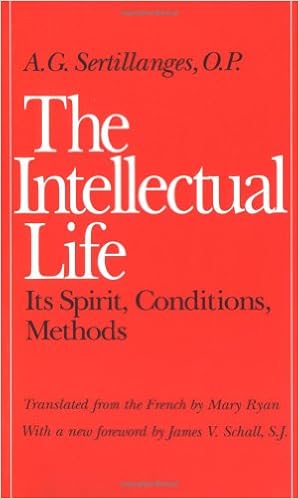
The Intellectual Life: Its Spirit, Conditions, Methods

US HERE – UK HERE

I don’t want to burden your EDC (“every day carry”), so I will stop there.

Oh yes… Rosary, for sure.  Perhaps Brown Scapular and Medal of Our Lady of Graces (the Miraculous Medal).

Posted in "How To..." - Practical Notes, ASK FATHER Question Box, Our Catholic Identity |
8 Comments