Some years ago I went to Viterbo for the Feast of Santa Rosa and the incredible spectacle of the Macchina di Santa Rosa.
Here is some video from this year. Yes, this is being carried by a bunch of men. HERE and HERE and HERE
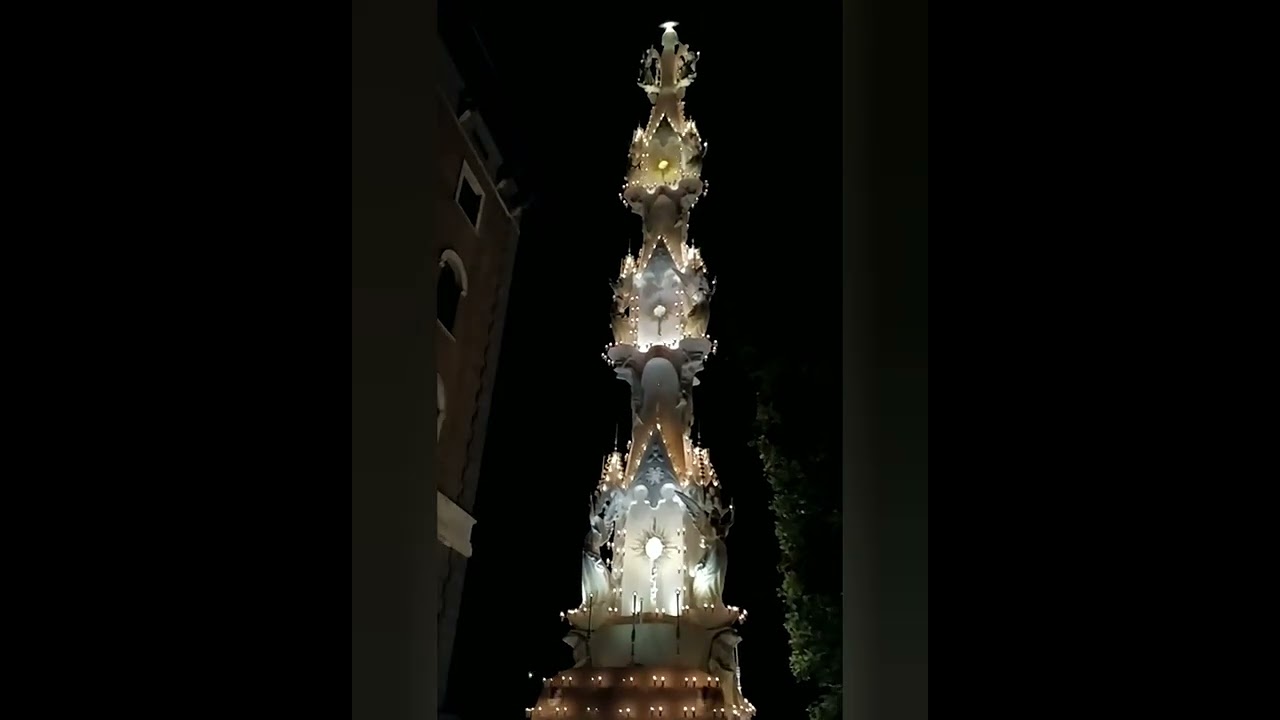

Some years ago I went to Viterbo for the Feast of Santa Rosa and the incredible spectacle of the Macchina di Santa Rosa.
Here is some video from this year. Yes, this is being carried by a bunch of men. HERE and HERE and HERE
 The Collect for the 23rd Ordinary Sunday – this Sunday – was not in any pre-Conciliar edition of the Roman Missal, but it was in the 8th century Gelasian Sacramentary in a section for evening prayers during Paschaltide.
You have to wonder how they – the cutting and pasting experts – made these decisions.
Deus, per quem nobis et redemptio venit et praestatur adoptio, filios dilectionis tuae benignus intende, ut in Christo credentibus et vera tribuatur libertas, et hereditas aeterna.
Take note of the lovely chiasms (so-called because, stylistically, they form a X or Greek chi): redemptio venit…praestatur adoptio (subject verb… verb subject) and also vera libertas…hereditas aeterna (adjective noun…noun adjective). And the two passives make a nice bridge.
It is brilliantly crafted and typically terse, according to the Roman genius.

Vocabulary connections suggest to me Patristic sources for this prayer (e.g., in St Hilary of Poitiers (+ c. 368) de trin 6, 44; St Ambrose of Milan (+ 397) ep 9, 65, 5).
Praesto, -iti, -atum means effectively “to stand before or in front”. It has a wide range of meanings, however, including “to fulfill, discharge, maintain, perform, execute” and concepts surrounding the same, making praesto a little confusing. The lexicographer Souter says that in about the 2nd century praesto meant, “lend” (like French “prêter”) and from the 4th century onward “offer”. Cassiodorus (+ c. 583) and other authors use praesto for “help, aid, give”. A. Blaise suggests the French “accorder” when praesto concerns God. Some weeks ago, (19th Sunday) we saw adoptio. Hereditas can be, “heirship” or the inheritance, the patrimony, itself.
OBSOLETE ICEL (1973):
God our Father, you redeem us, and make us your children in Christ. Look upon us, give us true freedom and bring us to the inheritance you promised.
BTW.. in all the years that I wrote these columns, I constantly reminded people that the slavishly literal versions I provided week in and week out were intended to help you see how the Latin works, to get the bones of the prayers, for the sake of comparing and contrasting more easily the official translations.. They were never intended to be liturgically ready versions… even though they were often better than what we got! So, keep that in mind. They are workhorses, merely.
SUPER LITERAL RENDERING:
O God, through whom to us come both redemption and adoption is guaranteed, kindly give attention to your beloved children, so that both true freedom and the inheritance everlasting may be bestowed on those believing in Christ.
See what I did in there?
CURRENT ICEL (2011):
O God, by whom we are redeemed and receive adoption, look graciously upon your beloved sons and daughters, that those who believe in Christ may receive true freedom and an everlasting inheritance.
What do you think?
By the fact of our unity with Christ in His and our common human nature, the way to divine sonship was opened up to us by the Father in Christ.
Christ is the Father’s Son by nature, we are sons and daughters by grace.
Our adoption through grace is “perfect” (adoptio perfecta) because it complete. Perfecta is from perficio, “bring to an end or conclusion, finish, complete”. From God’s point of view our adoption is perfect because He puts His mark upon us, especially in baptism and confirmation. Since God is not limited by time and for Him there are no past or future distinct from the present, He sees in perfection the results of every gift of adoption. From our point of view adoption will only be completed when we see Him face to face. Because of baptism the Father’s mark is sealed into us forever. In this marvelous adoption the Holy Spirit brings the Father and Son to us when He takes up His rightful place in our souls, thus creating the perfect communion, even family, within our souls.
Today’s Collect has its foundation certainly in the New Testament imagery of adoption, but I think it also flows out of ancient Roman legal concepts of manumission and adoption, freeing of slaves and adoption of heirs.
Ancient prayers rang differently in the ancient ears than they do in ours. Trying to get the content that rang then to ring also today is tricky. Sometimes it can’t be done, and still retain the prayer’s concision, a characteristic of the Roman style.
Let’s bang our hammer on the bell that is “adoption” for a while and see what rings out.
Our adoption by God takes us out of slavery and gives us a new status as free members of the Church and as sons and daughters. Baptism confers this freedom, membership, and adoption.
Even natural children of a father in ancient Rome required the father’s recognition (Latin recognitio – which is what today’s Motu Proprio on translation dealt with!) before they were legally considered to be his legitimate children and heirs with any rights. Adoption could grant those same rights and privileges. Roman adoptio removed a person from one familia and put him in another, while adrogatio legally placed people not under the power of a parent into a familia, thus placing them under the authority of the paterfamilias. In Latin, a familia is a house and all belonging to it, a family estate, family property, fortune. A familia had a head, the paterfamilias (or –familiae, the –as being a Greek genitive), the master of the house.
The baptized are no longer subject to Satan and destined for hell, but are now under new mastership of God.
In Rome there was also an “adoption” by being named an heir with the right of taking the name of the one bequeathing the patrimony. However, this was not an adoption in the fullest sense: you became heir of the father’s name and property without the other powers of a paterfamilias until they were confirmed by magistrates, etc.
Even after baptism our state can be deepened through confirmation.
Ancient slaves could be freed, but that did not make them Roman citizens with the greater rights. By baptism, we become citizens of heaven, members of the family of the Church. Not only are we free, but we gain even the chance of eternal salvation.
In ancient Roman a slave could become a citizen through certain types of manumission, by adoption, through military service, or a special grant to a community or territory. In a way, we have undergone all of these: by laying His hand on us (manus “hand” and mittere), we have been freed. We have been made sons and daughters of a heavenly Father.
We are now soldiers in the Church militant.
By membership of the society of the Church, a holy and priestly People, we gain privileges and obligations. God has recognized us as His own children with a perfect adoption. This is true freedom and true heirship, excluding nothing and, in some sense, lavishing on us even more than we might have had before we fell under the Devil’s dominion through sin.
This is a difficult mystery to grasp: we are already sons and daughters in a perfect sonship by adoption, but that sonship is not yet complete: we lack the final essential component, that is, perseverance in faith and obedience for the whole course of our lives and their ratification in death and our particular judgment.
It is through many trials that we come to the perfection of adoption which we now share in an imperfectly perfect way.
These collects during the summer, during Ordinary time, contain reminders of who we are and, therefore, what we are to do.
Christ reveals both.
Today there was a ceremony held in St. Peter’s Square for the beatification of the short-lived Pope everyone forgets to remember, John Paul I, Luciani (+1978).
In his sermon for the event, Francis seems to have doubled down on the message of Biden’s speech that was shouted against the luciferian red background.
Capita anche oggi: specialmente nei momenti di crisi personale e sociale, quando siamo più esposti a sentimenti di rabbia o siamo impauriti da qualcosa che minaccia il nostro futuro, diventiamo più vulnerabili; e, così, sull’onda dell’emozione, ci affidiamo a chi con destrezza e furbizia sa cavalcare questa situazione, approfittando delle paure della società e promettendoci di essere il “salvatore” che risolverà i problemi, mentre in realtà vuole accrescere il proprio gradimento e il proprio potere, la propria figura, la propria capacità di avere le cose in pugno.
[…]
The same thing happens today, at times of personal or societal crisis, when we are especially prey to feelings of anger or we fear things that threaten our future. We become more susceptible and thus, on the tide of emotion, we look to those who can shrewdly take advantage of the situation, profiting from society’s fears and promising to be the “saviour” who can solve all its problems, whereas in reality they are looking for wider approval and for greater power, based on the impression they make, their ability to have things in hand.
I’m pretty sure this is a shot at Bad Orange Man with a touch of self-projection, perhaps.
And then there’s this.
Con il sorriso Papa Luciani è riuscito a trasmettere la bontà del Signore. È bella una Chiesa con il volto lieto, il volto sereno, il volto sorridente, una Chiesa che non chiude mai le porte, che non inasprisce i cuori, che non si lamenta e non cova risentimento, non è arrabbiata, non è insofferente, non si presenta in modo arcigno, non soffre di nostalgie del passato cadendo nell’indietrismo.
[…]
With a smile, Pope John Paul managed to communicate the goodness of the Lord. How beautiful is a Church with a happy, serene and smiling face, a Church that never closes doors, never hardens hearts, never complains or harbours resentment, does not grow angry or impatient, does not look dour or suffer nostalgia for the past, falling into an attitude of going backwards.
What a beautiful image Francis has of so many people who just want to have traditional worship. Truly the heart of a pastor.
Meanwhile, Francis can really draw those big crowds. The weather in the morning wasn’t perfect, but… sheesh.

Compare and contrast with the beatification of other Popes. Even the not so beloved Paul VI.


Do we really need a photo of the crowd for John Paul II, beatified by Pope Benedict XVI in 2011?
Here are the overflow crowds near Castel Sant’Angelo.


The Vetus Ordo is against Vatican II! That’s why it has to be crushed and the people who want it marginalized and demoralized to the point that they will quite simply leave the Church. Instead, what will bring about the Vatican II springtime of joy we have been waiting for since 1965, the closure of that pivotal moment that reinterpreted the entire history, doctrine and worship of Christianity, is the only, that is to say, the unique expression of the Roman Rite, the Novus Ordo as interpreted hereunder in a video from Sacred Heart Church in Omaha.
“The only expression of the Roman Rite”
— Alberto (@FlatCath) September 1, 2022
Notable moments in a “Celebration of Life” for a deceased priest. If anyone does anything remotely like this for me, I will haunt you for the rest of your natural lives.
From the beginning there are a string of “eulogies”.
55:00 Gloria… this is truly hideous.
1:05:00 end of the Gospel (turn your volume down a little or you are certain to frighten the dogs of the neighborhood
1:25:00 Super oblata and beginning of Eucharistic Prayer
1:32:00 End of Eucharistic Prayer
1:33:00 Our Father (get a barf bag)
1:36:00 Sign of Peace chaos

Too many people today are without good, strong preaching, to the detriment of all. Share the good stuff.
Was there a GOOD point made in the sermon you heard at your Mass of obligation for the 13th Sunday after Pentecost (23rd Ordinary in the Novus)?
Tell about attendance especially for the Traditional Latin Mass. I hear that it is growing. Of COURSE.
Any local changes or (hopefully good) news?
A few thoughts of my own, HERE.
In this Sunday’s Gospel Christ leads a lawyer down a steep path into a gentle mugging with the Truth.
In medias res…
[…]
Holy Mass, particularly as celebrated – these days in particular – with the Vetus Ordo, more clearly manifests the fact it is not focused on man. It is focused on God. Certainly, we participate at Holy Mass because we desire that transforming touch in our encounter with divine mystery. But it is not the usefulness of Mass as being transformational that is primary. It is the religious rightness of being there, in awe-filled gratitude, for the sake of God. Of course, the one does not exclude the other, such is the magnificent love of our God. Paradoxically, the more we allow Mass to be less about ourselves, then the more it affects us. Our “active participation” in Holy Mass is rooted in our active receptivity, our outpouring of self that opens for the inpouring of what God wants to give.
[…]

 Someone asked in email what I am reading right now. I just finished a reading, after decades, of Thomas Merton’s Seven Storey Mountain. [US HERE– UK HERE] It was lyrically beautiful.
Also, in the evening, I am working my way though Trent: What Happened at the Council by John O’Malley. [US HERE – UK HERE] Not exactly the most conservative of scholars, but he has done his homework. What really impressed me was his laying out of the context, leading up to the Council of Trent.

This impressed me:
Fifty days to elect Clement VII. Two days to elect his successor. Why such a contrast? Cardinals from contending camps converged in their dismay over Clement’s seemingly shilly-shallying policies, which many blamed for the sack of Rome. More important, the mood had shifted. Concern, even panic, over what the future might hold was widespread. The sack, a portent of worse things to come? The Turks, seemingly unstoppable on the eastern frontier, controlled the eastern Mediterranean and raided southern Italian cities almost at will. The Schmalkaldic League threatened war in Germany. Luther was still at large. His teachings had spread far and wide throughout northern Europe and, the unthinkable, had penetrated even into Italy. England was in schism. In this perilous time the French king seemed to be playing a duplicitous game. Something had to change. In Alessandro Farnese, who at sixty-seven was the oldest participant in the conclave, the others saw a man they thought was up to the task. Farnese had been a cardinal since 1492, for forty-two years. He knew the ropes and knew how to make them work. Widely respected for his diplomatic skills, his firmness of purpose, his intelligence, and his good judgment, he had not hidden his disagreements with Clement’s political policies or Clement’s disregard of his advice. In the rivalry between Charles and Francis, he believed the Holy See needed to maintain a policy of absolute neutrality. He had long and publically proclaimed the necessity of a council. He seemed to be the man of the hour. Shortly after his election as Paul III, he announced three goals for his pontificate….
Meanwhile,

Please remember me when shopping online. Thanks in advance.
 PLEASE use the sharing buttons! Thanks!
In your charity would you please take a moment look at the requests and to pray for the people about whom you read?
Continued from THESE.
Let’s remember all who are ill, who will die soon, who have lost their jobs, and who are afraid.
I get many requests by email asking for prayers. Some are heart-achingly grave and urgent.
As long as my blog reaches so many readers in so many places, let’s give each other a hand. We should support each other in works of mercy.
If you have some prayer requests, feel free to post them below.
You have to be registered here to be able to post.
I ask a prayer for myself. I’m dealing with a particular challenge right now.
Also, I received this note today:
Phillip Douglas Steinacker, of Baltimore MD, a long time ZedHead, passionate Catholic, one-on-one evangelist (he could not stop himself), and good friend who introduced me to your awesome blog, died peacefully of cancer on August 24, 2022. Phil occasionally contributed comments, and was a fan. I just wanted to share.
While I am sad to hear of the passing away of a long-time participant here, I am glad to receive the news so that we can pray for the repose of his soul. Should any of his family or friends see this, please know that readers here will surely stop and say a prayer.
I received this email…
By way of a quick update (and perhaps you would be good enough to mention this on the blog), The Catholic Military Assoc of Our Lady of Victories has now gone live with an app called “Military Connect” developed by the Apostolat Militaire International and Tweeting with GOD in conjunction with members of the AMI including the CMA, is LIVE.
The app has been endorsed by the Holy See, with a message from Pope Francis via Secretary of State H.E. Cardinal Parolin stating that he hopes it will help to “make the situations in which military personnel are involved more human and Christian”.
The free app is currently available in both the Google Play and App stores, for smartphones and tablets, in 8 languages (English, Italian, French, Spanish, Croatian, German, Portuguese and Dutch).
The App offers:
Strong Catholic prayers
Answers to 200+ questions about faith and being a military Catholic
Prayers specifically for the military
Testimonies from serving Catholics
Inspiring military Saints and quotes
Guidance for preparing for Mass and Confession
Spiritual first aid
Users from member countries can contact a Military Chaplain and their Associations directly from the app
The facility to upload spiritual reading
Downloaded content so that it can be accessed on deployment etcWith our prayers and best wishes from the CMA
The oppressors of the faithful who desire the Vetus Ordo, on the obviously pure fantasy about a “unique expression” of the Roman Rite which was mandated by Vatican II are essentially hypocrites.
The Novus Ordo is the unique expression?
Try this on for size. You even have to speak German to sense what is wrong with this.


Coat of Arms by D Burkart









A Daily Prayer for Priests


They find you a pro-life agent in your area who commits to giving a portion of the fee to a pro-life group!

PLEASE subscribe via PayPal if it is useful. Zelle and Wise are better, but PayPal is convenient.
A monthly subscription donation means I have steady income I can plan on. I put you my list of benefactors for whom I pray and for whom I often say Holy Mass.
In view of the rapidly changing challenges I now face, I would like to add more $10/month subscribers. Will you please help?
For a one time donation...



Help Monks in Wyoming (coffee – UPDATED LINK) and Norcia (beer) and the wonderful "Soap Sisters" of Summit, NJ!


Please follow me on Twitter!










Visits tracked by Statcounter
since Sat., 25 Nov. 2006:

