Run, don’t walk, to Crisis…. NOW!
Francis Allies Reveal Their Plans for Revolutionary Change
Read the whole thing. Take careful notice of all the links in the text.
Discuss.
Moderation queue is ON.

Run, don’t walk, to Crisis…. NOW!
Francis Allies Reveal Their Plans for Revolutionary Change
Read the whole thing. Take careful notice of all the links in the text.
Discuss.
Moderation queue is ON.
This is the Sword of Damocles that hangs over the heads of law enforcement officers, who deserve our thanks.
Here is an amazing video of how cops can go from contact to shots fired in 3 seconds.
The reader who sent this rightly commented: “One must be prepared spiritually at all times.”
We don’t have to be cops to be in spiritual danger. Remember that “mortal sin” is called “mortal” for a reason. And spiritual death is a lot more serious than physical death.
Go to confession!

Podcast: Play in new window | Download
Subscribe: RSS
 Two things drive this post.
First, the Roman “summit” rammed a major aspect of The Present Crisis into a smaller box than reasonable people allow. They excluded many things that could have been addressed. One of them is the devolution of morals and the lost of the sense of purity.
Second, most people today have heard and would recognize the voices of recent Popes. Who can forget the great bass with the Slavic tinge of John Paul II and his particular cadences? However, most of us have not had a chance to hear the voices of Popes of deeper into the last century.
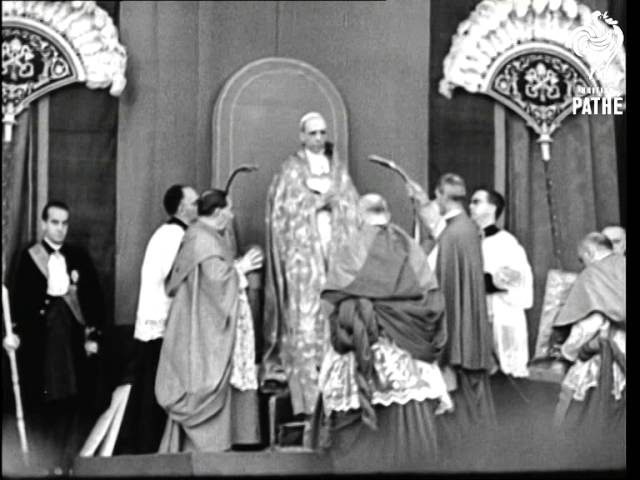
Both of those issues come together in this snippet from the sermon Pius XII gave for the canonization of St Maria Goretti. Pius, from about 1950 onward, seeing what was going on in society called for greater purity. What would he think about today?
Here is a snippet of Pius XII, the last Roman Pope.
Podcast: Play in new window | Download
Subscribe: RSS
The place: St. Peter’s Square, completely jammed
The date: 24 June 1950
The occasion: the canonization of St Maria Goretti
Full text HERE.
What you hear Pius XII say in the recording:
Perchè, diletti figli, siete accorsi in così sterminato numero alla sua glorificazione? Perchè, ascoltando o leggendo il racconto della sua breve vita, così somigliante a una limpida narrazione evangelica per semplicità di linee, per colore di ambiente, per la stessa fulminea violenza della morte, vi siete inteneriti fino alle lacrime? Perchè Maria Goretti ha conquistato così rapidamente i vostri cuori, fino a divenirne la prediletta, la beniamina? Vi è dunque in questo mondo, apparentemente travolto e immerso nell’edonismo, non soltanto una sparuta schiera di eletti assetati di cielo e di aria pura, ma folla, ma immense moltitudini, sulle quali il soprannaturale profumo della purezza cristiana esercita un fascino irresistibile e promettente : promettente e rassicurante.
Why, beloved children, have you rushed in such boundless numbers to her glorification? Why, hearing or reading the account of her brief life, so much like a pristine gospel narrative for the simplicity of its line, for the painting of its setting, for the very flaming violence of the death, were you touched even to tears? Why has Maria Goretti conquered your hearts so quickly, even to the point of becoming your favorite, your darling? Thus, there is in this world, manifestly overwhelmed and sunk into hedonism, not only a sparse crowd of the chosen, thirsting for heaven and pure air, but a throng, but an immense multitude, upon which the supernatural fragrance of Christian purity works an irresistible and promising allure: promising and encouraging.
Some visuals to go along with the sound.

Maria Goretti was murdered in the course of an attempted rape, which she resisted to the point of being mortally wounded. The Church teaches that those who die bearing witness  to Christ, to the Faith, or to some virtue or quality inseparable from the Faith, in that moment manifest the virtues in a heroic way and are, therefore, able to be proposed even for elevation to our altars. Something about St. Maria Goretti captured the imagination of the Catholic faithful in the early 20th c., as did, for example, St. Therese de Lisieux. Their lives show us that we can, in fact, try – with the help of grace – to be clean in a world that is fallen and fallen far. It is not hard to understand why even some Catholics react with strong negativity about Maria Goretti. They’ve gone the way of the world.
Also, my contact with exorcists informs me that St. Maria Goretti is a mighty intercessor and a serious terror of demons, surely after the heart St. Joseph… known for his purity. Joseph most chaste… Guardian of virgins… Solace of the wretched… Patron of the dying… THE Terror of demons.
Robert Royal of The Catholic Thing went to Rome for the Vatican “summit” on abuse. He has an excellent summary piece today, which I warmly recommend.
Three things in particular stood out for me in his piece.
First, try this on…
But like many Catholic prelates, including the Holy Father, [Card. Gracias] also leaned too heavily, in my judgment, on inequities of power – the clericalism gambit – which I believe betrays a wish to make the abuse crisis into more about social justice than personal sin.
It strikes me that so many movers and shakers in the Church, both ordained and in chanceries and plum posts and lay in academia, have become so mesmerized by “social justice” that they have nearly completely forgotten about personal sin. These same types, libs, are inclined to talk about sinful structures that have to be changed, etc.
No. Fail. If a structure lends itself to evil actions, it was built on the foundation of personal sins. People sin, not structures.
You will also find interesting Royal’s comments on the chatter about structures.
Next, speaking of structures, Royal recounts Card. Cupich’s caution that changing structures isn’t enough. Royal adds,
“True enough, but even changing structures, for many of us, would be a good – a real – start. Let it be noted, in fairness, even if it does not lead to any effective action, that Cupich ended with no fewer than twelve suggestions about how to hold a bishop accountable. These included structural and procedural changes that he elsewhere played down.”
This leads to the observation that, as it seems, Cupich’s talk was inherently incoherent.
Lastly, Royal gives a summary of questions asked by journalists during the presser on Friday. They are, in fact, more to the point of The Present Crisis than what the agenda of the “summit” set out to discuss.
Because it’s Friday, and because we have all had terrible news all week, here’s what I consider to be one of the five funniest Bugs Bunny cartoons.
One of my favorite lines is contained herein.
And watch the hooves when the bull really takes off and the little surprise beams that shoot out of his head on the hill. Comedy gold, folks.
I’ll add that I have been to the bullfights in Madrid and look forward to going again. So there.
I received a Kindle copy of the appalling “gay” book by the “gay” French writer – and I use the term writer loosely.
Damian Thompson’s review says it all better than I could:
An exposé of high-ranking gays in the Catholic Church bears the fingerprints of the Pope’s closest advisors
Team Francis are playing a nasty game in encouraging this attack on their conservative enemies[…]
Martel is, to put it charitably, an odd fish. He is besotted with Rimbaud, sleeping beside a volume of his poetry, and the generation of tortured French gay artists and intellectuals who followed him. He presses a ‘white volume’ (he won’t say what it is) into the hands of his inter-viewees. On almost every page he outs himself as a raging bore.
He’s more than an odd fish, though. He’s a menace, because he hasn’t bothered to equip himself with basic theological knowledge.
[…]
I know why the Pope’s hardline allies, known as Team Francis, indulged Martel.They wanted a hit job on their conservative enemies; he was writing this book and they saw their chance. [….]
Unfortunately for Team Francis, they have landed themselves in The Pink Panther rather than The Day of the Jackal.
[…]
 Right now and in the foreseeable future, work is being done on the server, back end, of the blog.
It is possible that there may be some outages or bumps along the way.
Some big changes are on the horizon.
Please say a prayer to your Guardian Angel to help every thing go smoothly, to guide the minds and insights of those working on things, and to keep the Enemy at bay.
FYI.
Archbishop Carlo Maria Viganò sent an open message to Francis and participants in the “summit”, mainly presidents of bishops conferences from around the world, meeting in Rome in order to avoid talking about the problem of homosexuality as the basis of clerical sexual abuse…. to talk about protection of minors.
My emphases:
Viganò, writing on the Feast of St. Peter Damian, the great reformer who blasted homosexuality among the clergy in his day:
We cannot avoid seeing as a sign of Providence that you, Pope Francis, and brother Bishops representing the entire Church have come together on the very day on which we celebrate the memory of St. Peter Damian. This great monk in the 11th century put all his strength and apostolic zeal into renewing the Church in his time, so deeply corrupted by sins of sodomy and simony. He did that with the help of faithful Bishops and lay people, especially with the support of Abbot Hildebrand of the Abbey of St Paul extra muros, the future Pope Gregory VII.
Allow me to propose for our meditation the words of our dear Pope Emeritus Benedict XVI addressed to the people of God in the General Audience of Wednesday, May 17, 2006, commenting on the very passage of the Gospel of Mark 8:27-33 that we proclaimed on today’s Mass.
Peter was to live another important moment of his spiritual journey near Caesarea Philippi when Jesus asked the disciples a precise question: “Who do men say that I am?” (Mk 8: 27). But for Jesus hearsay did not suffice. He wanted from those who had agreed to be personally involved with him a personal statement of their position. Consequently, he insisted: “But who do you say that I am?” (Mk 8: 29).
It was Peter who answered on behalf of the others: “You are the Christ” (ibid.), that is, the Messiah. Peter’s answer, which was not revealed to him by “flesh and blood” but was given to him by the Father who is in heaven (cf. Mt 16:17), contains as in a seed the future confession of faith of the Church. However, Peter had not yet understood the profound content of Jesus’ Messianic mission, the new meaning of this word: Messiah.
He demonstrates this a little later, inferring that the Messiah whom he is following in his dreams is very different from God’s true plan. He was shocked by the Lord’s announcement of the Passion and protested, prompting a lively reaction from Jesus (cf. Mk 8: 32-33).
Peter wanted as Messiah a “divine man” who would fulfil the expectations of the people by imposing his power upon them all: we would also like the Lord to impose his power and transform the world instantly. Jesus presented himself as a “human God,” the Servant of God, who turned the crowd’s expectations upside-down by taking a path of humility and suffering.
This is the great alternative that we must learn over and over again: to give priority to our own expectations, rejecting Jesus, or to accept Jesus in the truth of his mission and set aside all too human expectations.
Peter, impulsive as he was, did not hesitate to take Jesus aside and rebuke him. Jesus’ answer demolished all his false expectations, calling him to conversion and to follow him: “Get behind me, Satan! For you are not on the side of God, but of men” (Mk 8: 33). It is not for you to show me the way; I take my own way and you should follow me.
Peter thus learned what following Jesus truly means. It was his second call, similar to Abraham’s in Genesis 22, after that in Genesis 12: “If any man would come after me, let him deny himself and take up his cross and follow me. For whoever would save his life will lose it; and whoever loses his life for my sake and the Gospel’s will save it” (Mk 8: 34-35). This is the demanding rule of the following of Christ: one must be able, if necessary, to give up the whole world to save the true values, to save the soul, to save the presence of God in the world (cf. Mk 8: 36-37). And though with difficulty, Peter accepted the invitation and continued his life in the Master’s footsteps.
And it seems to me that these conversions of St Peter on different occasions, and his whole figure, are a great consolation and a great lesson for us. We too have a desire for God, we too want to be generous, but we too expect God to be strong in the world and to transform the world on the spot, according to our ideas and the needs that we perceive.
God chooses a different way. God chooses the way of the transformation of hearts in suffering and in humility. And we, like Peter, must convert, over and over again. We must follow Jesus and not go before him: it is he who shows us the way.
So it is that Peter tells us: You think you have the recipe and that it is up to you to transform Christianity, but it is the Lord who knows the way. It is the Lord who says to me, who says to you: follow me! And we must have the courage and humility to follow Jesus, because he is the Way, the Truth and the Life.”
Maria, Mater Ecclesiae, Ora pro nobis,
Maria, Regina Apostolorum, Ora pro nobis.
Maria, Mater Gratiae, Mater Misericordiae, Tu nos ab hoste protege et mortis hora suscipe.
+ Carlo Maria Viganò
Tit. Archbishop of Ulpiana
Apostolic Nuncio
February 21, 2019
Memorial of St. Peter Damian
I think that the key point here is:
You think you have the recipe and that it is up to you to transform Christianity…
That is what we have been watching. These sodoclericalist modernists have been working to transform the Church into something that Christ never intended.
 I received this from a military chaplain of many years, including service in Iraq. He reacted to the Hell’s Bible piece about priests who are “gay” (I hate that word) who whine about being “trapped” in the priesthood. My piece HERE.
Here’s the chaplain:
[…]
In reading the NYT diatribe of the gay priest and his pain, and the responses of others to said article, it occurred to me that there is a parallel. Holy Orders is a sacrament of service to the Church. The military is a service to the nation. As my former Soldier-blogger wrote, we have to remember that we are all sapiens, human beings with respect, dignity, and basic human rights. In order to become a citizen, we do give up certain rights (one may use “social contract theory” if desired to elaborate on this). To be a Soldier, in service to the nation, one gives up additional rights, though. The same is true of the priesthood. It seems unfortunate that I read so frequently about the rights of priests, most often in reference to persecution by some in the episcopacy. Rights ALWAYS carry duties, though. There is no such thing as a right without a duty. This is a contributor to the idea of freedom as license, “freedom from,” rather than freedom to be whom God made us to be in relation to Him.
Additionally, service is a privilege; it is never a right. Yes, as one priest respondent to the NYT article alluded, any of us are free to leave – that is a right that you have. No one has a right, however, to enter into service expecting the terms of that service, which are known before entry, to change to suit our own whims and desires. This is one of many pinnacles of hubris.
In these dark days, let us all pray fervently. I’ve joined Fr. Heilman in the USGF Operation Reparation 54. May God have mercy on us all.
Si vis pacem para bellum!

Coat of Arms by D Burkart









A Daily Prayer for Priests


They find you a pro-life agent in your area who commits to giving a portion of the fee to a pro-life group!

PLEASE subscribe via PayPal if it is useful. Zelle and Wise are better, but PayPal is convenient.
A monthly subscription donation means I have steady income I can plan on. I put you my list of benefactors for whom I pray and for whom I often say Holy Mass.
In view of the rapidly changing challenges I now face, I would like to add more $10/month subscribers. Will you please help?
For a one time donation...



Help Monks in Wyoming (coffee – UPDATED LINK) and Norcia (beer) and the wonderful "Soap Sisters" of Summit, NJ!


Please follow me on Twitter!










Visits tracked by Statcounter
since Sat., 25 Nov. 2006: