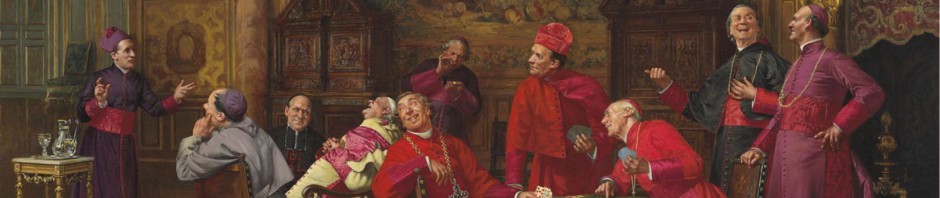
Rome Shot 260

Posted in SESSIUNCULA |
3 Comments

WDTPRS – 22nd Ordinary Sunday: O mighty God of hosts, graft into our hearts the love of Your Name!

In the Sanctus of Holy Mass and, in the great Te Deum, we echo the myriads of angels bowed low in the liturgy of heaven before God’s throne: “Holy, Holy, Holy LORD GOD SABAOTH …. God of “heavenly hosts”.

With small differences our Collect for the upcoming 22nd Ordinary Sunday (Novus Ordo) is based on a prayer in the 8th century Gelasian Sacramentary and, subsequently, one in the 1962 Roman Missal for the Sixth Sunday after Pentecost.

Deus virtutum, cuius est totum quod est optimum, insere pectoribus nostris tui nominis amorem, et praesta, ut in nobis, religionis augmento, quae sunt bona nutrias, ac, vigilanti studio, quae nutrita custodias.

Insero means “to sow, plant in, engraft, implant.”  I like “graft”.  Optimum is “best”, but seeing that we are applying “best” to God, we can get away with “perfect”.

Our Collect summons images of, on the one hand, armies and, on the other, an orchard and vine tending.  Many of our ancient prayers have vocabulary which invokes military, agricultural, and forensic/juridical images.  Today, on the one hand, the God of hosts guards the good things we have.  On the other, this same mighty God is grafting love into us and then nourishing it so it can grow.

OBSOLETE ICEL (1973):

Almighty God, every good thing comes from you. Fill our hearts with love for you, increase our faith, and by your constant care protect the good you have given us.

The norms underlying the current ICEL English translation stated that “deficiency in translating the varying forms of addressing God, such as Domine, Deus, Omnipotens aeterne Deus, Pater, and so forth, as well as the various words expressing supplication, may render the translation monotonous and obscure the rich and beautiful way in which the relationship between the faithful and God is expressed in the Latin text” (Liturgiam authenticam 51).

Today the priest invokes God as Deus virtutum, an expression in St Jerome’s Latin Vulgate Psalter (Ps 58:6; 79:5 ff; 83:9; 88;9) often translated as “God of hosts.”  Don’t confuse “host”, which is “army, multitude”, with the wheat wafer used at Mass.  Virtutum is genitive plural of virtus, “manliness, strength, courage, aptness, capacity, power” etc.

St Jerome chose virtutum to render the Hebrew tsaba’, “that which goes forth, an army, war, a host.”  Tsaba’ describes variously hosts of soldiers, of celestial bodies, and of angels.

LITERAL RENDERING:

O mighty God of hosts, of whom is the entirety of what is perfect, graft into our hearts the love of Your Name, and grant, that by means of an increase of the virtue of religion, You may nourish in us the things which are good, and, by means of vigilant zeal, guard the things which have been nourished.

CURRENT ICEL (2011):

God of might, giver of every good gift, put into our hearts the love of your name, so that, by deepening our sense of reverence, you may nurture in us what is good and, by your watchful care, keep safe what you have nurtured.

Today we pray to God for an increase in “religion.”  I’ll take this to be the virtue of religion. Last week I wrote about the difference between “values” and “virtues”.  Let’s make more distinctions.

The Catechism of the Catholic Church defines “religion” as a set of beliefs and practices followed by those committed to the service and worship of God.

The First Commandment requires us to believe in God, to worship and serve him, as the first duty of the virtue of religion (cf also CCC 2084, 2135).   St. Thomas Aquinas (d 1274) says that religion is the virtue by which men exhibit due worship and reverence to God as the creator and supreme ruler of all things (STh II-II, 81, 1).

We must acknowledge dependence on God by rendering Him a due and fitting worship both interiorly (eg, by acts of devotion, reverence, thanksgiving, etc.) and exteriorly (eg, external reverence, liturgical acts, etc.).

The virtue of religion can be sinned against by idolatry, superstitions, sacrilege, and blasphemy.

We creatures must recognize who God is and act accordingly both inwardly and outwardly.  When this at last becomes habitual for us, then we have the virtue of religion.  A virtue is a habit.  One good act does not make us virtuous.  If being prudent or temperate or just, etc., is hard for us, then we don’t yet have the virtues.

Our petition for religion follows immediately from our desire that God “graft” (insere) love of His Holy Name into our hearts.  We move from the title of God the angels and saints never tire of repeating in their everlasting liturgy in heaven: HOLY.  Then we beg for all good things to be nourished in us by God as He increases in us the virtue of religion.  This leads to the proper interior and exterior actions that necessarily flow from recognizing who God truly is and who we are.

Posted in WDTPRS |
Comments Off on WDTPRS – 22nd Ordinary Sunday: O mighty God of hosts, graft into our hearts the love of Your Name!

UPDATED – VIDEO: Priest announces he and people have been forbidden to say St. Michael Prayer and Hail Mary after Mass.

UPDATE: For fairness….

UPDATE: For commonsense….

UPDATE: For background…

A piece at First Things and another at Crisis.

Originally Published on: Aug 27, 2021 at 04:01


I will turn comments off for this, though I would like for a lot of people to see it. Share it.

This priest in Libertyville, IL, was required by Card. Cupich to cease praying the Prayer to St. Michael the Archangel publicly after Mass.  People can say it silently on their own, but they can’t pray it collectively.  He was also told not to say a Hail Mary after Mass.

It might take a moment for the video to download.  HERE

[UPDATE: I have a report that audio plays on computers but not on phones.]


I can think of a couple of reasons why this diktat might have come down.

Perhaps there was a person who didn’t like it, complained, and took all the oxygen out of the room for everyone else.  It’s plausible.  There are countless instances of bishops listening to one Karen and not backing the priest.

Otherwise, praying a Hail Mary and the St. Michael Prayer after Mass is what is done after the Traditional Latin Mass.  Can’t have that!  Gotta stomp that out.

It could be both.

It could be neither.

Either way, it’s just plain sad.

Get ready for more of this.

Meanwhile, pledge to be a Custos Traditionis.

Posted in Pò sì jiù, You must be joking! | Tagged
8 Comments

ASK FATHER: Griping about canon lawyers and marriage “annulments”

From a reader…

QUAERITUR:

My experience is that any marriage can be annulled on the grounds of gross immaturity or mental defect. (Didn’t know “porneia” was Greek for these terms….) And when canonists are asked about church laws regarding the responsibility of  priest and bishops to help reconcile marriages they says things like that’s old and we don’t do that anymore.

How can a church law be ignored because people stopped doing what they are supposed to be doing?

BTW it seems like many cannon lawyers are divorce lawyers.

GUEST PRIEST RESPONSE: Fr. Tim Ferguson

The two most common complaints about marriage tribunals are that 1) they grant too many annulments and 2) they don’t grant enough annulments.

Often, both complaints come from the same person. During my time as a lay canonist (two n’s, not three, thank you), I once met a priest. When I told him that I worked at the marriage tribunal, he said, “Oh, so you’re one of the folks who are destroying our marriages,” and turned and walked away. Three years later, when a case involving a member of his family received a negative decision, this same priest called me up and read me the riot act on the phone.

The complaints about tribunals granting too many or too few annulments come from looking at the situation in the wrong way. Judges don’t “grant” or “withhold” annulments as if they were some sort of favor. They are a judgment, based on the law and the facts presented before the Court. The facts presented might be flawed (people lie, people misremember), but they are what we have to go on.

A more helpful analogy is, perhaps, a medical diagnosis. A good doctor examines the patient, asks pertinent questions, perhaps does a few tests, then draws on his knowledge of medical conditions to come up with a diagnosis. His diagnosis might be wrong, despite his best efforts. The patient could be concealing some important factors, or there may be medical developments or conditions about which the doctor does not know. That’s why it’s generally good to get a second opinion before making important medical decisions.

If the local doctor examines 50 people and finds that 48 of the fifty patients have cancer, we don’t generally jump to the conclusion, “Dr. Gilligan is handing out cancer diagnoses like candy!” Instead, we start asking ourselves, why do so many people in this town have cancer?

A good tribunal (and most of them are good) examines the parties – interviews are conducted, evidence is examined, witnesses are called, often a psychological review is conducted. Unlike in the medical field, it is very rarely the case that only one canonist examines the case. Ideally, a degreed Defender of the Bond and three degreed Judges are involved in the case. If a majority of the judges find sufficient evidence for nullity, an affirmative decision is given. In the recent past, an automatic appeal to a second court was made. Now that appeal is optional, but a reasonable option for a party who disagrees with the decision.

The seemingly large number of affirmative cases in the United States and much of the Western world doesn’t say as much about the quality of canon lawyers and tribunal staff as it does about the travesty of marriage in our society. A society that treats marriage as disposable (and yes, the Church failed utterly when States first started introducing no-fault divorce), impermanent, and merely some sort of social contract allowing for guilt-free sex between two persons of whatever gender, it is entirely understandable that few young people have a clear understanding of the covenant they are entering into, and so many of them come from backgrounds that are so dysfunctional that their ability to sustain, let alone understand a mature adult relationship is severely damaged.

It is true that the Church urges pastors and those involved in nullity cases to try to assist couples with reconciliation whenever possible. Experience has shown that, by the time someone is considering filing for a declaration of nullity, reconciliation is difficult if not impossible. Pastors – and laity – have a lot of work to do in forming young people to understand what marriage is, how to find a suitable partner, and what the commitment of marriage is truly about. Throwing stones at canonists is much easier.

Anecdotal “evidence” to completely demolish what I’ve said above coming in three…, two…, one…

Posted in "How To..." - Practical Notes, ASK FATHER Question Box, Canon Law | Tagged ,
44 Comments

Rome Shot 259

In 2005 the bones of St. Augustine were brought to Rome from Pavia to the Church of St. Augustine, where there is also the tomb of Augustine’s mother, Monica.

It was the first time in 1617 years that they had been reunited.

Posted in SESSIUNCULA | Tagged ,
9 Comments

Catholics who support manifest evils … yes… they are “some kind of Catholic”.

I subscribe to very few print journals and magazines.  I just can’t get through them all as they rain down on me.  Hence, I am selective.

One publication I do subscribe to is Touchstone.

There was a powerful editorial in the July/August edition about the Catholicism of “devout” Joe Biden and Nancy Pelosi and their sort… which I assume includes not a few bishops, priests and many other lay people, both publicly seen and unseen.

Some people are not going to like that I posted this.  However, I offer it for two reasons.

First, there are those who say that Biden, Pelosi, the editors of the Fishwrap, ideological enemies of the Church’s traditional sacred worship, etc., are “not Catholics”.   They are Catholics.   Iuxta modum, but they are.

Next, let this serve as a form of examination of conscience before you GO TO CONFESSION.   We all fail in commission and omission, none of us being perfect and most of us having both bad habits and underdeveloped virtues (which means they are not virtues at all).  Mediocrity is not a goal of the awakened – not woke – Catholic.  And of course promotion of downright evil is the path to Hell.

Here We Remain: Touchstone & the “Devout” Friends of Abortion
by S. M. Hitches

[…]

President Biden is, to be sure, some kind of Catholic, as the Jewish atheist is some kind of Jew, or the anarchist who wishes to destroy his country is some kind of citizen, or the theologian who teaches in the name of Christ while denying his deity and his Resurrection is some kind of Christian, or the cancerous cell is some part of the body it is killing. If possession of some kind of religious sensibility, even an intense sensibility, is the proper mark of devotion, then perhaps one cannot even deny that Biden, Speaker Pelosi, and Catholics like them are “devout.” But this does not stop them from being very bad Catholics, servants of God in the same way Satan is, or bloody-minded enemies of the Church of which they are officially members in good standing, and which is replete with bishops who have no qualms about offering them Communion.

In response to the abortion-favoring policies of President Biden, Cardinal Gerhard Müller, former prefect of the Congregation for the Doctrine of the Faith—the Vatican curial department responsible for supervising the teaching of Catholic doctrine—wrote:

When the politico-religious rulers of their time wanted to forbid the apostles from proclaiming the teachings of Christ under threat of punishment, the apostles replied, “One must obey God rather than men” (Acts 5:29). . . . Those who -relativize the clear commitment to the sanctity of every human life on the basis of political preferences with tactical games and sophistical obfuscations [taktischen Spielen und sophistischen Verschleierungen] openly oppose the Catholic faith.

“Sophistical obfuscations”—like “devout Catholic.” What Cardinal Müller says for the believing segment of the Catholic Church is the same for any form of faith that is credibly called “Christian,” including, please God, that of this journal. On the abortion of a living child, a matter of mere Christianity, we remain as we have always been, but likely now more than ever, when faced with such devotion as Mr. Biden’s, under threat of punishment. Pray for us that our faith does not fail, and we continue to help our readers escape the religion of Antichrist, whose followers perpetually confuse religiosity with goodness.

“sophistischen Verschleierungen”…  sometimes you can’t beat German.

Posted in Emanations from Penumbras, Hard-Identity Catholicism, Liberals | Tagged , , ,
5 Comments

St. Monnica: “put my body anywhere”

Here is an oldie post, appropriate for the day:

Today in newer, Ordinary Form calendar of the Holy Roman Church is the feast of St. Monica, the mother of St. Augustine of Hippo.  In the traditional calendar her feast was back in May.

Her name, which is Punic in origin, is also properly spelled Monnica.

This is the chapel in the church of St. Augustine in Rome where the mortal remains of St. Monica (+387), the mother of Augustine of Hippo now rest.

To the right is a shot of the chapel on the day some years ago when the bones of her son, St. Augustine, were brought from their resting place in Pavia (near Milan) to Rome.

How did St. Monica’s tomb wind up here? 

Here is an excerpt from an article I wrote for Inside the Vatican (December 2004) on the above mentioned event.  I used the alternate (and more accurate Punic) spelling of the saint’s name – “Monnica” (emphasis not in the original):

Most visitors to the Eternal City find it puzzling and wondrous that Monnica’s remains would be in Rome and even more so that Augustine’s should be in northern Italy, or that we have them at all.  How did this come to pass?  Monnica died at age 56 of a malarial fever at Ostia, Rome’s port city, not far from where modern Rome’s port, DaVinci airport, is situated.

After Augustine’s baptism in 386 by Milan’s bishop St. Ambrose (+ AD 397), Monnica and Augustine together with his brother Navigius, Adeodatus the future bishop’s son by his concubine of many years whom Monnica had forced Augustine to put aside, and friends Nebridius, Alypius and the former Imperial secret service agent (agens in rebus) Evodius were all waiting at Ostia to return home to Africa by ship.  They were stuck there for some time because the port was blockaded during a period of civil strife.

As she lay dying near Rome, Monnica told Augustine (conf. 9): “Lay this body anywhere, let not the care for it trouble you at all. This only I ask, that you will remember me at the Lord’s altar, wherever you be.”  She was buried there in Ostia.  In the 6th century she was moved to a little church named for St. Aurea, an early martyr of the city, and there she remained until 1430 when her remains were translated by Pope Martin V to the Roman Basilica of St. Augustine built in 1420 by the famous Guillaume Card. D’Estouteville of Rouen, then Camerlengo under Pope Sixtus IV.  As fate or God’s directing have would have it, in December 1945, some children were digging a hole in the courtyard of the little church of St. Aurea next to the ruins of ancient Ostia.  They wanted to put up a basketball hoop, probably having been taught the exciting new game – so different from soccer – by American GIs.  While digging they discovered the broken marble epitaph which had marked Monnica’s ancient grave.  Scholars were able to authenticate the inscription, the text of which had been preserved in a medieval manuscript.  The epitaph had been composed during Augustine’s lifetime by no less then a former Consul of AD 408 and resident at Ostia, Anicius Auchenius Bassus, perhaps Augustine’s host during their sojourn.

It is possible that Anicius Bassus placed the epitaph there after 410 which saw the ravages of Alaric the Visigoth and the sacking of Rome and its environs.  One can almost feel behind these traces of ancient evidence Augustine’s plea to his old friend sent by letter from the port of Hippo Regius over the waves to Ostia.

Hearing of the devastation to the area, far more shocking to the ancients than the events of 11 September were for us, did Augustine, now a renowned bishop, ask his old friend to tend the grave of the mother whom he had so loved and who in her time had wept for her son’s sins and rejoiced in his conversion?

Looking for a great book on Augustine?  Try this!

Meanwhile, in here is my relic of St. Monica.

May she pray for us, for widows, and for parents of children who have drifted from the Church.

Be sure to pray for the departed.  Pray for them!  Don’t just remember them.  Don’t just think well of them.  Don’t just, as the case may be, resent or be angry at them.  Pray for them!  Prayer for the dead is a spiritual work of mercy.

Finally, I want to remind you of a book on Augustine

REVIEW: The book on Augustine which Pope Benedict would have wanted to write.

I had a note that when I originally posted this, the publishers at Oxford had to have a meeting to figure out what to do because your purchases outstripped their supplies.

Posted in Linking Back, Saints: Stories & Symbols | Tagged
7 Comments

Rome Shot 258


Posted in SESSIUNCULA | Tagged
1 Comment

Cri de coeur – “Pape Benoît, intervenez pour nous!”

This came from a friend in France.  While I warmly endorse the sentiment, I’m afraid this might be overly optimistic, that Benedict would intercede with Francis.  That Francis would even bother to listen even if he did!   He’d probably order the water and power to be shut off to Benedict’s house if he raised his pinky finger in open defense of Summorum.


lettre du 26 Août 2021

LE 28 AOUT 2021

SEPTIEME MANIFESTATION

POUR LA DEFENSE DE LA MESSE TRADITIONNELLE

DEVANT LA NONCIATURE APOSTOLIQUE A PARIS

Chers amis

Samedi 28 aout 2021 se déroulera à midi précise et jusqu’à 12h45, devant le 14bis avenue du président Wilson, notre Septième manifestation pour la défense de la messe traditionnelle et de nos prêtres devant la nonciature apostolique en France.

Avec la rentrée nous devrions nous retrouver plus nombreux à réciter pacifiquement notre supplique litanique au Pape Benoit devant la représentation du Pape François à Paris pour lui faire connaître notre refus de voir mettre à mort la Réconciliation et la Paix liturgique initiées par Benoit XVI ?

Pape Benoît, auteur de Summorum Pontificum : Ne nous oubliez pas !

Pape Benoît, qui avez voulu la paix liturgique : Ne nous oubliez pas !

Pape Benoît, qui avez voulu la justice : Ne nous oubliez pas !

Pape Benoît, qui avez voulu un traitement juste et paternel des minorités catholiques : Ne nous oubliez pas !

Pape Benoît, artisan d’unité : Ne nous oubliez pas !

Pape Benoît, qui avez proclamé la liberté de célébrer le Sacrifice de la Messe selon le missel tridentin : Ne nous oubliez pas !

Pape Benoît, qui avez affirmé que le missel ancien n’a jamais été abrogé : Ne nous oubliez pas !

Pape Benoît, qui avez affirmé la liberté de tout prêtre d’user librement le missel ancien pour ses messes : Ne nous oubliez pas !

Pape Benoît, qui avez affirmé que le missel tridentin est expression de la lex orandi : Ne nous oubliez pas !

Pape Benoît, qui avez dit aux curés d’accueillir volontiers et dans la paix les demandes des groupes de fidèles attachés à la liturgie traditionnelle : Ne nous oubliez pas !

Pape Benoît, qui avez libéré les célébrations des mariages, obsèques, messes de pèlerinage : Ne nous oubliez pas !

Pape Benoît, qui avez compris que les jeunes aiment à rencontrer le mystère de la Très Sainte Eucharistie dans la liturgie traditionnelle : Ne nous oubliez pas !

Pape Benoît, qui saviez que la célébration traditionnelle ne peut que rester fidèle et unie à la foi entière de l’Eglise : Ne nous oubliez pas !

Pape Benoît, qui saviez que la célébration traditionnelle ne génère pas de désordres : Ne nous oubliez pas !

Pape Benoît, qui estimiez que l’histoire de la liturgie est faite de croissance et de développement, et non de rupture : Ne nous oubliez pas !

Pape Benoît, qui avez affirmé que ce qui était grand et sacré pour les générations précédentes restait grand et sacré pour nous : Ne nous oubliez pas !

Pape Benoît, qui avez déclaré qu’il est bon pour tous de conserver les richesses qui ont grandi dans la foi et dans la prière de l’Église : Ne nous oubliez pas !

Pape Benoît, grâce à qui la vie liturgique a grandi à nouveau dans l’Eglise : Ne nous oubliez pas !

Pape Benoît, grâce à qui tant de vocations ont fleuri dans l’Eglise : Ne nous oubliez pas !

Pape Benoît, espoir des prêtres : Ne nous oubliez pas !

Pape Benoît, espoir des religieux : Ne nous oubliez pas !

Pape Benoît, espoir des religieuses : Ne nous oubliez pas !

Pape Benoît, espoir des séminaristes : Ne nous oubliez pas !

Pape Benoît, espoirs des laïcs : Ne nous oubliez pas !

Pape Benoît, espoir des familles : Ne nous oubliez pas !

Pape Benoît, intercédez pour nous ! Pape Benoît, intercédez pour nous !

Pape Benoît, venez à notre secours ! Pape Benoît, venez à notre secours !

Pape Benoît, intervenez pour nous ! Pape Benoît, intervenez pour nous !


Je compte sur vos prières et si possible sur votre présence

En union de prière et d’amitié

Christian Marquant

Posted in SESSIUNCULA |
21 Comments

In Pittsburgh, they can always hurt you more.

Become a Custos Traditionis (HERE) and don’t forget a Novena to St. Ann (HERE).

___

When I saw the letter sent by Bp. Zubik of Pittsburgh to the priests of that diocese, I was so taken aback by its overreach and pastoral stinginess that I had to read it again to make sure I had understood it correctly.

Bp. Zubik – whose mentor was Card. Wuerl, by the way, and in whose honor he dedicated a big new school – repressed all TLMs in the diocese leaving only the one parish in Pittsburgh (to hell with the people who live elsewhere) staffed by the ICK.  He said that at two other parishes there could be occasional Masses but explicitly excluded Christmas, Easter and Pentecost: at one church on the 3rd Sunday of each month at 2PM and 1st Fridays at 7PM and at the other church on the last Sunday of each month at 3PM.

How convenient.

What if Easter or Pentecost fall on the last Sunday?

  • In 2024, Easter is on March 29, in 2027 March 26, in 2029 March 30.  Last Sundays.
  • In 2024, Pentecost is on May 19, a 3rd Sunday.   In 2027, May 16, a 3rd Sunday.

I guess they’re hosed in 2024.

He forbade marriages, baptisms, confession, and anointing.

Anointing!

If you are moribund and you and your loved ones really want you to be anointed with the traditional form in Pittsburgh, the bishop says, in effect, “Too bad.  See ya’.”

That’s not all.  As we know from the Fat Man’s Laws of the House of God:

VIII. They can always hurt you more.

Zubik forbade priests to say the TLM privately.

Ponder that.

The indefatigable Peter Kwasniewski wrote at 1 Peter 5 about Zubik’s insensitive act of oppression proposing exactly what I am hearing privately more and more from US clerics of all orders.

[…]

The abolition of the private traditional Mass is something so evil one can hardly fathom it. That’s what an enemy of Christ and His Church would do. No one but an enemy would seek to outlaw this consolidator of priestly identity, this font of fervent prayer, this haven of spiritual refreshment and copious graces.

Priests would be entirely within their rights before God and Holy Mother Church to refuse to comply with such restrictions or prohibitions (as previous disobedience to unjust liturgical commands has been twice exonerated by the Holy See itself).[2] Priests in the diocese of Pittsburgh or any other diocese that implements a similarly cruel and anticlerical policy should continue to celebrate the Latin Mass and to utilize the other traditional sacramental rites whenever it is possible to do so, e.g., if they go somewhere on retreat, or are visiting trustworthy family and friends.

Yet this watershed might also be a priest’s moment of realization. Could this be a call from the Lord to continue calmly doing what he was doing before, in defiance of a manifestly unjust prohibition? Such a course of action is almost certain to result in his being sacrificed (“cancelled”) like a lamb led to the slaughter. The priest will likely be called on the carpet, stripped of faculties, hung out to dry—because, don’t you know, we have so many extra clergy that we can just afford to retire them early if they don’t fit the mold!

Perhaps it is time for many priestly grains of wheat to fall into the ground and die, so that they may bear a greater fruit of holiness than collaboration with corrupt chanceries would allow. They will quickly find laity who will support them in their needs. More home chapels than ever are being built; the lay faithful are busy preparing for this next phase of resistance to wayward pastors’ attacks on the Church’s common good.

[…]

That footnote is crucial:

[2] It is crucial to understand that, in the Catholic tradition, obedience has precise requirements and limits. For more on this point, see herehere, and here. As St. Thomas Aquinas teaches, an unjust law does not have the rationale of law and therefore should not be followed. In this case, the one who does not follow it is not guilty of the sin of disobedience but rather is to be praised for obedience to a higher law. On the question of whether TC possesses the wherewithal to be legitimate, see my article “Given Its Foundational Falsehoods, Does Traditionis Custodes Lack Juridical Standing?

Let us not forget that disobedience was precisely the modus operandi of the modernist left and progressivists in the Church in their quest to achieve their ultimate goal of reducing the Church to an NGO working for earthly “equity”.  That is how they obtained, for example, altar girls and Communion in the hand.  Disobey long enough, openly enough, and you get what you want.  I recall our canon law instructor smugly talking about establishing contra legem custom.

It could be that, in a couple of years, all this nonsense will be a non question because the diktats will be ignored.

We have to remember that, in the Church, the reception of laws is important.  I have post about that HERE.

Comment moderation is on.

Posted in Goat Rodeos, Pò sì jiù, The future and our choices, Traditionis custodes, You must be joking! | Tagged , , , , ,
35 Comments
























