This is too good not to share. This arrived in my SMS box.


 From a reader…
QUAERITUR:
A few year’s ago, I started trying to observe the older eucharistic fasting discipline of taking no food or water from midnight until the reception of Holy Communion the next day.
I am curious to know how this discipline was applied to Midnight Mass.
I know that Christmas Eve is traditionally a day of fasting, but the multitude of gastronomic traditions for this day would seem to indicate that a total fast from food was not observed in most Catholic cultures.
Does this mean that the relevant midnight for the Midnight Mass Eucharistic fast is the midnight that occurs simultaneous with the start of the Mass? Or, are these foods vestiges of a time of infrequent communion?
It think there is a little of both going on there, with traditional foods of Christmas Eve – like sette pesci – and the Eucharistic fast for Midnight Mass, starting at … well.. midnight.
Some background.
St Pope X promoted frequent Communion, but at the time, the Eucharist fast required was from midnight, abstinence from all food and drink. In 1953 Pope Pius XII issued an Apostolic Constitution Christus Dominus which allowed water. In 1957 Pius with the Motu Proprio Sacram communionem reduced to fast from food and drink to three hours before reception of Communion. In 1964 Pope Paul VI reduced the fast from food and drink to one hour before Communion. In 1973 Paul dispensed the sick and their caregivers from even the one hour Eucharistic fast. Immensae caritatis said that the infirm or elderly should fast for at least 15 minutes. That’s now mitigated, too.
On this trajectory, one might expect someone like Francis, who seems to allow divorced and remarried adulterers to receive Communion, to issue a decree that would require people to eat up to the moment of Communion.
The 1983 Code of Canon Law – now in force – says:
can. 919 §1. A person who is to receive the Most Holy Eucharist is to abstain for at least one hour before holy communion from any food and drink, except for only water and medicine.
§2. A priest who celebrates the Most Holy Eucharist two or three times on the same day can take something before the second or third celebration even if there is less than one hour between them.
§3. The elderly, the infirm, and those who care for them can receive the Most Holy Eucharist even if they have eaten something within the preceding hour.
In any event, the older, traditional Eucharistic fast before reception of Communion (not attendance at Mass) was from midnight onward, no food or water. That is not so rough when Mass is early in the morning. It was tough on the priests who had later Masses, such as at noon. Remember that the old practice for the timing of celebration of Mass was that Mass should not begin earlier than one hour before first light (not the same as dawn) and not later than one hour after noon (1917 CIC c. 821 §1: “Missae celebrandae initium ne fiat citius quam una hora ante auroram vel serius quam una hora post meridiem.”). However, there was an exception for the 1st Mass of Christmas: “§2. In nocte Nativitatis Domini inchoari media nocte potest sola Missa conventualis vel paroecialis, non autem alia sine apostolico indulto.”
But the old “black” fast from midnight before the 1st Mass of Christmas at midnight, would mean that you couldn’t eat, essentially, anything for the whole day. Right?
Nope. I haven’t found anything to the contrary, so this is how I read the situation on Christmas Eve. The fast from midnight onward, meant that you fast from midnight onward until Communion. Hence, you could eat pretty much right up to the last tick, 2359h 59s. Once midnight arrived, you couldn’t eat anything… during Mass… until Communion. No bringing in that flask and having a nip during the sermon. No bringing in a sack of White Castle sliders and snacking during the Canon.
As matter of fact, there was once a bit of a problem inebriation at Midnight Mass.
Not recommended… unless perhaps the celebrant is….
…
…
… no, not even then.
Meanwhile, a shot of a Midnight Mass from a 1944 noir film Christmas Holiday with Deanna Durbin, who has something of a conversion during the Mass. At the end of the clip, she says something pertinent to this post.
Holy Mass of the Ages, as filmed by Hollywood in 1944 from Moose Malloy on Vimeo.
 This morning I had a chat with a couple of hams over ZedNet.
We are going to have a directed “net” this coming Sunday, 6 December (2nd of Advent) at 2000h EST (0100 ZULU 7 Dec).
WIRESX (28598)
ALLSTAR (28868)
Brandmeister (31429)
NO ECHOLINK YET
NO DStar YET
If you are a ham and are interested in this to get yourself going, WB0YLE gave me a Bill of Materials. A list of what you need. HERE It’s what I have. Basic, but it works. It doesn’t use a local repeater. Rather the hotspot is in my home network. I do have a “mobile” set up, identical, in a small bag and I can tether it to my mobile phone.
And… there are sunspots! YAY! Is our long solar winter ending?
I created a page for the List of YOUR callsigns. HERE Chime in or drop me a note if your call doesn’t appear in the list.
#ASonnetADay – 106. “When in the chronicle of wasted time…” pic.twitter.com/ZkPzTLtfWa
— Fr. John Zuhlsdorf (@fatherz) December 2, 2020
IMPORTANT UPDATE:
I don’t know what I was thinking. I must have had a monsignor moment.
There is now available the great Parish Ritual which conforms to what was in force in 1962! I posted about it HERE (and there is a newer edition). This is a replacement for the old Collectio.
US HERE –

The first version had a few corrigenda, but nothing severe.
If you are looking for a CHRISTMAS GIFT for a priest… this is it.
ANOTHER UPDATE:
As per a comment, below in the combox (my emphases):
2. The Rituale Romanum, Title 8, Chapter 1 gives the general rules for blessings. These are also presented in Weller, vol. 3, pp. 2-5. Note that n. 2 states: “Both constitutive and invocative blessings are invalid if the form prescribed by the Church is not observed.” I read that to mean that a priest saying the English text out of Weller is not observing the proper form required by the Church, i.e., the Latin text, and that a blessing attempted with the English text out of Weller would be invalid. (I mean, of course, according to the laws regulating the Extraordinary Form which require doing what was in force in 1962, which was to use Latin.)
Yes, I think this is right. We know that God can do what he wants, but I know that we have to do what the Church says.
Fathers… are you trying to bless Holy Water using the ENGLISH from your volume of Weller? What you have there might be Special Water or Peculiar Water but I don’t think you have Holy Water, according to the mind of the Church.
From a priest…

QUAERITUR:
Is the Rituale Romanum, published in 3 volumes by Fr. Phillip Weller via PCP, allowed for praying the Latin prayers through Universae Ecclesiae? I am trying to get better at the EF, and would like to be able to use the prayers in these books, but I wasn’t sure whether UE allowed me to use this particular set.
The short answer is: No.
Let’s see why.
For readers in Columbia Heights… Universae Ecclesiae, the 2011 Instruction from the Pontifical Commission “Ecclesia Dei“, states that
35. The use of the Pontificale Romanum, the Rituale Romanum, as well as the Caeremoniale Episcoporum in effect in 1962, is permitted, in keeping with n. 28 of this Instruction, and always respecting n. 31 of the same Instruction.
No. 31 has to do with ordinations, so it doesn’t concern this question.
This same question comes up about the Collectio Rituum issued in 1964, which has Latin and English. I wrote about at length HERE.
In 1962, the Collectio that was in force was the 1961 edition.
The 1961 Collectio accords with the 1954 and 1959 permissions which granted limited use of the vernacular. In 1959 the Sacred Congregation for Rites permitted, in these USA at least, vernacular for sacraments excepting exorcisms, sacramental forms and blessings, and some other moments, such as prayers after funerals.
The 1964 Collectio gives wider use. The 1964, however, also says that forms of sacraments should be done in Latin.
However, we can’t use the 1964 Collectio with its wider permission for the vernacular.
“Weller”, in three volumes, is really handy, because it has English translations side by side with the Latin from the Rituale. It has been reprinted. US HERE – UK HERE
BUT… Weller’s volumes would have to be used in keeping with what was in force in 1962.
MOREOVER… Weller’s original work was done in the 1950’s and his translations are not the translations that were later approved for use.
So, Father, if we are doing a baptism in the traditional rite, there some things that we can do in English, but the exorcisms and the anointings and baptismal form must be in Latin. The “churching” of the mother is to be in Latin.
If someone comes to you with statues and medals and rosaries or a car to be blessed, you are to bless in Latin.
 The brilliant Matthew Hazell provided online a visual copy of the 1961 Excerpta e Rituali Romano, the British equivalent of the Collectio. HERE By the way, his Index Lectionum is invaluable as a preaching resource. I am grateful for his work every time I pick it up which is often. US HERE – UK HERE Anyway, the translations of the Excerpta and the Collectio would be different, but they were both approved.
Also, while the 1961 Collectio is really hard to find, the Excerpta is online and the Excerpta would indicate what must be in Latin (most everything of greater importance) and what can (not must) be in English. In the decree of the Excerpta we read “The use of English is not to be extended in any way to the recital of prayers, blessings, etc., beyond what is strictly determined in the foregoing. ”
So, no, we cannot use just the English side of Weller for blessings and most rites. It wasn’t an approved translation, and it doesn’t indicate which part must be in Latin and what can be in English in the rites.
I know that some priests may find this a little disappointing. Weller is useful for understanding the Latin… but if you want to do something in the Extraordinary Form from the Rituale Romanum STOP USING WELLER for blessings and so forth.
#ASonnetADay – 105. “Let not my love be call’d idolatry…” pic.twitter.com/yTz5k1R5R6
— Fr. John Zuhlsdorf (@fatherz) December 2, 2020
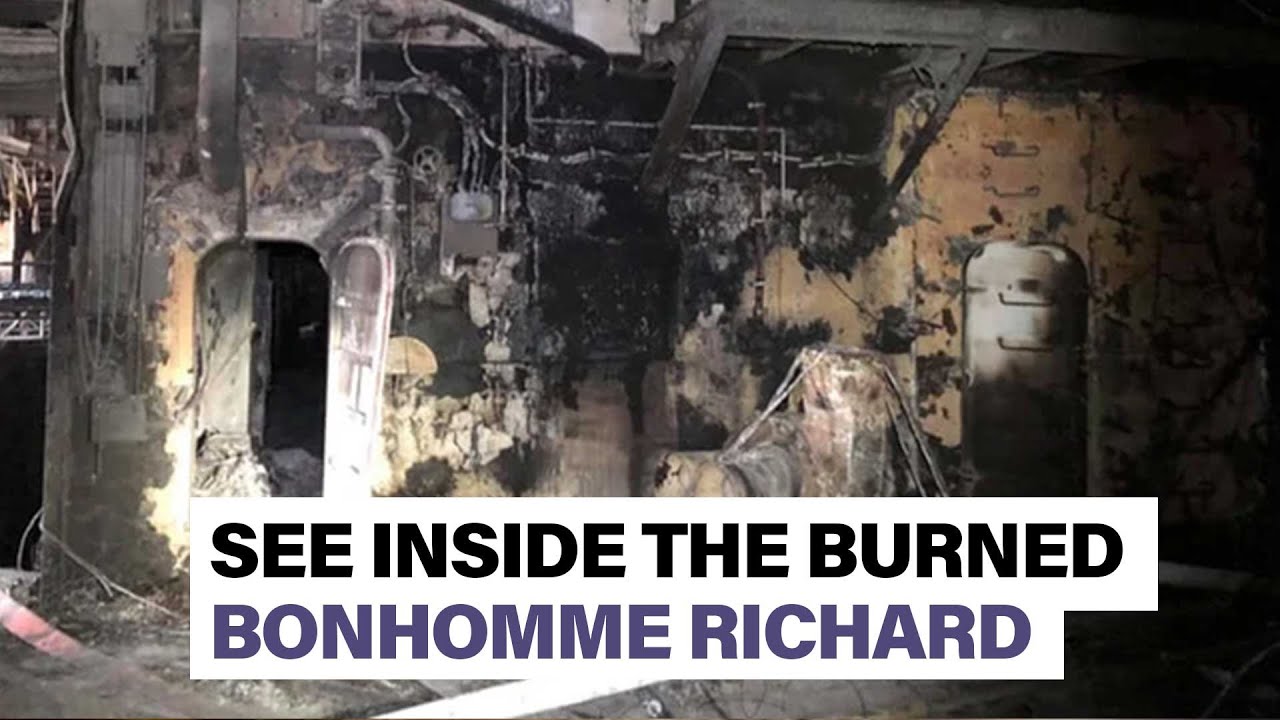
 I once wrote a rollicking post about priests who were martyred in the French Revolution, sent to die horribly on a “hulk” ship, the Bonhomme Richard, used as a prison off the coast of France. HERE
Bonhomme Richard is perhaps not the best name for a ship.
Here is melancholy news about the 3rd of our vessels named Bonhomme Richard, Wasp-class LHD-6, an amphibious assault ship. 844 feet long and 106 feet at the beam. The first – captained by John Paul “I have not yet begun to fight!” Jones – sank in 1779. She was, by comparison, 152 by 40 and a depth of 19.
From Navy Times:
Navy will scrap fire-ravaged Bonhomme Richard
The U.S. Navy will not repair the amphibious assault ship Bonhomme Richard, which burned for more than four days this summer in San Diego.
In the end, resurrecting the devastated large-deck amphib would have been too costly, Rear Adm. Eric Ver Hage, commander of the Navy Regional Maintenance Center, told reporters Monday.
The extensive damage to the flattop’s flight deck, island, mast and lower levels from the July 12 inferno would have required about 60 percent of the ship to be replaced, Ver Hage said.
To rebuild and repair the 22-year-old amphib would have cost between $2.5 billion and $3.2 billion, and would have taken five to seven years, he said.
To turn the stricken amphib into a hospital ship would have cost more than $1 billion and taken the same amount of time, he said.
Details on where the ship will be decommissioned and scrapped are pending, he added.
[…]
Hmmm… maybe the hulk of USS Bonhomme Richard could be repurposed for the “housing” of graffiti sprayers, business looters, police car burners, statue vandals, Antifa and BLM thugs, and people who cheated and committed voter fraud in the 2020 Presidential Election. They could have a little productive time in the healthy sea air, doing some clean up, in preparation to be sent back to do more clean up in the cities they tried to ruin.

 Americans are generous. Catholics are generous. We are hard-wired to help. We are especially interested in concrete ways to help, not vaporous. We are also a more than a little concerned about how the money we contribute is used. I sure am.
Here are suggestions for your donation dollars. I have full confidence in these groups.
First, the TMSM, the Tridentine Mass Society of the Diocese of Madison. CLICK HERE. This also a 501(c)3 organization. I am the president for some years now. We have over the years been building a good treasury of vestments. One day a cathedral will be built here (the old one burned – arson) and we will have worthy vestments for pontifical ceremonies. In the last year three more parishes not have stable TLMs. Donations have come in from readers all over the country. In turn, I firmly believe that the work of the TMSM, made known through this blog, has helped to inspire people in other places to get organized. We depend on you and I am grateful for the help. What we are doing, I believe, helps to raise the tide that helps all boats to rise. I just received a new Solemn Mass set in violet, and I hope in the next year for a new gold set for Pontifical Masses. Forward!
Next, year in and year out I have recommended a clinic here in Madison, Our Lady of Hope Clinic. OLHC It is run entirely on Catholic moral principles and it provides health care for the poor. I go there. I contribute. CLICK HERE The average cost of a visit to OLHC is approximately $80. A gift of $150 pays for nearly 2 doctor’s visits for a uninsured patient. Please CLICK HERE to watch the short video message from Bishop Hying. The Clinic is trying to expand. I have a strong sense of goodness when I go there.
Also, would you also consider giving support to the Archdiocese for Military Services (AMS)? CLICK HERE Chaplains play a mission critical role for our troops and their dependents. Remember that the families of those who are serving are also under the AMS, wherever they are. The Archdiocese for the Military is a complicated operation. Your support will help them provide spiritual care for people who are giving their lives to serve. Over the years the time I have spent on bases has given me explicit demonstrations of how appreciated chaplains are and how important they are. For example, during some months ago I subbed at Naval Station Guantanamo Bay. At the chapel, at the hospital, around and about, many young people wanted to engage. Support the AMS and support Catholic chaplains, seminarians and candidates for chaplaincy. Also, I know of your support for chaplains. You proved help when my friend Commander Johnson lost all his vestments when they airplane we had both been on went into the river on landing in Jacksonville. You donated and had travel vestments made for him. RIGHT NOW the goal is to raise $40,000 for the Archdiocese for the Military Services, USA (AMS), and your support is needed! The first $6,400 received will be matched dollar-for-dollar.
Let’s keep our support going, and tell them Fr. Z sent you!

Coat of Arms by D Burkart









A Daily Prayer for Priests


They find you a pro-life agent in your area who commits to giving a portion of the fee to a pro-life group!

PLEASE subscribe via PayPal if it is useful. Zelle and Wise are better, but PayPal is convenient.
A monthly subscription donation means I have steady income I can plan on. I put you my list of benefactors for whom I pray and for whom I often say Holy Mass.
In view of the rapidly changing challenges I now face, I would like to add more $10/month subscribers. Will you please help?
For a one time donation...



Help Monks in Wyoming (coffee – UPDATED LINK) and Norcia (beer) and the wonderful "Soap Sisters" of Summit, NJ!


Please follow me on Twitter!










Visits tracked by Statcounter
since Sat., 25 Nov. 2006:


