Advice from a saint, praise for a priest, explanation for a practice

13_02_17_alphonsusAccording to the Novus Ordo calendar, today is the Feast of St. Alphonsus Liguori.  In the traditional calendar it falls tomorrow.  He is a Doctor of the Church, whose writings set the Church’s approach to moral theology on a healthy course enduring to this day among the faithful.  I once had the astounding, intimidating privilege of holding in my hands his own manuscript of his Moral Theology, replete with glued in pages and scraps of notes and corrections.  Moreover, his Stations of the Cross, his version is what I will always hear for that devotion, his Manual for Confessors strongly shaped my approach to the sacrament, his Novena Prayer to Our Lady of Perpetual Help formed my earliest sense of truly pious Catholics.

Not long ago I posted about how St. Alphonsus bilocated so he could assist Pope Clement XIV at his death. HERE

Once again, my friend His Hermeneuticalness has posted something helpful today. It is great to have him back in the saddle again and posting frequently.  Fr. Finigan points out something that the saint to preachers.

The “Instructions to Preachers” at the beginning of the book is still of value for priests and can unsettle us today.

It were well that the preacher should sometimes exhort the audience to relate to others what they have heard in the sermon; as by this means it may be made useful even to those who have not heard it.

 If we are handing on the teaching of Christ and His Church, we ought to not to be embarrassed to ask others to pass it on. If we are embarrassed, is that because it is ourselves we are preaching?

Did you get that?  Relate to others what you heard in sermons, because it could be useful to them.

Each week I make a post here called “Your Sunday Sermon Notes”, in which I invite you to post a good point from the sermon you heard.

Why?  Because a) I hope that you will pay close attention and look even for good points in an otherwise humdrum homily and b) because many of the readers out there hardly ever hear a good homily.


Posted in "How To..." - Practical Notes, Sermons | Tagged
2 Comments

Giant robotic spider perched on Notre Dame Cathedral

I spotted this on Twitter, with a great comment by Andrew Cusack:

From CNS:

Ottawa archbishop surprised by negative reaction to robotic spider on cathedral

OTTAWA, Ontario (CNS) — The archbishop of Ottawa expressed regret that several Catholics were shocked at the sight of a giant robotic spider perched on Notre Dame Cathedral.

Archbishop Terrence Prendergast said he was surprised by the negative reaction to an artistic initiative after critics called the spider’s placement “sacrilegious,” “demonic,” and “disrespectful” of a sacred space.

“My cathedral staff and I anticipated that some … might object, but thought it would be minimal, as nothing demeaning was intended in the spider being near the church,” said the archbishop in an email interview with Canadian Catholic News.

“I regret that we had not sufficiently understood that others would see this event so differently. I say to those who were shocked that I understand that this would have been upsetting for them and that I regret that a well-intentioned effort to cooperate in a celebration was anything but that for them.”

The spider, named Kumo, is one of two giant robots created by a street theater company of artists, technicians and performers based in Nantes, France. The company, La Machine, was in Ottawa July 27-30 as part of celebrations marking Canada’s 150th birthday.

The spectacle of robots, music and other special effects drew tens of thousands to Ottawa’s downtown.

[…]

Not exactly Itsy Bitsy Spider.

Look.  I don’t want to make this seem more serious than it is, but it reminds me of something I learned about during my individual instruction as I entered the Church… no, not in seminary, where you would think this would be taught.  HA!  Given that place and those days, that makes me chuckle.  But I digress…

Once upon a time we paid a lot of attention to theological censures so as to protect the integrity of the Faith and prevent people from being mislead (in the case of falsehood) and confused (in the case of fuzziness).

One of the labels for something to be avoided was “offensive to pious ears” or piarum aurium offensiva.  A verbal expression is piarum aurium offensiva when it shocks the Catholic sense and delicacy of the faithful.

Today we run into this all the time, don’t we?  We hear dreadful statements like the one from the Superior General of the Jesuits who said that there was no tape recorder in the time of Jesus. HERE Hence, he suggested that we can’t know what Christ meant when Scripture records his words.  That is something at least “offensive to pious ears”.   Another category is male sonans, something that “rings badly”, that make you say, “That doesn’t sound right at all!”.  Something is male sonans when improper words are used to express otherwise acceptable truths. An example of this is when the same Jesuit Superior said that the Devil was a “symbolic construct” HERE.  Statements like that are imprudent and harmful, especially because an authoritative person said it.  Mind you, it could be that the Superior’s words were even worse than that, but he attempted to walk them back a little.

In case you were wondering, on list in descending order of gravity

  • hæretica (heretical)
  • erronea (erroneous)
  • hæresi proxima (next to heresy)
  • errori proxima (next to error)
  • temeratia (rash)
  • ambigua (ambiguous)
  • captiosa (captious)
  • male sonans (evil-sounding)
  • piarum aurium offensiva (offensive to pious ears)

Male sonans and piarum aurium offensiva were low on the list of censures, but that doesn’t mean that they weren’t taken seriously.

That spider contraption is piorum oculorum offensiva … offensive to pious eyes, and they should have known that before putting it up.

Just because something is “really cool” or has that “wow!” factor, doesn’t mean that it ought to be displayed in or near the sacred precincts of the Church, which ought to be the porta caeli and ianua caelestis.

Posted in Lighter fare | Tagged , , ,
33 Comments

BITCOIN revisited – 2017

Back in 2013 I polled you about use of Bitcoin.  HERE

With some imminent news about Bitcoin coming up this week, I thought I’d ask about it, and you, again.

Are any of you mining and/or using Bitcoin?

The combox is open… not in an anarchic way, but… just go ahead.

About Bitcoin in 2017...

View Results

Posted in "How To..." - Practical Notes, Si vis pacem para bellum! | Tagged ,
15 Comments

Wherein Fr. Z sends Michael Sean Winters a “Combat Rosary”

wile-e-coyote helpUPDATE:

Winters responded!  HERE
___
ORIGINALLY Published on: Jul 31, 2017:

The other day Michael Sean Winters, the juggernaut writer for the Fishwrap, attacked you readers here. HERE  He did so, because one of you asked me about the Most Holy Rosary as a “weapon”.

He ignored the context of my response to the questioner. HERE  My answer was, go ahead, but it is better to carry it concealed.   Winters referred to the “militaristic” language, hence the concept of spiritual warfare, as a kind of profanity.

That bothered me.

It isn’t uncommon to refer to the Rosary as a “weapon”.  It is a commonplace to speak about “spiritual warfare”.

Warfare against what?

St. Josemaria Escriva said,

“For those who use their intelligence and their study as a weapon, the Rosary is most effective. Because that apparently monotonous way of beseeching Our Lady as children do their Mother, can destroy every seed of vainglory and pride.”

I opined,

“I wonder if MS Winters prays the Rosary. He uses his intelligence and study as a weapon, after all.”

I also said, in that post:

“I would be delighted to send to MS Winters both a Combat Rosary and one of these Rosary “Concealed Carry License” cards.  All I need is a good postal address.”

So, dear readers, on your behalf and mine I took matters into my own hands. 

Since I don’t have MSW’s address, I sent a Combat Rosary and Card to the main offices of the Fishwrap in Kansas City MO.

I sent it registered, with a cover letter asking that it be forwarded.  Inside the envelope, I put a postage-paid envelope with the Rosary and Card.

The contents of the inner, unsealed envelope which was to be addressed and sent to MSW:

IMG_2561

I set it up in such a way that, when they opened it in KC MO, nothing within was sealed: they could check the contents easily.  There was nothing secret inside, just my personal card, and the Rosary.  I clearly identified myself and provided also a return address.  I was wholly above board.

IMG_2566

Now some time has passed.

I received back the card which certified that the package had been accepted at the offices of the Fishwrap on 19 July.

It was up to them to address the inner envelope, seal it, and mail it.  It already had correct postage on it.

Has there been a response from MSW yet?

No.

I would genuinely like to know if he received it.

Yes, this project had a touch of the facetious to it.  However, it is also a sincere gesture.

It’s my job to try to keep as many people out of Hell as I can.  The sending of the Rosary, while having also a touch of irony (it’s a “Combat Rosary” after all), was motivated from more than a touch of priestly solicitude.

I don’t think that anyone who regularly – even occasionally – prays the Rosary would have made a comment about spiritual combat, the image of spiritual weapons and warfare – in connection with the use of the Rosary, as being profane.

That jab moved me to a measure of even deeper concern than I already had.

I am sincerely concerned about the spiritual well-being of the people involved in the Fishwrap.  That’s why I ask you to pray earnestly either for conversion or for collapse of the Fishwrap.

I hope Winters decides to use the Rosary… or dig out the old chaplet that perhaps his, I dunno, grandmother had.  So long as he uses one.

Will MSW respond to or acknowledge Fr. Z's gift of a Combat Rosary?

  • No. (57%, 751 Votes)
  • Yes, publicly, with a snarky comment. (27%, 357 Votes)
  • Yes, privately, with a terse acknowledgement. (8%, 100 Votes)
  • Yes, privately, with a kind note of thanks. (6%, 82 Votes)
  • Yes, publicly, with a kind note of thanks. (3%, 39 Votes)

Total Voters: 1,329

UPDATE:

The moderation queue is… now… ON.

Posted in Just Too Cool | Tagged , ,
24 Comments

If Fishwrap and modernist Jesuits had their way…

Writers for the Fishwrap (aka National Sodomitic Reporter) and Amerika type Jesuits want us to become like these forward-looking, progressives whom they so idolize.

This was sent by a friend.  Here’s a smattering with my emphases and comments.

From American Conservative:

Spin Of The Year [Accompanied by a pic of their lesbian president in a band collar giving a 2009 abortion blessing at a gathering of NOW.]
By ROD DREHER

Via the Episcopal News Service, a press release revealing that the ultramegaliberal Episcopal Divinity School is winding things down:

Episcopal Divinity School will cease to grant degrees at the end of the upcoming academic year, the seminary’s board of trustees decided July 21 on a 11-4 vote. During the next year, the board will explore options for EDS’s future, some of which were suggested by a specially convened Futures Task Force to make plans for EDS’s future.

“A school that has taken on racism, sexism, heterosexism, and multiple interlocking oppressions is now called to rethink its delivery of theological education in a new and changing world,” said the Very Rev. Gary Hall ’76, chairman of the board, in introducing the resolution. “Ending unsustainable spending is a matter of social justice.”  [ROFL!]

Translation: “Having abandoned anything to do with orthodox Christianity, we find that we have made ourselves completely irrelevant. If we spin our theological and financial bankruptcy as a sign of our virtue, maybe we won’t look so bad.”

A sampling of courses from the current EDS catalogue:

HB CS 4152 Liberating Bible Interpretations, Antiracist, and White Identity: Approaches to Reading Scripture

What makes an interpretation of the Bible liberating? For whom? When? Where? We will explore how various stages of racial identity development and awareness present challenges to our reading of the texts and each other, in order to develop antiracist and other anti-oppression strategies for preaching and teaching from scripture. Critical Race Theory and Critical White Studies shall inform our primary focus on racial identity of “white” readers while also looking at other culturally dominant features of identity in the interpretive process of biblical texts. G

PT L 1420 Unleashing Our Voices: Voice, Identity, and Leadership
A course for the courageous, [a course for the already convinced] who wish to explore first-hand [oh dear] the liberatory [sic] and transformative power of their voices in community. Using the classroom community as a laboratory, the course will combine: (1) practical work on voice production and the body/mind/soul as human instrument with (2) in-class discussion and small team exploration of readings on voice, identity/community membership, and leadership. Voice work will include group exercises for freeing the body and voice, as well as individual work in front of the group using prepared spoken texts and/or sung pieces. Readings will be drawn from writings on the physical voice and voice as an element of social location from womanist, feminist, anti-white supremacist, and other anti-oppression perspectives. Participants will engage questions of voice and power in pastoral, liturgical, theological, educational, and spiritual contexts. [Honestly, I just had a flashback to a particular course in my first year of seminary.  This could have been a description of the agenda of two of the members of the team that taught the nightmare called “Liturgy Colloquium”.  One of them even told our class that she wanted us to crawl around on the floor like cats and meow, to introduce ourselves to the chapel by shouting, “HELLOOOO CHAPELLLLL!”  A kind of hideous “hello kitty” moment.  That day I introduced myself to the door of the chapel and then the sidewalk outside the chapel, and then my car door….]

L 3020 Challenging the Liturgical Traditions, Postcolonial, and Queer Perspectives

A critical exploration of intersections between a cluster of contemporary theologies—for example, feminist, queer, postcolonial, “child theology”—and liturgical theology and practice.  [Yep… it’s a “cluster” alright.]

T PT 2165 Mission, Ministry, and Sacraments: Re-visioning the Church Inside-Out

This course seeks to construct a theology of the church the essential nature of which is its “inside-turned-outness” for the life of the world. In the light of this basic stance of a church as a people—externally focused and God’s- Reign oriented—a theological re-visioning of the central elements of the church’s sacramental life, worship, wit- ness, [sic – I’m sure they mean “wit-less”] and ministry is undertaken. [Putting “… is undertaken” at the end like that makes it sound smarter than it is.] A central question is how we can recover [get this…] the basic calling of the church to be a sign and instrument of a God-intended “alternative humanity” and an [George Soros style] agent of transformation in a world characterized by oppressive, exclusivist, and fragmenting forces. [Watch for code…] Faith-filled resistance, compassionate solidarity, and creative hope shall serve as significant categories in such a re-visioning. Participants will explore the practical and pastoral implications of such a re-visioning for the empowerment of local congregations [wait for it….] as change agents.

[…]

Go there for more descriptions of alluring courses.

And that, ladies and gentlemen… and undecided… is how it’s done.  That’s how to destroy a church… well… ecclesial community.  That’s what libs want to do to us.

That’s Reason #86774 for Summorum Pontificum and hard-identity Catholicism.

Posted in ¡Hagan lío!, Hard-Identity Catholicism, Liberals, Lighter fare, Pò sì jiù, You must be joking! | Tagged ,
16 Comments

Jesuits and the Barque of Peter

Pius VIIMy good friend Fr. Finigan, aka His Hermeneuticalness, has a doozy of a post today about admirable Jesuits, on this the feast of their founder, St. Ignatius.  HERE

He names some great Jesuits, many of whom I know and one of whom was also one of my profs at the Augustinianum.  I studied St. Hillary of Poitier with him.  As a matter of fact, Fr. Giles Peland provided us with knock-out argument and quote against the dreadful proposals of Card. Kasper and Company.  HERE  Happily, it also applies to the quixotic suggestion that women should be ordained as deacons.

Father also mentions Fr. Paul Mankowski, one of the contributors to the extremely important book  Remaining in the Truth of Christ: Marriage and Communion in the Catholic Church (US HERE – UK link HERE – published by Ignatius Press founded by Jesuit Father Joseph Fessio).

Finigan also quotes from Sollicitudo omnium Ecclesiarum of Pius VII, by which document that Pope restored the Society of Jesus in 1814.  To wit:

“We would believe ourselves guilty of a great crime in the presence of God, if, in these so grave necessities of the public interest, We were to neglect to put to work those salutary helps which God, with singular providence has provided Us, and if We, placed in the bark of Peter, tossed and buffeted by continual storms, were to reject the expert and valorous rowers who offer to break the waves of a sea which at every moment threatens Us with shipwreck and ruin.

For the text (Latin and English), HERE

If you want the Latin of that quote, above, get a load of this!

Gravissimi enim criminis in conspectu Dei reos Nos esse crederemus, si in tantis reipublicae necessitatibus ea salutaria auxilia adhibere negligeremus, quae singulari Providentia Deus Nobis suppeditat, et si Nos in Petri navicula assiduis turbinibus agitata et concussa collocati, expertos et validos qui sese Nobis offerunt remiges, ad frangendos pelagi naufragium Nobis et exitium quovis momento minitantis fluctus, respueremus.

Wow.  Those guys could really write.

Fr. Finigan observes:

This reminds me of the recent message of Pope Benedict for the funeral of Cardinal Meisner who, the Emeritus Holy Father said, had “learned to let go and live increasingly from the conviction that the Lord does not leave his Church, even if at times the ship is almost filled to the point of shipwreck.”

Be sure to check out Father’s good post, especially his final sagacious comment.

Meanwhile, more about the 1814 bull Sollicitudo omnium ecclesiarum.  Pius VII had already recognized that the Jesuits were still in existence in Russia, where Clement XIV’s earlier suppression had not been implemented.  He also recognized them in Kingdom of the Two Sicilies in 1804.  So, Pius’ bull Sollicitudo omnium ecclesiarum did the same for the whole world, thus reversing Clement XIV’s suppression forty years before.  So, on 7 August 1814, the date of the bull,  Pope Pius went to the glorious baroque main church of the Jesuits in Rome, the Gesù, where, in the presence of prelates and nobility and a crowd of Jesuits, celebrated mass at the altar of of the tomb of St. Ignatius.  After the Mass the bull was read and handed over to the superior of the Jesuits in Italy.  More about all of that HERE.

Pius giving the bull to the Jesuits:


Posted in Mail from priests | Tagged , , , ,
19 Comments

My View For Awhile: Northward Bound

Time to head home. In other words, it’s time for another bout with Delta.

On my computer screen in that photo, is the text of a comment posted under my last travel post extravagantly defending Delta!  HERE.   To which I respond: HA!

In any event, it was a successful visit.  A successful visit includes at least a couple dozen oysters.

UPDATE

So far it’s a smooth boarding, probably less complicated because it’s a Saturday.

I’m into Peter Kwasniewski’s new book.  Outstanding.   More HERE!

UPDATE

We made it.  There were a few serious, attention getting bumps along the way, the sort that pitch liquids out of glasses.  The real problem, however, was the lack of AC before, during and after the flight.  Hence, it was incredibly hot inside that plane, drenched-hair hot.

Now, in the new lounge.  They are finally beginning to catch up with their European counterparts.

I have enough time here for my shirt to dry out a bit and to grab a bite before the bell rings for the next round.

They are trying new ways to channel people into boarding at the proper time and not block the corridor.


UPDATE:

Seated. The boarding is going on… not water boarding, but there’s still time for that.

I just read on Twitter:

29 July 1941 | During selection for starvation death Father Maksymilian Kolbe asked SS to take him instead of Franciszek Gajowniczek. https://t.co/dLTiiPmOpw

Today his cause would surely be on the new path, oblatio vitae.

Meanwhile…

Here is a great quote from my book:


We are being told that the boarding process went so smoothly that we can leave early but… the taxi will be longer than usual. It’s a wash.

Posted in On the road, What Fr. Z is up to |
14 Comments

ASK FATHER: Was St. Michael Prayer after Mass suppressed by Vatican II?

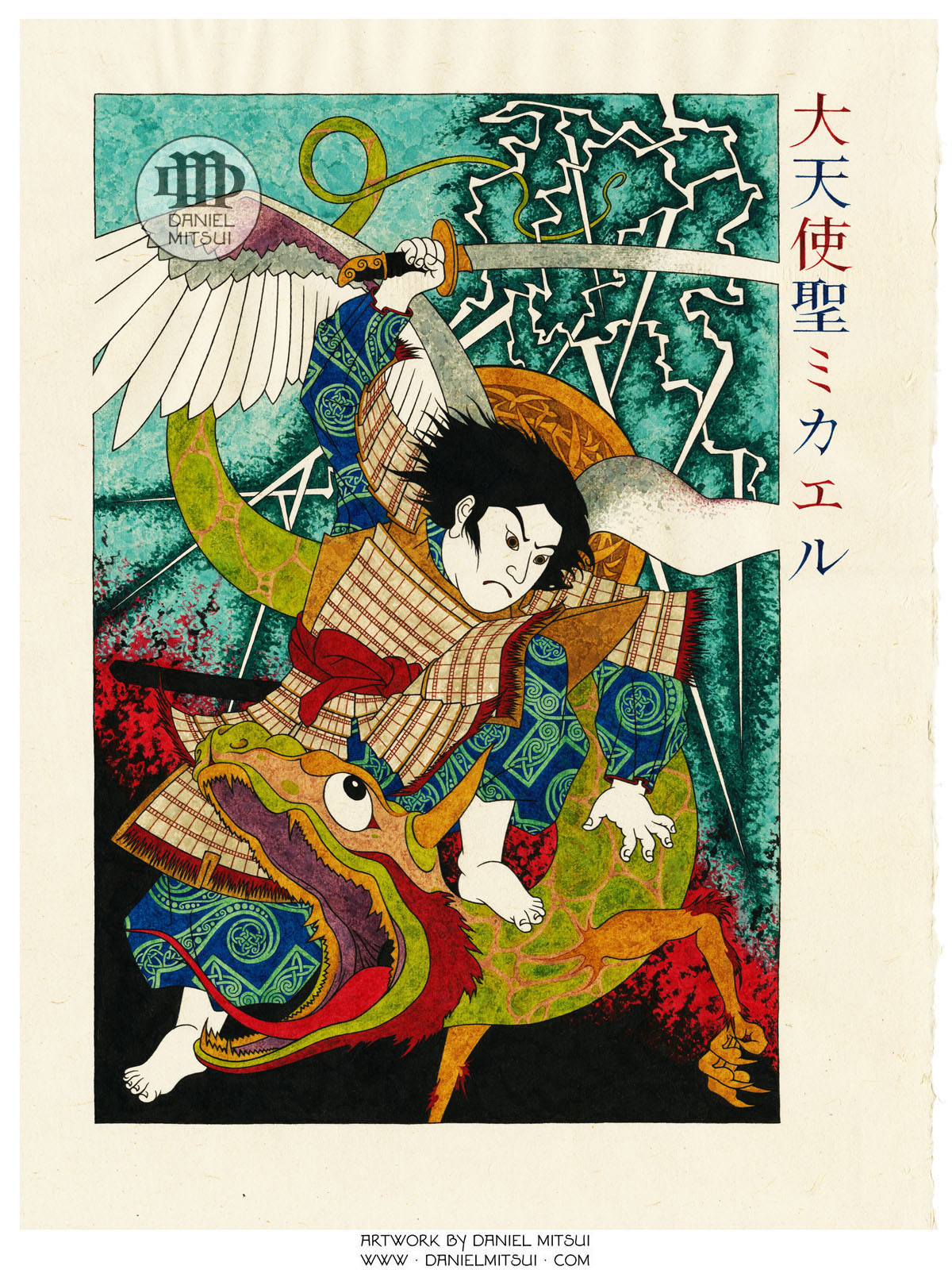
St. Michael by Daniel Mitsui. Click for more.

From a reader…

QUAERITUR:

I recently heard a priest announce to his congregation that the St. Michael Prayer had been “suppressed” by Vatican II. [No.] People could still pray it privately, but it could not be recited in congregation after mass. Is this correct? This was at a Novus Ordo mass, not the Extraordinary Form.

Interesting.  I was just talking about this issue not long ago with a priest friend.

Vatican II did not suppress the St. Michael Prayer.

The Sacred Congregation of Rites, in the 1964 instruction on the implementation of  Sacrosanctum Concilium called Inter Oecumenicisaid:

j. The last gospel is omitted; the Leonine Prayers are suppressed.

Of course the St. Michael Prayer, by itself, is not the sum and total of the Leonine Prayers. It is only one of the Leonine Prayers.  So, that 1964 suppression is irrelevant to the recitation of the St. Michael Prayer by itself.

Also, I think we can say about Inter Oecumenici, who cares?  We have had several editions of the Roman Missal since then, including massive overhauls in 1965 and 1969 and an edition that had to be immediately withdrawn because it had heresy in the introduction. We now also have a desirable process of “mutual enrichment” underway with Summorum Pontificum.

Moreover, in 2013, the Bishops Conference of the Philippines authorized the St. Michael Prayer for use in all churches nationwide and recommended its use especially in troubled regions. HERE  I am not sure that they had to authorize it for it to be used after Mass.  It’s after Mass, after all.  However, they put their official stamp of approval on the practice.

In these USA, the great Bp. Thomas Paprocki of Springfield did the same for his diocese in 2011.  HERE

In a 1994 Regina Caeli Address, St. John Paul II – who should be named Doctor of the Church – recommended that people pray the St. Michael prayer for the Church.

This prayer is coming back far and wide.  I’ll bet readers here know parishes where it is a regular feature after Mass.

If people are moved to pray such a prayer after Mass, why should they be stopped?   Is there some other important official business that has to be conducted at that very moment?  Other than the fact that Father wants to leave?

It isn’t as if people are attempting glossalalia.  They aren’t babbling incoherently.

The St. Michael was written by Pope Leo XIII who had a frightening vision the battle between the Church and Satan. He wrote the prayer and ordered that it be added to the prayers Pius IX had commanded to be recited after Low Masses (Pius X added the three-fold invocation of the Sacred Heart), which continued until 1964.

One must ask: Does anyone think that Satan has stopped waging war on the Church?   We still need to say prayers precisely like this.  Is there a better time than when people are together in church?

It doesn’t take very long to say it.  People can have their moment of silent prayer and say their thanksgiving prayers directly after.

If once the Leonine Prayers, with the St. Michael Prayer, were associated with the conversion of Russia, couldn’t they be used nowfor the conversion of these USA?   How about for defense of our Christian brethren in the Middle East and Africa from the hellish attacks by Islamic terrorists?  Is that a good enough reason?  How about for an end to abortion?

Specific intentions come and go.  The prayers we recite can be reapplied for other intentions.  You could have a different intention each day of the week.

I think that people should pray not only the St. Michael Prayer, but the whole of the so-called Leonine Prayers, including the collect:

O God, our refuge and our strength, look down with mercy upon the people who cry to Thee; and by the intercession of the glorious and immaculate Virgin Mary, Mother of God, of Saint Joseph her spouse, of the blessed Apostles Peter and Paul, and of all the saints, in Thy mercy and goodness hear our prayers for the conversion of sinners, and for the liberty and exaltation of the Holy Mother the Church. Through the same Christ Our Lord. Amen.

What’s wrong with that prayer?  It even mentions mercy, which is quite fashionable these days.  It mentions mercy twice.

We need prayers like these now more than ever.

Bishops and pastors everywhere, and the Holy Father too, should reinstate the Leonine Prayers after Masses.

There are urgent and burning intentions to pray for and these prayers are just the thing.

So, circling back to the question.  No. The priest is wrong.  Vatican II did not suppress the St. Michael Prayer.   The SCR suppress the Leonine Prayers (which were mandatory after Low Masses).  However, it the pastor doesn’t want this, he must be respected.

It is, however, entirely reasonable to to keep working on him, perhaps with the St. Michael Prayer!

Posted in "How To..." - Practical Notes, ASK FATHER Question Box, Our Catholic Identity | Tagged
48 Comments

NLM: Useful study of creation of the Novus Ordo Lectionary

Have you followed the tennis match back and forth that has resulted since Card. Sarah’s suggestion in La Nef that the Extraordinary and the Ordinary Forms of Mass should have a coordinated Lectionary?

Some were cool about that suggestion and others were more enthusiastic.  Those who were enthusiastic tend to argue that more pericopes (selections) of Scripture for Mass, as in the Novus Ordo v. the TLM, is better, mostly because there’s more.  Those who are cool tend to argue that the introduction of more to the TLM isn’t automatically better and would, in fact, be disruptive in a harmful way.

You can follow this debate HERE.

Now I see that at NLM,  Matthew Hazell has started a 3 part series about the creation of the Novus Ordo Lectionary.  He has posted Part 1 and it is not to be missed.

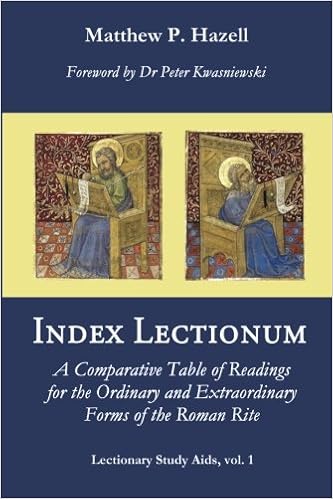
Hazell holds that the integration of the Novus Ordo Lectionary into the older, traditional form of Mass would do irreparable damage to the traditional form.  He is qualified to have a position about this question, inter alia he assembled the useful and instructive:

Index Lectionum: A Comparative Table of Readings for the Ordinary and Extraordinary Forms of the Roman Rite (Lectionary Study Aids) (Volume 1)

US HERE – UK HERE

Every priest, at least, should have this useful book.   It compares, side by side, the use of Scripture selections in the Novus Ordo and the TLM, going through the Bible in order.  So, if you want to find out on what days a specific verse of Scripture is used in the Novus Ordo and the TLM, this is your book.

Hazell says:

[T]he integration of one lectionary into the other form is simply impossiblewithout irreparable damage is, in my opinion, quite correct. So, if some sort of “convergence” of the two lectionaries is to happen, it cannot be on done on this basis. [1Furthermore, in this author’s opinion, it is an open question as to whether or not the specific, practical reforms mentioned in Sacrosanctum Concilium, such as the readings being intra praestitutum annorum spatium in SC 51 or the abolition of Prime in SC 89, should still be part of any potential future liturgical reform.] A comprehensive examination of their strengths and shortcomings is required—and, for the Ordinary Form lectionary in particular, this will involve a detailed critique of the rationale and work of Group 11 of the Consilium. [There’s the infamous Consilium!  I am reminded of my post on BUGNINICARE!]

However, another important part of this study is the following question: what sort of reform did the Council Fathers and the periti envisage? Looking at the liturgy constitution in itself, it would seem difficult to answer this question. On the one hand, “there must be no innovations unless the good of the Church genuinely and certainly requires them; and care must be taken that any new forms adopted should in some way grow organically from forms already existing” (SC 23); on the other hand, the stated desire for some sort of multi-year cycle of readings in SC 51 is an innovation without precedent in the liturgical tradition. [Incoherent, no?]

So, in this short series, I hope to provide some of the background material necessary for a deeper examination of this question—not just from the Second Vatican Council itself, but also from the preparatory work done before the Council.

“But Father! But Father!”, some libs sputter, “How dare you post about this?!?  It is clear to everyone who agrees with us that more Scripture is better, especially when all the bits we don’t like are edited out.  All that stuff about sin is such a downer… a pre-Conciliar downer!  You just want to disturb people with these texts from the Council and … and… facts.   Why?  Because YOU HATE VATICAN II!”

Is that so?  Let’s learn what the Council really said, learn with the Council Fathers really initiated, before we come to conclusions.

Posted in "But Father! But Father!", "How To..." - Practical Notes, Liturgy Science Theatre 3000 | Tagged , , , ,
24 Comments

Wisdom from Hugh of St. Victor

Hugh of St. Victor addressing listeners.  One of them seems to have had an "Ah ha!" moment.

Hugh of St. Victor addressing listeners. One of them seems to have had an “Ah ha!” moment.

I picked up this great quote on Sententiae AntiquaeMy emphases and comments:

Hugo of St. Victor, Didascalion

On the Study of Reading – Preface (Part I)

“There are many whom nature has left so destitute of intellect that they are unable to grasp even those things which are easiest to understand; of these people, there seem to be two types. There are certain people who, granting that they are not ignorant of their own dullness, eagerly strive for knowledge with whatever effort they can, and apply themselves to the task with unremitting zeal; though they achieve little from the realization of the work, they seem to deserve something for their efforts. But there are other people who understand that they will never be able to understand the highest things, so they neglect even the smallest ones, and resting secure in their own indolence, we find that the more they waste the light of truth in the most important things, the more they flee from learning the smallest things, which they are actually able to understand. For this reason, the Psalm has it, ‘They did not wish to understand how they could do well.’ Not knowing is, indeed, a far different thing from not wanting to know. Indeed, ignorance is a kind of weakness, but the detestation of knowledge is the sign of a depraved will.

There is, however, yet another group of people whom nature has so enriched that she has offered them a clear approach to the truth. For these people, even if the strength of their mind is not equal to the task, there is not the same virtue or will for cultivating the senses through exercise and natural instruction. For, there are many people who, wrapped up in the business and concerns of this age more than is really necessary, are entirely given to the vices and pleasures of the body, and they bury the treasure of God in the ground; they neither seek the fruit of wisdom, nor the use of good work – these people are on the whole rather detestable. Again, for some people, family poverty or their slender means diminishes the opportunity of learning. Yet, I think that these people can hardly be excused on this account, since we see so many people laboring under famine, thirst, and even want of clothes, who yet attain the fruit of knowledge. Indeed, it is one thing when you are not able (or, I should say, are not easily able) to learn, and it is an entirely different thing when you are able to learn but unwilling to do so. Just as it is more glorious to attain wisdom by virtue alone, when no other opportunities rush to assist you, so too it is much more shameful to have a vigorous intellect and to overflow with wealth while wasting away in idleness.”

For those of you who enjoy the Latin:

[770C] Multi sunt quos ipsa adeo natura ingenio destitutos reliquit ut ea etiam quae facilia sunt intellectu vix capere possint, et horum duo genera mihi esse videntur. [770D] nam sunt quidam, qui, licet suam hebetudinem non ignorent, eo tamen quo valent conamine ad scientiam anhelant, et indesinenter studio insistentes, quod minus habent effectu operis, obtinere merentur effectu voluntatis. ast alii quoniam summa se comprehendere nequaquam posse sentiunt, minima etiam negligunt, et quasi in suo torpore securi quiescentes eo amplius in maximis lumen veritatis perdunt, quo minima quae intelligere possent discere fugiunt. unde psalmista: Noluerunt, inquit, intelligere ut bene agerent. longe enim aliud est nescire atque aliud nolle scire. nescire siquidem infirmitatis est, scientiam vero detestari, pravae voluntatis. est aliud hominum genus quos admodum natura ingenio ditavit et facilem ad veritatem veniendi aditum praestitit, quibus, [771A] etsi impar sit valitudo ingenii, non eadem tamen omnibus virtus aut voluntas est per exercitia et doctrinam naturalem sensum excolendi. nam sunt plerique qui negotiis huius saeculi et curis super quam necesse sit impliciti aut vitiis et voluptatibus corporis dediti, talentum Dei terra obruunt, et ex eo nec fructum sapientiae, nec usuram boni operis quaerunt, qui profecto valde detestabiles sunt. rursus aliis rei familiaris inopia et tenuis census discendi facultatem minuit. quos tamen plene per hoc excusari minime posse credimus, cum plerosque fame siti nuditate laborantes ad scientiae fructum pertingere videamus. [771B] et tamen aliud est cum non possis, aut ut verius dicam, facile non possis discere, atque aliud posse et nolle scire. sicut enim gloriosius est, cum nullae suppetant facultates, sola virtute sapientiam apprehendere, sic profecto turpius est vigere ingenio, divitiis affluere, et torpere otio.

Posted in "How To..." - Practical Notes, Lighter fare | Tagged ,
4 Comments