When Tinkeritis STRIKES!

The Knights of Columbus have replaced their Fourth Degree uniforms.  I’ll admit that it might have been time to change a few things.  However, what they did was, frankly, hard to explain.  Their new look is that of an prep school boy… blazer… little hat.  It is if they were determined to kill off the last honor guards.

What is it with tinkeritis?  Remember what the Archdiocese of Detroit did to their timeless coat-of-arms?  Well, they don’t have a coat-of-arms any longer.  Now they have a cheap looking logo, guaranteed to look obsolete in a few years as styles change.

Now I read at Eye of the Tiber that the Swiss Guards will get a make over.

swissguards_hipstersIt was announced today that the Swiss Guard’s uniform will be changed to a more modern hipster look.

Pontifical Swiss Guard Commandant Daniel Anrig told Guards gathered at the annual When Do We Get To See Some Action Jamboree that the traditional “uniform” worn by the Knights will be replaced so as to be more appealing to millennials.

Instead of the well-known European Renaissance-style uniform, the average member of the Swiss Guard will be wearing a pair of skinny jeans, a beanie, and a leather jacket “no matter how hot the temperature gets in Rome,” Anrig said. Anrig did not specify whether swords would be replaced with scarfs or whether they would be replaced with pens in case “the muse strikes and gives them the inspiration to write the next Infinite Jest.”

“I have decided that the time is right for a modernization of the Swiss Guard Uniform,” Anrig said. “From now on, along with skinny jeans, beanies, and leather jackets, the preferred dress for the Guard will include v-necks or flannel shirts, vintage sneakers, bow ties, and black squared frames for glasses whether Guards wear prescription glasses or not.”

Swiss Guard David Adank told EOTT via a shrug of the shoulders this morning that, though a little bit nervous and hesitant about the change, he welcomes it with open, sarcastic arms.

Whatever,” Adank went on to say before departing to an undisclosed coffee shop.

Another member of the Swiss Guard, Toby Caspari, told EOTT that he was worried that he would be expelled from the Guard since he struggles growing a proper mustache.

“I guess it’s the mandatory mustache that I’m most afraid of,” Caspari said. “I’ve never really been able to grow one, and all everyone’s talking about is what type of “stache wax” to use. Whatever, maybe I’ll use a fake. I trust the commandant’s judgment. I think skinny jeans really helps to show a striking, imitative image of Christ because he was kind of a hipster in his own way. He too didn’t care what people thought. But at the same time, he wanted people to notice him, but at the same time not notice him, if you know what I’m saying. You know what I’m saying?

I think we are coming to a consensus.

Perhaps some adjustments were needed for the Fourth Degree uni.  What they came up with…

FAIL

Posted in Lighter fare | Tagged , ,
33 Comments

Of seminarians, books, birettas, new vestments, and wherein Fr. Z is very pleased

Every summer the Extraordinary Ordinary of the Diocese of Madison, His Excellency Most Reverend Robert C. Morlino, gathers all the seminarians for about a week of fraternity and conferences.  We are in full swing.

Today, I celebrated Holy Mass for them in the Extraordinary Form.  Just now, lunch having been completed, they are off to paint ball.  What better way for men to build camaraderie than to pray together, eat together and then pretend to kill each other.

biretta berettaAlso, the new guys who do not have birettas are all being measured.  The results will be sent to Leaflet in St. Paul as part of our ongoing BIRETTAS FOR SEMINARIANS PROJECT.   Very cool.

Also, we have distributed to all the men the copies of the book I selected for this summer’s gathering.  Thus this year’s BOOKS FOR SEMINARIANS PROJECT is completed.   This year YOU readers gave to the men:

Tracey Rowland, Catholic Theology.  

US HERE – UK HERE

This book is simply terrific.  Also, in her section on Liberation Theology, there is quite a bit about Pope Francis.  I think she has him exactly right.  The men are filling out online thank you notes through Amazon.  You donors of books should soon get notes.

BUT WAIT!  THERE’S MORE!

Today I paid Gammarelli in Rome quite a lot of money for the last of the WHITE Pontifical Vestments.  They shipped the last wave of vestments for the set, including the extra copes and dalmatics and chasubles for ordinations.  They are embroidered with the arms of the Diocese.

PLEEEEEEEZ donate?  It’s tax deductible.  We have yet to make the Rose, Black and BLUE!  Also, I need more funds so we can make the folded chasublesHERE

Moreover, I’ve been receiving SMS texts saying that the two boxes from Rome are OUT FOR DELIVERY!   So, they will come today.  Needless to say, I am looking forward to seeing them in their splendor.  This bring the project to completion, though in the future we could add chasubles and a couple more copes.

I will post updates and photos.

This is how Mass looked last May.

17_05_31_PontMass_Queenship_07

Our next Pontifical Mass is on 22 August, Feast of the Immaculate Heart.

Lastly, we will have SOLEMN MASS on Sunday for the Feast of the Transfiguration.  One of the new deacons will be deacon and the Vocation Director will be Subdeacon.  Talk about strong support for the TLM!


Posted in ACTION ITEM!, Seminarians and Seminaries | Tagged , , , , , , ,
4 Comments

JUST TOO COOL: Sunday – Feast of the Transfiguration – special blessing of GRAPES

Go buy some grapes and take them to the priest  for the Feast of the Transfiguration (Sunday, 6 August), with a page from the Rituale Romanum (go to p. 345 – Benedictio uvarum), or cut and paste the English text (below, or here) and ask the priest to bless them.

The Roman calendar has many little treasures which remind us of how our Faith and the Church’s calendar, the rhythm of temporal and spiritual life, are integrated in our seasons.

This is the time of year with the first grapes of the harvest are blessed.  Together with the Transfiguration of our Lord, the blessing of grapes – an eschatological symbol – shows that Holy Church is already in the end time, though we wait for its completion.

Here is the text for the blessing of grapes, for those who don’t have Latin:

V. Our help is in the name of the Lord.
R. Who hath made heaven and earth.
V. The Lord be with you.
R. And with thy spirit.

Let us pray.

Bless, we beseech Thee, O Lord, this fresh fruit of the vine,
which Thou hast graciously brought to full ripeness
with the dew of heaven, abundant rain, and calm and fair weather.
Thou hast given them for our use;
grant that we may receive them with thanksgiving
in the name of our Lord Jesus Christ, the True Vine,
who liveth and reigneth with Thee in the unity of the Holy Ghost,
God for ever and ever.
R. Amen.

(And they are sprinkled with holy water.)

I was delighted by the reference to “dew of heaven… rore caeli“.  You might recall the controversy over the reference to “dew” when the new, corrected 2011 ICEL translation was being prepared.

The cultivation of certain types of grapes requires special conditions.

In a contrast to the benefits of dew lauded in the prayer of the blessing, however, dew isn’t always good for grapes.  Dew helps fungus to get hold, through in the case of some grapes, certain fungi are welcome, as in the case of the “noble rot” in a very late harvest which produces wines of a spectacular sweetness and depth.  Also, it is important to harvest grapes after dissipation of dew.  But certainly the evocation of dew in the prayer refers to the necessary moisture grapes need for their proper development.  And of course, dew is a Scriptural image for the descent of God with graces.

The coming of and effects of the Holy Spirit, in Scripture and in the Fathers of the Church, are often described not by fire imagery, but rather by water images and, indeed, dew.

First, ros can come from above like rain.  Second, ros is dew which forms nearly imperceptibly.  In one case, rain flows across a thing and washes it.  Dew slowly dampens.  In both cases there results a penetrating soaking.  Arid ground yields to planting.  Seeds germinate and sprout.

The ros Spiritus in the 2nd Eucharistic Prayer can be both the cleansing and the moistening.

Our Catholic doctrine of sanctification teaches us that at baptism a person is both justified and sanctified by the washing/indwelling of the Holy Spirit.  That sanctification can be deepened through the course of one’s life.  It comes suddenly.  It comes gradually.

In Scripture the psalmist sings about the “King of Justice”. “May he be like rain (Vulgate ros) that falls on the mown grass, like showers that water the earth!” (Ps 72:6 RSV).  In the Song of Songs, we hear, “Open to me, my sister, my love, my dove, my perfect one; for my head is wet with dew (ros), my locks with the drops of the night. By night I have put off my coat, how shall I put it on? I have washed my feet, how shall I defile them” (Cant 5:2-3).  St. Augustine (+430) saw in the lover and beloved an image of Christ calling His ministerial Church to service.  From Isaiah we have an image which has come into the Latin Church’s liturgy, namely, “Rorate caeli desuper … Shower (rorate), O heavens, from above, and let the skies rain down righteousness; let the earth open, that salvation may sprout forth, and let it cause righteousness to spring up also; I the LORD have created it” (Is 45:8 Vulgate and RSV – Introit 4th Sunday of Advent).

The Fathers made much of ros through an allegorical technique of interpretation.

Origen (+254), via Rufinus’ translation of the Homilies on the Book of Judges (8.5) says: “But we also, if only we might offer our feet, the Lord Jesus is ready to wash the feet of our soul and cleanse them with a heavenly washing (rore caelesti), by the grace of the Holy Spirit, by the word of sacred doctrine.”  Saint Ambrose of Milan (+397), who drew much upon Origen’s writings as a starting point, in his work on the Holy Spirit wrote: “The Holy Scriptures were promising to us this rainfall (pluvia) of the whole world, which watered the orb under the coming of the Lord, in the falling dew of the divine Spirit (Spiritus rore divini)” (De spiritu sancto 1.8).

The imagery of grapes is also Scriptural.  The immediate association for Catholics is the Eucharist.  But grapes symbolize the end times.  They have an eschatological import.   In Revelation 14:19-20 we have an image of the end times and judgment when the grapes of wrath are pressed in the winepress:

And the angel thrust in his sharp sickle into the earth and gathered the vineyard of the earth and cast it into the great press of the wrath of God: And the press was trodden without the city, and blood came out of the press, up to the horses’ bridles, for a thousand and six hundred furlongs.

Of course the image of grapes is a happy one as well… obviously.  From the ancient Roman Church grapes are found in carvings in the catacombs and on sarcophagus reliefs.  Bunches of ripe grapes are symbols of completion, that the season has finally brought things to fruition.  Grapes remind us that Christ is the Vine, whence all our life and hope flows out to us, His branches and tendrils.

In those ancient depictions we sometimes see the harvest of grapes, which is the happy completion of life.  For example there is the relief of the famous 4th c. sarcophagus with the Good Shepherd from the Catacombs of Praetextatus which shows a harvest.  In the Catacomb of Priscilla there is a 4th century carving of a dove eating grapes, the dove being a symbol of the Christian soul and grapes the happy attainment of the goal of fullness in due time, heaven.

Remember that reference, above, to the dove from the Song of Songs?  It all fits together.  For a larger view of that sarcophagus, click HERE or HERE.

Grapes remind us that we shall be known from the fruits we both bear and we generate for the benefit of others.

Grapes remind us that we should not be sour grapes for others.

Grapes remind us that, if we do not live our vocations as the Lord’s branches well, then the grapes may be those of wrath, though mercy and forgiveness is what the Lord offers those who fall.

So, get your grapes and get them blessed if you can.

When you eat them consider:

  • how good God has been to you, even if some of the grapes are bitter;
  • whether or not, through the dew of God’s graces and the light He shines on you, you are developing well for your own eternal salvation;
  • whether or not you are producing fruits for the benefit of others, hopefully sweet fruits and not sour.
Posted in "How To..." - Practical Notes, Four Last Things, Liturgy Science Theatre 3000 | Tagged , , ,
5 Comments

ASK FATHER: Lay people using the Rituale Romanum to bless things

UPDATE:

People don’t always read carefully before they react.

Let me be clear.  It is okay – it is good – for parents to bless their children by tracing the sign of the Cross on their foreheads.

Stop sending me questions about that. Read what is posted, below.

It is NOT okay for lay people to attempt to exorcise things.  It is NOT okay for lay people to attempt to bless in the manner of a priest, that is by making the sign of the Cross over someone in the usual way that priests do.

___ Original Published on: Aug 3, 2017

From a reader…

QUAERITUR:

In a fairly popular book about celebrating the liturgical year at home, The Year and Our Children, the author recommends purchasing “the Ritual, that slim black book the priest carries about when he gives the blessings.” She goes on to explain how her family “blessed” their own herbs. Can you tell me if laypersons can bless objects and if so, under what conditions? Thank you!

I don’t know that book.  You haven’t quoted any of the book, so – since your planet’s yellow star doesn’t give my the psychic power I would need to know what it says – I don’t know what it says.  However, my first reaction is…

NO!

Lay people should not do anything like that, especially involving making the sign of the Cross over anything, as if they were ordained priests.

NO! I say, and again I say NO!

Take things to the priest to bless.

Ask Father to come to bless things.

This is not DIY, people.

If you are not a priest, don’t do these things.  Don’t use the Rituale for anything, especially if there is something to do with exorcisms.   You do NOT want to get into it with the Enemy when you don’t have the grace of ordained priesthood and the authority and power that comes with it.

There is no reason why lay people can’t ask God to bless things.  However, it should not be done with accompanying gestures of blessing, etc.

The moderation queue is ON.

Posted in "How To..." - Practical Notes, ASK FATHER Question Box | Tagged
34 Comments

Wherein Michael Sean Winters responded to Fr. Z’s gift of the Combat Rosary

The other day I posted about sending a Combat Rosary to Fishwrap‘s Michael Sean Winters, who had had a little nutty about “militaristic” imagery.  I wondered whether or not MSW would acknowledge receipt.

Today, I see that he responded!  HERE

Lastly, Fr. John Zuhlsdorf has been speculating about how I would respond to his gift of a “combat rosary” to me. It arrived Tuesday. I do not have Father’s mailing address so I shall communicate to him here:

Dear Fr. Zuhlsdorf,

Thank you for the gift of a rosary. I pray the rosary using one my dear beloved grandmother of happy memory gave me, and she was combative enough for the three of us.

Kind regards,
Michael Sean Winters

First, I’m glad that he received it.  I’m delighted that uses one.  Coincidentally, I had written: “I hope Winters decides to use the Rosary… or dig out the old chaplet that perhaps his, I dunno, grandmother had.  So long as he uses one.”

So, who was right in the poll?  It appears that the 3%!  “Yes, publicly, with a kind note of thanks.”

Will MSW respond to or acknowledge Fr. Z's gift of a Combat Rosary?

  • No. (57%, 751 Votes)
  • Yes, publicly, with a snarky comment. (27%, 357 Votes)
  • Yes, privately, with a terse acknowledgement. (8%, 100 Votes)
  • Yes, privately, with a kind note of thanks. (6%, 82 Votes)
  • Yes, publicly, with a kind note of thanks. (3%, 39 Votes)

Total Voters: 1,329

Frankly, I find his response to be not only kind, but charming.  As a matter of fact, it inclines me to consider not picking on him any more…

Nahhh.

Finally, I thought I had included my return address.  No matter.  FWIW, MSW: My return address is always on the sidebar.  Feel free to drop a Christmas card and I’ll return the favor.

The moderation queue is on.

Posted in Lighter fare | Tagged ,
19 Comments

Sign of Peace as ratification of what has gone before or as reconciliation before Communion?

paxToday my friend Fr. John Hunwicke has a stunner of a post in which he detonates and explodes the present day commonly chaotic infra dignitatem group-grope “Sign of Peace” during Holy Mass.

First, he writes of period during which the Our Father was introduced in to liturgical worship.  Previously, it had not been considered liturgical prayer.  However, after it’s introduction in liturgical worship, it was followed by a kind of “signing off” on what had preceded, a “signaculum orationis“.

Father writes:

It seems highly likely that what happened is this. When the Our Father was introduced into the Mass, it brought with it its concluding signaculum, the Kiss of Peace. Thus the Pax in the Liturgy is not, in itself, a reconciliatory preparation for Communion, but a ‘signing off’ from the Our Father and the Eucharistic Prayer. We find this situation reflected in the Letter of Pope S Innocent I to the Bishop of Gubbio in 416 (PL 56 515). Troublemakers [never lacking in any epoch] in Gubbio had been saying that it was better to follow the custom of another Church as to the position of the Peace rather than that of Rome; [plus ça change] the Pope responds ‘ the Pax has to be done after all the things which I’m not allowed to mention to show that the people have given their consent to everything which is done in the mysteries and celebrated in Church, and to demonstrate that they are finished by the signaculum of the concluding Pax‘. The fact that he employs the very term signaculum which had been used by Tertullian suggests that we are dealing with conventional usage widespread enough to be common to Rome and North Africa and over a period of at least two centuries.

He also explores the historical question of fast days and the exchange of the Pax, and he wraps up with lots of questions.  In conclusion, however, he adds:

I never cease to be surprised at what I find whenever I delve back into the history of the venerable and wonderful Roman Rite.

Do I hear an “Amen!”?

Fr. Z kudos to Fr. H.  I’ve compressed this a great deal.  You should go over there and read the whole fascinating thing.

That said, one might use Father’s post as part of a series to catechize a parish about a proper way to give the sign of peace.

Ratification of what has gone before or reconciliation before Communion. Of course the one does not automatically exclude the other.


Posted in "How To..." - Practical Notes, Liturgy Science Theatre 3000, Mail from priests | Tagged ,
5 Comments

Knights of Columbus change Fourth Degree uniforms

I’m am irritated with the Knights of Columbus for a couple reasons.

The KCs are changing their Fourth Degree uniform.

I am not heavily invested in the KCs’ Fourth Degree uniform, mind you.  But consider the implications.

OLD

OLD

NEW

NEW

Here is another reason via the newspaper of the Diocese of Phoenix:

Knights of Columbus change Fourth Degree uniforms

The Knights of Columbus, long associated with swords, capes and chapeaus, will be going through a significant uniform change.

The traditional regalia worn by the Knights’ Fourth Degree members will be replaced, announced Supreme Knight Carl A. Anderson during the Knights of Columbus 135th Supreme Convention being held in St. Louis Aug. 1. The address was available via livestream on EWTN.

Throughout the years, the regalia of the Fourth Degree, known as the patriotic degree, has gone through changes, Anderson said. When the Fourth Degree was first established, the uniform included white ties, top hats and tails.

In place of a tuxedo with a black bow tie, members will be wearing a blue blazer, an official Knights of Columbus tie and a beret, all with the Fourth Degree emblem on them, along with a white shirt and dark gray slacks. There was no mention as to whether the swords would remain a part of the uniform.  [What do you want to bet they won’t now be using AR-15s.]

“The Board of Directors has decided that the time is right for a modernization of the Fourth Degree Uniform,” Anderson said. “On a limited basis, Assemblies may choose to continue using the traditional cape and chapeau for Color Corps at public events and Honor Guards in Liturgical Processions. However the preferred dress for the Fourth Degree, including Color Corps and Honor Guards, is the new Uniform of jacket and beret.”

[…]

That will eliminate honor guards, I think.

I think the Councils should ignore this.

Also, did you know that there is a a growing group of traditional Councils?

Posted in Pò sì jiù, You must be joking! | Tagged
100 Comments

Lefeverist smuggling tunnel discovered by Swiss Guards.

From the sometimes amusing Eye Of The Tiber:

The largest cross-boarder Lefeverist smuggling tunnel to date was discovered in a midnight raid earlier today by Swiss Guards.  The smugglers fled, abandoning contraband with a street value of over 3 million euros.
Smuggled goods found included pirated copies of “Teach Yourself Latin” software, DVD’s of “The Cardinal,” as well as thousands of copies of Familiaris Consortio and the Decrees of the Council of Trent.
Lead detective on the case Giovanni Verde told EOTT this morning that all of the items seized were street ready.

“From here they would have gone out and been available in the Vatican colleges and back rooms by sunrise,” noting that the tunnel terminated in a small subterranean chapel under one of the Vatican buildings.  “See how the chapel is set up ad orientem?  This is a site of a clandestine Tridentine Mass.

Rumors have been circulating for years that undocumented Lefeverists were responsible for the countless tunnels undermining the Vatican since the early 1970’s.  According to Verde, his goal is not simply taking down the powerful Lefeverist “cartel,” but also “the numerous groups inside the Vatican supporting them.”

Verde told reporters that he has been tracking a “shadowy figure” who is considered the true leader of the cartel.

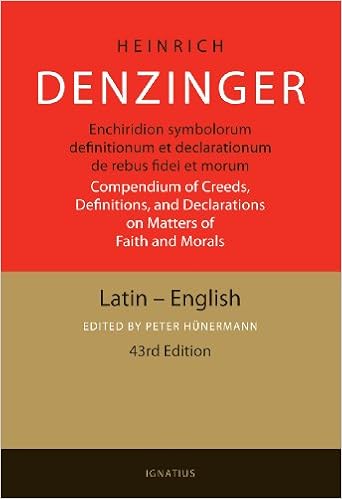
We only know him as “Denzinger,” but he is highly respected in some circles, and his writings are quoted like the Bible. It’s not a secret in the Vatican that the recently terminated the head of the CDF, Gerhard Cardinal Muller, was an admirer of Dezinger.

“It was clear for a number of years that the Cardinal had been Denzinger’s man inside the halls of the Vatican, and now we finally have hard evidence of a conspiracy. Denzinger’s influence over the CDF and the Church will finally be broken.”

What is this “DENZINGER” of which they speak?

US HERE – UK HERE


Every priest, seminarian, student, serious defender of the Faith must have this.

Posted in Lighter fare, SSPX | Tagged , ,
12 Comments

The Cassock

cassockUse of the cassock.

In England… and in Wales?… it was illegal to wear the cassock in public.  Perhaps it still is.  I believe there is a tale told that Queen Elizabeth paid the fine for John Paul II.  Se non è vero….

In these USA, the Council of Baltimore, held in a time of real persecution of Catholics, it was determined that in public priests would wear the more secular frock coat, rather than the cassock.  That policy, which shaped the old priests who shaped me, lingers in my practice.  I don’t often go out in public in the cassock, but my resistance is … futile.

However, the erosion of our Catholic identity, and the erosion of priestly identity – directly related to each other – have led inexorably to a lack of comprehension of what a priest is, how to recognize one, etc.  And priests haven’t made that easy.

Now I read a story about a group of seminarians in clerical dress were denied entry to a pub in Cardiff, because the innkeeper thought they were in “fancy” dress or they were there for a “stag do”.

From The Telegraph:

Father Michael Doyle said the seven went to the pub in Quay Street to celebrate the ordination of Father Peter McLaren at Cardiff Metropolitan Cathedral of St David near Queen Street. He said it was a double celebration because Fr McLaren was the second to be ordained to the priesthood in a week.

He added that the City Arms was a favourite of his colleagues including the Archbishop of Cardiff, George Stack.

Fr Doyle said: “They arrived at the City Arms and they were dressed wearing the clerical collar. “The doorman basically said something along the lines of, ‘sorry gents, we have a policy of no fancy dress and no stag dos’.”

The doorman was good-natured but firm, and the students had started to leave when they were approached by the bar manager. “He basically said, ‘you’re real, aren’t you?’,” said Fr Doyle.

“He invited them back in and when they walked back in the entire pub burst into a round of applause, and they had a free round off the City Arms.

[…]

The Directory for Priests identity – in the first place – the cassock as the proper dress of the priest and, oh yes… after that other sorts of garb.

I don’t trust priests who speak badly of the cassock.

Posted in Lighter fare, Mail from priests, Our Catholic Identity, Priests and Priesthood | Tagged , ,
64 Comments

Translating ICEL

One of you alert readers sent this…

17_08_01_ICEL_Dead_End

Posted in Lighter fare | Tagged
3 Comments