GUEST POST: 10 years of ‘Summorum Pontificum’ and its effect on seminarians

A GUEST POST from a reader

I have been meaning to write this for a little while but the holiday gives me a time to reflect on several observations over the past weeks and several years. This in light of priestly ordinations of late as well as the realization that this coming Friday July 7th is the tenth anniversary of the release of Summorum Pontificum.

As you know I live close to a major metropolitan diocese where times have been challenging and tradition has been suppressed and those attached to it oppressed for many decades. However, times and conditions are changing, and for the better.

While the number of vocations, a perennial measure of the health of the Church, are not quite what we’d call booming, there is a healthy pipeline of seminarians coming in and working through their studies, and the quality of the men finishing seminary preparation is not only impressive but remarkable in many ways.

Having attended 1st Holy Masses of the newly ordained regularly for the past decade, there are some noticeable changes occurring. The newly ordained are taking more serious the rubrics for liturgical dress; I’ve seen them saying the vesting prayers in recent years and using the amice and cincture more and more. Seminarians too come well prepared in pressed, crisp cassock and surplice and in large numbers to support their elder brothers.

Ordinands are also choosing more traditional, sometimes gothic, sometimes Roman vestments. What would have been unthinkable eight to ten years ago, and in some places five years ago when the more traditional priests were pushing the limits and being berated, is being done widely now, without expectation of prior negative consequences.

Once in the parish, many new priests are greeting their new parishioners in the same cassock and surplice they have become accustomed to wearing during seminary years, which, while bringing comments and surprise is mostly welcomed. I have seen a number of new associates who are distributing Holy Communion at masses they are not celebrating and none of them come in simple alb and stole, not one. Ten years ago, this would have been unheard of, now it is commonplace.

Another noticeable trait that has been introduced slowly, which includes at altars in the seminaries, is the central facing cross and candle set. Some of the newly ordained, and a few who have recently become pastors, even after only 5-7 years spent as pastoral associates, have made this change to their parishes main altar of sacrifice. In effect, the boundaries of a more traditional practice are being pressed wherever possible.

I have also been impressed by the newly ordained and their attachment to the ancient rite. It is crystal clear that they both know and have come to learn about it, and several I have spoken too have learned to love it and make it part of their priestly sense of self. I had a young priest friend send me a message last week, for instance, that he had offered his private TLM for me and my family, for which I was so very thankful. Some newly ordained offered their first and second Holy Masses in the Extraordinary Form – where and how this happens still unfortunately is done guardedly. I was present at one this year, and if I didn’t know the young priest had just been ordained, I would have thought he’d been saying the mass for some years.

One of the heartening and beautifully fraternal aspects of these early masses, both in the OF and EF, is the presence of other recently ordained who come to support their brother, especially in the EF where they come and attend in choir or server as deacon and sub-deacon.

Perhaps most significant, there are a number of other moves that the newly ordained are making which betray a deep spiritual affection for their office and the souls of their charges. These young priests are taking very seriously their role as shepherd of souls. Most of the newly ordained do not preach at their own first masses where I am, however, they uniformly do later take a moment to thank those who helped them on their path; and time after time, I have been increasingly hearing messages imploring folks to go to confession, attend weekly mass, pray the rosary and attend Eucharistic devotions especially Adoration and Holy Hours. Many have also provided the great spiritual gift to those in attendance of procuring the necessary permissions from the Apostolic Penitentiary to allow for a Plenary Indulgence, under the normal conditions, for attending their own first Holy Mass.

All of the early masses I have attended include an opportunity afterwards to receive a first blessing from the priests, and half or better I have heard give the blessing in Latin. In talking about this with a some priests who have been ordained for a few years, they all say that the guys in seminary know where the resources are, how to get them, and learn what they are required to know. I was surprised to know that of the priests ordained coming out of a major seminary, a full 60% or better are expected to be saying the older form of the mass, predominantly in private for now, and in expectation for the days when it is even more accepted.

In summary, I am seeing very good progress over the past 10 years. I am filled with much hope in these times and expectations of great holiness from our new priests.

Posted in Liturgy Science Theatre 3000, Our Catholic Identity, Priests and Priesthood, Seminarians and Seminaries, SUMMORUM PONTIFICUM |
17 Comments

Pres. Trump offered help in the case of Charlie

La Reppublica is reporting that Pres. Trump has offered his help in the case of Charlie, struggling for life, state pitted against parents.

Also, the famous pediatric hospital Bambino Gesu said that they are ready to receive him for whatever time remains him.

This has been a sad case to watch.

Prayers.

Posted in Si vis pacem para bellum! |
44 Comments

CRISIS: A reflection on differences of the Novus Ordo and Traditional Roman Rite

From the useful Crisis with my emphases and comments:

Worship Worthy of God
MICHAEL J. ORTIZ

July 7 is [already!] the tenth anniversary of Pope Benedict XVI’s Summorum Pontificum, a decree that allows priests to celebrate the form of the liturgy of the Mass before it was reformed in 1970. [aka The Emancipation Proclamation] For most Catholics, this will likely fall into the category of ecclesiastical arcana, and pass unnoticed. Yet this same decree’s widespread obscurity—enacted primarily to insure “worship worthy of God” throughout the Church[Yes, that is the primary purpose.  It had little or nothing to do with the dopey “nostagia” claim that libs throw in the teeth of good people to whom they feel morally superior.  Whenever you hear the claim of “nostalgia”, know that you have heard some snug virtue signaling.] implicitly shows that Catholic liturgy following the Second Vatican Council (1962-65) did undergo significant changes, some marking a departure from centuries of tradition. [In direct violation of the Council Father’s manifest desire that the reforms NOT be a departure.] Successful revolutions, after all, usually involve a loss of memory before the year zero, the inauguration of a new era.  [And to think that Kark Rahner (SJ) thought that V2 was tantamount to a new “Council of Jerusalem, and Küng thought V2 didn’t go nearly far enough.  Imagine the horror show we would have today… which we don’t have yet.]

It’s hard today for many Catholics to imagine a Mass spoken in Latin, or chanted in Gregorian chant, with the priest facing liturgical east, because so many Catholics now worship with a different orientation[some, in more ways than one] than before the reforms of Paul VI, the pope who brought Vatican II to a close, and implemented the liturgical innovations he felt necessary to bring the Church more in tune with the modern world. [That’s one way to phrase it.]

Yet Benedict’s decree has taken root. [It has, and it is growing and producing fruit.] In the late 1970s, there were, in the United States, less than a dozen communities celebrating the old rite, usually without canonical recognition by a local bishop. Today, there are over 400 parishes (admittedly a small fraction of the total number) that regularly offer the Extraordinary Form of the Roman Rite, as Pope Benedict called it in 2007. This growth is significant for a number of reasons.

One reason is the old rite is suffused with a sense of the sacred. [It is hard-wired into the rite itself.  Part of what helps that sense of the sacred is that the rite keeps the priest under control.] Part of this involves the amount of silence woven into the old Mass. [Certain for Low Mass.  However, Low Mass isn’t supposed to be the norm.  The Missa cantata and the Solemn Mass are not Low Mass with things added.  The Missa cantata and Low Mass are Masses with lots of things stripped out.  Ideally we should aim for me Solemn Masses and, better, Pontifical Masses as we do where I lurk.]Those who have tasted this sacred silence don’t easily forget it. Many unknowingly yearn for it. Last week at my parish, for instance, I noticed after Communion many in the pews—parents, grandparents, some singles—virtually trying to wrap themselves in silence, with hands to their faces, seemingly saddened, as if they could not reach further into the mysterious embrace to which they had been called. I think I know what they were missing, though I dare not speak for them. I only say, look at this ancient Mass, see what has been taken away from you, perhaps even before you were born. [A good point.  Dear readers, this is our patrimony, our inheritance, lovingly polished through the centuries and handed down.  It has been kept from you. You have been robbed.  You should demand it back.  It’s yours.]

I realize that when the Extraordinary Form was simply the Roman rite, it wasn’t paradise in every parish in the Catholic Church. There was, after all, the “Here comes everybody” reality, which is how it should be: Christ died for everyone, not simply those sensitive to aesthetic values. But the ancient form of the Mass should hardly be considered only for those with so-called highbrow tastes, for the benefit this liturgy brings is for everyone.

In his recent book, The Power of Silence: Against the Dictatorship of Noise, [US HERE – UK HERE], Cardinal Robert Sarah put his finger on the fevered pulse of our contemporary culture: “The tragedy of our world is never better summed up than in the fury of senseless noise that stubbornly hates silence. This age detests the things that silence brings us to: encounter, wonder and kneeling before God.[That’s is.  It is in the hard moments of silence where we encounter mystery.] Having in many places lost this sacredness of the liturgy, is it any surprise that, as Cardinal Sarah notes, we see a world increasingly incapable of wonder, of silent awe in the presence of God?

Aidan Nichols, in his Looking at Liturgy, in 1996, explains how a desire to increase the understanding and participation of the laity in the Mass did so on faulty sociological theories. Citing Dominican liturgiologist Irenee-Henri Dalmais, Nichols shows that, contrary to many of the Fathers of Vatican II’s experts, liturgy “belongs in the order of doing (ergon), not of knowing (logos). Logical thought cannot get far with it; liturgical actions yield their intelligibility in their performance, and this performance takes place at the level of sensible realities … capable of awakening the mind and heart to acceptance of realities belonging to a different order.” The theme of noble simplicity, one of the principle axioms of Vatican II’s liturgical reforms, in this light appears somewhat naïve, [at the very least] excluding as it does methods of perception proper to the human person that are wider than Enlightenment epistemology can obtain or even account for. [Can you spell “apophatic”?]

Additionally, the new form of the Mass today in the vernacular instead of Latin robs Catholics of a universal language of worship as our global village grows smaller. Marked by numerous options, the new Mass also includes opportunities for ad hoc remarks or emphasis by the celebrant (see George Weigel’s “It’s Howdy Dowdy Time!” at First Things for a recent example), [That was a good one.] standing in stark contrast to the older rite, with its self-effacing demands that the personality of the celebrant yields to the larger sanctity of the Mass itself. [As I said, the older rite keeps the priest under control.] Is it any wonder that many Catholics today succumb to emotionalism or sentimentality when it comes to addressing moral issues when our Novus Ordo liturgies are often marked by the same ethos?

In other words, the new rite shows all the marks of the 1970s, while the older rite is rich in the silence of slow time, [An analogy: the difference in satisfaction one has from fast food or slow food.] or, as in a sung Mass, the otherworldly harmonies of Gregorian chant, now a rarity in many parishes that use only the reformed Mass. Which is not to say they are incompatible. Benedict XVI wished each could strengthen the other in a complementary manner. Justice Scalia’s funeral Mass last year, for instance, was a widely-noted model of this, with its Gregorian chanting in Latin of antiphons rich with sacred solemnity.

So the Mass that inspired Dante, Bocaccio, Chaucer, Shakespeare, Fra Angelico, Bernini, Michelangelo, Brunelleschi, Ghiberti, Rubens, Titian, Vazquez, da Vinci, Cezanne, Hemingway, Fitzgerald, Waugh, Tolkien, and others too numerous to name, thanks to Pope Emeritus Benedict XVI, has been on something of a comeback in the last decade. [And even non-Catholic, such as the famous intervention with Paul VI that included Agatha Christie.] Yet there are bishops who are hostile to the ancient liturgy, as if it is somehow inappropriate for our ever advancing post-modernity.  [It is astonishing to me that bishops would be hostile to the traditional rite.  That’s like hating your parents and grandparents and their parents, etc., and all they accomplished for your benefit.]

Nevertheless, given the old rite’s disproportionate shaping of culture and art for more than 1000 years, its demonstrable beauty, and power to nurture souls in tune with natural and supernatural gifts, it is still too rarely known in parishes. This is tragic, and a betrayal of the deepest sources of Catholic life and sanity. As we have learned to our regret, W.B. Yeats was profoundly right in asking, “How, but in custom and ceremony / Are innocence and beauty born?”

Fr. Z kudos.  He gets it.

Posted in Liturgy Science Theatre 3000, SUMMORUM PONTIFICUM, The Drill, The future and our choices | Tagged , , ,
31 Comments

ASK FATHER: Holding hands or the “orans” position during the Our Father. Wherein Fr. Z rants.

From a reader…

QUAERITUR:

Over at the Fishwrap (aka National Schismatic Reporter) there is a question today about hold hands during the Our Father.  As you might guess they reference liberals who are probably unreliable.  What say you?  Is hand holding forbidden in the Novus Ordo?   How about in the Tridentine Mass?

I’ve written about this several times, so I’ll brush some frost off an answer from the ice-box  (easily found using the search box on the side bar) and add to it.

First, I’ll remind you that I had a POLL on the subject.  Let’s just say that, when it comes to hand holding during the Our Father, for both men and women NO was the overwhelmingly dominant choice.  HERE

There is no specific prohibition against holding hands during the Our Father, or any other time at Mass for that matter, either for the Novus Ordo or the TLM.

However, there is also no provision to ask or invite people to do so.  Were a priest or anyone else to do so during Mass he/she/? would commit a grave liturgical abuse.

Priests can’t just make stuff up and impose things because they think it is meaningful.

For those who don’t care to partake, the hand holding thing – which I hope will soon vanish – is a seriously irritating invasive aberration.  The aforementioned POLL shows that most people don’t like it and want to avoid it.

That said, if people spontaneously desire to do this, hold hands, I cannot see any problem with it.

“But Father! But Father!”, some of you libs are bleating from the depths of your sclerotic hearts, “You can’t have it both ways!  You legalists are all alike.  So can you hold hands or not?  See?  you are caught in your own trap. HA!  You try to crush the spirit!  Especially the spirit of Vatican II! Why? Because YOU HATE VATICAN II!”

Friends, don’t expect libs to be logical.  Lib logic is sort of like a bag full of cats: its always on the move but who knows what’s really going on in there?  We, on the other hand, filled with compassion and common sense just want what the Council Fathers of Vatican II would want: follow the books faithfully.  That’s the true spirit of Vatican II: be faithful, apply common sense and avoid stupid.

Hence, I can say… No, people should not hold hands during the Our Father… unless they do.

How do we square that circle?

I can picture spouses holding hands… each others, that is, and not just little junior’s to keep him from opening a nearby lady’s purse.  That’s a good reason to hold a child’s hand during Mass by the way.  Also, moms and dads, when you have babe in arms, hold their hands down firmly at the moment of Holy Communion!  Please?  Father doesn’t need their curious help.  But I digress.

So, no, don’t hold hands … unless…

I can picture myself with a Mass kit on a crate with candles in the London Underground during the Blitz.  As I say Mass, horrible booms tremble through the ground and echo in the tube tunnels as bombs rain down from German airplanes.  Loose tiles fall and children cry.  People who have never met are holding hands.

I can picture myself saying Mass just after an announcement that a terrorist group lit off dirty suit-case nukes in Washington DC, Chicago, and LA.  People flood to churches out of fear, grief and anger, looking for direction and solace.  At the Our Father they spontaneously reach for each other’s hands.

I can picture myself saying a Requiem Mass for five teens killed in a car accident. Their classmates and families hold hands.

I can picture an asteroid… well, you get my drift.

Congregations of total or near total strangers might be spontaneously driven sincerely to hold hands in some circumstances.

But – and perhaps it is a lack of something on my part – I cannot see this hand holding stretch exercise across aisles, for example, as a regular practice as anything other than contrived sentimentalism which distracts us from the transcendent nature of God Almighty and the meaning of the petitions in the Our Father.

Yes, the Our Father is a series of petitions, which are easily recognizable especially in the way that the Gregorian chant format provides the text and melody in the Roman Missal.

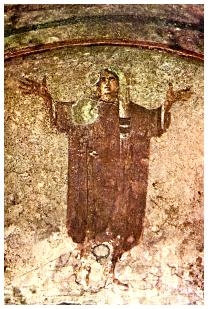
A 3rd c. allegorical depiction in the Catacombs of Priscilla of the praying Church, hands in the orans position. This is NOT, as some loony feminists claim, a fresco of a female priest.

On a related note, during the Our Father the faithful are not to use the so-called “orans position” (“praying position” with hands extended, open), which is the proper hand position of the priest celebrating the Mass.  Even worse is when they hold that position after the Our Father through the (Protestant) addition that follows.  The orans position is reserved for a certain liturgical role (read: priest – not even deacons).  That position of extended hands is not appropriate for the lay faithful in the pews.

We must not mix or confuse liturgical roles.  Lay people have their own dignity without trying to jazz them up by – and how condescending is this? how clericalist? – allowing them to do what the priest does.  That’s the worst sort of clericalism and it is always used by libs, isn’t it?  The subtle message given, when roles are purposely confused for the sake of “active participation” or “getting the laity involved”, is really “You aren’t good enough on your own, so I’ll let you do something that I can do.”   Grrrrr.  But I digress.

So, I repeat: I am unaware of a prohibition of holding hands during Mass.  Spontaneous hand holding? Fine.  It must never be invited or imposed by someone with a microphone anywhere near the altar or by anyone in the pews.

Posted in "But Father! But Father!", "How To..." - Practical Notes, ASK FATHER Question Box, Linking Back, Our Catholic Identity, Wherein Fr. Z Rants | Tagged ,
81 Comments

ASK FATHER: How to support a seminarian assigned to our parish?

seminarians NACFrom a reader…

QUAERITUR:

Our parish has received a terrific seminarian this summer. He comes from a great background and his older brother is a priest so he seems to have a strong support at home. My question is how can my family help support him along with our parish? Aside from adding him to my intentions in my rosary, what I else can I do for him, not only now but as he continues his studies?

Prayer is a good thing, as well as intentional sacrifices and mortifications offered on his behalf and against the wiles of the Enemy.  The Rosary is a great choice.  Offering Holy Communions for him is good.  Go, perhaps, to daily Masses and when Father prepares the chalice for the Sacrifice, at the addition of the water, mentally add the seminarian to the wine to be transformed by Father and Christ’s priestly action.  Ask your Guardian Angel also to help him and to defend him from the Enemy.

Another thing you can do is contribute to his future clerical sense.  That is to say, depending on where he is in his formation – such as major seminary – you might provide for him a biretta through this blog’s ongoing BIRETTA PROJECT.   By “clerical”, we don’t mean snooty or superior, of course.  That’s for libs, with their smug condescension.  Books on the priesthood are a fine contribution.  Perhaps something like  Those Mysterious Priests by Fulton J. Sheen (US HERE – UK HERE) or even The Priest Is Not His Own which is terrific (US HERE – UK HERE).  Joseph Ratzinger put out a little book of reflections on priesthood called Ministers of Your Joy: Scriptural Meditations on Priestly Spirituality (US HERE – UK HERE).  There are myriad more books.  Perhaps, Fathers out there reading this… you could post or send your own suggestions about works on priesthood which were and are helpful for you.

I just had a thought… what a great gift it would be for a seminarian, a newly ordained priest, or a veteran, to receive a Kindle pre-loaded with a couple dozen or more books on priesthood.  Interesting, no?  I suppose one would have to…

  1. create an email that could be handed over to Father (or the seminarian);
  2. form a group who could purchase and send as gifts the Kindle books to that email address;
  3. load them on the Kindle;
  4. give the pre-loaded Kindle to Father along with email address and password.

People could then continue to add titles as they surface.  Even if Father moves to another place, the Kindle could still receive so long as books are sent to that email.  Also, that priest could also pass the Kindle along, with the email and password, to another priest or seminarian.  Father or the seminarian could create wishlist as well.  Kindle (US HERE – UK HERE).

You can even get the pre-Conciliar Roman Breviary on Kindle in ENGLISH in two-monthly portions (e.g., current July/Aug 2017 – US HERE – UK HERE).

I like this idea.

However, remember when trying to give support to a seminarian to keep balance between friendly presence and a bit of distance.  We must never make a seminarian feel obliged to remain in seminary if priesthood truly isn’t his calling.  A man must be totally free in making his choice without a sense that, because people were good or generous to him, he has to stay in.  Get my drift?  Avoid psychological pressure at all costs.  Giving some things anonymously is often a good plan.  Find the balance.

GUEST PRIEST BONUS RESPONSE: Fr. Tim Ferguson

Prayer is one of the best things you can do. Let him know of your prayers. Get the address of the seminary he’ll be returning to in the Fall and make a plan of writing to him. Gifts are nice, but use some common sense with gifts – seminarians often get inundated with well-meant, but ill-conceived gifts. It is likely, for example, that the seminarian already has a rosary. Statues, prayer books, and religious tchotchkes of all sorts – unless the seminarian has expressed a specific interest in something – are likely to be appreciated as far as the sentiment is concerned, but are less appreciated than, say, a gift certificate for a religious goods or clerical clothing store. A gift certificate to a local restaurant can be a good things – seminarians will occasionally have some free time, and a chance to get off campus for a nice dinner with friends can be a healing salve. Depending on how far away the seminary is, some gifts that have a local flavor can be kind – candy from a hometown candy store, or a small memento from a local sports team. When you do write to your seminarian, be sure to include a family picture – perhaps even something with the local parish church in the background.

While he’s still in town, invite him over to dinner, or out to a local restaurant. Get to know him, and let him know of your prayerful support for him as he continues his discernment and formation.

Posted in "How To..." - Practical Notes, ASK FATHER Question Box, Priests and Priesthood, Seminarians and Seminaries | Tagged ,
7 Comments

WDTPRS 4th Sunday after Pentecost: O Captain, my Captain!

I may have quoted Whitman, but, no, I’m not talking about Abraham Lincoln.
Today’s prayer is found in ancient sacramentaries, such as the Veronese and the “Hadrian” version of the Gregorian, and the so-called Gelasian.  It is unchanged in the “Tridentine” form of the Missale Romanum as my trusty copy of the 1570MR shows.  It survived the Consilium’s hackers and grafters who pieced together the Novus Ordo as the Collect for the 8th Sunday of Ordinary Time.

COLLECT: (1962 Missale Romanum): 

Da nobis, quaesumus, Domine, ut et mundi cursus pacifico nobis tuo ordine dirigatur: et Ecclesia tua tranquilla devotione laetetur.

Some vocabulary from the mighty Lewis & Short Dictionary.  Cursus can mean anything from “course, way, journey” to “course of a ship”, the “flow of conversation” and “postal route”.  Dirigo is “to give a particular direction” or “to lay or draw a straight line”.  It was used, among other things, to indicate ordering an army to march to a certain point or to direct or steer a ship on its course.    Ordo means too many things to get into in depth.  Suffice to say that it can refer to the “methodical arrangement, class or condition.” By extension it is applied to everything from the “orders” of the clergy, the way trees are planted, the lines of an army, or the banks of rowers in a ship.  Pacificus is a composite of pax and facio meaning “peacemaker” or “peaceable”.  The problem with that laetetur is that it could be from the deponent laetor or passive from laeto.  Because of those ablatives in that clause, I am opting here for the passive, like dirigatur.   Among the things that devotio means are “fealty, allegiance, piety, devotion, zeal.”

LITERAL ATTEMPT

Grant us, we beg, O Lord, both that the course of the world be set by Your methodical peace-producing plan for us and that Your Church may be made joyful by means of tranquil devotion.

Despite the wordy literal translation I have given this time, I will later lend to this a rather poetic aspect.

Notice that in our collect’s vocabulary there are traces of military and nautical imagery.

Try reading this prayer with the mental image of a ship.

Its great Captain sets its course upon the sea. So great is the Captain that He can command calm waters and a favorable wind as well.  The ship can be seen as the world.  In this case I see the ship as the Church in the world, the Church Militant, which is not an unfamiliar image to those familiar with the Barque of Peter.  The sea it sails upon is the deep and turbulent world we live in.  The Captain is our Lord Jesus Christ, who calmed the stormy waters and commanded Peter to walk to Him upon them.  He entrusted His ship to Peter, to steer it in His stead.  Once all has been put into proper order, made “ship-shape and Bristol fashion”, our own sense of loyal zeal, our devotion, is the wind that the Captain uses to steer the ship upon the course He sets, carrying us its crew to the port and safe haven.

The word pacificus brought to mind an antiphon of First Vespers of Christmas: “Rex pacificus magnificatus est, cuius vultum desiderat universa terra… The peacemaker King, whose glance the whole world longs for, has been exalted.”  Is not the sight of God, “in whose will is our peace”, our true desire?  Is that not the port and safe haven we journey towards in the turbulence of this world?

We must look more intently at devotio… devotion.

According to St. Thomas Aquinas (+1274) writing in his monumental Summa Theologiae, devotio is an “active” virtue.  The Angelic Doctor wrote:

“The intrinsic or human cause of devotion is contemplation or meditation. Devotion is an act of the will by which a man promptly gives himself to the service of God. Every act of the will proceeds from some consideration of the intellect, since the object of the will is a known good; or as Augustine says, willing proceeds from understanding. Consequently, meditation is the cause of devotion since through meditation man conceives the idea of giving himself to the service of God” (STh II-II 82, 3).

The Jesuit preacher Louis Bourdaloue (1632-1704) translates this into “a devotion to duty”. What we do, including our “devotions”, must help us keep the commandments of God and stick to the duties of one’s state in life before all else. (See? Not everything from Jesuits is to be avoided!)

In other words, there is an interplay between our devotions and our devotion.

Each of us has a state in life, a God-given vocation we are duty bound to follow. We must be devoted to that state in life, and the duties that come with it, as they are in the here and now.

That “here and now”, hic et nunc, is important.

We must not focus on the state we had once upon a time, or wish we had, or should have had, or might have someday: those are unreal and misleading fantasies that distract us from reality and God’s will.

If we are truly devoted and devout (in the sense of the active virtue) to fulfilling the duties of our state as it truly is here and now, then God will give us every actual grace we need to fulfill our vocation. Why can we boldly depend on God to help us? If we are fulfilling the duties of our state of life, then we are also fulfilling our proper roles in His great plan, His design from before the creation of the universe. God is therefore sure to help us. And if we are devoted to our state as it truly is, then God can also guide us to a new vocation when and if that is His will for us.

Faithful in what we must do here and now, we will be open to something God wants us to do later.

This attachment to reality and sense of dutiful obedience through the active virtue devotio is a necessary part of religion in keeping with the biblical principle in 1 John 2:3-5:

And by this we may be sure that we know Him, if we keep His commandments. He who says ‘I know Him’ but disobeys His commandments is a liar, and the truth is not in him; but whoever keeps his word, in him truly love for God is perfected. By this we may be sure that we are in Him: he who says he bides in Him ought to walk in the same way in which He walked.

Before the creation of the universe God knew each one of us and desired us and loved us.

He called us into existence as a precise point in His great plan, His economy of salvation.  He gives us a part to play in that plan and gives each of us the tools and talents we need to fulfill it.  If we devote ourselves with real devotio to our state-in-life and strive to carry out His will, God will give us every actual grace we need since we are furthering His great plan.

This is why I suggest above that our devotion can be like the wind that the Captain uses to direct our great ship.  More than just being the “hands on deck”, we play a vital part in the actual forward motion of the ship. We are not merely being hauled along upon the “alien merits” of Christ, as some Protestants call God’s saving intervention.  While we truly depend on Him and Him alone, while we truly do not merit what He provides, mysteriously it is part of His plan. He brings it to pass that His work becomes ours and ours His.  He “makes it so”.

A Somewhat Smoother Version:

Grant, we beseech you, O Lord, that the course of the world be steered by your plan for peace and that your Church be filled with joy from tranquil devotion to that plan.

Or a bit more poetic:

O Lord, we beg Thee to grant that the peaceful steerage of the world’s course be set according to Thy plan and that Thy Church be made full with joy from our tranquil devotion.

OBSOLETE ICEL (1973):

Lord, guide the course of world events and give your Church the joy and peace of serving you in freedom.

It is hard to strike a balance between the literal, which can be awkward and wordy, and the simple, which can be banal and miss the real impact of the prayer.

CURRENT ICEL (2011):

Grant us, O Lord, we pray, that the course of our world may be directed by your peaceful rule and that your Church may rejoice, untroubled in her devotion.

You decide.

Posted in Hard-Identity Catholicism, Liturgy Science Theatre 3000, WDTPRS | Tagged , ,
3 Comments

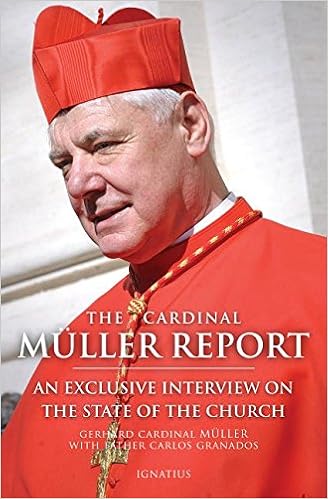
BOOK REMINDER: The Cardinal Müller Report: An Exclusive Interview on the State of the Church

I bring to the attention of the readership a new book from Ignatius Press. It is clearly meant to hearken to the now-classic and still relevant Ratzinger Report published in 1985 (US HERE – UK HERE). Joseph Ratzinger was Prefect of the CDF then, as Card. Müller is Prefect has been for the last five years until 1 July 2017.

Now Card. Müller, 69, is off the leash, in that Pope Francis didn’t assign him to another mandate.  The word going around is that Müller declined another appointment, since anything after CDF would be a demotion.  Can his book give us any clues as to what he will do in the future?  Card. Burke hasn’t been invisible and quiet.  What about Müller?

¡Hagan lío!

The Cardinal Müller Report: An Exclusive Interview on the State of the Church

US HERE – UK HERE


Posted in ¡Hagan lío!, The Campus Telephone Pole, The Coming Storm | Tagged
Comments Off on BOOK REMINDER: The Cardinal Müller Report: An Exclusive Interview on the State of the Church

NEW PREFECT for CDF: Archbp. Luis Francisco Ladaria Ferrer, SJ

Published on: Jul 1, 2017 @ 06:10 CDT (1119 UTC)

It seems that Arcbp. Luis Francisco Ladaria Ferrer, SJ, will be the new Prefect of the Congregation for the Doctrine of the Faith.  He has been the Secretary of the same Congregation.

The Bolletino in Italian:  HERE

Conclusione del mandato quinquennale del Prefetto della Congregazione per la Dottrina della Fede e nomina del successore

Il Santo Padre Francesco ha ringraziato l’Eminentissimo Signor Cardinale Gerhard Ludwig Müller alla conclusione del suo mandato quinquennale di Prefetto della Congregazione per la Dottrina della Fede e di Presidente della Pontificia Commissione “Ecclesia Dei”, della Pontificia Commissione Biblica e della Commissione Teologica Internazionale, ed ha chiamato a succedergli nei medesimi incarichi Sua Eccellenza Reverendissima Monsignor Luis Francisco Ladaria Ferrer, S.I., Arcivescovo titolare di Tibica, finora Segretario della Congregazione per la Dottrina della Fede.

Friends, this could have gone in an unthinkable direction, but it did not.  Frankly, I’m pleased with the appointment.   When I consider the other names that have been tossed about for this post… we have dodged a big one.

UPDATE: I am told that Card. Müller will not have another appointment in the Curia.  After all, once he has been the Prefect of the CDF, which has always been known as “La Suprema”, there is only demotion.  It is hard to imagine that he will go to Germany as a diocesan bishop.  There is a possibility that he’ll wind up, at only 69, as Patron of the Knights of the Holy Sepulcher (which position is still at present filled).

However, if Card. Müller doesn’t have an appointment, and is effectively “retired”, then he is off the leash.

What is interesting is the timing of the announcement of the new Prefect.  Rather than make the announcement on Monday (which would make sense), it is made in advance, a virtual preemptive strike.   It could be that the powers-that-are rushed to get the news out because that feared that Card. Müller would go to the press (perhaps because that’s what they did/would have done).

Again, Card. Müller, without an appointment, is off the leash.

Posted in ¡Hagan lío! | Tagged ,
34 Comments

ASK FATHER: Why are “ad orientem” and Communion on the tongue preferable?

leafhopperFrom a reader…

QUAERITUR:

I am a convert to the faith 27 years ago and was just recently ordained a permanent Deacon. I am curios as to why celebrating the mass ad orientum and reception on the tongue exclusively are preferable. I often find myself near tears when receiving the Eucharist and was just wondering why receiving in the hand should not be allowed.

There are some common misspellings that crop up frequently in this line of work. Occasionally, one sees reference to alter boys, which is alarming (at least to non-Jesuits). One hears stories of lectors proclaiming that a reading is from St. Paul’s Letter to the Filipinos. And frequently the liturgical phrase “ad orientem” is butchered.

BTW… the orientus (which in Latin would give us the accusative form orientum) is a genus of critter in the leafhopper family. Hence, offering the Holy Sacrifice of the Mass “ad orientum” would be offering it toward or in the presence of this irritating little bug. Something we might end up doing incidentally, if the church has not been thoroughly cleaned by the aspirants of the Blessed Imelda Lambertini Society alter… no… altar guild section. But that’s something we should not intend to do.

Instead, we should offer the Holy Sacrifice facing – at least symbolically – the direction of the rising sun, the orient, or, in Latin, oriens (in the accusative form orientem).

As to the specifics of why worship ad orientem is preferable and why reception of Holy Communion on the tongue is preferable, there have already been many electrons spilled on this blog to cover the topic. You might do a little searching around in these webby pages.

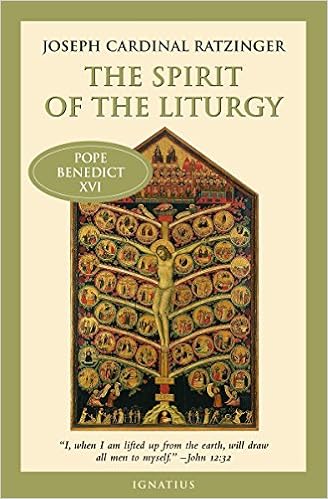
Also, try reading Dominus Est, a wonderful little book on the Eucharist by Bp. Athanasius Schneider, and The Spirit of the Liturgy, by Pope Benedict XVI, aka Joseph Ratzinger.

Those highly useful and readable books will not fulfill your self-identification as “curios”, however.

US HERE – UK HERE

US HERE – UK HERE

Posted in "How To..." - Practical Notes, ASK FATHER Question Box, Lighter fare, Liturgy Science Theatre 3000 | Tagged ,
16 Comments

ASK FATHER: Could a “Pope Emeritus” under 80 vote in a Conclave?

popes_posterFrom a reader…

QUAERITUR:

Canonically speaking, if a Pope emeritus were alive at the time of the conclave to elect his successor’s successor, given he was a Cardinal and Pontiff, may he vote if he were under 80 years old? If he is over 80, may he participate in the same manner that other super-annuated cardinals are permitted to participate?

We are waaaay into the realm of speculation.

However, if we start from a couple of premises, and noting that we won’t be seeing anything like this in the near future, maybe we can think it through.

First, being a Cardinal is an specific role.  It can be conferred and removed and resigned.  It seems to me that when Cardinal Ratzinger was elected, he ceased to be a Cardinal and began to be Roman Pontiff.  With his resignation, he did not become a Cardinal again.  Before he resigned, Benedict could have decreed that, with the instant of his resignation, he would be a Cardinal again, or still.  He didn’t do that.  Furthermore, in no way has he comported himself as a Cardinal, retired or other.

WERE Benedict a Cardinal, then, being over 80, he would not be able to vote in the Conclave, but he would be able to participate in the events leading up to the Conclave.   If he thought he was still a Cardinal, he could have – before his abdication – changed the laws of the Conclave in regard to voting age.  But, he didn’t.

The same would apply to Pope Francis were he to resign.  He would have the option to say, “After I resign, I’ll be a Cardinal.”  He would have the option to do what Benedict did… or didn’t.  He could determine – before his resignation – what his role would be or he could be silent about it.  The next Pope could determine a role for him, or not.

So, this is waaaay out there in the realm of unsettling speculation.

I, for one, don’t long to see a multiplication of these resignations or emeriti, regardless of the affection one might have for them.

Posted in "How To..." - Practical Notes, ASK FATHER Question Box, Benedict XVI, Francis | Tagged , ,
5 Comments