ASK FATHER: Confirmation using an instrument. Tradition says “NO!”, but the CDW said “YES”.

From a reader…

QUAERITUR:

In a May 14, 2020 dubium to the Holy See, the USCCB asked if an instrument such as a cotton ball may be used for the anointing with sacred Chrism during the celebration of the sacrament of Confirmation, much as the law allows for “an instrument” to be used for the anointing during the Anointing of the Sick. The Congregation for Divine Worship and the Discipline of the Sacraments replied on June 2, 2020 that “The use by the minister of an instrument (gloves, cotton swab…) does not affect the validity of the Sacrament.” A cotton ball or cotton swab may therefore be used—one for each candidate—and then disposed of by burning afterward. Were a glove to be used, it would need to be changed between each anointing. If no cotton ball, cotton swab, or glove is used, priests must wash or sanitize hands between each anointing so that the Sacred Chrism is not contaminated nor is contagion spread between candidates.

How can that be? What about the “imposition” of the hand which in the NO was reduced to the contact in the anointing itself. Now even that is gone.

Can we say The response of the Vatican is “wrong”?

The CDW responded that an instrument may be used for the administration of the Oil of the Infirm in the Sacrament of Anointing.

That is disturbing.   It directly contradicts previous teaching and tradition.

Who am I to question the CDW in these matters?  After all, I am just an Unreconstructed Ossified Manualist.  So let’s check on our sources.

Mind you… what I am about to write applies to the TRADITIONAL manner of administering the Sacrament of Confirmation.   By no means can the CDW response be applied to the TRADITIONAL celebration of the sacrament.

Also, as far as the Novus Ordo goes, the Church gets to decide about the matter and form of the sacraments, provided that their divine institution is not violated.  The Church cannot, for example say that rice cakes can be used for the Eucharist.  But the Church can, for example, change the form, the essential words, for the Sacrament of Confirmation or of Holy Orders, and what instruments are used, such as the traditio instrumentorum in the rite of ordination.

His scriptis, there are still important principles to deal with.  If we believe that sacraments have matter and form (and we do) then we have to figure out if the use of an instrument for the anointing with Chrism in Confirmation is permissible.  Theologians in the past have always… always… answer NO.  The hand must be used without and instrument, because the hand of the minister is connected to the matter of the sacrament.

Turning to Sabetti-Barrett’s 1919 edition of Compendium Theologiae Moralis, I read (in Latin):

669.  Query. – Question 2.  How is the anointing to be done?

Response. It must be done with the right thumb of the Bishop in the manner of a cross on the forehead of the one confirmed.  However, the anointing would be valid if it were done by a different digit of the Bishop, and even if it were a digit of the left hand, because it would be an imposition of the bishop’s hand.  But a Bishop would sin, were he to do that without necessity, because he would be departing from the universal praxis of the Church; albeit it does not seem that an inversion of the aforementioned ceremony would reach the level of grave guilt. – Cf. S. Alphons. n. 165

Question 3.  Whether anointing can be done validly by means of an instrument?

Response. NEGATIVE., and the reason is, that the immediate imposition of the hand of the Minister would be lacking, which is absolutely required from what has been said.  On this in the new Code (1917):
§2. Anointing is not to be done with any instrument, but it is imposed properly by the hand of the minister on the head of the confirmand.

Prümmer in the 1953 Manulae Theologiae Moralis says:

156. 3. The anointing must be done with the thumb of the right hand, and not with a stylus or another instrument, as has already been said.  If, however, the bishop has a bad thumb, he can licitly anoint with the thumb of his left hand or with another digit.

We must grant that THE CHURCH gets to determine how the sacraments are to be administered.   However, the 2020 CDW response seems to ignore the opinions of theologians which the Church has, hitherto, rested on for a contrary opinion.  I don’t think they can simply be left aside.

We still need to have distinctions such as proximate and remote material, if we still believe in matter and form.

Let’s go another step.

Is the imposition of the hand hitherto required accomplished if a glove is worn?

The answer is surely YES.

I would you to the imposition of hands to the rite of ordination of priests.

It seems that an essential imposition of hands, when required, is accomplished with the use of gloves.

Could one say that the gloves are instruments.   Not really.  They do not significantly distance the hand from the head.  An instrument does (which is the point of using it).

Hence, in the administration of the Sacrament of Confirmation, the bishop can anoint using a gloved hand, but he cannot use an instrument to anoint.  I think the Congregation’s response is wrong and that it is highly likely that the use of an instrument to anoint with Chrism for Confirmation (not Anointing) is invalid.

A bishop or priest can use an instrument to anoint in the Sacrament of Anointing, because imposition of the hand is not required for the administration of the sacrament.  However, our best theologians, with St. Alphonsus, are firm on this point: the bishop must confirm with his hand, not an instrument.  His hand can be gloved, but the Chrism must be applied with a finger of his hand and not through an instrument.

In any event, I hope this gives any priest (with permission to confirm) and any bishop serious pause in the matter of using an instrument to apply Chrism.  DON’T DO IT.

I think this needs greater clarification.

Meanwhile, allow me to muddy the waters a little.   In the 15th c. Rogier van der Weyden – a painter with a sharp eye – thought bishops could confirm using an instrument.   This is from his amazing Seven Sacraments Altarpiece.

First, the bishop is clearly confirming.

And for Ordination to the Priesthood and for Extreme Unction.

Again, the Church gets to decide how sacraments are celebrated, what the matter is and what the form is.  If, however, this constitutes a departure from previous theology, the Congregation should be clear about that.

Salvo meliore iudicio, of course.   But I would ask that this be reviewed and clarified by the same Congregation.

Comment moderation is ON.

Posted in "How To..." - Practical Notes, ASK FATHER Question Box, Liturgy Science Theatre 3000, Our Catholic Identity |
4 Comments

NEW BOOK: Paul Claudel: Five Great Odes from Angelico Press

Introductions and Prefaces are important when looking at books. Never skip over them. In the introduction by the translator Jonathan Geltner to this wonderful new book from the ever more valuable Angelico Press I found a first key to grasping the topic.

“Paul Claudel was among the last artists of the Christian civilization of Western Europe: an artist who wrote from the heart of that civilization, not as an isolated survivor of it living on in an altered world.”

Paul Claudel: Five Great Odes.

US HERE – UK HERE

Claudel, fascinating man.  Contemplative, but active as a diplomat, with his own checkered past that fueled his writing with auto-referential authenticity.  You might know of the story of his conversion.  The young Claudel had an epiphany moment in Notre-Dame during the singing of the Magnificat during Vespers of Christmas

“In that moment an event happened that dominates my whole life. In an instant my heart was touched and I believed. I believed with a force of adhesion so great, with such a lifting of all my being, with a conviction so powerful, in a certainty that would not leave room for any kind of doubt that, from that point onward, no reasoning, no circumstance of my agitated life could either shake my faith or touch it.”

Back to the introduction:

“With the poetry of Claudel’s cogenerationist and coreligionist Charles Péguy, the Odes have little in common superficially, though they share much in the way of a feeling that is uniquely both French and Catholic. I would call that feeling fierce and con?dent, with an eye to the etymology of those words connoting, respectively, legitimate pride or bravery, and faithfulness. There is a certain swagger to the Odes, something brazen yet Christian insofar as rooted in humility conceived as a virtue, the paradoxical strength of weakness.”

And…

“I will return to Claudel as man of religion/desire in a particular and infamous respect, but I wish first to draw a better comparison with our French writer than any of the foregoing. Of all twentieth-century literary artists I believe it was J.R.R. Tolkien who would, after Claudel, most embody a sacramental poetics in his work. … It is perhaps worth noting that both Claudel and Tolkien produced their literary work on the side while fulfilling the duties of family life and careers as a diplomat and a philologist. But the affinity between the two artists is no doubt difficult to perceive, so disparate are their efforts, one in a lyric mode going back to the Hebrew Scriptures (at least in the Odes) and the other in a mode—high fantasy—so new that he had largely to invent it for himself. Yet the affinity is there: they were both catholic. I intend the aural and typographical pun, for both men were members of the Roman Catholic Christian communion and their work was obviously and thoroughly governed by that membership.”

You might see what I am getting at.

Once there were men who, when they wrote, wrote from the Christian Catholic viewpoint because they were still in a Christian and Catholic milieu. At least Christian. At least something like the Western Civilization born from Hellenistic, Roman and Judeo-Christian roots. At from the vestiges or the embers of Western Civilization.

I wonder if in our day the viewpoint has finally become the large graffiti vulgarities spray-painted the walls of downtown Seattle… er… CHAZ… er… more ironic… CHOP. Those graffiti being to the large character posters of the Cultural Revolution what the cave-flickerings are to Plato’s forms… or to keep with the Tolkien line, what Peter Jackson’s movies are to the real thing.

Translation of poetry run the risk of being only shadows of the original too. But I’m not going to let that stop me from enjoying this book.

I was rather surprised to Tolkien as a reference through the whole introduction. He had such such a foundational influence on my whole like. But I get with the commentator, Claudel’s translator is driving at, which is precisely why I am eager to settle slowly and patiently into Claudel’s poetry, which I have never read. O, that I could first read it in French without a hesitation of vocabulary or idiom! But in French read it also I will, but I’ll be riding this pony as I do.

We need to read and rest in Christian Catholic minds. Now more than ever are their books like salves for the soul.

In a time wherein more and more people seem to – for real – take themselves as the arbiter of truth not just for themselves in their own little fantasy world, but now also for everyone else… “OR ELSE!”… how refreshing to read:

“I believe without changing one point / what my fathers believed before my time.” (p. 118)


Posted in REVIEWS | Tagged
3 Comments

SHOPPING ONLINE? Please, come here first!

Your use of my Amazon link is a major part of my income. It helps to pay for insurance, groceries, everything. Please remember me when shopping online. Thanks in advance.

US HERE – UK HERE

These links are always on the right side bar of the blog.
Once you use one of those links to enter Amazon, I’ll get a small percentage of what you purchase during that session.  I can’t see what you buy.
Also, I regularly pray for and say Masses for my regular and occasional donors. It is my pleasure and duty to do so,
Posted in ¡Hagan lío! |
Comments Off on SHOPPING ONLINE? Please, come here first!

Fr. Z’s Kitchen and Sacristy: Starching a linen corporal to a glassy finish

A project.

Recently, at Corpus Christi, I recalled the story of the Eucharistic miracle at Bolsena during which a Host bled on a corporal, which spurred the institution of the feast.  I got to thinking about corporals.  A little light bulb went on.

Some of you might recall that, a couple years ago when I was in Rome, I posted about the wonderful corporals we have for Mass in many of the churches, for example, St. Peter’s Basilica (where I said daily Mass for many years) and at my adoptive Roman parish Ss. Trinità dei Pelegrini.

The corporals are hard starched, so much so that they have a glassy shine and are very stiff.  This means that it is extremely easy to spot particles of the Host and lift them with the edge of the paten.

Here are a couple of photos of such a corporal in Rome.

Notice that it doesn’t yet want to lie flat.

Note the shine of the starch.

Folded.

I determined that I wanted to make corporals like this.

First, what is a corporal?

A corporal (from Latin corpus “body”) is a square white cloth of linen upon which the chalice with its paten and host, and also ciboria containing the smaller hosts are placed during the celebration of Holy Mass.   The corporal is used whenever the Blessed Sacrament is taken out of the tabernacle, for example for exposition.  If vessels are to be purified even – in the Novus Ordo – blech – at the credence table (i.e., not on the altar) a corporal is to be used.   Hear that you priests out there?  Redemptionis Sacramentum 119 we also see the importance of using the corporal.

Practical use.  The first thing has to do with the priest’s intention at Mass to consecrate the Eucharist.  Priests are to have the intention to consecrate the matter they know they want to consecrate.  The usual way to help with this intention, to help make it explicit, is to place the matter to be consecrated on the corporal which is spread on the altar.  If the priest has the intention to consecrate everything on the corporal, he’s good to go.  He doesn’t have then to try to hold the specific intention for all the hosts in the ciborium as well.  And if there are hosts nearby, but not on the corporal, in a storage box or vessel for another Mass, no problem.

The old De defectibus, section on defects, which was part and parcel of the Roman priest’s knowledge for centuries is helpful in this regard.  There is a description of defects of intention:

“For that reason every priest should always have such an intention, namely the intention of consecrating all the hosts that have been Placed on the corporal before him for consecration.”

This is a priest’s moral intention.

Corporals shouldn’t be embroidered.  These days they tent to have a little cross, supposedly because the priest is so dopey that he can’t figure out where to put the Host.   Well.. these days… hmmm.   It also could be there to help the priest get oriented for refolding the corporal properly.   No, the corporal should not even have that little cross, but most do.  As a matter of fact, the one I worked with for this project has the little cross.

Why don’t I like the little cross?  Because in the TLM we place the consecrated Host directly on the corporal and only later slide the paten under it.  Particles of the Host could be caught in the fibers of the embroidered cross.  So, NO… no cross.   When I have a corporal with a cross, I tend to turn it around so that it is at the top, and I place the chalice there.

The corporal’s main purpose, however, along with indicating what is to be consecrated, is to prevent the loss of particles from the Host.  Should one fall, as sometimes happens because of it is dry or during the fractio rite, when it is broken, and the priest misses it, the way the corporal is folded will contain the host, as if with a little envelope… ne pereant.    Folding the corporal correctly is important.    So is way it is placed on the altar.   To that end, preserving particles, the corporal is always gently scraped with the edge paten just before the Precious Blood is consumed, or perhaps if necessary at the time of the purification of vessels.

These people, for example, at a traditional web site GOT IT WRONG.

It’s upside down.

Then there are  those who – I have seen this – leave the corporal on the altar.   Even worse – I’ve seen this – some person preparing or tidying up – picks the unfolded corporal up and moves it or even shakes it.    This is bad.

Another important discipline regarding the corporal pertains to all linens for Mass, including altar cloths.  Linens should first be rinsed a few times by a priest and the water should go down the sacrarium on onto the ground.

Once you figure out what linens do, practically, these things naturally follow from our love.

Back to my project.

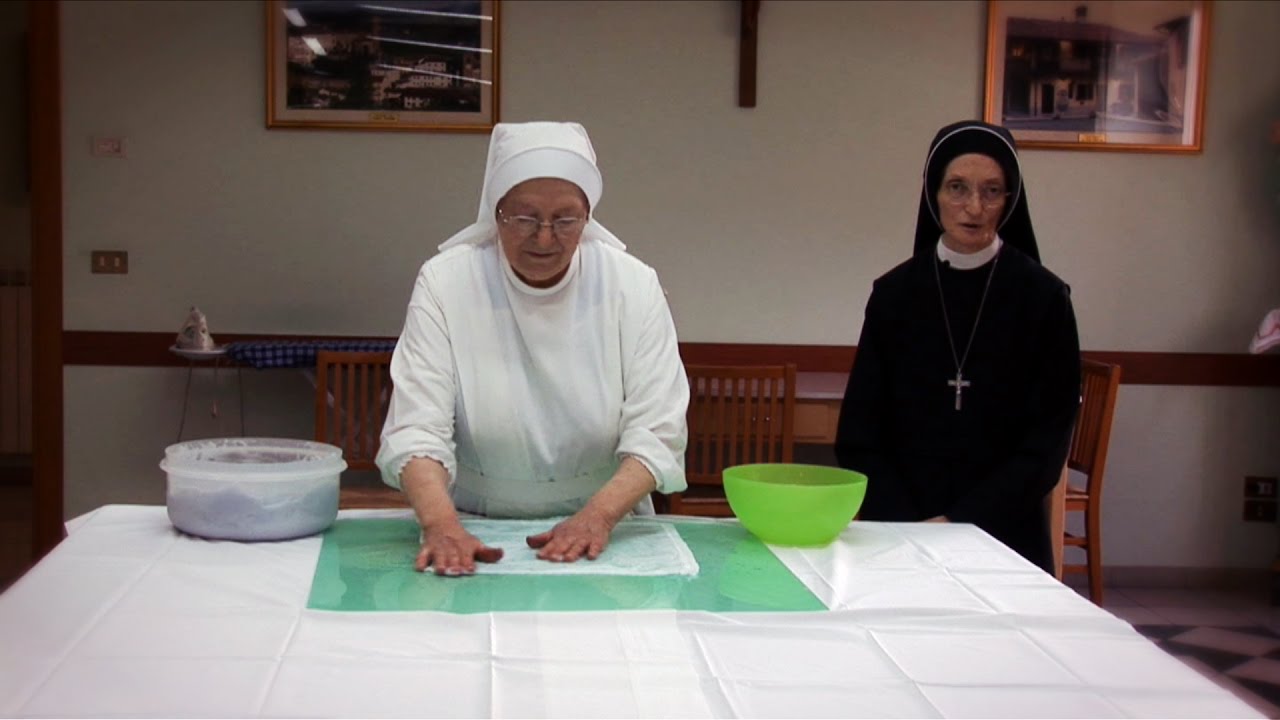
Year and years and years ago, I asked the Giuseppine nuns along the Tiber (who, by the way, to the linens for Ss. Trinità and San Pietro) how they accomplished the shine.   Memory served.  They use rice starch and Marseilles soap.  They spread the corporal, imbued with the same, on glass or the equivalent, and let it dry.  The oil in the soap helps to set the starch and allows you to peel the corporal off when dry.

So, my mise en place.   The soap is 80% olive oil.  Alas, there was only lavender scented at the store.  And I was worried about the green coloring… but… this was an experiment to figure out the proportions to use.

Starch.

Shave soap.

Into simmering water.

Start to add the starch in increments.  It will eventually thicken.

Yep… a little green.

I bought a sheet of clear acrylic.  Eventually I need a LOT more water on the right.

Get it really in there.  Pick it up and do both sides well.   Remember to put the business side DOWN.  That’s the side that will have the desired glassy finish.

Set up to dry.

Next day… when dry… get out your Dremel tool.

Just kidding.  I didn’t use my Dremmel.

Peal it off.

Ta daaah!  Success the first time.

It has a slight green tint when compared to another corporal.

I will now be on the hunt for high percentage olive oil soap which is both without fragrance and coloring.

Now that I’ve done this once, it will be easy to do again.

I have a bunch more of the starch/soap paste in the fridge.  However, I really want a new batch without coloring.

I am extremely pleased with the result and I will, tomorrow, use the corporal for Mass.

UPDATE:

Well look at this!  A commentator alerted us about this video from the very Giuseppine I mentioned above. Italian. But it is clear. It looks like the soap they used was blue!

YouTube thumbnailYouTube icon

Posted in "How To..." - Practical Notes, Fr. Z's Kitchen, Liturgy Science Theatre 3000, Save The Liturgy - Save The World, What Fr. Z is up to | Tagged , ,
22 Comments

40th Anniversary of the Anglican “Pastoral Provision”: a landmark of authentic ecumenism

As we know, Benedict XVI issued Anglicanorum coetibus, which provided for whole Anglican congregations to enter into communion with Rome and to retain substantively their liturgical tradition and to be self-governing.   Benedict is, of course, the Pope of Christian Unity.

However, that move was built on an earlier foundation, the “Pastoral Provision”.  St. John Paul II authorized an Anglican form of liturgy and a jurisdiction for Anglicans who came into the Church.

That was 40 years ago today.

There is a great article about this, and I urge you to look at it, at the site of the Anglicanorum Coetibus Society.  HERE

One of the reasons why I post this, is because my old pastor at St. Agnes in St. Paul, the late Msgr. Schuler, accompanied to Rome some of the early priests looking for this provision for a meeting with Card. Seper, who was Card. Ratzinger’s predecessor at the CDF.  Fr. Barker, one of those priests and now a member of the Ordinariate, was a guest at St. Agnes.  I remember him.

This is a great chapter of the Church’s modern history of authentic ecumenism.

Posted in Just Too Cool, Pope of Christian Unity | Tagged ,
1 Comment

How bad is the state of the Catholic Faith in Germany?

One incident can’t tar a whole nation. However, the single incidents keep heaping up and up and up.

The last in just how nuts Germany is.

From LifeSite:

German archdiocese celebrates Corpus Christi with photos of monstrance in profane places
Photos showed the monstrance in a playground, on a trophy room shelf, and on a park bench.

MUNICH, Germany, June 15, 2020 (LifeSiteNews) – In a new publicity stunt for the feast of Corpus Christi (where Catholic celebrate the body of Christ in Holy Communion), the German Archdiocese of Munich and Freising, headed by Cardinal Reinhard Marx, is promoting photos of a monstrance with a non-consecrated host in profane places like a playground, a trophy room, and a park bench.

The photos are accompanied by short texts without any connection to the meaning of the real presence of Christ in the Eucharist.

Taken by two lay ministers employed by the archdiocese, the pictures show a monstrance “in different places of everyday life,” outside of liturgical functions, for instance on a bench in the park, or in what appears to be a beauty salon.

[…]

“A whole series of successes. Some things were easy to achieve, for others I had to try really hard. It’s amazing what I’ve already done and accomplished,” the text stated. “And in the middle of it all, God. He hardly stands out. His message is also inconspicuous: You are good just the way you are. No matter what happens or what you do. I love you.”

[…]

The two lay ministers said their idea for putting a monstrance in profane places came about during a conference in 2019 that discussed “how to speak about God today in a modern and understandable way.”

They did not explain how their photos and texts are supposed to draw people to the Catholic faith, nor did they address the scandal the photos would cause among the faithful.

On Facebook, the Archdiocese of Munich and Freising made clear it was siding with the two lay ministers, after several users had criticized the publicity stunt.

[…]

Lay ministers, eh?

Where did they get the monstrance – okay, people can buy monstrances – WHERE DID THEY GET THE HOST?

If they took the Host without the priest’s knowledge, because they have keys to the church and access to the tabernacle, that’s a problem. The pastor’s first duty is care of the Eucharist. He is incompetent and they are sacrilegious thieves.

If the priest knew about this and supported it, then he is imcompetent and should be dealt with severly. The lay people should be instructed and then asked not to function again in what they do.

Any way you look at this… it’s sacrilege.

Posted in The Coming Storm, You must be joking! | Tagged ,
28 Comments

Your Good News

Do you have some good news for the readership?   How are things going with churches where you are?   (Good news, please.)

For my part, some of you great people who follow my live-streamed Mass each day sent donations for flowers.   I have had terrific luck with these alstromeria.  I think today is their final hurrah, for Mass.

Speaking of donors.  Some of you have contributed chess boards, pieces and clocks.  I would like to get something going with chess here.  My interest revived a while back – it seems like forever ago – when I was last in D.C. and at the Army and Navy Club on a Saturday morning.  They had a meeting of their chess club and they invited me to play.  It had been a really long time but I acquitted myself well.  I getting back into it.

Anyway, I have four vinyl boards and wonderful heavily weighted pieces which is quite simply a pleasure to pick up, along with four old fashioned wind up clocks (which they are for when the EMP hits).

Another simple pleasure provides good news, and again, due to the kindness of a reader who sent colatura di alici from my wishlist.

Chop up a clove (or more) of garlic.  Put it in a bowl.  Chop some parsley.  Put it in the bowl.  Put a three or four spoons of the colatura in the bowl.  You can also add some peperoncino (really hot peppers) or use flakes.  Put it in the bowl.   Let it all macerate while you cook the pasta.  Vermicelli works best for this: you want lot’s of surface for the mixture to cling to.  When the pasta is done, drain it very well and toss everything together in the bowl.

This stuff is super fast, simple, and out of this world.

Last night we had another Supper For The Promotion Of Clericalism.  There were seven of us clerics and we supped.

Here, by the way, are two of the boards set and ready for play last evening.

There was Campari and soda or Aperol Spritz with salty nibbles beforehand.  I made strozzapreti alla puttana siciliana, my variant of puttanesca using homemade caponata.  Leafy greens and a garlic vinaigrette with macerated cherry tomatoes.  Two 2″ thick rib eye on the big Weber in the courtyard.  Cheeses and Honey Crisp apples after and a choice of “Magnum” bars and “bomb pops”.  Amaro.


Posted in Fr. Z's Kitchen, SESSIUNCULA, What Fr. Z is up to | Tagged ,
27 Comments

15 June – Traditional Latin Mass – Monday – LIVE VIDEO: 1200h CDT (GMT/UTC -5)

Click To Contribute

I will LIVE stream a Traditional Latin Mass at NOON Central Daylight Time (= GMT/UTC -5 and ROME 1900h).

Today: Votive Mass of the Most Holy Trinity
Prayers Added: For the sick
After Mass: Prayer in time of pandemic
propria.org has the texts for this votive Mass HERE

Will you please tell others about these Masses?  Will you please subscribe to my channel? HERE

  • NB: You can usually find an English translation of the Mass formulary HERE.  Scroll down. Use the 1960 setting.
  • We can say the Regina Caeli together, since the Angelus bells are usually ringing when the live stream starts.
  • I will say a Spiritual Communion prayer at the very beginning for those of you who cannot make a Eucharistic Communion. 
  • I will also recite in Latin the traditional  “Statement of Intention” (…a hint to priests).
  • After Mass and the Leonine Prayers, I will recite a prayer in Latin “In time of pandemic” followed by a blessing with a fragment of the Cross
    For texts of Prayers before Mass for each day of the week, in versions for laypeople and for priests: HERE


THANK YOU to my flower donors!

Posted in Liturgy Science Theatre 3000, LIVE STREAMING |
1 Comment

ACTION ITEM! 15 June – 1930 EDT – Online DEACONETTE discussion! Free, but you have to sign up!

Here’s something sure to be of interest to all of you!

Promoted by none other than Jesuit James Martin.

https://www.facebook.com/FrJamesMartin/posts/10157078036511496

Dear friends: You’re invited to an online conversation:

Imagine the Future: A Church with Women Deacons
A conversation…

Posted by Fr. James Martin, SJ on Thursday, June 11, 2020

You, too, can participate!

The whole text if you don’t want to click those links.

Dear friends: You’re invited to an online conversation:
Imagine the Future: A Church with Women Deacons
A conversation on women deacons hosted by Sister Colleen Gibson, SSJ with Dr. Phyllis Zagano.
Monday, June 15
7:30 pm Eastern
This online event is free, but registration is limited to 500 participants. Register online here, and you will receive a confirmation email with additional instructions to access the talk. You are welcome to share this invitation with friends who may be interested.
https://hofstra.zoom.us/meeting/register/tJYsfuGoqzsuGtIsrbdnJKq9svbyASeYMmVa

I hope many of you will benefit from your active participation in this event.

HERE

Hurry!  It’s limited.  Fill up that room!

Posted in Deaconettes | Tagged ,
11 Comments

14 June – Traditional Latin Mass – Sunday – LIVE VIDEO: 1200h CDT (GMT/UTC -5)

Click To Contribute

I will LIVE stream a Traditional Latin Mass at NOON Central Daylight Time (= GMT/UTC -5 and ROME 1900h).

Today: 2nd Sunday after Pentecost

Prayers Added: For dear friends
After Mass: Prayer in time of pandemic

Will you please tell others about this Mass?  Will you please subscribe to my channel? HERE

  • NB: You can find an English translation of the Mass formulary HERE.  Scroll down. Use the 1960 setting.
  • We can say the Regina Caeli together, since the Angelus bells are usually ringing when the live stream starts.
  • I will say a Spiritual Communion prayer at the very beginning for those of you who cannot make a Eucharistic Communion. 
  • I will also recite in Latin the traditional  “Statement of Intention” (…a hint to priests).
  • After Mass and the Leonine Prayers, I will recite a prayer in Latin “In time of pandemic” followed by a blessing with a fragment of the Cross
    For texts of Prayers before Mass for each day of the week, in versions for laypeople and for priests: HERE


THANK YOU to my flower donors!

Posted in LIVE STREAMING |
Comments Off on 14 June – Traditional Latin Mass – Sunday – LIVE VIDEO: 1200h CDT (GMT/UTC -5)