Wait long enough and that hardly-to-be-imagined thing will happen.
Holy Church has been at this Holy Mass thing for a really long time and in really diverse circumstances. Hence, she has been through a great many “What if X happens…?” situations.
Wisely, and like the good mother she is, the Church used to tell us what to do, at least with general principles, so we could correct the situation and get on with it.
“What to do”, for example, “if a spider drops into the chalice after the consecration? … if a mouse runs across the altar and runs away with a host? … if the celebrant drops dead between the consecrations? … if it is discovered at the time of Communion that the wine for Mass was corrupt or had turned and wasn’t valid?”
Not to worry. Armed with first principles, priests know what to do!
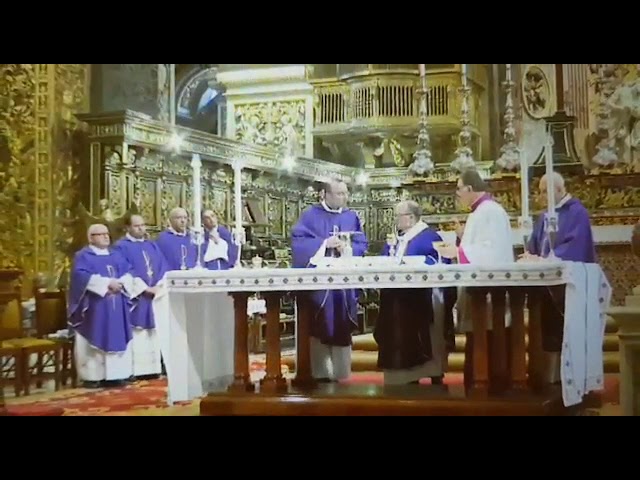
Take for example the recent Mass in Malta when the celebrant, Archbp. Scicluna, decided at the time of Communion that – surprise! – that was whiskey in that cruet and not wine.
I guess the sacristan was storing the ALTAR WINE bottle along side the ALLT-A-BAINNE. I mean, if you squint and know the right pronunciation, hey! They’re pretty close, right? Of course, a sacristan would want to keep those bottles in a place where they’d be, you know, “safe”.
So, the Archbishop gets a snoot full of Scotch – O Lord let it have been a single Malta – and informs the concelebrant… who immediately tried it! As one does.
You can hear them… “whisky… whisky…”, at which the camera lists to starboard to focus on a picture of a cleric. (Please leave your Graham Greene cracks at the door.)
So, here’s is what is supposed to happen next.
Once the substance in the chalice is determined to be invalid, you must take steps. Namely,
13. If the celebrant notices before the consecration of the Blood, even if the Body has already been consecrated, that there is no wine in the chalice, or no water, or neither wine nor water, he should immediately put in wine and water, make the offering as above and consecrate, beginning with the words Simili modo, etc.
14. If after the words of the Consecration he notices that there was no wine in the chalice, but only water, he is to pour the water into some vessel, put wine and water into the chalice and consecrate, starting again from the words Simili modo, etc.
15. If he notices this after consuming the Body, or after drinking the water in question, he is to set out another host to be consecrated, together with wine and water in the chalice, offer both, consecrate them and consume them, even though he is not fasting.
So, in this situation, having discovered that the stuff in the chalice was invalid matter, the celebrant should immediately require wine (and water) to be brought, probably with a new chalice, and a new host, and go through the two-fold consecration again.
Of course this situation in the video is complicated by the fact that it is a concelebration. How do you do this discreetly to avoid scandal… never mind that it’s being televised and because of that damnable clip on microphone you are saying “Whiskey” to the whole world.
Moral of the story. Don’t use clip on microphones!
Or, if you do, be sure to say the proper vesting prayer when putting it on.
Concede, Domine, virtutem labiis meis et prudentiam ad Tuam proclamandam veritatem, ut per indigni servi Tui vocem, vox Tui tonitrui in rota contremat terram.
One more thing before we break for a drink.
What constitutes valid matter, valid wine, for Mass?
For this spirited question we Unreconstructed Ossified Manualists turn to, of course, Tanqueray!
I am not ginning up a response to this important question. Tanqueray is really a writer of manuals of theology, in this case Tanqueray’s tonic for the soul the Theologia Dogmatica.
It is of divine institution that the only valid substances for transubstantiation are, for the Body of the Lord bread made from wheat and, for the Precious Blood, wine made from grapes or raisins (dessicated grapes).
But the grapes also have to be ripe, which rules out “wine” such as verjus (I actually have some, for ancient Roman and Medieval recipes). It can be red, white, dry, sweet, whatever. Some prefer red because it resembles blood. Some prefer white because it is easier to clean the linens.
Sometimes questions come up about the use of wine which has very low alcohol content, called mustum, a wine which had the fermentation process halted by means of rapid freezing. That is a valid substance because it is from grapes and the natural fermentation process began, making it wine. It has an artificially low alcohol content, but mustum is consider valid wine.
However, there is the other end of spectrum to consider: wine which has an artificially high alcohol content. Sometimes alcohol distilled from wine is added to wine in order to preserve it against spoiling, changing to vinegar. In this case we have “fortified wine”. The usual types of “fortified wine” we encounter are port, sherry, madeira, marsala, and vermouth.
 Long ago it was established that fortified wines are valid matter so long as the wine-spirit added was distilled from grapes, that the quantity of alcohol added, together natural content from the fermentation, does not exceed 18% and that the additional alcohol is added during the process of fermentation.
Fathers. If you have any doubts about the wine, don’t use it!
I would rule out vermouth, because herbs and so forth are added. I would not go for sherry because, if I am not mistaken, the addition of the spirits takes place after fermentation. Marsala seems to be okay, so long as it is 18% or less. Vin Santo, from dessicated grapes, is fine. As the name implies, it is wine for the altar! Port is valid, 18% or under.
Furthermore, this is a good reason why there are ecclesiastically approved makers of altar wines. If you have a doubt, don’t screw around with anything that may not be valid.
Lastly, back to that single Malta Mass. Do you suppose that the other cruet contained club soda?



 Was there a good point made during the sermon you heard for your Mass of obligation this 5th Sunday of Lent (Novus Ordo).