The Swiss Guard and the “Combat Rosary”

ORIGINAL Published on: May 7, 2016

Here is something extremely cool.

First, you may recall that last year we had a project to help one of the Swiss Guard have custom armor made.  HERE   I’ve stayed in touch with the Guard and his wife.

Then I got another project going, with the essential aid of my good friend Fr. Richard Heilman, who has been featured in these electronic pages often.   He took his parish to ad orientem worship and the numbers of attendants increased.  He put in an altar rail and moved his people to receive on the tongue.  He implemented Summorum Pontificum.  We just had the bishop there for Ascension Thursday.  He is the state chaplain of the Knights of Columbus and has many other things going, including something advertised on this blog on the side bar, his “combat” Rosaries, which he has made.  Super-tough Rosaries.

Now to the project.

At my prompting Fr. Heilman sent the gun-metal rosaries to all of the Swiss Guards.

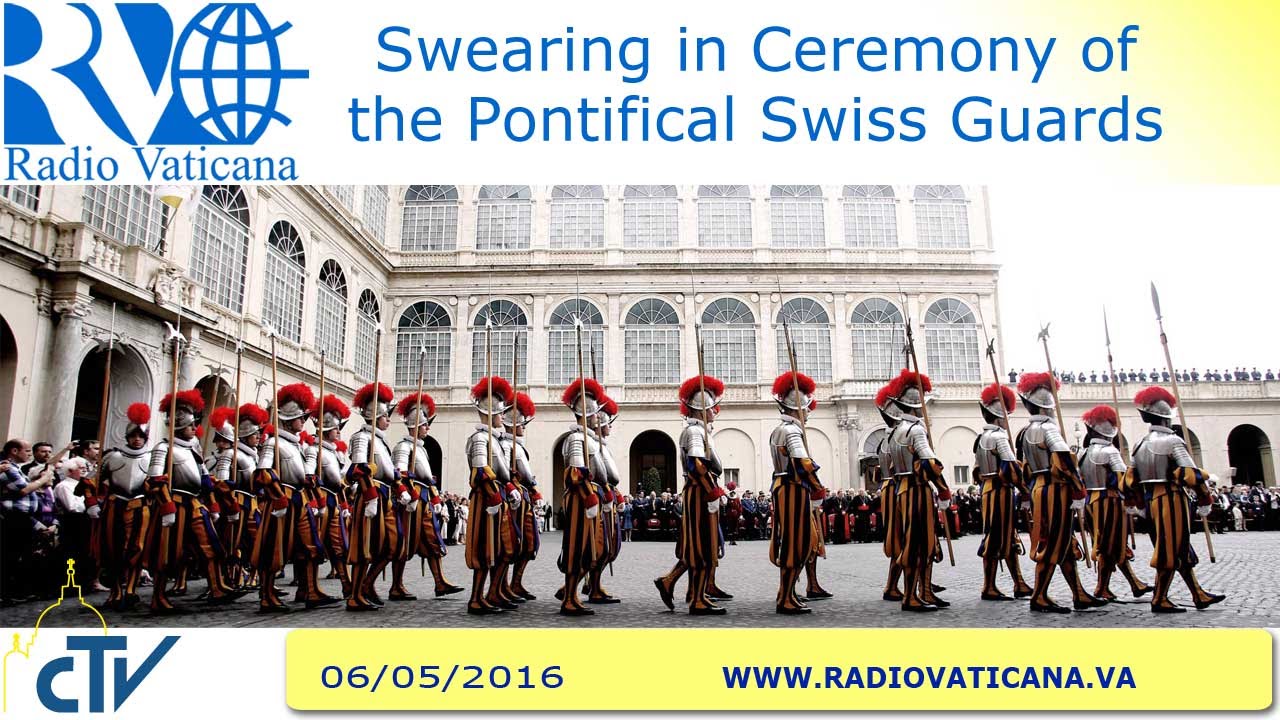
Today, during his address to the new recruits about to be sworn in, the Commandant held up one of them during his address and told them that training and arms are necessary, but “the most important weapon is the ‘combat rosary'”.  (Some of the speech – below.)

Is that not cool?

16_05_07_Swiss_Guard_Rosary_01

Yes, that’s cool.

More later on this.

Meanwhile…

YouTube thumbnailYouTube icon

Start at about 18:00.  The Rosary itself is held up at 20:37.

And…
16_05_06_Swiss_Guard_Rosary_03From ACISTAMPA:

CITTÀ DEL VATICANO , 07 maggio, 2016 / 11:00 AM (ACI Stampa).-
“Al momento giusto, all’inizio dell’anno, un generoso donatore ci ha sorpresi con un regalo. Egli ha fatto pervenire alla Guardia Svizzera Pontificia l’arma più efficace che esista sul mercato: il “combat Rosary”, letteralmente, il rosario per il combattimento. Subito è stato dato in dotazione a tutte le guardie. È importante che ritroviamo la via della preghiera,soprattutto la preghiera del Rosario.

La nostra vita, le nostre opere e le nostre azioni sono nelle mani di Dio. Questo però non significa che possiamo rinunciare alle armi e alle esercitazioni. Dio ci usa come strumenti per scongiurare il male in alcune situazioni. Per questo servono una fede salda, fiducia in Dio e preghiera”. Così il Colonnello Christoph Graf, Comandante della Guardia Svizzera Pontifica, ha salutato il Giuramento delle nuove reclute, ieri pomeriggio nel Cortile di San Damaso.

[My translation…] In the right moment, at the beginning of the year will a generous donor surprised us with a gift. He had shipped to the Pontifical Swiss Guard the most powerful weapon that exists in the market: the “Combat Rosary”…. They were immediately given to all the guards.  It is important that we recover the way of prayer, especially the prayer of the Rosary. Our life, our works and our actions are in the hands of God. This doesn’t mean, however, that we can give up arms and drills. God uses us as instruments to thwart evil in certain situations. For this we need a firm faith, trust in God and prayer.

[Here’s a bit more of his speech, which I transcribed from the video.]

During a morning Mass in the chapel of his residence, Pope Francis said, “faith is victory”. Last year in an audience granted in the occasion of the swearing of the new guards, the Holy Father invited the young men to dedicate themselves evermore to prayer even during their duty time. There is always time for this.  I assure you that this invitation is being followed. And we will help them to pray to God from our hearts and entreat the Blessed Virgin Mary, especially in this month dedicated to her, that they keep far from us every evil.

Cindy Wooden of Catholic News Service tweeted…

On another note…

This is great, but even greater would be YOU praying the rosary, whatever your rosary looks like.

If you don’t pray it, it’s just … there.  Right?

And…

GO TO CONFESSION!

UPDATE:

Great image…

Combat Rosary GI black and white

Posted in Just Too Cool | Tagged , ,
34 Comments

ASK FATHER: Going to another diocese of First Communion and Confirmation

12_04_27_confirmationFrom a reader…

My wife and I live in the Diocese of ___ and are devotees of the Extraordinary Form of the Holy Mass. Unfortunately, there are no viable EF Masses available in the Diocese on a regular basis, so we are members of our local Novus Ordo parish and support it financially.

However, we regularly attend an EF Mass on Sunday in the Diocese of ___ about an hour away. As of now, we have five children (Praise God!) – one of whom is ready to receive First Holy Communion next year. My question – are there any restrictions for receiving the sacraments in a diocese that is not the one that you reside in? If so, would I need my current Ordinary’s permission? I ask because our EF Priest doesn’t know, and we haven’t gotten any answers definitive elsewhere.

There should be no problem with your child receiving First Holy Communion in another diocese.  In this day and age of great mobility, this not infrequently done.  As long as the priest/chaplain in the other diocese is amenable to it, there should not be an issue.

Canon law states that it is the duty of the parish priest (i.e., the pastor) along with the parents to make sure that children who have reached the age of reason are suitably prepared for the reception of Holy Communion (can. 914). The law does not give the parish priest the absolute prerogative to be the one who gives a child his First Holy Communion.

As in all things, it’s best to be above board with this. Your pastor cannot prevent you from taking your child to another parish, or another diocese, for First Holy Communion, but ideally, he should be aware that you are doing this.

Confirmation gets a little (but not much) more complicated.

The law seems to favor a diocesan bishop confirming his subjects within his diocese. However, a diocesan bishop can confirm those who are not his subjects, but are in his territory (can. 886, 1) unless there is an express prohibition by the ordinary of the one being confirmed.

Posted in "How To..." - Practical Notes, ASK FATHER Question Box, Liturgy Science Theatre 3000 | Tagged , , ,
2 Comments

WDTPRS – Ascension COLLECT (1962MR): The hope that informs our trials in this life

Ascension 1651 by Francisco Camilo Museu Nacional dArt de Catalunya MNAC Barcelona smWe Catholics know that what was not assumed, was not redeemed (St. Gregory of Nazianzus).  Our humanity, body and soul, was taken by the Son into an unbreakable bond with His divinity. When Christ rose from the tomb, our humanity rose in Him.  When He ascended to heaven, so also did we.  In Christ our humanity now sits at the Father’s right hand.  His presence there is our great promise and hope.  It is already fulfilled, but not yet in its fullness.  That hope informs our trials in this life.

COLLECT – (1962MR):

Concede, quaesumus, omnipotens Deus: ut, qui hodierna die Unigenitum tuum Redemptorem nostrum ad caelos ascendisse credimus; ipsi quoque mente in caelestibus habitemus.

Our hard working Lewis & Short Dictionary can have a little rest today, I think.  There is nothing especially noteworthy in the vocabulary.  Let us therefore move on to a straight-forward…

LITERAL TRANSLATION:
Grant, we beseech You, Almighty God,
that we, who believe Your Only Begotten Son our Redeemer
to have ascended on this day to heaven,
may ourselves also dwell in mind amongst heavenly things.

Bl. Abbot Columba Marmion, OSB (+1923), wrote in Christ in His Mysteries that “of all the feasts of Our Lord … the Ascension is the greatest, because it is the supreme glorification of Christ Jesus.”

Then, speaking about the very Collect we are looking at today, Bl. Columba says,

“This prayer first of all testifies to our faith in the mystery in recalling the title ‘Only-begotten Son’ and ‘Redeemer’, given to Jesus, the Church shows forth the reasons for the celestial exaltation of her Bridegroom;—she finally denotes the grace therein contained for our souls. … The mystery of Jesus Christ’s Ascension is represented to us in a manner suitable to our nature: we contemplate the Sacred Humanity rising from the earth and ascending visibly towards the heavens.”

Of course it is not only Christ’s humanity but our humanity that ascended into heaven.

Preaching on 1 June 444 St. Pope Leo I “the Great” said,

“Truly it was a great and indescribable source of rejoicing when, in the sight of the heavenly multitudes, the nature of our human race ascended over the dignity of all heavenly creatures, to pass the angelic orders and to be raised beyond the heights of archangels. In its ascension it did not stop at any other height until this same nature was received at the seat of the eternal Father, to be associated on the throne of the glory of that One to whose nature it was joined in the Son.”

Leo says in another sermon of 17 May 445,

“This Faith, reinforced by the Ascension of the Lord and strengthened by the gift of the Holy Spirit, has not been terrified by chains, by prison, by exile, by hunger, by fire, by the mangling of wild beasts, nor by sharp suffering from the cruelty of persecutors.  Throughout the world, not only men but also women, not just immature boys but also tender virgins, have struggled on behalf of this Faith even to the shedding of their blood.  This Faith has cast out demons, driven away sicknesses, and raised the dead.”

The knowledge that our humanity is now enjoying heaven can work wonders for us in the hour of need. Keep this in mind in time of trial.

When the Lord ascended to heaven He did not lose touch with us His people in this vale of tears.  St. Augustine in s. 341 talks about Christ’s presence in every word of Scripture as Word equal to the Father; or as the mediator in the flesh dwelling in our midst; or Christ as the Head and Body together as in a spousal relationship, Christ and His Church intimately bound.

This means that Christ is not insensible to our sufferings.  Our faith in this unbreakable bond of Head and Body calls us to be clean and worthy of this saving intimacy.

Posted in EASTER, Liturgy Science Theatre 3000, WDTPRS | Tagged
Comments Off on WDTPRS – Ascension COLLECT (1962MR): The hope that informs our trials in this life

Just Too Cool: 9 May – The Transit of Mercury!

It’s not quite as nifty as the Transit of Venus (for which Sousa wrote a march), but it is still very nifty.

As viewed from your planet, Mercury will pass in front of your yellow sun on 9 May.

From NASA’s JPL:


Transit of Mercury 2016
This animation shows the path Mercury will take as it transits the sun on May 9, 2016. See below for more on how to safely watch the transit of Mercury. Credit: NASA

In the News

It only happens about 13 times per century and hasn’t happened in nearly a decade, but on Monday, May 9, Mercury will transit the sun. A transit happens when a planet crosses in front of a star. From our perspective on Earth, we only ever see two planets transit the sun: Mercury and Venus. (Transits of Venus are even more rare. The next one won’t happen until 2117!) On May 9, as Mercury passes in front of the sun, viewers around Earth (using the proper safety equipment) will be able to see a tiny dark spot moving slowly across the disk of the sun.

[…]

Then and Now

In the early 1600s, Johannes Kepler discovered that both Mercury and Venus would transit the sun in 1631. It was fortunate timing: The telescope had been invented just 23 years earlier and the transits wouldn’t happen in the same year again until 13425. Kepler didn’t survive to see the transits, but French astronomer Pierre Gassendi became the first person to see the transit of Mercury (the transit of Venus wasn’t visible from Europe). It was soon understood that transits could be used as an opportunity to measure the apparent diameter – how large a planet appears from Earth – with great accuracy.

In 1677, Edmond Halley observed the transit of Mercury and realized that the parallax shift of the planet – the variation in Mercury’s apparent position against the disk of the sun as seen by observers at distant points on Earth – could be used to accurately measure the distance between the sun and Earth, which wasn’t known at the time.

[…]

Go over there for tips on HOW TO WATCH IT.  For example, if you are human don’t be stupid and stare straight into your planet’s yellow sun with your naked eyes.

And from Spaceweather:

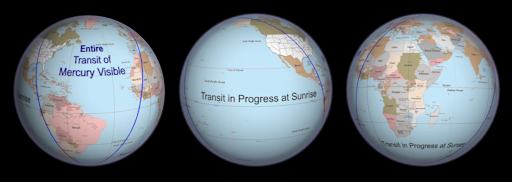
People on almost every continent can see at least some of the transit. These global visibility maps are courtesy of ShadowandSubstance.com:

Now for the bad news: Mercury is so small, you can’t see the transit with the unaided eye. Safely-filtered solar telescopes are required. Don’t have one? In that case, you can watch the transit online, broadcast live from the Coca-Cola Space Science Center in Columbus, Georgia. Also, NASA’s Solar Dynamics Observatory will transmit images from space.


Posted in Look! Up in the sky! | Tagged
6 Comments

Fr. Z’s Kitchen: Bronzino!

No, not the 16th c. mannerist painter.  The fish!

But first this.

I had an ammo loading class.   In this activity you also follow recipes!   (See what I did there?)  There are minimum and maximum specs to follow, depending on the caliber, type of casing, type of bullet (that’s the projectile part), and powder.  Follow the recipe and you minimize the chance of bad things happening.

In case you are wondering… Colt .45.  I don’t have a Colt .45, but we used that because, well, it’s big.

Moreover, I always pick up a dozen eggs at the gun shop. All gun shop owners should have fresh eggs from their own chickens.  This time I got a green egg… yes, it’s really green, and it’s produced by – I am told – an Americana.  Who knew?

I hope it’s not green on the inside, if you get my drift.

On the way home, I tuned in to part of James Levine’s last performance as Music Director of the Met.

Enough stalling.

Now – Bronzino, whole, on sale at the local shop.  When getting whole fish, check for firm flesh, clear eyes, and fish-smell within reason.  This one was lightly killed and gutted.

Hmmm…. biggest pan and it doesn’t fit.  Who cares?

I salted and peppered the cavity and stuffed in chopped garlic, thin lemon peel, thyme.

For some accompanying veg.  Mushrooms and green onions were on sale, so that’t what I bought.  Sauteed in olive oil and lemon juice.

I had room so I quartered a couple small tomatoes.

Into the (electric) oven on the high broiler setting for a few minutes on each side.

Sauvignon blanc, in case you wondered, not blanks being loaded.  (See what I did there?)

The other side was a bit more done, but I tore it up a little in the transfer.

As I dined on this crispy-skinned critter I watched the 1984 movie Amadeus, which features Mozart’s Entführung aus dem Serail, which was on the radio on Saturday.

As I come to an end, Archbp. Colloredo thinks that you need to order more ….

Mystic Monk Coffee….

… and then make a donation to the RED VESTMENT PROJECT.

UPDATE:

A friend set this… a splendid variation.  Except… notice that the fish is backward, which changes the flavor.

IMG_1677


Posted in Fr. Z's Kitchen | Tagged
13 Comments

It’s time to scare the hell out of kids – POLL

Here’s an idea… require all students at Catholic schools to attend a course taught by an exorcist.

In Spain….

Students at Spanish college forced to take exorcism class

A publically funded college [!] in Spain has told students that it is compulsory to attend a course given by a priest who is an expert in exorcisms.

The University College of Barberán and Collán (Colegio Mayor Universitario Barberán y Collán) is connected to the public research institute Complutense University of Madrid, and is also funded by Spain’s Defence Ministry. [As I sit here in The Cupboard Under The Stairs I have images of Defense Against The Dark Arts classes.]

But some of its curriculum doesn’t seem quite typical of a publicly-funded institute.

The college is requiring its 196 students – who are all members of military families – to attend a theological conference focused on “the fields related to the devil, exorcisms, being possessed and hell”, according to newspaper El Diario.

A woman who answered the phone at the college told The Local that there was seminar about exorcism, but could not immediately confirm other details.

The seminar called “The Evil” is set to take place on Thursday evening and will be led by Father José Antonio Fortea Cucurull, author of such works as “Summa dæmoniaca” – a treatise on demonology which includes a manual for exorcists.

[…]

So… this is at a secular school getting public funding from the military in Spain.

How ’bout this in Catholic schools?

This could be “New Evangelization” with an edge.

I suspect it would drive a lot of students to confession and attendance at the Traditional Mass of the Holy Roman Catholic Church, along with an increase in devotions.  On the other hand, these dark things can something have an allure that might draw the unwary into bad things.  After all, the modern entertainment industry has turned spiritual evil into a punch line and the modern education system has turn our young people into a bunch of dopes.

So… what could go wrong?

Let’s have a quick poll.  Anyone can vote, but only registered readers can comment.

Requiring students to learn about the Nature of Evil, Hell, Demonology, Exorcisms is...

View Results

Posted in ¡Hagan lío!, Four Last Things, Hard-Identity Catholicism, New Evangelization, POLLS | Tagged
37 Comments

SSPX Bp. Fellay: “This is new.”

I saw an interesting juxtaposition of churchy news items.

First, from the SSPX site DICI:

Europe: The churches are closing

That isn’t news, really. We have been seeing this everywhere. How the decades of reform have worked!

Next, from SSPX.org, we have some preaching from SSPX Bp and head Bernard Fellay at the consecration of one of their new churches. A taste:

…Let us ask God to help us understand this mystery a little better and understand that despite all human misery, despite the fact that even a pope is now saying unbelievable things on morality and trying to tell us that sin is the state of grace – what we are hearing today is unbelievable, unheard of! – well, despite that, this pope can still accomplish actions that sanctify and save. God has not taken from him his power to bind and to loosen (see Mt. 16:19). He can do good and he still does. It is the same with the bishops. These are great mysteries. It does not mean that we approve the evil that is done; far from it, we reject it and guard ourselves from it. But at the same time we recognize that in the Church there is something stronger and greater than the things we see: there is God, the infinite God, infinitely holy, infinitely good. There is one path that has been given to us for our salvation, for there is no other. If we wish to go to heaven, we have to go through the Church, the Roman Catholic Church; there is no other path. We can try to invent whatever we want: it is all to no avail. It is the only path. So we must not leave the Church.

There are scandalous things that happen these days, it is true, for what we see now is a situation of growing confusion, a more and more chaotic situation. You ask one bishop what he thinks, you ask another bishop what he thinks and they give contradictory answers, even on the essentials: the Faith, what we must do to be saved. So it is extremely serious. And as time goes on, the situation spreads.

And at the same time, we see how God works in His Church. At the same time we see that, especially among the youngest, there is starting to be a reaction, even high up in the hierarchy. There are cardinals and bishops who are starting to say: “This is too much.” They are starting to speak out. I would say that we are no longer the only ones protesting and reacting; there are others. This is new.

MEANWHILE…

At the National Schismatic Reporter (aka Fishwrap) we see their glee over the remarks of German Cardinal Karl Lehmann of Mainz, who was presided over the decline of the Church in Germany as president of the bishops conference from 1987 to 2008.

He complains that his team are not getting their candidates for the episcopate through.  Imagine my sorrow.  Get this:

However, Lehmann said he believed the nomination process was being disrupted by people “focused on a strict church policy allowing no deviation” and who had “knowledge of how things work in Rome.”

[Hold on….!] “Much greater attention should be given to an episcopal candidate’s theological competence than his formal orthodoxy,” said Lehmann. “There’s an urgent need for clarification — otherwise, the whole appointment process will come into question.”

Get that? When picking bishops…

Much greater attention should be given to an episcopal candidate’s theological competence than his formal orthodoxy.

So… they should be really smart, like him and Card. Kasper and not so much mired in all those dogmas and creeds and formulas.  I mean, they have to know those things, but they don’t really have to be attached to them.  Sure… there’s formal orthodoxy… clinging to those old formulae and teachings and stuff… and then there’s the really heady stuff that frees us from the rigidity of the “institutional” ossification of the spirit-filled blue-skying that has been such a success in Germany over the last few decades.

Sorry… I’m ranting.  I’ll let you all get back to reading your Rahner.

Posted in SSPX | Tagged ,
18 Comments

Sat 7 May – Met Opera: Maestro Levine to retire, last day of season

I have some friends who are inoperable.

No matter what I’ve tried, they don’t like opera.

What sort of person could they be?!?

In any event, in case you didn’t know, I believe that tomorrow is the very last conducting appearance of James Levine as the Music Director of the Metropolitan Opera.  HERE He will conduct Mozart’s Die Entführung aus dem Serail for the matinee.  With some seminarians I saw him a couple weeks ago conduct Abduction (Die Entführung aus dem Seminar).  Great cast.

You might try to tune in on radio or stream to hear a historical moment.  MET Check your local radio stations and also your satellite radio.

End of an era for opera.

Excerpt from the link above:

Levine made his Metropolitan Opera debut in 1971, when, at the age of 28, he conducted a performance of Puccini’s Tosca. Less than a year later, he was appointed as the company’s principal conductor, and he became the Met’s music director in 1976. To this day, he had led a total of 2,551 performances with the company—more than twice the number led by any conductor in Met history—of works by thirty-three composers. Levine significantly also expanded the breadth of the Met’s repertoire, conducting the company’s first ever staged performances of Berg’s Lulu; Gershwin’s Porgy and Bess; Rossini’s La Cenerentola; Verdi’s I Vespri Siciliani, Stiffelio, and I Lombardi; Mozart’s Idomeneo and La Clemenza di Tito; Schoenberg’s Erwartung and Moses und Aron; Weill’s Rise and Fall of the City of Mahagonny; Busoni’s Doktor Faust; and Berlioz’s Benvenuto Cellini, as well as world premieres that included John Corigliano’s The Ghosts of Versailles and John Harbison’s The Great Gatsby.


Posted in Events, Just Too Cool | Tagged , ,
9 Comments

Sam Gregg of ACTON on medieval distinctions about usury and legitimate forms of money-lending

I saw at American Banker an interesting article by Sam Gregg of Acton Institute which is excerpt from his new book For God and Profit: How Banking and Finance Can Serve the Common Good.  UK HERE

How Medieval Monks Changed the Face of Banking

Given that he was a member of the famously ascetic Franciscan order with his own reputation for detachment from worldly things, St. Bernardine of Siena (1380-1444) was remarkably insightful about money. [And about certain immoral acts, too.  And he wasn’t shy about preaching about them.  Also, note that Franciscans are friars, not monks.]

Understandably, most people are surprised to learn that some of the important intellectual developments that first enabled finance to become an engine of growth were made by men like Bernardine who had, for the most part, freely taken vows of poverty.

Like all medieval clergy, Bernardine fiercely opposed usury. [As did the Fathers of the Church.] In a sermon, Bernardine wrote: “Usury concentrates the money of the community in the hands of a few, just as if all the blood in a man’s body ran to his heart and left his other organs depleted.”

Yet the same Bernardine also invested time in explaining why it was legitimate for creditors to charge interest on loans to compensate themselves for relinquishing the opportunity to invest their money elsewhere. [That was not what the Fathers would have approved.] In such circumstances, he believed the lender had a right to be compensated for what amounted to foregone profits.

He wrote: “What in the firm purpose of its owner is ordained to some probable profit has not only the character of mere money or a mere thing, but also beyond this, a certain seminal character of something profitable, which we commonly call capital.”

This title, known as lucrum cessans (profits given up or what we today might call the opportunity cost of liquid funds) reflected the insight that money was not always sterile and could become productive: money could turn into capital.

Franciscans didn’t limit themselves to writing about such issues. From the 14th century onward, they sought to help the needy gain access to credit in the form of loan companies. The first of these lending institutions — more popularly known as montes pietatis — were established by Franciscans and initially funded by donations from wealthy Christians. The montes pietatis lent money to relatively poor people who were unable to access loans from established moneylenders. Borrowers would provide the montes with small items of value as a form of security for the loan’s repayment.

Controversy arose, however, when the montes began charging interest that ranged between 4% and 12%. One of their strongest boosters, another Franciscan, Bernardine of Feltre (1439-1494), insisted that some interest-charging by such institutions was essential if they were to become self-sustaining. Eventually, this became the norm for all Franciscan-established montes. Not surprisingly, they were also eventually accused of engaging in usury.

The montes and their interest-charging practices were, however, vindicated, first by Pope Paul II in 1467 when he approved the original montes in Perugia, [Barbo, an interesting guy.  The nephew of Eugene IV, he rose in the ranks quickly. Before his election he promised to give every cardinal a summer villa to beat the heat.  He was elected by acclamation at the first ballot.] and then by Pope Leo X in 1515 [Medici… he excommunicated Martin Luther in 1521.  So, Popes who are not always models of perfect holiness can do good things!  Which would be prefer, I wonder… Popes who are pious, but who do things to damage the Church, or Popes that are crafty and do things to build up the Church.] when he issued the papal bull “Inter multiplicis” also affirming that montes were not engaged in usury.

Subsequently, hundreds of montes emerged throughout Italy, France, Austria, Germany, Flanders and Spain. One of the earliest, the Monte dei Paschi di Siena, was founded in 1472 and still exists today. It is Italy’s third largest bank and employs thousands of people around the world.

Despite papal approval, usury accusations against the montes didn’t disappear. This produced defenses of their interest-charging by scholastic thinkers such as the 16th century Dominican Martín de Azpilcueta (1491-1586). He argued that the interest was, strictly-speaking, a charge for administering the loan rather than a direct payment for the loan.  [Another friar]

Many people today look at the way in which Christian thinkers reacted to these developments throughout the medieval and early modern period with some cynicism. [!] More than one person has suggested it amounted to Christians engaging in torturous semantics to help Christianity adjust to widespread economic changes as the world’s first forms of capitalism began taking root in medieval Europe.

To reduce such intellectual development to a crass adjustment to circumstances would be a mistake. Certainly, context is important. But it’s also true that an environment of immense economic change stimulated many Christian scholars from the 11th century onward to rethink the nature of money. Over time, they developed a series of important insights and clarifications — the most significant being a clear distinction between usury and legitimate forms of money-lending.

These writers did not approach these issues as economists. They addressed these questions in the context of moral theology and law.

In short, the ideas that drive modern banking — like the banking profession itself — have a much deeper pedigree than many people realize. That’s not a bad thing to keep in mind in an age when bankers and banking are viewed with much suspicion.

And… let’s all say it together!

ACTON INSTITUTE!

Posted in Our Catholic Identity, The Drill | Tagged , , ,
16 Comments

Atheists sue US House chaplain for not allowing non-prayer “invocation” in the House

From The Catholic League:

Atheists Sue U.S. House Chaplain
May 6, 2016

Bill Donohue comments on an atheist group suing the U.S. House chaplain:

Thursday, May 5, was America’s annual National Day of Prayer. So of course the anti-prayer Freedom From Religion Foundation (FFRF) [These goofs are based in Madison.] chose that day to sue the chaplain of the U.S. House of Representatives. FFRF president Dan Barker is upset that House chaplain Father Patrick Conroy, a Jesuit priest, has declined to invite him to deliver a non-prayer “invocation” on the House floor. FFRF also named House Speaker Paul Ryan, along with several members of Father Conroy’s staff, in the lawsuit.

Remarkably, Barker invokes his ordination as a Christian minister 41 years ago to justify his request—even though he later renounced God and proclaimed his atheism. [I fear for his soul.]  Noting that House rules require  guest chaplains to submit a valid ordination certificate, FFRF states that “Barker, who was a Christian minister for 19 years, retains a valid ordination, which he still uses to perform weddings.” Really? Do those he marries know that he has renounced the Christian faith for which he was ordained? In short, do they know that the man is a fraud?  [I suspect he gets paid.]

Fortunately, the House chaplain sees through this sham. It has been a long-standing requirement, Father Conroy explains, that any guest chaplain must be “ordained by a recognized body in the faith in which he/she practices (My italics.) “This is a substantive requirement—not a mechanical or check-the-box requirement,” Father Conroy wrote to Barker’s Congressman. “For example, I do not invite member-recommended individuals who have obtained an Internet-generated ordination to serve as guest chaplains, even if they hold deep and long-standing religious beliefs.”

All the more reason not to invite as a guest chaplain someone whose deep and long-standing beliefs are anti-religious. On a day in which President Obama reminded us of the need to “see God in everyone,” FFRF reminded us that they see God in no one.


Posted in Blatteroons, Puir Slow-Witted Gowk, You must be joking! | Tagged ,
5 Comments