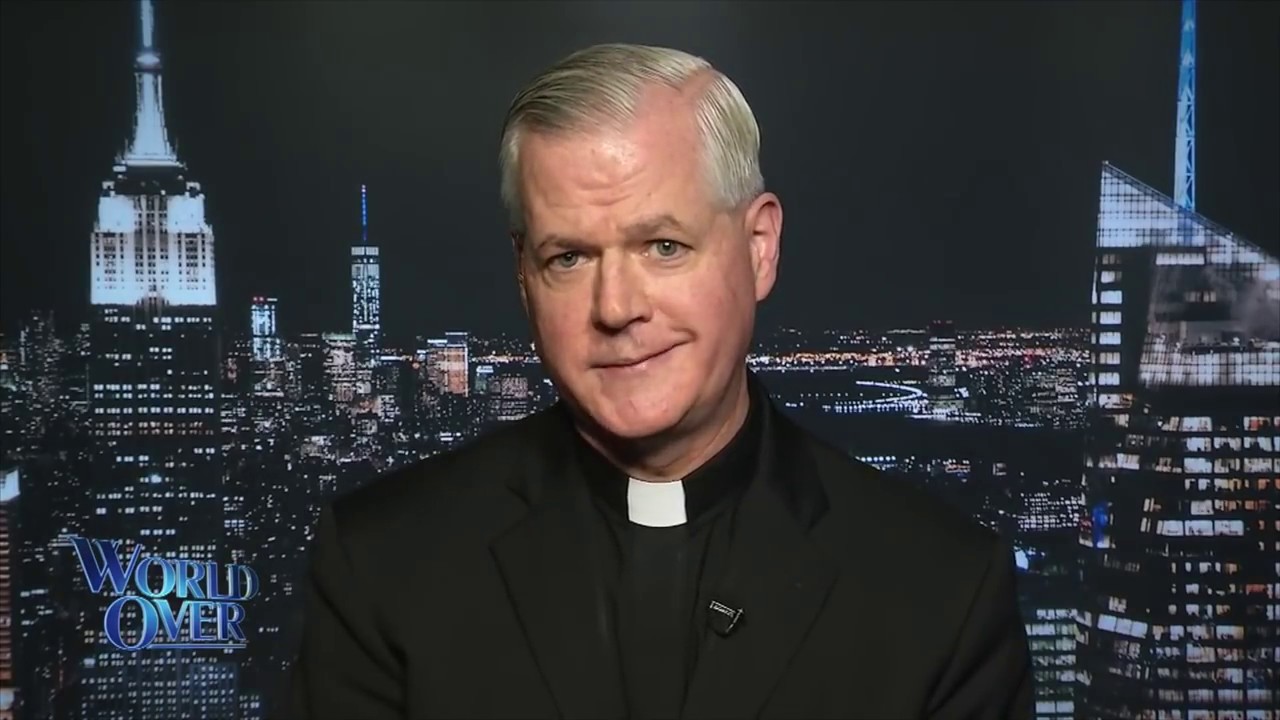
Francis trades quips with Polish photographer in Vilnius

If AP is to be believed about anything having to with the Church or with Francis, AP has an interesting tid bit about Francis’ present trip to Lithuania.

First, remember the great photo of John Paul II by Grzegorz Galazka?

Now read this…

VILNIUS, Lithuania (AP) — The Latest on Pope Francis’ visit to the Baltic countries (all times local):

6:35 p.m.

Pope Francis has acknowledged that his reputation pales a bit compared to St. John Paul II — at least as far as Poles are concerned.

Greeting journalists Saturday en route to Lithuania, Francis was given a book about the former pope by Polish photographer Grzegorz Galazka. Receiving the large book with a beaming John Paul on the cover, Francis quipped: “(Pope John Paul II) was a saint, I am the devil.”

Laughing, Galazka immediately corrected him: “No, you are both saints! You are both saints!”

Francis’ quip appeared to acknowledge that he has his detractors, particularly among conservative Catholics who long for the more doctrinaire papacies of John Paul and Emeritus Pope Benedict XVI.

The criticism of Francis by conservatives has grown more vocal recently amid the church’s sex abuse scandals and the distress over his opening to letting divorced and civilly remarried Catholics receive Communion.

Moderation is ON.

Posted in Francis | Tagged ,
20 Comments

Your Sunday Sermon Notes

Was there a good point made in the sermon you heard during your Mass to fulfill your Sunday Obligation?

Let us know.

For my part, I worked from the readings for this 18th Sunday after Pentecost.

Posted in SESSIUNCULA |
9 Comments

Archbp. Chaput of @ArchPhilly on upcoming Synod’s working document. Concerns.

Not only is there a new document out which changed the way the Synod (“walking together”) of Bishops runs, but a substantive supplemental document with more details (needed because the new document left things out) hasn’t yet been issued. The clock is ticking.

Before a Synod of Bishop convenes, a preliminary “working document” for the Synod’s meeting is issued. It is called in Latin an Instrumentum Laboris.

It seems that the IL for this upcoming Synod (on Young People) is… sub-par.

Archbp. Charles Chaput of Philadelphia – whom Archbp. Viganò says was personally maligned by Francis when they met for the first time (“[T]he Bishops in the United States must not be ideologized, they must not be right-wing like the Archbishop of Philadelphia!”) – received a summation of the IL from a noted theologian.  It concerned him enough to offer it to a wider audience through First Things.

Chaput wrote:

Over the past several months, I’ve received scores of emails and letters from laypeople, clergy, theologians, and other scholars, young and old, with their thoughts regarding the October synod of bishops in Rome focused on young people. Nearly all note the importance of the subject matter. Nearly all praise the synod’s intent. And nearly all raise concerns of one sort or another about the synod’s timing and possible content. The critique below, received from a respected North American theologian, is one person’s analysis; others may disagree. But it is substantive enough to warrant much wider consideration and discussion as bishop-delegates prepare to engage the synod’s theme. Thus, I offer it here:

If you are interested in the Synod (I think you should be), you should go to First Things and read the whole thing.  Sample:

The IL upends the respective roles of the ecclesia docens and the ecclesia discens. The entire document is premised on the belief that the principal role of the magisterial Church is “listening.” Most problematic is §140: “The Church will have to opt for dialogue as her style and method, fostering an awareness of the existence of bonds and connections in a complex reality. . . . No vocation, especially within the Church, can be placed outside this outgoing dynamism of dialogue . . . . [emphasis added].” In other words, the Church does not possess the truth but must take its place alongside other voices. Those who have held the role of teacher and preacher in the Church must replace their authority with dialogue. (In this regard, see also §67-70).

There were serious problems with the Final Report – and the procedure surrounding it – from the last Synod.  There were serious problems with the procedure of both the Synods on the Family.

Do you suppose, after the rigging of the last Synod, Zuhlio will have more to say about the Synod and present state of affairs?

Posted in "How To..." - Practical Notes, Synod, The Coming Storm, The Drill | Tagged , , ,
8 Comments

THIS IS WAR! Wherein Fr. Z calls on bishops and priests to FIGHT BACK as priests and bishops!

Preliminary note:  For the last two nights, I have had nightmares.  Last night was as bad as anything I have ever had and it was incredibly real.  As I wrote this post, I had the dreaded BSOD.   Hasn’t happened for long time and I was freshly rebooted.  Coincidence?


Under another post, about Akita, Communion in the hand, and homosexuality, I mentioned that certain vile sins – I’ll spare you – invite demons to attach themselves to the people who commit them and to the places where they are committed.

When I travel, one of the first things I do is bless the hotel room or place I am staying with Holy Water blessed with the older, traditional form.

Given that The Present Crisis is grounded in homosexual sins and cover ups by those who perpetrate them, we must also consider the other, dire spiritually corrosive effects of the demonic which of necessity infiltrates when sodomy is committed.  Also, the effects of sodomy will be graver because they also involve sacrilege.   When a priest, a consecrated person, commits sodomy, he also commits the sin of sacrilege, because he is a consecrated person.

Let’s call it…

#sodoclericalism

I suggest that demons revel in that opportunity and tenaciously latch onto any place where sacrilegious sodomy is committed.

If I were a diocesan bishop, I would quietly give all my priests the permission to use Chapter 3 of the traditional Roman Ritual‘s rites of exorcism. 

Chapter 3 covers exorcism of places.  I would give the priests permission to use it and then tell them that they should use it

  • in their rectories
  • in the convent if there is one
  • in the offices of the parish
  • on the grounds of the parish
  • in the school if there is one
  • in the sacristy
  • in the church

Si vis pacem para bellum!

Some time ago, I recorded the Latin of Chapter 3 and said that I would make it available to priests who request it.

The Devil hates Latin.  The Devil is also quite legalistic.  It is best to use good, clear Latin at all times when dealing with Hell.

NEVER FORGET:  Just as sacramental effects are not less real just because we can’t see, touch, hear, taste or smell them, so to other supernatural realities, such as the infestation or oppression of the demonic.

Priests are ordained to deal in these insensible supernatural realities more than they are ordained to deal with the administration of material goods, etc.   Anyone can do those things, but only priests and bishops and tackle the supernatural realm.  That’s what priests are really for.

Something important about the priest’s true identity has been obscured by the busyness of his daily life stretched out over years and years and years.   Couple that with the enervating long-term effect of celebration of weakened worship, with its deficient explication of priestly identity, and we have a real problem.

Priests and bishops and lay people alike need to wake up to who the priest is.

Fathers, let’s get some strong cups of traditional Catholic identity coffee and wake up.

THIS IS WAR.

It’s time to dust off and employ all our armor and weapons.  We have to get into the fight as priests who fight back as priests.  We aren’t just anyone.

We’re ALTER CHRISTUS!

And, Fathers, Excellencies…

GO TO CONFESSION!

That’s a preliminary to everything we do.

The rites of the Rituale Romanum are sacramentals.  Confession is a sacrament.  Sacraments are far more effective than sacramentals.

If you know that something really bad happened in a place, it might be a good idea not just to bless it and use Chapter 3.  You might say Mass there.    (Having an altar from St. Joseph’s Apprentice would be handy!)

Si vis pacem para bellum!

Our Lady, Queen of the Clergy, pray for us.

Posted in ¡Hagan lío!, "How To..." - Practical Notes, ACTION ITEM!, Si vis pacem para bellum!, Sin That Cries To Heaven, Wherein Fr. Z Rants | Tagged , , ,
23 Comments

Akita, Communion in the hand, and homosexuality

The Bellarmine Forum there is a longish piece which makes a connection between some topics:

Our Lady’s Messages at Akita
Communion in the Hand
Homosexuality

Said Our Lady at Akita:

“The work of the devil will infiltrate even into the Church in such a way that one will see cardinals opposing cardinals, bishops against bishops. The priests who venerate me will be scorned and opposed by their confreres…churches and altars sacked; the Church will be full of those who accept compromises and the demon will press many priests and consecrated souls to leave the service of the Lord.”

Full of those who accept compromises??So the problem is broader than the homosexual contagion.?The problem is the detente with the devil.?Being lax on error.?Going along to get along, it seems.

Here is something that I didn’t remember about the Akita messages:

While the criminal perpetrators have been frolicking around in clerics, some of whom lectured us on the need to be more tolerant, Our Lady gave us a clue in her Akita apparitions as to where the battle line should be drawn. During those apparitions, Sr. Sasagawa received the stigmata on her left hand. The statue of Our Lady had a matching cross-shaped stigmata in the right hand.  She and Bishop Ito interpreted this as a sign against receiving communion in the hand. Japan had a vote of its bishops in 1970 permitting communion in the hand. Three years later, Our Lady would tell them it was wrong.  This aspect of Akita condemning communion in the hand is frequently ignored by commenters today.  Yet, Sister Sasagawa and Bishop Ito repeatedly told anyone who asked that this was a major aspect of Our Lady’s message.?

Our Lady was telling us that the compromise over Communion in the hand was too much.

The article goes on with a misstep, in stating that Bp. Morlino (aka The Extraordinary Ordinary) “ended Communion in the Hand” in his Diocese of Madison.   However, Bp. Morlino did ask the priests of the diocese strongly to encourage people to receive on the tongue while kneeling.  He said that First Communicants should, first, receive on the tongue.   This doesn’t go so far as ending Communion in the hand in the Diocese, but it is a step in the right direction and highly to be praised.

It is also … coincidence?… that Bp. Morlino also sees clearly that homosexuality is at the root of The Present Crisis.

What about “clericalism”?   Sure.  I guess we can say that the environment of cover-up that the homosexual cabal within the priesthood created is a kind of clericalism, because they are clerics who created it.  However, in other environments, such as public schools, it isn’t clericalism.   “Clericalism” is not the problem.  Everything that goes with homosexualist subculture is the problem.  It is simply more evil within a clerical sphere because it is also the perpetration and protection of sins of sacrilege.

And let us not forget that demons attach themselves to people who commit certain sins and to the places where they are committed.

More on that under another post.


Posted in "How To..." - Practical Notes, Si vis pacem para bellum!, Sin That Cries To Heaven | Tagged , ,
10 Comments

Card. Zen on the “Provisional Agreement” with the PRC on Bishops

When I lived in Rome I had some contact with the Chinese Catholic ex-pat community.  Today, I can only imagine their heartbreak and fear.

The reaction of His Eminence Joseph Card. Zen is at LifeSite.

“It’s a complete surrender … I have no other words.”

The only consolation is that this is a “provisional” accord.

Communique?
concerning the signing of a Provisional Agreement between the Holy See and the People’s Republic of China on the appointment of Bishops

Today, 22nd September 2018, within the framework of the contacts between the Holy See and the People’s Republic of China that have been underway for some time in order to discuss Church matters of common interest and to promote further understanding, a meeting was held in Beijing between Msgr. Antoine Camilleri, Undersecretary for the Holy See’s Relations with States, and H.E. Mr. Wang Chao, Deputy Minister for Foreign Affairs of the People’s Republic of China, respectively heads of the Vatican and Chinese delegations.

During that meeting, the two representatives signed a Provisional Agreement on the appointment of Bishops. The above-mentioned Provisional Agreement, which is the fruit of a gradual and reciprocal rapprochement, has been agreed following a long process of careful negotiation and foresees the possibility of periodic reviews of its application. It concerns the nomination of Bishops, a question of great importance for the life of the Church, and creates the conditions for greater collaboration at the bilateral level.

The shared hope is that this agreement may favour a fruitful and forward-looking process of institutional dialogue and may contribute positively to the life of the Catholic Church in China, to the common good of the Chinese people and to peace in the world.

Comment of Greg Burke, Director of the Holy See Press Office:

This is not the end of a process. It’s the beginning. This has been about dialogue, patient listening on both sides even when people come from very different standpoints. The objective of the accord is not political but pastoral, allowing the faithful to have bishops who are in communion with Rome but at the same time recognized by Chinese authorities”.

Posted in The Coming Storm, The future and our choices | Tagged
26 Comments

WDTPRS – 25th Ordinary Sunday: Each love fuels the other, when love of God is first.

Want a really PIUS clock?  Click HERE!

This week’s Collect for Mass for the upcoming 25th Ordinary Sunday (Novus Ordo, obviously), was introduced into the Missale Romanum with the Novus Ordo but it is influenced by a prayer in the ancient Veronese Sacramentary.

Deus, qui sacrae legis omnia constituta in tua et proximi dilectione posuisti, da nobis, ut, tua praecepta servantes, ad vitam mereamur pervenire perpetuam.

OBSOLETE ICEL (1973):

Father, guide us, as you guide creation according to your law of love. May we love one another and come to perfection in the eternal life prepared for us.

BRUTALLY LITERAL ATTEMPT:

O God, who placed all things of the sacred law which were constituted in the love of You and of neighbor, grant us that we, observing Your precepts, may merit to attain to eternal life.

CURRENT ICEL (2011):

O God, who founded all the commands of your sacred Law upon love of you and of our neighbor, grant that, by keeping your precepts, we may merit to attain eternal life.

This Collect seems to be founded on the exchange between Jesus and a lawyer:

“But when the Pharisees heard that he had silenced the Sadducees, they came together. And one of them, a lawyer, asked him a question, to test him. ‘Teacher, which is the great commandment in the law?’ And he said to him, ‘You shall love the Lord your God with all your heart, and with all your soul, and with all your mind. This is the great and first commandment. And a second is like it, You shall love your neighbor as yourself. On these two commandments depend all the law and the prophets’” (Matthew 22:34-40).

St Thomas Aquinas (+1274) glossed this verse in his Commentary on Saint Matthew:

When man is loved, God is loved, since man is the image of God.

In 1 John 4:21 there is a good explanation of this double precept: “This commandment we have from him, that he who loves God should love his brother also.”

All of the Law is summed up in Jesus’ two-fold command of love of God and neighbor.

The first part of the two-fold law is about unconditional love of God. The second follows as its consequence.

We must cultivate our different loves in their proper order.

God comes first, always.

Always.

A married person must love God more even than a spouse. We must never put any creature, no matter how proximate to us in our hearts, closer than the God in whose image and likeness we are made. When this logical priority is properly in place, love of God and neighbor will not conflict or compete.

Each love fuels the other, when love of God is first.

HEY!  YOU out there promoting an agenda that can’t honestly be reconciled with the Church’s teaching!  You are putting something in God’s place.  That’s perilous.  You run the risk of burning in Hell for eternity.  You know who you are.  Some of you have SJ by your name.

Today’s Collect reestablishes that we have a special relationship with each person who lives, and not merely with God alone. People are made in God’s image. They are our neighbors, though some are closer to us than others.

But there is no person on earth who is not in some way our neighbor, even enemies.

This reciprocal relationship calls to mind another act of reciprocity which the Lord teaches us: forgive or you will not be forgiven.

When our Savior taught us how to pray what we now call the Lord’s Prayer (Matthew 6:9-13), the first thing he then explained and stressed was forgiveness:

“For if you forgive men their trespasses, your heavenly Father also will forgive you; but if you do not forgive men their trespasses, neither will your Father forgive your trespasses” (vv 14-15).

It is often hard to forgive.
The second section of the Catechism of the Catholic Church [US HERE – UK HERE ] digs into the Lord’s Prayer. When we get to the examination of “…as we forgive those who trespass against us” we read (2842):

“This ‘as’ is not unique in Jesus’ teaching: ‘You, therefore, must be perfect, as your heavenly Father is perfect’; ‘Be merciful, even as your Father is merciful’; ‘A new commandment I give to you, that you love one another, even as I have loved you, that you also love one another.’ It is impossible to keep the Lord’s commandment by imitating the divine model from outside; there has to be a vital participation, coming from the depths of the heart, in the holiness and the mercy and the love of our God. Only the Spirit by whom we live can make ‘ours’ the same mind that was in Christ Jesus. Then the unity of forgiveness becomes possible and we find ourselves ‘forgiving one another, as God in Christ forgave us.’”

QUAERITUR: When it is your time to go to Your Lord, will you be well-reconciled with the neighbors you leave behind?

Our time will come. Let us pray daily that we will not die without the solace and strengthening of the sacraments and an opportunity to make peace with our neighbor.

Do you have unfinished business?

Time is running out.

Reconcile with your neighbor.  Get right with God and others.

GO TO CONFESSION!

tick… tick… tick… tick… tick… ti-

Posted in GO TO CONFESSION, WDTPRS |
4 Comments

VIDEO: Fr. Murray on aspects of The Present Crisis

Let libs tremble and clutch their pearls upon their fainting couches.

My good friend Fr. Gerald Murray was interviewed by Raymond Arroyo last night on The World Over.

YouTube thumbnailYouTube icon

Posted in Mail from priests, The Coming Storm, The Drill | Tagged
5 Comments

ASK FATHER: Adding water to Holy Water

What are priests for?

Short answer: They offer sacrifice.

The role of the priest is to confect the Eucharist, absolve sins, impart blessings, preside at all manner of approved rites.   The jocular Scriptural basis for this is, of course, “For God so loved the world that he did not send a committee.”   Priests these days are pulled into all sorts of parish activities because of their role of governance in the Church, which goes along with their priestly and prophetic roles.  However, governance has been drawn down into the minutiae which can, if permitted, take him away from what he is really for: offering the Sacrifice, absolutions, blessing.

There has been for many decades now an erosion of the identity of the priest and of the bishop.  As the lodestone of liturgical worship which energized and activated them weakened, other forces drew them in.  Now they are pulled into all sorts of things and away from what they ought to be doing.

This struck me forcefully during the 7.5 hour ceremony for the consecration of the new Gower Abbey church.   There we no other place where it was better for priests and bishops to be.  What was going on there is precisely why we are ordained.  We were kicking the Enemy out of the place with mighty rites of cleansing and exorcising.  We were readying the sacred space for the people to enter.  We were making it into a mighty transceiver of grace and intercession.  That’s what priests and bishops do.  Only they can do it!

Hence, they should be allowed to be free enough to do those things that only they can do, for the sake of the People of God.

This little rant is a prelude to a question I received.

From a reader…

QUAERITUR:

Dear Father,

I was asked to help clean our parish Baptismal font (also use as a holy water font by parishioners). When we finished putting about 30 gallons of fresh water in it I was instructed to get one cup of holy water from the holy water container by the main entrance.

When I placed the cup of holy water in the baptismal font I was told this made all 30 gallons holy water?

It does not seem right to me? Can you tell what is going on?

Your sense did not fail you.  That wasn’t right.

What’s going on?

A couple things.

First, it sounds as if you have one of those “font of living waters” gizmos or one of those “wading pools”.   They are sort of silly, but let that pass.

Some people are under the impression that adding a little Holy Water to a large amount of unblessed water will render the whole into Holy Water.

No.

Some say that you can add some Holy Water to regular water as you describe.  Some will even say that so long as you add the same amount of Holy Water to regular, plus just a bit more – like one percent – and that’ll do the trick.  Thus, you would double the amount.  I think that’s a bad approach.  We should be more prudent and respectful.

The REAL solution I’ll post below.

But, in the meantime, let’s use the analogy of how much water can be, should be, added to the wine at the offertory in the preparation of the chalice.

Manualists say that no more than 1/5 (one fifth) of the volume of the wine should be added  by the water to be sure that the substance of the wine has not been compromised and, therefore, consecration would be invalid.  One fifth.

Let’s now apply this for the combination of Holy Water to water.  I would say that perhaps 1/5 of the volume of the Holy Water in regular water could be added to the Holy Water, in order to increase its volume by 20%.  And I think you could do that once.

You see… I think that Holy Water is important.  You don’t fool around with this stuff because we use Holy Water for serious purposes.  It is not a toy, part of a game, or a souvenir.   Holy Water puts to flight the influence of the Enemy.

That’s why I have never, not even once in 27 years of priesthood, ever used the new prayers for “holy water”.  I have always ever used the older, traditional form, with the exorcisms of the salt and the water before their blessing and mixing.

Here is the REAL solution for the concrete case described above.

Father should get off his backside, go over to the church and BLESS THE WATER (preferably with the older Ritual).

If Father can’t be bothered because he is involved with more important things, like a committee meeting, then, I contend, his priorities are screwy.  Sure, he might not be able to come at this very minute, but that’s his job: bless stuff.


Posted in "How To..." - Practical Notes, ASK FATHER Question Box, Hard-Identity Catholicism | Tagged
19 Comments

ASK FATHER: If in letters Benedict XVI imparts still the Apostolic Blessing…

Debates about the true status of Benedict XVI could root the stuff of novels.

There are those who say that Benedict XVI is still really Pope.  There are different reasons given.  One is that his abdication was under duress and is, therefore, void.  Another is that he himself did not intend to resign: why else would he remain in Vatican City, retain the papal name Benedict XVI and dress in the classic white cassock with white zucchetto, but not the simarra which, with its pellegrina or cape, is a symbol of jurisdiction?  Some wonder if there isn’t a way in which Benedict remains Pope but with a solely contemplative role, while Francis is pope with an active role which includes potestas, such that the munus Petrinum is now shared.

Here is another bit of information to toss into the speculation ring.

I received an email from a reader…

QUAERITUR:

Can Benedict XVI impart an apostolic blessing if he has ceased to be the Pope?

In the Bild article leaking excerpts of Benedict XVI’s letters to Brandmuller, he ends one with:

Beten wir lieber darum, wie Sie es am Ende Ihres Briefes getan haben, daß der Herr seiner Kirche zu Hilfe kommt. Mit meinem apostolischen Segen bin ich

Ihr

Benedict XVI

My translation:

Let us pray, as you did at the end of your letter,  that the Lord will come to the help of His Church.  I am with my apostolic blessing

Your

Benedict XVI

It may be that His Holiness B16 dashed that off as a matter of habit.  Heck, I know an older priest or two who still mention John Paul in the Eucharistic Prayer.

It may be that His Holiness is using the term somewhat loosely.

That said, the Apostolic Benediction is given by the Pope.   They do so solemnly on occasions such as the Urbi et Orbi blessing.  It is done at audiences (except when Francis chooses not to bless at all).  They do so also in writing for some occasions.

A few others in limited circumstances impart the Apostolic Blessing.  A priest can give it with an indulgence when someone is dying.  Bishops could give the blessing three times a year on solemn feasts.

However, in general Popes give this blessing and Popes customarily end special letters with an expression that they impart the Apostolic Blessing.

It is possible that Benedict XVI was using terms loosely, and really meant his pontifical blessing, his episcopal blessing as a bishop.

Finally, I suspect that Benedict, who by all reports is still as sharp as a scalpel, knows very well what he can and cannot do, none better.


Posted in "How To..." - Practical Notes, ASK FATHER Question Box, Benedict XVI, The Drill | Tagged ,
22 Comments