Must view video. Fr. Gerald Murray and Prof. Robert Royal comment on what’s going on.
In the wake of the Letter to Argentinian Bishop being placed in the AAS and of Il Papa Dittatore… just watch.
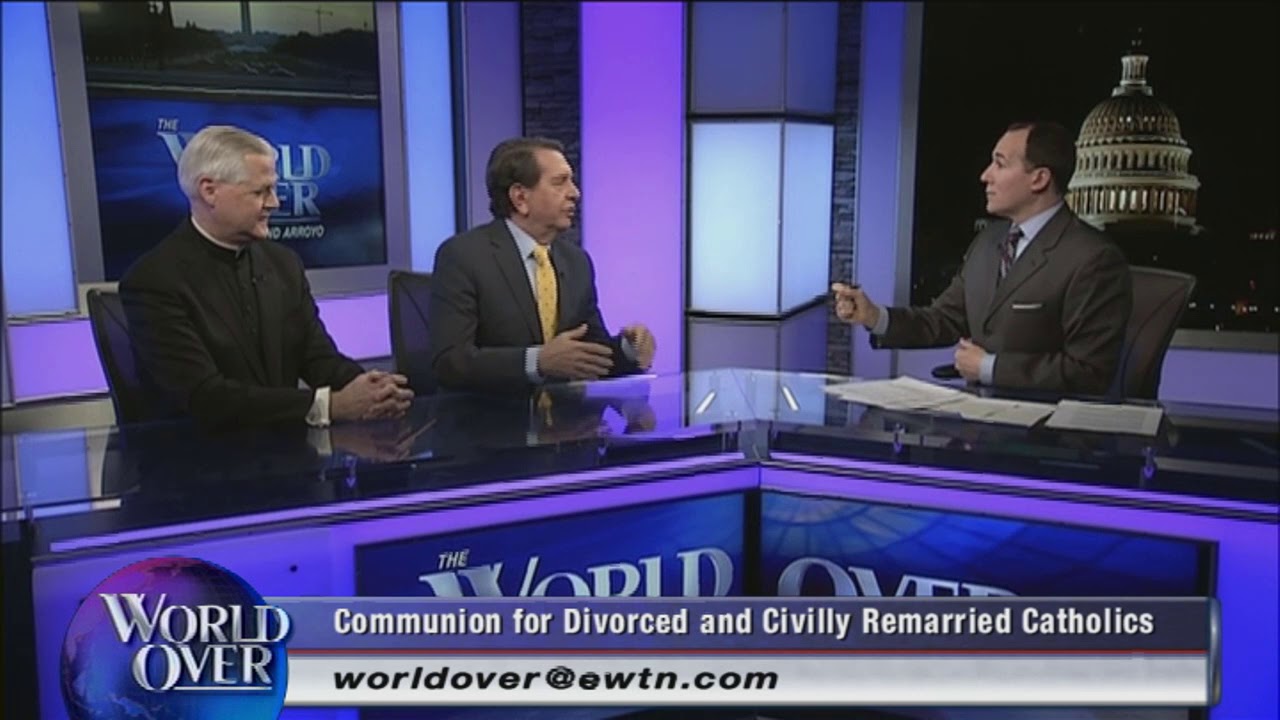

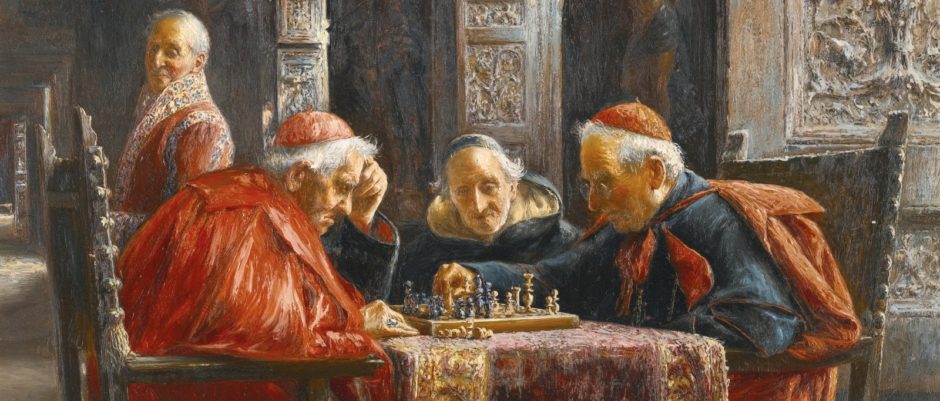
Must view video. Fr. Gerald Murray and Prof. Robert Royal comment on what’s going on.
In the wake of the Letter to Argentinian Bishop being placed in the AAS and of Il Papa Dittatore… just watch.
From a reader…
QUAERITUR:
Something that I have been wondering about is whether or not the Church could deny marrying a couple where one intended spouse was previously married, had children then the Church granted an annulment [declaration of nullity] saying the marriage was invalid. Could it be argued that, for the sake of the children from the first marriage, a new marriage would not be possible until those children were adult age and the damage minimized from a parent’s new marriage and family? I’m not sure I explained my question well but I see so many damaged children struggling with assorted wounds and disorders from marriage and remarriage and new children and new step parents and all that instability. If Amoris Laetitia guides Pastors to consider what’s better for children in new unions, shouldn’t the Church also be mindful of protecting children from [of?] previous unions, even if those first unions were granted annulments?
GUEST CANONIST RESPONSE:
A monitum (warning) or vetitum (prohibition) is usually only applied to one party or both if one or both of the parties simulated their matrimonial consent (i.e., said “yes,” but meant “no”), and therefore either should not or must not attempt marriage in the future until it is certain that nothing stands in the way of a valid and licit celebration of marriage, in accordance with canon 1066 of the Code of Canon Law; or if there is still present in one party or the other (or both) a serious anomaly or grave affliction of the psyche which rendered the marriage null due to incapacity to contract marriage (e.g., this can be anything from alcoholism or drug addiction to schizophrenia) as under such circumstances it is also necessary to verify ahead of time that any possible future attempt at marriage will not result in an invalid marriage (emphasizing once again the immense importance of canon 1066, the admonitions of which are gravely incumbent upon those who prepare people for marriage). [Fr. Z adds: Can. 1066: Before a marriage is celebrated, it MUST be EVIDENT that NOTHING stands in the way of its valid and licit celebration. – EMPHASES added!]
I have never heard of anyone who had a marriage declared null — having been declared free to marry and not having monitum or vetitum attached — having their right to marry (ius connubii) impacted or restricted due to the age of any offspring involved.
A Tribunal’s competence is to make a determination about the marriage presented at the request of one or both parties and, if necessary, to make provisions regarding any possibility of a future invalid attempt at marriage.
Ultimately, there is only so much any Tribunal can do. Painful family situations can often be addressed at the parish level or through counseling. Most family dysfunction is beyond the scope of any Tribunal’s competence to address or resolve.
That long-term, delicate, and time-intensive work must be left to others, in other sectors of the Church outside of the judicial branch.
Canon law can only do so much.
Fr. Z JUMPS IN
In addition to the monitum and vetitum, when a party is bound by a natural bond to a children from a previous union, can. 1071 §1, 3° requires the permission of the local ordinary before it may proceed.
It would be good for that to be spelled out in decrees.
 From a reader…
QUAERITUR:
A few weeks ago I went to confession, and after some words of consolation and admonition, Father gave me my penance. He said I had to pray to the Holy Spirit during Lauds and Vespers for a week (I’m a layperson, but I pray parts of the Breviary as my daily routine).
Problem is: I wasn’t able to fulfill this obligation because one day I simply didn’t have the time to pray Lauds/Vespers.
Does this make my confession invalid?
I’ve answered this question many times in these electronic pages. But, since it keeps coming up, let’s go at it again! Repetita iuvant.
FIRST: The absolution was valid.
Your doing the penance afterward or not doing the penance does not in any way alter the validity of the absolution.
Remember, every penance is arbitrary and cannot possibly be commensurate with offending God! Big and hard penances, small and easy penances… none of them are proportionate to offending our infinite God. We just do our best.
However, priests must give penances to penitents and penitents are obliged to fulfill penances themselves (can. 981). However, the penance should be clear, reasonable and doable in a reasonable period of time.
It should be clear: “Think a nice though about someone,” isn’t clear. How do you know when you have done it?
It should be reasonable: “Rebuild with your own hands old St. Ugthred’s Church, which has been abandoned since 1923.” Most people can’t do that.

Update your coffee ordering link!
It should be doable in a reasonable time frame: “Say the rosary for 100 days… Travel to the Shrine of Our Lady at La Vang, Vietnam… Next Easter Sunday (months away) do… Obtain and watch this movie ….”
This last point – reasonable time frame – was your situation. You are not obliged to say the Office. You sometimes don’t have time to do it in your state in life. So, don’t worry about it.
That said, doing penance for sins is an obligation we have out of justice. Penance is a necessary part of the sacrament of penance.
The next time you make your confession, tell the confessor that you are not sure you adequately performed the penance you were given last time, but add that the penance was complicated and drawn out over many days.
Ask for a clear penance you can perform right away. If you don’t think you can do something that the priest suggests, ask for something else.
 A few days ago wrote about the hard-hitting recently released on Kindle in Italian and in English. The author wrote under a pen name.
Controversial Book about Pope Francis: “The Dictator Pope”
In Italian – US HERE – UK HERE
In English – US HERE – UK HERE
Need a Kindle (trick question – YES! You do.)
US HERE – UK HERE
The book is making waves.
I read now at the UK’s best Catholic weekly, the Catholic Herald, an article about the book and the author.
‘They will unmask me eventually,’ says author of ‘The Dictator Pope’
The pseudonymous ‘Marcantonio Colonna’ claims Pope Francis has seen a shortlist of six possible authors
Marcantonio Colonna, the pseudonymous author of The Dictator Pope, has said the Vatican is trying to discover his identity. The book was published as a Kindle edition last week and has caused consternation with its claims about Pope Francis’s reign.
Speaking to the Catholic Herald over email, Colonna claimed that the Pope had been given a list of possible names.
“A person in England was misidentified as the author at one point and immediately received threatening telephone calls from Rome,” Colonna said. “I now hear that Vatican officials have laid before the Pope a shortlist of six people who they think may be the possible author. I suspect that it’s not for the purpose of awarding a literary prize.”
Asked whether he thought his anonymity would last, Colonna said: “Under the present Pope, the Vatican machine has taken espionage to a new level, and I have little doubt that they will unmask me eventually, perhaps after a few more false casts. But they will need to ask themselves whether it is at the cost of giving me more publicity.”
[…]
Read the rest there.
 In another post, I responded to a question from a reader about blessings at the beginning of sacramental confession, following the words, “Bless me, Father, I have sinned…”.
Of course, some people begin their confession differently.
It occurred to me to find out what you readers say?
Let’s have a POLL (now that my poll plugin is working! THANKS JL – and pppfffft to BY!)
Anyone can vote. You must be registered and approved to post a comment.
Pick your best answer.
And remember to examine your consciences and…
GO TO CONFESSION!
The first time I learned of the word “Fashionista” was back in the days of the Catholic Online Forum, when staffers Dawn and Gayle (who made the best, the most beautiful rosaries I’ve ever seen – RIP and prayers for her) went at it.
Let’s just say that Fashionista.com isn’t one I’ve bookmarked. However, someone sent me a link to a story about Catholic “millennials”:
WHY MILLENNIAL CATHOLICS ARE RE-ADOPTING THE TRADITIONAL CHAPEL VEIL
A growing group of young Catholic women are choosing to cover their heads in church.When former “America’s Next Top Model” contestant Leah Darrow first encountered young women in her Catholic community putting lace veils on their heads when entering church, she was a little weirded out. Having returned to the faith after a mystical experience on a magazine photo shoot [all those flashes?] convinced her to leave modeling behind, Darrow was serious about Catholicism — but wary of a practice she considered outdated at best.
“I was like, ‘Is somebody making you do this? What’s it about?'” Darrow says over the phone.
Since the practice of women covering their heads in Catholic worship spaces used to be the norm, but was largely abandoned by the ’60s, Darrow was uncertain as to what women covering their heads might signify in the 2010s. But the fact that the veil-wearing peers in question were “normal girls you could have a glass of wine with, but also very faithful” gave Darrow pause.
“There was something attractive to me about the life that they lived and how they prayed,” Darrow says. After researching more about the history and significance of veiling in the Catholic tradition, Darrow decided to try it herself. “I’m definitely a girly girl, so wearing a pretty veil sounded kind of fun,” she laughs.
Though Darrow didn’t start wearing a veil to mass every week, she did come to a new appreciation for the practice and now regularly brings a head covering on her visits to Rome, where she leads pilgrimages at least once a year. Her travels as a Catholic speaker and book author have convinced Darrow that veils are experiencing a renaissance amongst Catholic women — especially young American ones. [Wait ’til she discovers the TLM.]
“There’s a new uprising in the Church of millennials who are actually wanting a more traditional take on their faith,” she says. This poses a striking contrast to Protestant mega-churches that are leveraging streetwear and celebrity connections to stay relevant.
Samantha Skinner, a high school science teacher in North Dakota, is one Catholic millennial interested in a return to tradition. Raised loosely Protestant but not a regular church attendee until she converted to Catholicism in college, Skinner began wearing a veil to mass every week before she’d even completed the classes necessary to formalize her conversion. A conversation with a friend who worked in a “holy bookstore” convinced Skinner to try the practice for herself.
“It just kind of resonated with me,” she says on the phone. For Skinner, the appeal of veiling was initially an emotional one: It made her feel humbled and reverent, like removing a hat during the national anthem or at a funeral might, [which men do, but not women] and made her more able to focus on prayer.
[…]
¡Hagan lío!
Gazing at an image crafted by a true master who intended to open us up into mystery can, over time, produce great fruits.
For example, the 6th c. Byzantine icon of The Christ Pantocrator reveals two attitudes, in the two halves of His face. On the right side He holds the Gospels and His attitude is that of the severe Judge whom nothing shall escape. On the left, His hand blesses and his face is gentle.

If this treasury of ongoing spiritual dividends is true of images made by man, how much more might it be true of images made by God?
First and foremost, we contemplate Christ Himself, the Eternal Word made flesh. The Son is the perfect invisible image of the invisible Father, begotten but not made. In His Incarnation and Birth, the Son takes His Body, made with the Virgin Mother, and becomes the perfect visible image of the invisible Father. In contemplating Him we find infinite mysteries, awesome and alluring.
Next, each one of us are images of God. Each person reflects mystery. Our fallen nature’s solitary boast, moreover, presents mystery to us in her own way, as do all the saints who beautifully reflect God in living flesh. Remember that Holy Church has given two great patrimonies to the whole human race: art and saints, which both reflect, in different media and manners, the mystery of God in His goodness, truth and beauty.
And so we come to the point of my post.
I read today a story at LifeSite about the tilma of Our Lady of Guadalupe, whose feast it is.
The tilma has revealed many mysteries. As science advances, more and more fascinating – and hitherto unknown elements – are discovered in it, much as what is happening with the image of Mary’s crucified Son, the Shroud of Turin (which I happen to accept as being authentic).
Today, however, I read something that didn’t so much involve discovery of new depths in the tilma through technology, as through gazing.
The writer, Pete Baklinski, gazed at the image of Mary in the tilma. It eventually occurred to him that one side of her face looked happy, pleased, while the other side looked said.
The left side

The right side

He explored Mary’s message at Guadalupe and found themes of both joy and sadness. He suspects that her image means to reflect both.
You might go over there and read the whole account.
In 2012, five whole years ago and a few months, Benedict XVI answered a public question about the divorced and remarried. The occasion is a meeting in Milan and the 7th World Meeting Of Families. TEXT HERE
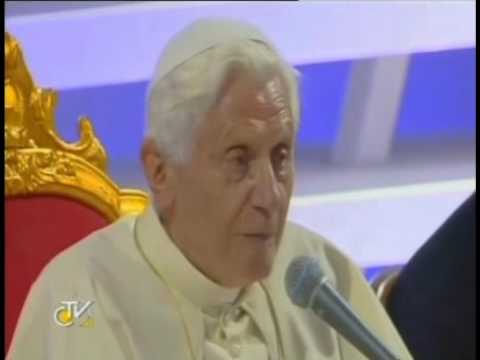
5 THE ARAUJO FAMILY (a Brazilian family from Porto Alegre)
MARIA MARTA: Holy Father, in our country, just as in the rest of the world, marriage breakdowns are continually increasing.
My name is Maria Marta and this is Manoel Angelo. We have been married for 34 years and we are now grandparents. As a doctor and a family psychotherapist, we meet a great many families and we notice that couples in difficulties are finding it harder and harder to forgive and to accept forgiveness. We often encounter the desire and the will to establish a new partnership, something lasting, for the benefit of the children born from this second union.
MANOEL ANGELO: Some of these remarried couples would like to be reconciled with the Church, but when they see that they are refused the sacraments they are greatly discouraged. They feel excluded, marked by a judgement against which no appeal is possible.
These sufferings cause deep hurt to those involved. Their wounds also afflict the world and they become our wounds, the wounds of the whole human race.
Holy Father we know that the Church cares deeply about these situations and these people. [Q:] What can we say to them and what signs of hope can we offer them?
THE HOLY FATHER: Dear friends, thank you for your very important work as family psychotherapists. Thank you for all that you do to help these suffering people. Indeed the problem of divorced and remarried persons is one of the great sufferings of today’s Church. And we do not have simple solutions. Their suffering is great and yet we can only help parishes and individuals to assist these people to bear the pain of divorce. I would say, obviously, that prevention is very important, so that those who fall in love are helped from the very beginning to make a deep and mature commitment. Then accompaniment [Remember, no Pope before 2013 ever talked about “accompanying”.] during married life is needed, so that families are never left on their own but are truly accompanied on their journey. As regards these people – as you have said – the Church loves them, but it is important they should see and feel this love. I see here a great task for a parish, a Catholic community, to do whatever is possible to help them to feel loved and accepted, to feel that they are not “excluded” even though they cannot receive absolution or the Eucharist; [A POPE said that? Really? But, hey. That was 5 whole years ago. Obsolete by now.] they should see that, in this state too, they are fully a part of the Church. Perhaps, even if it is not possible to receive absolution in Confession, [Wow… he said it again.] they can nevertheless have ongoing contact with a priest, with a spiritual guide. This is very important, so that they see that they are accompanied and guided. Then it is also very important that they truly realize they are participating in the Eucharist if they enter into a real communion with the Body of Christ. Even without “corporal” reception of the sacrament, they can be spiritually united to Christ in his Body. [He seems to mean what he says, this Pope.] Bringing them to understand this is important: so that they find a way to live the life of faith based upon the Word of God and the communion of the Church, and that they come to see their suffering as a gift to the Church, because it helps others by defending the stability of love and marriage. [Accompany them in their suffering?!? Which can be a defense of marriage and love?] They need to realize that this suffering is not just a physical or psychological pain, but something that is experienced within the Church community for the sake of the great values of our faith. [Hmmm… What are these “greater values”, of which he speaks?] I am convinced that their suffering, if truly accepted from within, is a gift to the Church. They need to know this, to realize that this is their way of serving the Church, that they are in the heart of the Church. Thank you for your commitment.
Let me get this straight.
That’s positively medieval!
But that was five whole years ago.
 From a reader…
QUAERITUR:
One of our wonderful [traditional order/institute] priests this Sunday mentioned – prior to his sermon – that he was surprised that so many of us were not correctly following the ritual of Confession.
He said that many begin with “Bless me, Father for I have sinned…” and then just go right into listing their sins. He said if we are asking for a blessing then we should stop and wait for him to bless us and then to proceed.
He said if you simply say, “Forgive me, Father…” and then go on that would be fine. But he said don’t ask for a blessing and not wait for it. [O! the HUMANITY!]
He actually seemed to be perturbed by this.
I have never ever heard that I should wait to be blessed and then proceed with my confession. I asked a couple of other parishioners and they had never heard of it either. [For good reason.]
Of course that may simply underscore Father’s admonition – that we need some catechesis.
Should we wait for a blessing before continuing with our confession?
Hmmmm… perhaps Father is young.
I see two scenarios…
I can picture it now.
The penitent literally wants a blessing before beginning and says “Bless me, Father!” and then stops, waiting for the blessing. Meanwhile, the inflexible priest, ordained now all of a couple months, grits his teeth on the other side of the grate and does … nothing. They remain there in the dark, in obstinate silence, each unwilling to blink. Minutes pass. A quarter hour. A half hour. The line, outside, knows exactly what’s going on. Someone leans forward to the next guy ahead and says, “I’ll bet she asked for a blessing.” The other penitents, nearby, sag a little and look at the floor shaking their heads in commiseration. A confessional Mexican standoff!
Or else…
The penitent kneels down and says, “Bless me, Father, for I have sinned. It has been four….”
“HEY! WAIT” says the priest, “Stop!”
“…weeks since my last confession. These are my….”
“NO! Wait a minute! You asked for a blessing and, by God, you are going to get one whether…”
“… sins. I lied three times. I kicked my dog twice. In a fit of picque I stabbed my…”
“Benedictio Dei omnipotenti, Patris et …. HEY HANG ON! SHHHHH!…. I’m trying to…”
“… husband in the left shoulder with a carving knife. I’m really sorry about that too. I was aiming for the right…”
“Would you STOP IT? I trying to give you the damn blessing you wa…”
“… because there was this big spider, see? The last time one of those critters bite him it was, like, all anti… anti… antipathetic – is that the word? – shock and all the swelling and choking. So, I.. I guess I did a bad…”
“…Patris… PATRIS!…. ET FILII….”
“…thing. Maybe that wasn’t a mortal sin. Father? What do you think?”
“…. DESCENDAT … no…. SPIRITUS… grrrrrr….”
“Father? Are you okay?”
I have several reactions to this.
First, Father should zip it when it comes to this.
We all agree that we should understand what we are doing as Catholics, especially important things like going to confession. We should be careful, think about what we do and say when, for example, we genuflect on entering pews, make the sign of the Cross, say our prayers… ask for a blessing….
But…
“Sheesh”, as we say.
I suspect that most people say, “Bless me, Father…”, as something they learned as a child from Sr. Mary Opportuna back at St. Fidelia’s School back in Blackduck. I’d do a poll on this, but my poll plug in is STILL BROKEN and my guy is ignoring me. In anglophone regions, I think most people will say “Bless me” or “Forgive me”. Either way of beginning is fine.
In “Bless me” Mode: Think about it. You are about to make a confession. You ask for the priest’s blessing to help you to do well and to keep off the Enemy of the soul. Later on, after you have confessed your sins, you explicitly ask for penance and absolution along the lines of, “For these and all the sins I cannot now remember, I ask a penance and absolution.” So, you wind up saying “forgive me” in some way. Right?
In “Forgive me” Mode: Think about it. You are about to make your confession. You make your confession and get absolution. You say “forgive me” in some way … again.
If the penitent has gotten into the confessional, isn’t it the usual expectation that she is there to be forgiven?
There’s nothing wrong with asking for a blessing. At the same time… you Blessing Wait-ers don’t have to wait for it either. Father can give you a blessing as you move ahead into saying how long it has been since your last confession.
How about some give and take, here?
Yet another scenario….
“Bless me, Father, for I have sinned. It has been four….”
[On the other side of the screen, Father silently raises his hand, gives a blessing, and keeps listening.]
“…weeks since my last confession. These are my….”
[Or, if there is a pause, Father says, “God bless you as you make your confession.]
Not as bloggable, I guess. But it does save time.
Father doesn’t have to go through the whole, “Benedictio Dei omnipotentis… descendat super te…” while you wait.
ASIDE: I would be curious to know if this same priest starts the Formula of Absolution while the penitents are still reciting their Act of Contrition. After all, if we are being literalists, we are not to delay absolution once the penitent has expressed adequate sorrow. The classic Act of Contrition said in most places starts with an expression of attrition, which is sufficient, if not as perfect as contrition. Hence, he should start the absolution during the Act of Contrition.
Orrrrrr …. he can wait for the penitent to finish. Either way.
As I was ranting… a penitent says, “Bless me, Father…” and I bless him, pause or not. What’s the big deal?
Understand. There should be a good, solid routine for making a confession, so that it is orderly and comfortable. This is especially important for children (and Father too, apparently).
However, while we are being orderly, we don’t have to be rigid or force people into only one groove.
If they want to say “Bless me” or “Forgive me” at the beginning, so what?
If they wait for the blessing… or not… big deal.
If at the end they say, “For these and all my sins, etc.”, as I do, or if, as some people from some ethnic backgrounds or formation say “My Jesus, mercy” to indicate that they are done confessing, or if they say, “That’s it, Father!”, you go forward.
As a matter of fact… at the beginning of a confession you don’t have to be in either “Bless me” or “Forgive me” Mode. You can just start bluntly by saying, “It has been [X] since my last confession.”
The essentials are:
So, you priests out there who would surely rail against sloppy, or non-traditional “McPenance”, but who nevertheless demand that penitents be just so, as if this were Burger King, please do us all a favor and unclench.
I am not for confessional anarchy. However, pull out the cork and let some pressure out. Going to confession is hard enough for most people.
Finally, everyone, review my
20 Tips For Making A Good Confession
And, having examined your conscience…
GO TO CONFESSION!
If Father sighs heavily when you say “Bless me, Father!”, just smile and get on with it without waiting in obstinate silence.
I am not making this up.
I discovered that TAN Books has put out an 2018 wall calendar (including both Ordinary and Extraordinary Form feasts, etc.) called… really…
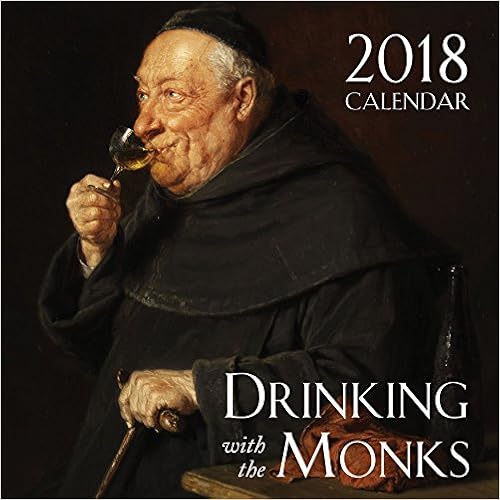
Of course they also have other calendars featuring artwork of the life of Our Lord and of the Blessed Virgin Mary, etc. They are beautifully printed and handy for keeping track of how the calendars of the two forms of the Roman Rite coincide and diverge.
For more
US

Coat of Arms by D Burkart









A Daily Prayer for Priests


They find you a pro-life agent in your area who commits to giving a portion of the fee to a pro-life group!

PLEASE subscribe via PayPal if it is useful. Zelle and Wise are better, but PayPal is convenient.
A monthly subscription donation means I have steady income I can plan on. I put you my list of benefactors for whom I pray and for whom I often say Holy Mass.
In view of the rapidly changing challenges I now face, I would like to add more $10/month subscribers. Will you please help?
For a one time donation...



Help Monks in Wyoming (coffee – UPDATED LINK) and Norcia (beer) and the wonderful "Soap Sisters" of Summit, NJ!


Please follow me on Twitter!










Visits tracked by Statcounter
since Sat., 25 Nov. 2006:

 WHY MILLENNIAL CATHOLICS ARE RE-ADOPTING THE TRADITIONAL CHAPEL VEIL
