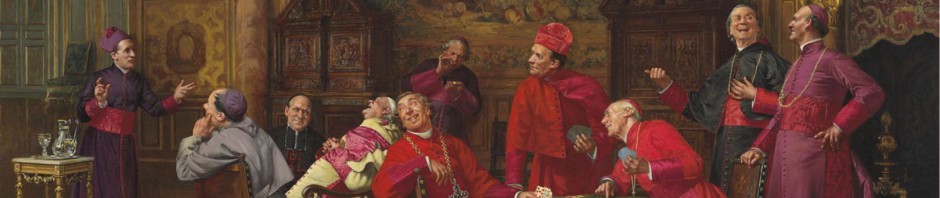
10 September 1957 – Pius XII to Jesuits

Pope-Pius-XII

Not amused

A priest friend of mine sent me the text of an Allocution to Jesuits made by Pius XII on 10 September 1957 (AAS 49 – pp. 802-812).  I haven’t found it in English and I don’t have the time today to render it for you, but here are a couple savory bits.

Pius is clearly concerned that the Jesuits are drifting from their moorings.  He reminds them of their Founder’s ideals for them and the special vows they make.  They are to be especially obedient, hierarchical, sound in doctrine, austere and detached from worldly things.  Note especially:

Sane inter praeclara facinora maiorum vestrorum, quibus iure gloriamini quaeque aemulari contenditis, illud ceteris praestat, vestram nempe Societatem, Cathedrae Petri quam intime adhaerentem, doctrinam a Pontifice illius Sedis, ad quam «propter potentiorem principalitatem necesse est omnem convenire Ecclesiam, hoc est eos qui sunt undique fideles» propositam, semper intactam custodire, docere, defendere, promovere conatam esse; nec quidquam quod periculosam vel non satis probatam novitatem sapiat tolerare.

[…]

Hanc autem laudem rectitudinis doctrinae et fidelitatis in obedientia Christi Vicario debita, nemo a vobis tollat; nec locus sit inter vos cuidam superbiae «liberi examinis», heterodoxae potius quam catholicae mentis propriae, qua unusquisque ea etiam quae a Sede Apostolica emanant, ad trutinam proprii iudicii revocare non refugit; nec toleretur coniventia cum quibusdam autumantibus magis ex iis quae fiunt quam ex iis quae fieri debent normas agendi atque ad aeternam salutem contendendi esse desumendas; nec sinantur pro libitu sentire et agere ii quibus disciplina ecclesiastica videatur res antiquata, vanus, ut aiunt, «formalismus», quo quis, ut veritati serviat, se facile eximat oportet. Si enim eiusmodi mens, ab incredulorum coetibus mutuata, in agmine vestro libere serperet, nonne brevi inter vos reperirentur indigni et infidi filii vestri Patris Ignatii, quamprimum e corpore vestrae Societatis resecandi?

[…]

HA! And if they were to get rid of harmful elements quamprimum… as soon as possible… from their own body, does it not stand to reason that, if they don’t do that, the Church should – quamprimum – get rid of that harmful foreign body from the body of the Church? 

Because Pius seems to have thought that the Jesuits were getting too worldly, he beats them for a couple paragraphs with exhortations not to use to many conveniences or travel much or spend time outside of religious houses.  They should practice mortifications.  He even says that they should stop using tobacco: “Inter ea annumerandus est usus, qui hac nostra aetate tantopere diffunditur, tabaci, quo variis formis adhibito homines delectantur.”  Jesuits have, in the past, had quite the relationship with tobacco, especially as missionaries in the New World and the Far East.

If I may be allowed a digression, I will observe that Leo XIII, St. Pius X, Pius XI and John XXIII used tobacco, either via snuff, cigars or cigarettes.  If memory serves, when younger so did Benedict XVI (some say he liked US Marlboros).  [UPDATE: Apparently not.] Not to get too far from the point of this post – the swift reformation of the Jesuits or their rapid suppression – my favorite papal tobacco story remains – and always will remain – that of the great Papa Lambertini Benedict XIV (whose Z-SWAG is available HERE – read more about it HERE with explanations).  Lambertini was a lover of tobacco in the form of snuff, which was very popular in the 18th century.  Decorative snuff boxes of the era are found in every great museum of the world.  One day, in a great gesture of friendly papal condescension, Benedict offered to a cardinal a pinch of snuff from The Apostolic Snuff Box.  The cardinal declined, saying, “Thank you, no, Your Holiness.  I don’t have that vice.”  Never at a loss for words, Benedict retorted, “Your Eminence, were it a vice, you would have it.”


Posted in "How To..." - Practical Notes, Lighter fare | Tagged , , , ,
17 Comments

WDTPRS – Pentecost (2002MR): Salvation selvage

detail-of-pentecost-EL-GRECOThis magnificent Sunday (which in the Roman Rite’s Extraordinary Form retains its Octave along with the special Communicantes and Hanc igitur) has in the Ordinary Form a Collect rooted in the ancient Gelasian Sacramentary.

Deus, qui sacramento festivitatis hodiernae universam Ecclesiam tuam in omni gente et natione sanctificas, in totam mundi latitudinem Spiritus Sancti dona defunde, et, quod inter ipsa evangelicae praedicationis exordia operata est divina dignatio, nunc quoque per credentium corda perfunde.

I like that defunde and perfunde.  Spiffy.

Cor is “heart” and corda “hearts”.  Sacramentum translates Greek mysterion.  Sacramentum and Latin mysterium are often interchangeable in liturgical texts.  Defundo means “to pour down, pour out”. Perfundo, is “to pour over, moisten, bedew”, and “to imbue, inspire” as well as “to dye”.

Exordium means “the beginning, the warp of a web”. Exordium invokes cloth weaving and selvage, the cloth’s edge, tightly woven so that the web will not fray, fall apart. Exordium, also a technical term in ancient rhetoric, is the beginning of a prepared speech whereby the orator lays out what he is going to do and induces the listeners to attend.  From Pentecost onward Christ the Incarnate Word, although remote by His Ascension, is the present and perfect Orator delivering His saving message to the world through Holy Church. “He that heareth you, heareth me”, Christ told His Apostles with the Seventy (Luke 10:16).  Much hangs on exordia.

LITERAL VERSION:

O God, who by the sacramental mystery of today’s feast do sanctify Your universal Church in every people and nation, pour down upon the whole breadth of the earth the gifts of the Holy Spirit, and make that which divine favor wrought amidst the very beginnings of the preaching of the Good News to flow now also through believers’ hearts.

OBSOLETE ICEL (1973):

God our Father, let the Spirit you sent on your Church to begin the teaching of the gospel continue to work in the world through the hearts of all who believe.

CURRENT ICEL (2011):

O God, who by the mystery of today’s great feast sanctify your whole Church in every people and nation, pour out, we pray, the gifts of the Holy Spirit across the face of the earth and, with the divine grace that was at work when the Gospel was first proclaimed, fill now once more the hearts of believers.

Unity and continuity are keys to this Collect.

The Holy Spirit pours spiritual life into the Body of Christ.

The Holy Spirit wove the early Church together through the preaching of the Apostles and their successors and, in the Church today, extends their preaching to our own time.

The Holy Spirit guarantees our unity and continuity across every border and century.

The Holy Spirit imbues and infuses, tints and dyes the fabric of the Church as He flows through it.

When the Holy Spirit poured over the Apostles, they poured out of the upper room and began to preach in public speeches to people from every nation.  The Holy Spirit, in the preaching of the Apostles, began on Pentecost’s exordium to weave together the Church’s selvage, that strong stable edge of the fabric, through the centuries and down to our own day.

The bonds of man and God symbolically unraveled in the Tower of Babel event, when languages were divided (Gen 11:5-8).

Ever since the Pentecost exordium’s “reweaving”, though here and there and now and then there may be rips and tatters, Holy Church’s warp and weft hold true.

Let our hearts and prayers be raised for unity. Sursum corda!

In our Collect we pray that our corda may be imbued with the Gifts of the Holy Spirit.  Sacrum septenarium!

Let them be closely woven into, knit into Holy Church and even over-sewn with her patterns, not ours.

Let our hearts be bounded about by her saving selvage, dyed in the Spirit’s boundless love.

Let us also pray for the unwitting agents of the Enemy of the soul, hanging onto Holy Church’s edge but in such a way that they tear at and fray the Church’s fabric.

Pardon my homographs, but though they be on the fringe, the periphery, they endanger necessary threads, precious souls of our brothers and sisters who through their work of unraveling can be lost in the fray.

When we mesh with the Successor of Peter and remain true in the Faith and charity, our holy selvage and our salvation will not be undone.

Posted in Liturgy Science Theatre 3000, WDTPRS | Tagged , , , ,
Comments Off on WDTPRS – Pentecost (2002MR): Salvation selvage

D. Madison – Five First Saturdays during Fatima Centenary – Answering Our Lady’s Call

OLFatima-200Answering Our Lady’s Call

Five First Saturdays at St. Mary’s Church, Pine Bluff, WI

This year we are observing the 100th anniversaries of the apparitions of Our Lady at Fatima, Portugal, from May to October 1917.

Central to the messages given by the Blessed Virgin Mary during those apparitions, and then for years afterward to one of the “seers” at Fatima, Lucia, was the urgent need of the faithful to do penance and make reparation for sins committed by humanity against Mary’s Immaculate Heart.

The Mother of God said that if her requests were heeded, many disasters could be avoided.

She also made the promise of divine assistance at the time of death to all the faithful who would make the Five First Saturday Devotion, which Pope St. Pius X had approved in 1904.

To respond in a special way to Our Lady’s request and promise, at St. Mary’s in Pine Bluff there will be for five months – from June to October – an explicit and convenient opportunity to help people fulfill the Five First Saturday Devotion specifically requested by the Mother of God.

The conditions for the First Saturday Devotion are:

1) Confession of sins before or within 8 days of receiving Holy Communion,
2) Holy Communion within 24 hours of the First Saturday of the month with the conscious intention of making reparation for sins which offend Mary’s Immaculate Heart,
3) recitation of a chaplet (5 decades) of the Holy Rosary with the intention of making reparation for sins,
4) 15 minutes of meditation on one, some, or all of the Mysteries of the Rosary with the intention of making reparation for sins.

Schedule:

3 June – Vigil of Pentecost
1 July – Feast of the Most Precious Blood
5 August – Feast of the Dedication of St. Mary Major
2 Sept – Votive Mass of Immaculate Heart
7 October – Feast of Our Lady of the Rosary

Each Saturday from June to October:

7:30 – Confessions before Mass
8:00 – Mass (Extraordinary Form)
Following Mass:
15 Minute Reflection on Mysteries of the Rosary
Recitation of the Rosary
Confessions

Printed material about the Devotion and a special “checklist” card will be available.

Rosaries will also be available for use.

The Five First Saturday Devotion can be undertaken alone or with a group. The conditions for the Devotion are not difficult. Nevertheless, the initiative at St. Mary’s is intended to make the undertaking as convenient and explicit as possible – during this 100th anniversary year – for the sake of gaining many graces and answering the unambiguous call for reparation for sins from the Mother of God herself.

Posted in ¡Hagan lío!, "How To..." - Practical Notes, Hard-Identity Catholicism, Our Solitary Boast | Tagged , ,
5 Comments

ASK FATHER: First Mass of a new priest – Requiem?

requiemFrom a reader…

QUAERITUR:

I have heard that there is an ancient tradition in which a newly ordained priest offers either his first Mass or one of the following Masses for the souls of the faithful departed, specifically for his deceased family members.

I ask because I recently saw some photos of a newly ordained priest (Deo Gratias) from Brazil, offering his first Mass in the OF: black vestments, biretta, etc for the faithful departed.

If you have any insights, thoughts, or information on this, may I ask your opinion? Thank you in advance.

I don’t know how “ancient” that tradition would be, but, yes, there are variations of this practice. It could be a fitting start to priestly ministry.

As far as one of the first Masses being a Requiem is concerned: imagine a new priest, thinking with gratitude about the role that his deceased parents or grandparents and others played in bringing him to the altar. He would, quite properly, want to “return the favor” as it were.

At the same time, any Mass can be offered for the intention of the living or of the dead. A Mass celebrated for the intention of the deceased doesn’t have to be a Requiem Mass.

My hope is that, soon, all newly ordained priests will have the opportunity to celebrate their First Mass in the Extraordinary Form, and even solemnly.

If a newly ordained priest wants to celebrated a Solemn Mass, and were he able to get around a little bit, perhaps we of the TMSM could be of help.

Posted in "How To..." - Practical Notes, ASK FATHER Question Box, Priests and Priesthood, Seminarians and Seminaries | Tagged ,
7 Comments

ACTION ITEM! Birettas for Seminarians Project RENEWED!

action-item-buttonYOU, dear readers, have supplied over 100 birettas to seminarians.  Kudos.  Some thank you notes from seminarians with spiffy new birettas HERE and HERE.

Last night after the Pontifical Mass I was chatting with seminarians and learned to my horror that a few of them have their names on the BIRETTA PROJECT LIST and that they have – O the pathos! – been waiting for some love.  For pity’s sake – HELP THEM!

What is this project and how does this work?

We want to get as many clerics to use birettas (and all that goes with them – fidelity to doctrine, reverent ars celebrandi, good life choices, solid priestly identity, etc.) as possible.

  • Seminarians should 1) discern their hat size and then 2) contact the biretta supplier and get their names on a NEED list.
  • YOU, dear readers, contact the biretta supplier and PAY FOR the birettas which are then distributed.

You remain anonymous to each other.

Seminarians and potential donors…

Contact John in church goods at Leaflet Missal in St. Paul – 651-209-1951 Ext-331. 

DO NOT WRITE TO ME TO ASK FOR A BIRETTA!  (If a seminarian doesn’t get that straight then… how are your grades?!?)

CONTACT TO JOHN AT LEAFLET.

If John is away, leave a voicemail with your phone number and he will call you back ASAP.

John keeps track of the names of the seminarians and their hat sizes. My involvement would only get in the way of the process. Don’t write to me.

Let’s encourage these men.

Call John and buy a biretta for a seminarian.  It’s as easy as that.

There is also a SATURNO FOR CLERICS Project.  Ask John about that, too!

Posted in ¡Hagan lío!, Seminarians and Seminaries | Tagged
4 Comments

What saint is this?

Any ideas?

Posted in Saints: Stories & Symbols | Tagged ,
37 Comments

Pontifical Mass at the Throne in Madison – PHOTOS

Last night, 31 May, His Excellency Most Reverend Robert C. Morlino, Bishop of Madison and Extraordinary Ordinary, celebrated a Pontifical Mass at the Throne at Immaculate Heart of Mary Church in Monona for the Feast of the Queenship of Mary.  The Mass was in the Roman Catholic Church’s Traditional, Extraordinary Form.

A lot of preparations go into these Masses.  There are a lot of moving parts.

Speaking of moving parts… the construction of the portable throne.

In attendance were many priests, seminarians and faithful.  The Knights and Dames of the Equestrian Order of the Holy Sepulchure of Jersusalem processed in with the bishop as Knights of Columbus provided the Honor Guard.  The music included lovely Marian hymns such as Ave Maris Stella, Regina Coeli and, with a great thunder of pipe organ, Hail, Holy Queen Enthroned Above for the recessional.  The Ordinary of the Mass was the Missa Prima by Fr Michael Haller (+1915) and the Proper in Gregorian chant.

During his sermon, Bishop Morlino, who observed his anniversary of ordination, spoke in a special way about the priesthood.

The Mass was also the occasion of the first use of the new set of white vestments from Rome, embroidered with the coat of arms of both the Diocese of Madison and of Bishop Morlino.   The vestments are intended for these complex Pontifical Masses and for ordinations to the diaconate and the priesthood.

This is the church back in the early 1960s, for a Pontifical Mass in the presence of the bishop.

IHMPhoto2-cropped

Getting ready to vest the bishop for a Pontifical Mass at the Throne on another occasion:

IHMPhoto1

Here is last night, from about the same angle.

17_05_31_PontMass_Queenship_06_BW

It would have been fun to recreate that old photo!

This, however, is how we set up the altar.

17_05_31_PontMass_Queenship_05

Some shots.

The deacon reverences the bishop before returning to the altar to fetch the Evangelarium.

17_05_31_PontMass_Queenship_01

17_05_31_PontMass_Queenship_08

17_05_31_PontMass_Queenship_03

Hanc igitur

17_05_31_PontMass_Queenship_10

17_05_31_PontMass_Queenship_04

The Second Confiteor

17_05_31_PontMass_Queenship_11

An afterward.

17_05_31_PontMass_Queenship_20

After the Mass the clergy and seminarians piled into the rectory for a splendid supper and celebration of the bishop’s anniversary.

Have you ever seen a biretta cake?

Help us with our NEW project!

HERE

Posted in ¡Hagan lío!, "How To..." - Practical Notes, Liturgy Science Theatre 3000 | Tagged , , ,
20 Comments

“Great as no goddess’s Was deemèd, dreamèd”

Today is, in the older Roman calendar, the Feast of the Queenship of Mary.  In the Novus Ordo calendar, this Feast was transferred to mere Memorial status on 22 August.  In the Novus Ordo calendar, 31 May is the Feast of the Visitation.

Pius XII wrote of Our Blessed Mother:

“Let all Christians, therefore, glory in being subjects of the Virgin Mother of God, who, while wielding royal power, is on fire with a mother’s love.”

Pius, in his 1954 encyclical Letter Ad caeli Reginam, proclaimed the Queenship of Mary and established her Feast.  He included in his encyclical many patristic references, amongst which is a quote from St Gregory Nazianzen (d 390) calling Mary, “Mother of the King of the universe,” and the “Virgin Mother who brought forth the King of the whole world.” There are also liturgical references from both East and West, including lines from the Tract of the Feast of our Lady of Sorrows: “Near the cross of Our Lord Jesus Christ there stood, sorrowful, the Blessed Mary, Queen of Heaven and Queen of the World.”  Since her earliest years, Holy Church has revered the Mother of God.

Here is a marvelous exhortation from Pius’ encyclical no less suitable for our own day and devotional lives than it was in 1954:

  1. Let all, therefore, try to approach with greater trust the throne of grace and mercy of our Queen and Mother, and beg for strength in adversity, light in darkness, consolation in sorrow; above all let them strive to free themselves from the slavery of sin and offer an unceasing homage, filled with filial loyalty, to their Queenly Mother. Let her churches be thronged by the faithful, her feast-days honored; may the beads of the Rosary be in the hands of all; may Christians gather, in small numbers and large, to sing her praises in churches, in homes, in hospitals, in prisons. May Mary’s name be held in highest reverence, a name sweeter than honey and more precious than jewels; may none utter blasphemous words, the sign of a defiled soul, against that name graced with such dignity and revered for its motherly goodness; let no one be so bold as to speak a syllable which lacks the respect due to her name.

There is lovely poetry in the feasts of our Faith, particularly when we celebrate the Blessed Virgin.  We could spend a moment with her today through the lens provided by one of the great poets of Modern English.

Hopkins is not easy.  First, simply try reading it through, aloud, and quickly.  Then go back and savor more slowly.

The Blessed Virgin compared to the Air we Breathe.
Gerard Manley Hopkins, 1918

Wild air, world-mothering air,
Nestling me everywhere,
That each eyelash or hair
Girdles; goes home betwixt
The fleeciest, frailest-flixed
Snowflake; that ‘s fairly mixed
With, riddles, and is rife
In every least thing’s life;
This needful, never spent,
And nursing element;
My more than meat and drink,
My meal at every wink;
This air, which, by life’s law,
My lung must draw and draw
Now but to breathe its praise,
Minds me in many ways
Of her who not only
Gave God’s infinity
Dwindled to infancy
Welcome in womb and breast,
Birth, milk, and all the rest
But mothers each new grace
That does now reach our race–
Mary Immaculate,
Merely a woman, yet
Whose presence, power is
Great as no goddess’s
Was deemèd, dreamèd; who
This one work has to do–
Let all God’s glory through,
God’s glory which would go
Through her and from her flow
Off, and no way but so.

I say that we are wound
With mercy round and round
As if with air: the same
Is Mary, more by name.
She, wild web, wondrous robe,
Mantles the guilty globe,
Since God has let dispense
Her prayers his providence:
Nay, more than almoner,
The sweet alms’ self is her
And men are meant to share
Her life as life does air.

If I have understood,
She holds high motherhood
Towards all our ghostly good
And plays in grace her part
About man’s beating heart,
Laying, like air’s fine flood,
The deathdance in his blood;
Yet no part but what will
Be Christ our Saviour still.
Of her flesh he took flesh:
He does take fresh and fresh,
Though much the mystery how,
Not flesh but spirit now
And makes, O marvellous!
New Nazareths in us,
Where she shall yet conceive
Him, morning, noon, and eve;
New Bethlems, and he born
There, evening, noon, and morn–
Bethlem or Nazareth,
Men here may draw like breath
More Christ and baffle death;
Who, born so, comes to be
New self and nobler me
In each one and each one
More makes, when all is done,
Both God’s and Mary’s Son.

Again, look overhead
How air is azurèd;
O how! nay do but stand
Where you can lift your hand
Skywards: rich, rich it laps
Round the four fingergaps.
Yet such a sapphire-shot,
Charged, steepèd sky will not
Stain light. Yea, mark you this:
It does no prejudice.
The glass-blue days are those
When every colour glows,
Each shape and shadow shows.
Blue be it: this blue heaven
The seven or seven times seven
Hued sunbeam will transmit
Perfect, not alter it.
Or if there does some soft,
On things aloof, aloft,
Bloom breathe, that one breath more
Earth is the fairer for.
Whereas did air not make
This bath of blue and slake
His fire, the sun would shake,
A blear and blinding ball
With blackness bound, and all
The thick stars round him roll
Flashing like flecks of coal,
Quartz-fret, or sparks of salt,
In grimy vasty vault.

So God was god of old:
A mother came to mould
Those limbs like ours which are
What must make our daystar
Much dearer to mankind;
Whose glory bare would blind
Or less would win man’s mind.
Through her we may see him
Made sweeter, not made dim,
And her hand leaves his light
Sifted to suit our sight.

Be thou then, O thou dear
Mother, my atmosphere;
My happier world, wherein
To wend and meet no sin;
Above me, round me lie
Fronting my froward eye
With sweet and scarless sky;
Stir in my ears, speak there
Of God’s love, O live air,
Of patience, penance, prayer:
World-mothering air, air wild,
Wound with thee, in thee isled,
Fold home, fast fold thy child.

US HERE – UK HERE


Posted in Liturgy Science Theatre 3000, Our Solitary Boast, Poetry |
4 Comments

31 MAY – MADISON, WI – Pontifical Mass at the Throne for Feast of the Queenship of Mary

This evening, 31 May, the Feast of the Queenship of Mary, we will have a wonderful Pontifical Mass at the Throne at 6 PM at Immaculate Heart of Mary Church in Monona, WI.  The Extraordinary Form Mass is organized by the TMSM with Bp. Robert C. Morlino, Bishop of Madison.

We will be using the new Pontifical Set in White.  NB: The Extraordinary Ordinary’s coat of arms on the “Filipo Neri” style chasuble.

To help with the work of the TMSM: >>HERE<<

Posted in Events, The Campus Telephone Pole | Tagged , ,
2 Comments

The Religion of Peace 102: Dawa

Today at The Catholic Thing there is useful information about Islam and its tenets.

Is “Dawa” in your vocabulary?

So, what do you know about dawa? You know what jihad is, and what sharia is. That is Islamic vocabulary 101.

At the more advanced end of the lexicon are terms such as taqiyya (a form of lying specifically permitted to advance the cause of Islam). Or the formerly obscure taharrush, which might sound familiar inasmuch as it – the practice of groups of men surrounding and sexually assaulting women in public – rudely materialized in several European cities recently. That there is a name for it suggests it is a frequent enough occurrence. Charming.

[… cutting out a bit which you should read, over there…]

Dawa can be likened to proselytizing, but it is much more than that. It might be summed up as the insidious project to Islamize the world – as cultural imperialism bent on corroding Western liberties and ultimately imposing sharia law. It is an all-encompassing precursor to jihad, a summons to conquer non-violently, and utilizes any number of mechanisms to achieve that end.

[…] [Years ago I read a transcription of a Friday sermon by an imam in Italy.  He told his listeners to “take their women”.  “If before we did not win with the long sword, we will win with the short sword.”  This is an example of dawa.]

Dawa is nothing short of the effort to subvert from within. It is “to the Islamists of today what the ‘long march through the institutions’ was to twentieth-century Marxists.” We have a hard time imagining the immutable designs of Islam, even though Islamic leaders themselves forthrightly say they will conquer Europe and America though dawa, not the sword. [!]

It would be hard to find this more explicitly spelled out than in the Strategic Plan of the Muslim Brotherhood for North America – a land they see as territory to be settled:

The [Muslim Brotherhood] must understand that their work in America is a kind of grand jihad in eliminating and destroying the Western civilization from within and “sabotaging” its miserable house by their hands and the hands of the believers so that it is eliminated and God’s religion is made victorious over all other religions.

To bring this about, alas, they are to become masters in the art of cooperation and coalition building. Authorities happened to stumble upon that document back in 2004, making their partners in “dialogue”– however much they want to seek common ground – all the more willfully credulous today.

[…]

We must not be ignorant of the tenets of the dominant religions of the world (including our own). Words matter, because they convey concepts which dedicated adherents of religions put into practice.

I recommend The Grand Jihad by Andrew McCarthy.  This explains how and why the liberal left coddles and cooperates in the destruction of Western culture.

US HERE – UK HERE

And, of course…

Defeating Jihad: The Winnable War by Sebastian Gorka.

US HERE – UK HERE

More on this HERE.

Many thanks to the reader who sent me the Kindle version from my wishlist.

Get a Kindle!  US HERE – UK HERE

Sts. Nunilo and Alodia, pray for us!

Our Lady of Victory, pray for us!

Posted in "How To..." - Practical Notes, The Coming Storm, The future and our choices, The Religion of Peace | Tagged , , , , , ,
19 Comments