
To all the priests out there still… unbelievably still putting sand in holy water fonts during Lent…
KNOCK IT OFF!
And if you go into a church where you see this sort of idiocy… for the love of God, DON’T bless yourself with SAND.
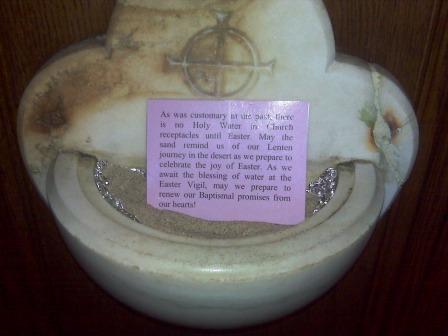
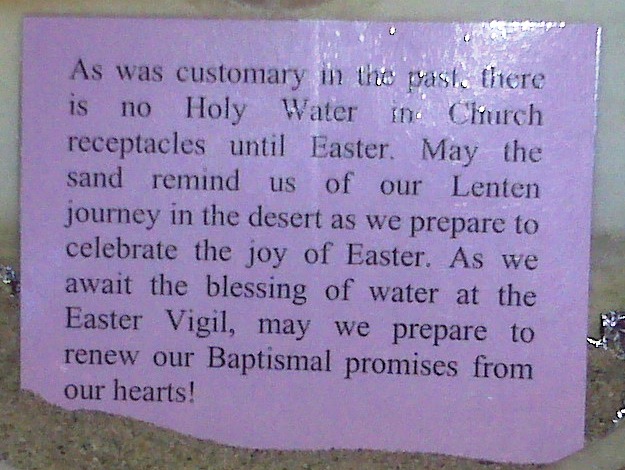
Total FAIL.
- Sand in your holy water stoup
- Dumb liberal idea #3464: Removing Holy Water during Lent
- Empty holy water fonts during Lent… GRRRRRR!
- QUAERITUR: removing holy water during Lent
You know you are a soldier and pilgrim in a dangerous world, right? What is Lent for? Spiritual discipline and war, right?
So why… why… why would these dopey liturgists and priests REMOVE a tool of spiritual warfare precisely duing the season of LENT when we need it the most??
Holy water is a sacramental.
It is not a toy, or something to be abstained from, like chocolate …. which is the stuff of a childish Lent.
This is a response from the Congregation for Divine Worship and Discipline of the Sacraments about this question. Enjoy.
The emphases are mine:
Prot. N. 569/00/L
March 14, 2000
Dear Father:
This Congregation for Divine Worship has received your letter sent by fax in which you ask whether it is in accord with liturgical law to remove the Holy Water from the fonts for the duration of the season of Lent.
This Dicastery is able to respond that the removing of Holy Water from the fonts during the season of Lent is not permitted, in particular, for two reasons:
1. The liturgical legislation in force does not foresee this innovation, which in addition to being praeter legem is contrary to a balanced understanding of the season of Lent, which though truly being a season of penance, is also a season rich in the symbolism of water and baptism, constantly evoked in liturgical texts.
2. The encouragement of the Church that the faithful avail themselves frequently of the [sic] of her sacraments and sacramentals is to be understood to apply also to the season of Lent. The "fast" and "abstinence" which the faithful embrace in this season does not extend to abstaining from the sacraments or sacramentals of the Church. The practice of the Church has been to empty the Holy Water fonts on the days of the Sacred Triduum in preparation of the blessing of the water at the Easter Vigil, and it corresponds to those days on which the Eucharist is not celebrated (i.e., Good Friday and Holy Saturday).
Hoping that this resolves the question and with every good wish and kind regard, I am,
Sincerely yours in Christ,
[signed]
Mons. Mario Marini [Later, the Secretary of the Pontifical Commission Ecclesia Dei, now with God.]
Undersecretary
I suggest little beach chairs made from toothpicks and a drink umbrella would look good in there…. maybe a golf ball?
Some fast sprouting beans and a little water when no one is looking?
Have sand in your fonts? How about some photos!?































Agreed, by that thinking why not just suspend celebrating the Mass during Lent and receiving Holy Eucharist? I will give up what I must for penance and to teach me to discipline my body to obey my soul, but I needs my Sacraments and sacramentals to make it through!
Another directive from Rome ignored in the diocese of Fresno, Ca. Sand in the water fonts, rocks and desert tumbleweeds around the altar and in the sanctuary. Write to the bishop and be told nothing is wrong. God help us. Holy Father send us orthodox sheperds to California where we suffer greatly.
Fr. Z opines: I suggest little beach chairs made from toothpicks and a drink umbrella would look good in there…. maybe a golf ball?
I’d be sorely tempted to “decorate” them with what any small container with sand next to a doorway suggests to me: with cigarette butts. [I know… I know…. But resist. The more jocular touch is best in a parish.]
Just when in the past was this customary? Holy Water fonts are empty only during the Sacred Triduum, and the rubrics say nothing about putting sand in its place.
Thankfully at the two churches I frequent in my California diocese, Holy Water can still be found!
Some years ago my wife and I belonged to a parish that emptied the stoups of holy water during lent, and put a huge bowl of ashes in the center aisle during Lent. I have to be honest, I kind of liked the idea.
But I don’t think it’s a good idea to use a bowl of ashes as a replacement for holy water during Lent. It seems to me that if you want to use that imagery during Lent, then fine, but keep holy water in the stoups, please. Put the bowl of ashes someplace else.
Perhaps one could put one’s envelope in the collection basket with a note saying, “As is my own personal custom, there is no check in this envelope until Easter. When the Holy Water returns, so will my financial support of this parish. Instead, a check has been sent to the Bishop, with an explanation of why I am withholding my funds at this time. May this emptiness remind us of our Lenten journey in the desert as we prepare to celebrate the joy of Easter. As you await the blessing of income at Easter, may you consider reading and reviewing liturgical law.”
What about baptismal founts? The churches I’ve attended that had baptismal fonts in the front of the church turned them off & drained them for Lent, leaving the ones by the doors filled.
Father, thanks to your blog a Holy Water “success story”. Last year I was disappointed to see the Holy Water disappear at one of the parishes we visit. I wrote the pastor, who was relatively new to the parish, and made particular note of the letter from the CDW (from your post last year). As always (at your suggestion) I wrote with charity. His response was encouraging, “sometimes the worst thing to hear is that is the way it has always been done.” The Holy Water did not reappear during last year’s Lent, but I was overjoyed to visit the parish last week to see the Holy Water in the fonts! BbyB.
Gotta love the homemade little tin foil font liner for the sand. Nice touch, lol.
“…in which Father Z tells unnamed Priests to ‘pound sand!’ “
Apparently the beach umbrella idea has been publicized as the latest variant I’ve seen is burlap. At least that’s probably a good deal easier to clean up than is sand.
Tim Ferguson: Bravo! Except I wouldn’t send the check to the bishop, either. Then he might be spurred to take action in his diocese.
“Childish Lent”?
I guess my abstaining from sweets needs to be revisited?
Tim Ferguson: you might want to fill the envelope with sand…
SO ridiculous! ARGH! This is so irritating.
I am so glad that my current parish does not do this, though, I sure bet that if our Pastoral Associate had her way they would. For those of you that have to deal with the sand in the font issue, might I suggest skillfully molded Tootsie Rolls to be placed in the sand when no one is looking.
rev96 – I wouldn’t fill the envelope with sand because that would just punish the (generally) nice, pious ladies who come in on Monday to count the collection, and who probably had noting to do with the silly “custom.”
and Tradster, I would send money directly to the bishop for two reasons – one to bring to the bishop’s attention that things are awry in his diocese, and two, to maintain my obligation to provide for the support of my pastors.
Of course sand is the right symbolism for the spiritual desert that is modernism. Anyone who runs into such sand should print the Prot. N. 569/00/L and place it in the “sand font.”
I thought they were being socially correct by giving us a place to put out our cigarette. So, you mean I shouldn’t have put my cigarrette butt in there? Oh dear.
Gratefully, this practice is loosing ground in my diocese after too many years. I think this sort of thing comes from a sense of misery in the Church. I have never met such unhappy and miserable people as those who ran the seminary I was sent to, and their only joy in life was making other people just as unhappy and miserable in every aspect of life as they were. It seems that so many clergy of a certain age only see holiness and good in being miserable and unhappy and I think sand in the fonts is a symbol of this idea.
How’s about putting jelly beans in the fonts at Easter . . . they are a symbol of new life, we’re told. Or Cadbury mini-eggs.
Yikes.
Not just tinfoil . . . but they don’t poultice the marble to get the stains off . . . and is that bathtub caulk applied by some well meaning home handyman?
You’d think somebody in the parish would know how to repair and refurbish marble properly. It’s fiddly work, but they make wonderful resin/marble dust cement (we’ve used it to repair family gravestones).
I like the Tootsie Roll idea. I once made a cake like that for a CFA party, the recipe must be on line somewhere by now.
It was also customary in the past to say Mass in LATIN!!!
I ran into this at a couple of parishes in my diocese in the past. Just before Lent, our bishop put out a letter to priests to tell them to keep the Holy Water in the fonts, articulating the same reasoning as Fr Z that we need the sacramentals at this time of Lent. The faithful were reporting to the bishop the lack of Holy Water during Lent. Hats, er, birettas, off to Bp. Braxton. Good for the people for speaking up.
On Ash Wed, I went to the area’s Shrine, Our Lady of Snows run by the OMI order, where I’ve encountered no holy water in the past. [They do not put sand, as they have an indoor waterfall from which allegedly holy water flows. Is it really holy going through those mechanisms?] They did have the water continuing to flow this year.
I’ve heard of a parish in town where the priest covered all the statues for the entire Lenten season, because he wanted anyone who walked into the parish to “feel” like it was lent. Does anyone know if this is allowed?
Might I suggest alfalfa sprouts? They are cheap and sprout easily.
Peggy,
At least things are moving in the right direction in our diocese. I haven’t seen the sand or empty fonts in a few years here in 618 land.
johapin
I believe that is a time honored tradition. As a child I remember that in every church. I thought it a beautiful idea.
Replacing water with sand during Lent is seen by Modernists as acceptable because they don’t believe that Holy Water is indeed Holy. They undoubtedly view it as merely symbolic of Baptism, which in the minds of many Modernists, is also merely symbolic. So sand is equal to Holy Water as a symbol. We need to get people back into contact with true Catholic spirituality, including the intrinsic value of Sacramentals.
On a related topic, I’m looking for a gothic-style (or other classical style) Holy Water font for my home for daily use as I go out into the world… does anyone know a good supplier of tasteful holy water fonts? There are a lot of tacky ones for sale out there.
Thankfully, we have not been troubled in the 615 diocese with sand in the holy water fonts. At least, not to my knowledge. On the other hand, we have been blessed with faux desert scenes – rocks, cacti, the works – erected on the steps leading up to the altar of my parish. I’ve spoken to the pastor about it, but he has not indicated that he’s receptive to reason or tradition. The best part? This faux desert will slowly bloom so that by Easter, it will be a ‘resurrection garden’ complete with a water feature. Because that’s coherent with the synoptics! Silly me – I had forgotten that on Day 27 Jesus mistakenly wandered out of the desert and into a neighbor’s lush backyard.
Let me tell you a story.
When my parish was seeking a new baptismal font a few years ago, I was searching far and wide for something made of stone–marble if possible–classic design, etc. Our parish, I was told, had a marble font at one time, but no one knew what became of it.
Eventually, my search led me to a parish elsewhere in the diocese, in a part of town where few Catholics lived any more, and few came to Mass. The parish got only a few hundred dollars a week in its collection, and was no longer using its beautiful church for Mass; it was using the old rectory instead.
A parishioner came with me to look at the font (I won’t tarry to describe the church, but you can guess it was beautiful once). It was in a corner area, once the baptistry I’m sure; it was covered with grime but it was a beautiful white marble.
It was filled with white stones.
Fast-forward. We moved it, cleaned it up, and it’s filled with baptismal water for people to bless themselves as they come for Mass.
Dr Eric,
Yes, indeed. Praise to God.
PS Don’t you know we’re properly thought of as “downstate” by the denizens of Chicagoland?
I visited a local church for a Sunday evening Mass, because I couldn’t make the earlier one at my usual church. There I found smooth river stones at the bottom of the holy water. I don’t know if that was meant to mean anything. Perhaps Father Z or someone here knows?
Aside from all the other idiocy of this practice, it also takes away from the depth of the stripping of the church on Holy Thursday evening, after the Mass, when also the fonts are to be emptied — and to be left empty during Good Friday, and to be filled at the Easter Vigil. Thus the Triduum — the Easter Vigil especially–, like the Divine Office, becomes another stepchild of the (current practice of the) Faith.
johapin — 2 March 2010 @ 9:40 am:
On the website for the Diocese of Raleigh the directives Lent direct that the statues are to be covered, except the crucifix, in the last two weeks of Lent. I think these two weeks were once called “Passiontide”.
That should be “The directives for Lent”.
edwardo3 — 2 March 2010 @ 8:37 am
Sounds like the seminary where I served hard time in the ’80s. The silly outrages done at that time include not what was in the font but what was in the Eucharistic bread. The academics were actually “conservative” (i.e. authentic); yet the liturgy, the pastoral aspects, and the evaluation of who gets ordained were all “liberal”. Thus the “liberals” (many of them sodomites) hated the academics, and the “conservatives” hated everything else. Accordingly everyone there was miserable and dyspepsic. The atmosphere was so poisoned, such a Hobbesan dialectic between fear and power, that many of the folks there became quite snarling. The results became public in 2002, something we there saw 20 years earlier. Sad days.
People should send their photos of SAND in their fonts!
Skeeton,
You live in Nashville? Which parish do you attend? I like to know who the Tennesseans are on the blog. :)
@ Jenny… St. P’s in Franklin. You?
I hope all that sand does not spill all over the floor as people reach in thinking it’s holy water. Then the pastor would have a true Lent of cleaning up the sand!
And let’s hope no one accidentally gets sand all over their hands before the sign of peace…
Skeeton & Jenny:
Fellow 615er here, as well. Cathedral, here. You two?
Skeeton & Diezba,
Nativity in Spring Hill
Father,
Sorry for the sidebar.
I bring my own holy water just in case, a parish i went to last week didn’t have holy water in the fonts.
@ Jenny & Diezba & other Nashvillians… email me at catholicinnashville@gmail.com.
Yes, Fr. Z, sorry for the side convo. [Glad it’s over now!]
Father, I have an unconfirmed lead on where this odious practice comes from. Supposedly it is advised in a book by Gabe Huck The Three Days: Parish Prayer in the Paschal Triduum, [Interesting. YUK!] which as I understand is a book in use by many parish liturgists. If someone has access to a copy and confirm it’s in there it would be great. If it is, then we can get to the business of collecting those books and putting them on the curb, and if we get resistance from the liturgist, put them on the curb as well. :)
If I went to Mass at a parish where sand was placed in the font, I would print the Holy See’s letter and leave it in the font covering the sand.
I heard a rumor churches in the Hong Kong archdiocese [diocese] were told to drain holy water fonts altogether, for fear of contamination from the H1N1 virus. Can anybody verify this? [Sort of a different issue, no?]
Sid,
I look back on my seminary days with tremendous sadness. Sadness at what I witnessed in the seminary and the diocese I was studying for. But most of all, sadness at my reaction to what was going on around me. To the credit of the seminary I went to, I have heard from reliable sources that things are far better now, than while I was there. I hope that they keep making improvements.
On a side note, Fr. Z, should one ask permission to take pictures in church before one does? I always feel a bit uneasy about it. [I think people take pictures in churches all the time, right? Just don’t disturb a service.]
A nearby parish does have holy water…however; they have replaced the chalice and the goblets for the extraordinary ministers with pewter or clay as a rememberance of our need for penance…fine, but why punish my Lord by putting him in unworthy vessels! [Not to mention violate the explicit instruction Redemptionis Sacramentum! That is a liturgical abuse.]
Intensely stupid.
I wonder how many of these Sandmen are also increasing prayer for Lent…
The last time I saw sand in a holy water font, I dumped it out and filled it from the bottle of holy water in my car. [Try the beans next time!]
At my former parish (I’m thankfully now at an FSSP parish) the holy water was replaced with sand for a number of years. However, the older folks who came for perpetual adoration left notes in the fonts complaining about it. So, the powers that be said they could have holy water, but ONLY in the adoration chapel. Fortunately, there hasn’t been any sand at all for the last few years, though there were some really ugly cactus all over the sanctuary last year.
Anita Moore OPL………..God bless you, being able to go to the T.L.M. I don’t encounter that catholic mentality anymore.
Re Tim Ferguson’s comment – I LOVE IT !! What a capital idea (pardon the pun).
The sillyness that has gone on for the last 50 years is amazing to me, like replacing Holy water for ,sand,beans,eggs,etc, but the beautiful and symbolic tradition of covering the statue’s and crucifix with purple, to remind all who enter the Church, that this is the time of penance and fast, as Christ did for 40 days, are never given a thought of…. Oh! when will the goofy stuff stop and the wonder of symbolic tradition is restored.
I also attend Mass sporadically at Our Lady of Grace in Edina, MN. The holy water is absent. The Adoration Chapel has no Holy Water. I took my trustee bottle of Holy Water to Mass and poured Holy Water in one of the Holy Water receptacles.
But, here is what I am really peeved about. I went to Mass in Seattle on Sat. evening, St. Joseph’s to be exact – don’t go there. I knew ahead of time this Church was a little off. They had gallons of Holy Water, but the talking was non-stop; not one lay person genuflected when they passed the Tabernacle; a lay person gave the Homily, about climbing mountains and finding a place to meet Jesus – take a deep breath, etc. I was watching the priest and he was in la la land. The chalice is glass, and the Precious Blood was poured into glass chalices by a lay person. A big bucket of Holy Water would have come in handy. I received on the tongue as I normally do.
Re: H1N1
We had no holy water in the fonts from Oct-mid-Feb: it’s back now.
Fascinating ……..
I have an even better idea. Due to H1N1 concerns, instead of saying “Peace Be With You” at the Ordinary Form, we split our fingers and say “Live Long and Proshttps://wdtprs.com/wp-admin/comment.php?action=editcomment&c=190350per.” (1)
Spock
(1) This was illustrating absurdity by being absurd. Please don’t do this.
[As in….?]
Our parish in Winnipeg has full water fonts for the first time in a long time.
It is as if someone who is teaching part of the Confirmation program (or something) is filling them with Holy Water every so often – Hanukkah style – while they are being left to evapourate for Lent.
No idea who could possibly be behind this subversive move… :)
Another abuse, some Priests and parishoners call custom that thank goodness is going away. At least in some places. I pray the Holy See never gives in and makes this allowable as has happened with other things that started as abuse. The tradtion of covering statues is beautiful but I must say I have never seen it in the NO parishes here in NY. These are the sorts of things I would think would be a good thing for the Holy Father to reiterate around this time of year. Sand no, covered statues yes, and let’s move on. But in a loud voice. Some people do not even know about this tradition. Would it be so hard to issue a statement, a paragraph long from the Holy Father himself. I think it would take about 10 minutes to compose.
with all the sloppiness in regard to liturgical matters out there, I often wonder how much plain tap water ends up in the fonts. Is not there supposed to be salt in there as well? Anyone knows where one could read up on the proper “procurement” of the above?
H1N1 via holy water fonts has gone the way of Al Gore and global warming, So to, will the sand pass when the hippies retire.
We have empty Holy Water Fonts. I forgot about this “tradition” at our parish. I meant to fill up a bottle of Holy Water to have it during Lent.
The foil adds a nice touch. I’m really liking the idea of adding a mini paper parousel!
“…DON’T bless yourself with SAND.”
Really? If you get sand in your eyes trying to, it’ll be called a safety hazard and the practice will finally be banned, even if for the wrong reason.
On a more serious note, these people aiming for “symbolic” don’t know the first thing what they’re talking about. Baptism into death and into resurrection. Lent is all about the waters of Baptism. It is the uneducated who think the desert fast is the only aspect of this season. Well, the uneducated, and the miseducated sophists who boast of their education while demonstrating that they’ve only been educated to call the sky red and the grass purple.
When you find dirt in the holy water font, it’s your duty to help the custodian keep the church clean. Give him a hand and dump it outside. It’s the least you can do to be helpful and pitch in. It’s LENT!!
Adam Welp gets the 1st prize. I think little tootsie rolls in the sand are perfect.
Signed,
Cat Owner
so far no sand, but no holy water either, in the Delaware parish my wife’s family goes to or the home parish in rural Shakopee, MN. time to bring my bottle to Mass…
No sand in the Holy Water fonts here at St Michael’s in Annandale Virginia. Thank you, Fr Pokorsky!
Last year during Lent, I emailed my pastor the CDW response Fr Z posted above. He told me that replacing the holy water with black stones was a 20+ tradition of the parish, holy water would be back at Easter and they would work on updating the liturgy next year [Lent 2010.] Soon after, I started attending the EF at a parish about a mile away and we now no longer attend the “desert” parish.
catholicmidwest,
I found the recipe! It is scary. As they note, nobody eats much of it.
Signed,
another Cat Owner
Robert_H – 4, you’de think that pastor was aware of St. Paul’s, “Beware the traditions of MEN.” It’s a blessing to have good parishes within driving distance.
Aaaak, another Cat Owner. Modernist Lent Cake–symbolic of the desert of life, with lumps. Oh woe is us, let’s play awful music now and %p celebrate!
Sorry, Fr Z, if all the modernists disappeared, I’d be a little sad in a way. They’re so d**n funny.
I had a little Christmas Tree ornament which was Santa sitting in a beach chair, with a cool drink, swimming trunks, and sunglasses. I would say to those who have sand in their fonts to go on e-bay or somewhere and buy some of these and put them in the fonts.
This is so ridiculous….
Well, I have the perfect music to eat Modernist Lenten Cake by . . .
http://www.youtube.com/watch?v=b0hwPKY0e90
Here’s another one: http://www.youtube.com/watch?v=QhA5i4cIBe0
On another note, there’s an article in the March 2010 issue of “First Things.” [And no, I’m not a neo-con. I just enjoy all kinds of stimulating articles and this magazine sometimes has some.]
It’s called “How the World Lost its Story,” and it’s a very good account of worldviews and how they’re changing to preclude easy access to the the “Story and Promise” aspect of Catholicism which, as we all know is bedrock to understanding salvation history, from the very first Biblical accounts on.
There are some points I would dispute in the article, particularly those that attest that the a (Judeo-Christian) worldview drawn from story and promise is synonomously a catholic attribute for conservative Catholics, but generally it’s a very good account.
I personally believe that, on the general level of the prevailing cultural evolution, we’re on a collision course with a dispute between contrary *primitive* worldviews (pre-modern transformed into post-modern because modernity is dying and there are only so many options to be grasped). The majority of Catholics are still fighting within the modern paradigm but that’s passing away, crumbling before our very eyes with its rationality and order, along with the dangers that we might have dreaded within it, and the language that it uses. The destruction is bad news, but it is also good news.
Instead, we find ourselves in another juxtaposition: a “post-modern” ahistorical, non-narrative mindset which is pagan (which is something of which we have little experience now) vs. a historical narrative mindset which is traditional in the strict sense of the term and rather more clearly distinct from the vagaries of modernism, which had obfuscation built into its very structure in order to survive the 20th century. Its death was inevitable from a philosophical point of view.
Another bit of good news, actually a lot of good news, is that the Church has thrived and shown great creativity (in the positive sense!) in periods of uncertainty like this: post-Hellenic and post-Imperial Roman periods, the scholastic periods, and so on. But it does change our mission endeavor significantly. If we fight against modern liberalism–its moral problems, traits, cliches and so on–with all our strength, we fight the wrong battle. We must lead with tradition–story and promise–and work with and in tradition. People must be led to understand where they and their loved ones fit into the great narrative of salvation history, which is embodied in Scripture, tradition and the Catholic Church which are inseparable. It is not possible to do this without tradition.
Adjunct to this:
People, particularly young people, are divorcing themselves from modernism–or increasingly–never imbibing in it in the first place. We MUST ourselves leave the trappings of modernism behind or we will be left with it in the scrapheap of history. Young people often take one look at it now, and sometimes say “Yawn, no thanks: more of the same.”
But face it: The church, truth be told, never was all that invested in real modernism in the first place (*that’s been the gripe, right, that the church won’t step in and force people and the church won’t fix our modern problems?*), although some members have been.
[And why not? We were force fed that modernist ideals were compatible with religious ideals in almost every case, and distinctions were discouraged without much critical discernment. Be good, learn your spelling lesson, grow up to be well-off, be good at what you do pretty much no matter what, things have to make sense, you are responsible for civil goodness, you have a personal narrative that you are responsible for and society will reinforce that-so behave, etc etc]
We MUST grasp tradition and tell the REAL STORY of salvation history as it has been revealed to us throughout Jewish history and New Testament history and beyond to the present day. It’s all about the narrative of tradition (true tradition, which starts with revelation in Scripture) and the promises we have been given by Father, Son and Holy Spirit. And it’s sensational and scary and rugged, something the modern mind hates, but it’s true anyway.
You said, “The world is going back to Paganism.”
A Cliche’ Came Out of its Cage
We should be so lucky.
In the Archdiocese of Cincinnati, newly installed Archbishop Schnurr sent a memo out to all priests via his worship office to cease and desist immediately from the practice of removing holy water from the stoups in Lent. [OORAH!] A good sign that some of our ordinaries are attentive to some of the liturgical abuses (big and small) that are still occurring.
Another vertebrate archbishop!
Things are looking up!
An American Mother–we may indeed be that lucky, if that’s what you want to call it. The old rational discourse which culminated in modernity–marked by reasoning narrative–including both *sides* of the appeal, is dying. It was held in place by the vestiges of the heritage given Europe and its derivatives (which include us) by the Church, having been given it by the ancients. We are heading back to the puzzles of Aquinas, and heading for a mission field of converting a completely uncomprehending populace, a populace that thinks that life is a series of mazes, lucky events and conquests, a populace that thinks that life is completely what you make it, except for the mysteries that must be feared, and cannot reasoned with but only fought off, a populace that looks to heroism and nobility in the midst of squalor as its god (lower case). But beware, this time the eclipse of reasoning narrative will employ technology.
For those who understand Christianity in a basic and traditional way, nothing essential inside the church will really change.
For those who never understood, things will become very strange for them, but they may claim it preferable, even beautiful.
Therefore, you may still be getting some traction out of trying to convert people by the time-honored “argument of points method,” but that is waning as an effective method, day by day, as anyone who uses it knows. It’s going to be effective only on those who can be reached through the modern paradigm and finds that paradigm compelling enough to motivate the openness needed for belief and assent.
Increasingly though, that isn’t going to work on many people, and already that is the case. To those people, it just sounds like more “modern moralizing” about something that could be, but might not be from their point of view. To those people, the christian world view might seem like something you simply choose, a stance, a political statement, an idea, something to compel individual actions, but nothing that could compel the direction of a life or the view of eternity.