My Sunday Mass intention today is for my benefactors, those of you who donate regularly, ad hoc, or send things.
Too many people today are without good, strong preaching, to the detriment of all. Share the good stuff.
Was there a GOOD point made in the sermon you heard at your Mass of obligation for this Feast of Christ the King (Last Sunday of October) in the Vetus Ordo and in the Novus Ordo the 30th Ordinary Sunday?
Tell us about attendance especially for the Traditional Latin Mass. Where I was, at The Parish™, it was completely jammed. It is the end of the Summorum Pontificum pilgrimage.
Any local changes or (hopefully good) news?
A taste of what I offered at 1 Peter 5 this week.
[…]
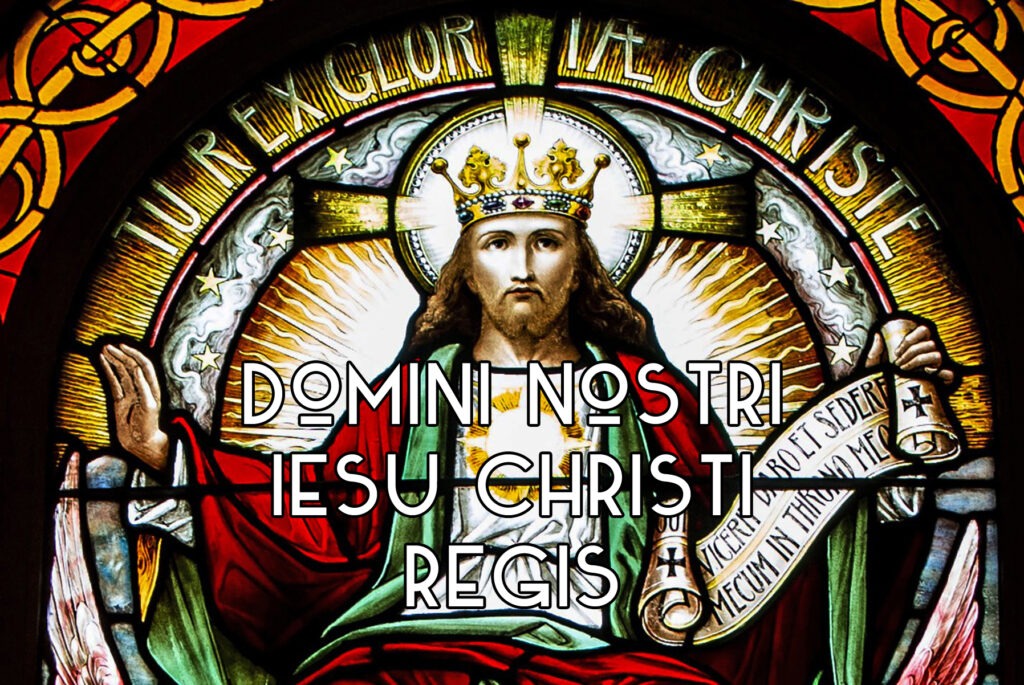
Three years later, in Quas primas (11 December 1925), Pius established the Feast of Christ the King, fixing its celebration on the last Sunday of October, the month Communists dedicated to their “permanent revolution”, namely, pursue goals with no compromise with the opposition. That phrase, “permanent revolution”, which is coming into ominous vogue again today, was penned in 1844 by Karl Marx in a work diabolically called The Holy Family. The Devil always tells you what he is doing.
One wonders what Papa Ratti would make of our seemingly interminable ecclesiastical processes of reimagining, restructuring, and permanent walking together, with their listening sessions and conclusions that somehow always seem to require still more listening sessions. “Permanent process” has a certain uncompromising revolutionary ring to it.
In any event, by placing Christ the King on the final Sunday of October, Pius XI situated the feast immediately before All Saints, All Souls and the month of November when Mother Church directs our attention toward the Four Last Things: Death, Judgment, Heaven, and Hell. November dovetails with Advent and its expectation of the glorious return of the Lord. Christ’s universal sovereignty, the triumph of His saints, the purification of the departed, and the judgment awaiting every soul are brought by the Feast into a close liturgical harmony. The Church gives us a mini-season within the “green time” for getting our priorities straight before moving again to penitential violet.
[…]































NO. Pastor preached on setting a good example, riffing on Saint Josemaria and the Epistle to the Thessalonians. Challenge people to let their lives proclaim the faith they profess with their lips, especially by bringing Christ to the rest of their community and not just those who happen to be gathered at our, fairly full, Masses every week.
Driving back to Houston last Sunday, I stopped at a church just off I-45 in the Diocese of Tyler for 9:00 Mass.
It was a remarkable service. A small, but lovely church. Novus Ordo Mass, but done ad orientem. No altar girls. No insipid music; indeed, no music at all. A Scripture reader not from the William Shatner school of recitation. A very good homily about punctuality (especially at Mass) and how it’s an act of respect and charity to others. Plus an appeal to children to be a help to their parents. No handshaking. None of the laity adopting the orans posture. A short Communion rail with many people kneeling and receiving on the tongue.
Usually, for me going to a Novus Ordo Mass is like checking off a box, a week-long renewal of anti-Hell insurance. But this was actually a spiritually refreshing experience.
NO.
we often see the Pharisees in a purely negative light, when in point of fact they were trying to obey the OT laws in their entirety, which is admirable. the problem was that many of them did so in a performative way, to be noticed for how good they were. St. Paul was a pharisee, but he later admitted “the good i wish to do i do not do, but the evil i wish not to do, this i do”. pastor also noted a new convert being received into Holy Church today. the young man stated that he believed everything taught by the Church to be revealed by God. i wonder how many bishops could say that truthfully.
NO
Replying to a question from a lawyer Christ states “Thou shalt love the Lord thy God, etc . . . and the second is thou shalt love thy neighbor as thyself.”
The sermon was about how the lawyer was expecting one of the 10 commandments. I did not understand why one would think that since there are about 300 commandments in the OT. But I bring this up to ask a question, why did not the priest mention these two commandments respectively are found in Deuteronomy and Leviticus. (I have never heard a preacher point this out in a sermon. Maybe I fall asleep too easily.) It would seem a good time to remind us that divine law does not change.