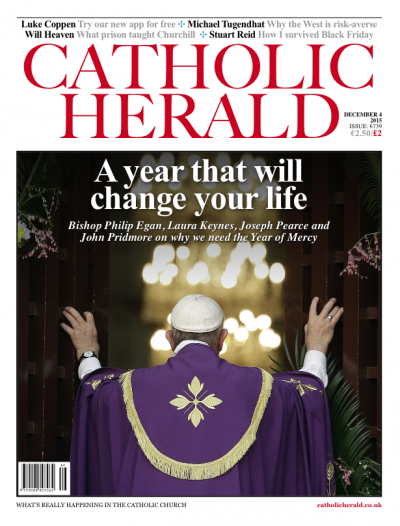
Catholic Herald app!

For a few years I have been writing a weekly column for the UK’s best Catholic weekly, the Catholic Herald.  At first I had a column about the prayers of the Mass, which carried us through the transition to the new English translation of the Roman Missal.  Now I have an eclectic column called Omnium Gatherum.  They don’t underscore my column online very often, but it is in the print edition each week.

My editor informed me about…

The new Catholic Herald app is now up and working at iTunes, Google Play and Amazon.

Would you consider retweeting this? [Done!]

We’re offering the first four issues of the magazine absolutely free to anyone who downloads the app anywhere in the world. So this is a chance for us to expand our readership dramatically.

My article HERE.

And our FAQs.

Alas, they don’t have a Fr Z promo code!

Check out the app. Also, you can read subscribe to read the entire print edition online and search their archive.  Very handy for people who would otherwise receive the print edition after the date.

Posted in The Campus Telephone Pole | Tagged
4 Comments

WDTPRS 2nd Sunday of Advent: “we escape neither the Enemy lion nor the glorious Lion of Judah”

Our Collect (once called the “Opening Prayer”) for the 2nd Sunday of Advent was not in the pre-Conciliar Missale Romanum but it was in the so-called Rotulus (“scroll”) of Ravenna, dated perhaps as early as the 5th century.

Omnipotens et misericors Deus,
in tui occursum Filii festinantes
nulla opera terreni actus impediant,
sed sapientiae caelestis eruditio
nos faciat eius esse consortes
.

Impedio (built from the word pes, pedis, “foot”), at the core of this prayer, is “to snare or tangle the feet”.   A consors is someone with (con-) whom you share your lot (sors).   The phrase “faciat eius esse consortes” recalls both the Collect for Christmas Day and the priest’s preparation of the chalice during the offertory.  Deus, “God”, is declined irregularly. In solemn discourse the nominative is used as the vocative form (e.g. cf. Livy 1, 24, 7).  Sapientia (“wisdom”) and eruditio (“learning”) are packed, technical terms from ancient rhetoric and philosophy.

BRUTAL LITERAL RENDERING:

Almighty and merciful God,
let no works of worldly impulse impede
those hurrying to the meeting of Your Son,
but rather let the learning of heavenly wisdom
make us to be His co-heirs.

OBSOLETE ICEL (1973):

God of power and mercy,
open our hearts in welcome.
Remove the things that hinder us
from receiving Christ with joy,
so that we may share his wisdom
and become one with him
when he comes in glory,…

CURRENT ICEL (2011):

Almighty and merciful God,
may no earthly undertaking hinder those
who set out in haste to meet your Son,
but may our learning of heavenly wisdom
gain us admittance to his company.

Last week in our Collect we rushed to meet the Coming Lord while striving for our reward through works made meritorious by Him alone.  During Advent, as the Baptist warns us, we are to make ready the path for the coming of the Lord.  This week we are still rushing but perhaps we are wiser after the first rush of excitement.

This week we are wary of obstacles which could impede us, snare our feet.  These impediments are merely worldly ways and works, not meritorious for salvation since they are not performed in Christ.  Worldly ways entangles us.  St. Paul contrasts the wisdom of this world with the Wisdom of God (cf. 1 Cor 1:20;  3:19; 2 Cor 3:19).  In Romans 12:2 Paul admonishes, “Do not be conformed to this world but be transformed by the renewal of your mind, that you may prove what is the will of God, what is good and acceptable and perfect.”  This is not just a Pauline concept.  Compare today’s Collect with 2 Peter 1:3-4: “His divine power has granted to us all things that pertain to life and godliness, through the knowledge (cognitio: cf. eruditio) of him who called us to his own glory and excellence, by which he has granted to us his precious and very great promises, that through these you may escape from the corruption that is in the world because of passion, and become partakers of the divine nature (efficiamini divinae consortes).”

St. Augustine of Hippo (+430) dismantled Donatist arguments that all clerics ordained by a sinful bishop would automatically be stained by the same guilt. He used imagery reminiscent of today’s prayer: “The mire (lutum) their feet are stuck in is so thick and dense that, trying in vain to tear themselves out of it, they get their hands and head stuck in it too, and lingering in that muck they get more tightly enveloped” (c. Don. 25).  The Donatist argument was based on worldly, not heavenly, wisdom.  Sticky lutum is a metaphor for a worldly, sinful life. Augustine contrasts being lutum with being children of God. “Noli esse lutum …Don’t be muck, but become (efficere) a child of God through His mercy!” (diu. qu. 68.3).

If we neglect God, we weak sinners can eventually convince ourselves of anything: down becomes up, back becomes front, black is white, wrong is right, and muddy is clean.  We excuse away our sins.  Once self-justification becomes a habit, it is a vice in more than one sense of that word.  Our consciences may occasionally struggle against the vice of self-deception, but the proverbial “Struggle” supplies permission: “I really ‘struggled’ with this, … before I did it.”

If we go off the true path into the sticky mire of error, we escape neither the Enemy lion seeking whom he might devour (1 Peter 5:8), nor the glorious Lion of Judah who will open the seals and read the Book of Life (Rev 5:5).

During Advent, let us make straight Christ’s path and watch our step.

Nevertheless, no matter how sticky may be the mess we have gotten ourselves into, Christ’s loving mercy washes its stain away in a good, complete confession before Christmas.

Posted in ADVENT, WDTPRS | Tagged , ,
4 Comments

ASK FATHER: Does a chalice have to be consecrated before use?

15_12_04_chaliceFrom a reader…

QUAERITUR:

My family plans to give a priest a chalice (he is from Ireland and does not have one of his own here in the US) and I have the following

questions:  [Usually I take one question at a time, but today I am feeling benevolent.]

1) Must it be consecrated before using it to hold the Precious Blood of Our Lord Jesus Christ?
2) If so, who can do the consecration? Can the priest do it himself or must it be done by a bishop?
3) Can the consecration be done during mass or must it be done before mass?
4) What are the applicable canons that cover this?

1) It should be consecrated before hand, yes.  But if it is not, after it’s first use it will be by the very fact of its use at least sanctified, if not consecrated.  More on that later.

2) This is more properly a task for a bishop, but a priest can do it too.

3) See 1.

4) This is not mentioned in the Code of Canon Law, but some directions can be found in the rubrics, which is a species of canon law.

I warmly recommend the use of the older form, by a bishop.  It is rich and inspiring in a way that the modern form… isn’t.   I wrote about that HERE and HERE.

Following the Novus Ordo, however, the chalice, paten, and ciborium are usually blessed at Mass, using the text in the Missal. I do not see a formula in the Missal for blessing the chalice or ciborium outside of Mass.

I hold to the argument that an unconsecrated chalice used for Mass may thereafter be considered sanctified but not consecrated. A chalice that is consecrated and then used for Mass is also sanctified. By consecration a chalice is formally, by special rites, set apart for a particular use.

“But Father! But Father!”, some of you are warbling. “This is just merciless nitpicking.  You are nitpicking merciless nitpicker!  You hate mercy and compassion and all those…. other things that Pope Francis talks about … like… the Earth’s climate and fairness and … and you hate Vatican II!”

We can grant that the sanctification which the chalice receives in its use at Mass could be the equivalent of consecration, but the special formal act is still lacking.  I think we have to make the distinction.

And, frankly, why not consecrate the chalice with the special rite that Holy Church provides?  Why not?

Thanks for asking about this.  It got me thinking.

I have been thinking that it is time to have my chalice regilded.  My 25th Jubilee is coming up.  After a quarter century of use, the chalice and paten made at the time of my ordination are worn down to the silver in some places.  Perhaps there is a reader out there who would like to help with this project… but I digress.

Because we are Unreconstructed Ossified Manualists around here, let’s drill into this question of restoration and regilding.

Thus the question is raised:

QUAERITUR:

Must a chalice be re-consecrated after it has been replated, reguilded, restored?

Auctores scinduntur.

Some (e.g., Suarez) argue for reconsecration after regilding because the new surface is not consecrated. They perceive the new surface as something morally separate from the rest of the chalice. Others (e.g., Lugo) say that once it is consecrated, the whole chalice, new surface included, remains consecrated no matter how many times it is regilded because the new surface is morally part of the whole chalice.

Think of it this way.  If you paint a church’s interior, you don’t have to reconsecrate it. As Lugo argues in De Sacramento Eucharistiae (Disp. 20. n. 95):

Ergo si manet calix, qui consecratus fuit, non opportet consecrare, illam novam superficiem, sicut neque in ecclesia, quae de nova dealbatur, oportet de novo consecrare superficiem novam.

Most theologians took the negative position.

However, on 14 June 1845 the Congregation of Rites settled the issue. The question was asked:

Ut declarare dignaretur, utrum calix et patena suam amittant consecrationem per novam deaurationem, et sic indigeant nova consecratione?”

The reply: “Affirmative; amittere nimirum, et indigere iuxta exposita.”

The more modern Lehmkuhl (Vol. 2, n. 228, 3), however, says:

Neque pro practice probabili haberi potest aliquorum veterum opinio vasa vel vestimenta sacra si ante consecrationem vel benedictionem, sive bona sive mala fide sacrificio missae servierint, pro iam consecratis haberi posse.

Click to buy!

I refer you now back to my earlier point that their use in Mass sanctifies but doesn’t consecrate them.  Consecration is something different, separate.

Then you have the situation of a chalice that needs to be reconstructed in some way, as in the case wherein the cup becomes separated, broken off, from the stem, or stem from the base, etc. I once had repaired a broken 19th century silver chalice with stamps of the Papal States.  I took it to my bishop for consecration with the older rite and he was happy to do it.

If the chalice is made so that the cup unscrews from the stem, etc., then separation by unscrewing doesn’t require that the chalice be reconsecrated after reguilding of the parts. However, it they are broken, I would say, yes, the chalice has to be reconsecrated.

I would also say that if things are added to the chalice or it is altered in a major way, it should be reconsecrated.  For example, because St. Therese of Lisieux did something for me back in my bad seminary days, and I had a classic “sign of roses” that some people experience, I designed the chalice to have a wreath of roses at the top of the base.  However, the roses are actually places for small jewels to be set, but they remain to this day filled in.  I thought that, as some point, I would ask my mother to provide some small stones from her jewelry, which would be yet another a great way to keep her in mind during Mass.  (Yes, Fishwrapers, Fr. Z has a mother.  He wasn’t assembled from spare parts in a lab.)  And there are a few other small changes I would make.  In that case, I would have the chalice reconsecrated.

Similarly, if we do major work on an altar such that it is radically changed, or if the table becomes separated or broken in any way, then it has to be reconsecrated.

Let’s not be minimalists.  These gestures and rites mean something for our Catholic identity.


Posted in "But Father! But Father!", "How To..." - Practical Notes, ASK FATHER Question Box, Hard-Identity Catholicism, Liturgy Science Theatre 3000 | Tagged , , ,
9 Comments

VIDEO: Straight talk from Fr. Murray about secular media that mocks prayer and belief in God (ACTION ITEM!)

After the massacre in San Bernardino the liberal New York Daily News mocked people to pray and who believe in God. HERE

My friend Fr. Gerry Murray provided some straight talk on Fox News with Neil Cavuto. This is outstanding!

Dear Lord, send us more priests like Fr. Murray. Mary, Queen of Priests, defend all priests with your mantle and ask Your Son, the Eternal High Priest, to give them courage to speak the truth with clarity and mercy.

People are looking for good causes for their charitable giving.  Say “Thanks!” to Fr. Murray by dropping some spondulix (i.e., MONEY) into the collection basket at his parish? Father is pastor of Holy Family, the UN parish in Manhattan and I know for a fact that they could use the help. At the parish website, in the lower corner, you will see a ParishPay button.  C’mon!  Stun him with your generosity.

15_12_03_HolyFamilyParishPay

Posted in ACTION ITEM!, Biased Media Coverage, HONORED GUESTS, Liberals, Mail from priests, The Coming Storm | Tagged
24 Comments

Fishwrap: The Church is evil for having different roles for women, so we might have to leave.

I wonder if most of the writers for the Fishwrap (aka National Schismatic Reporter) – deep down – hate the Church.



That’s a horrible thought, but how else can one explain this sort of thing?

An article about how evil the Church is and whether or not women should leave.

A sample:

[…]

Posed by presenter Barbara Hilkert Andolsen, professor of applied Christian ethics at [Jesuit-run] Fordham University, the question was prompted by the U.S. bishops maintaining that the inclusion of birth control in the Affordable Care Act results in material cooperation with evil, despite attempts by the Obama administration to distance employers from directly contracting or paying for those services.

It struck Andolsen as ironic, given the remoteness of the contact in the Affordable Care Act, compared with active participation in a sexist church. She first established that the “benevolent sexism” of the church is indeed sinful, even evil. [“established”… okay, the writer accepts the premise…] Benevolent sexism differs from the “hostile sexism” of the past, which overtly made women less than men, pointing out their spiritual weakness or propensity toward sin.

Instead, benevolent sexism, seen in the church’s teaching of complementarity, asserts that women are only different from men, often using positive language, praising their roles as mothers or identifying them as more nurturing than men. Women are the “strawberry on the cake,” if you will. [That’s a quote from Pope Francis, btw.]

“The benevolent sexism of the church is not harmless,” [Remember, the premise was accepted.. now we drive to a conclusion….] Andolsen said. “It is detrimental to women and undermines the ability of women and their allies to mobilize and improve the situation of women.”

Which leads Andolsen to wonder: “What moral responsibility do I have as a woman who remains active in the church?” More pointedly: “Are we morally responsible, because remaining active in the church constitutes complicity with evil?

[…]

Here’s how the argument runs, more or less.

  • Different roles in the Church for men and women is evil.
  • If the Church condones this, the Church condones evil.
  • We cannot cooperate with evil.
  • Thus, we have to leave the Church.

Mind you, the writer doesn’t go on to refute this argument.  She seem to accept it.

I respond….

  • If that’s what you think, sorry… feel, then get out.
  • We’d rather see you stay and be faithful and happy.
  • Please don’t wait.
  • Take the Jesuits with you.

Keep in mind, perhaps daily, a prayer I offered some time ago HERE.

Posted in Liberals | Tagged , , ,
30 Comments

Reason #8573 for Summorum Pontificum

A priest friend sent a video of a Portuguese priest, Fr. José Cruz in Moita dos Ferreiros from Easter 2014.

I can imagine statues of Our Lady of Fatima weeping at the sight of this.

Enjoy more of Cruz HERE.

Posted in Liberals, Lighter fare, Liturgy Science Theatre 3000, Mail from priests, Puir Slow-Witted Gowk, You must be joking! | Tagged
48 Comments

A proposal for the Year of Mercy: ban Communion in the hand

Dom Mark Kirby of Silverstream Priory posted at his blog Vultus Christi an idea which I endorse.

Reacting not only to the hideous sacrilege committed by an “artist” in Pamplona, Spain, but also to constant abuses of the Eucharist across the globe, Dom Mark suggests Holy Masses of Reparation be offered, public Hours of Adoration and Reparation be scheduled, Eucharistic processions of reparation through the city streets. But then he goes on with…

Proposal for the Year of Mercy

Even if these things were done, it remains that other questions need to be addressed. A priest friend said to me this morning that bishops the world over need to consider a moratorium on Holy Communion in the hand. Perhaps for the Year of Mercy? Are we to show no mercy to the One who is present among us under the appearances of a thing so fragile as the Host? [Do I hear an “Amen!”?] Do we not recognize in the Sacred Host God become, for love of us, vulnerable, poor, silent, and defenseless? Do we not see that the Sacred Host is the ultimate expression of what Saint Paul (see Philippians 2:7) calls the kenosis of the Son of God, that is His utter self–emptying? [The Host is not a something.]

More than a Mere Oversight?

The Instruction Redemptionis Sacramentum promulgated eleven years ago by the Congregation for Divine Worship and the Discipline of the Sacraments 25 March 2004, seems, in most places, to have had little or no effect. One wonders if the clergy were at all given the opportunity to come together to study the document and, with one mind, plan its implementation. Among other things, in article 92,the Instruction says clearly:

“If there is a risk of profanation, then Holy Communion should not be given in the hand to the faithful”.

Read the rest there.

Posted in Hard-Identity Catholicism, Year of Mercy | Tagged , , ,
22 Comments

ASK FATHER: Lutheran wife is against me, a convert, going to Mass

From a reader…

QUAERITUR:

I am a convert from Lutheranism, and my wife and children remain irregularly practicing Lutherans. My wife says that my absence for Mass every Sunday is a selfish betrayal of family time, and that our whole family suffers. I do not want to upset her, particularly since her bad moods affect our children, but I cannot live with the idea of regularly missing Sunday Mass. What can I do?

Marriage is difficult. Mixed marriages are even more difficult. Successful marriages require lots of prayer, communication, and compromise. Compromise does not entail giving up things that are essential, but rather finding ways to give a little in order to make peace. Compromise where one party is forced to give up something essential is not really compromise, but rather capitulation.

Depending on where you live, there might be other Masses that are possible to attend. Is there an early morning Mass you could attend, before the rest of the family is up? Or a Mass later in the day? Or perhaps even a Mass on Saturday evening?

If there is not another Mass to attend, which might accommodate the family schedule, then the onus on you is to ensure that before and after Mass, you’re giving your all to your family.

Let’s say, for example, the Catholic Mass is at 10 AM, and the Lutheran service that your wife and children irregularly attend is at 10:30. Wake up early and prepare a nice breakfast for your family to enjoy (as they are not enjoined to fast before worship), even if it’s an egg casserole warming in the oven as you toddle off to Mass. Let your wife know that she need not do the dishes after their repast because you’ll take care of that as soon as you get home. Kiss your wife tenderly when you return from Mass (or when she returns from the Lutheran service) and let her know the joy you feel from being able to receive Christ and how your newly found Catholic faith strengthens you as a person, strengthens your love for her, and strengthens your marriage.

If she starts to see your Catholicism not as some sort of a rival in the marriage, but rather as an asset to you and to the marriage itself, she may become a bit less hostile.

Regular applications of flowers and chocolate can help, too, … so I’m told.

Look for other ways, after Mass, to maximize your family time. Read some Scripture to your children, pray a psalm or two with them. They, too, need to see their father’s Catholicism as something which makes him a better person and a better, more loving father, not as something that takes him away from them.

Certainly, pray for your family’s conversion, but in the meantime (or if that doesn’t happen), you need to show them by your actions how your Catholic faith makes you a better man, and thereby a better husband and father.

Posted in "How To..." - Practical Notes, ASK FATHER Question Box, One Man & One Woman, Our Catholic Identity | Tagged
15 Comments

ASK FATHER: Prayer services and lay people extending hands to “bless” an Advent wreath

From a reader…

I have recently noticed something strange at my school. We had an Advent Prayer service in which the students were told to extend their hands to bless the Advent wreath. Is this alright? I heard that lay people shouldn’t be raising hands and giving blessings, but I wasn’t sure.

Also, we began praying the Our Father later on, and most of the students began holding hands. I think that’s a negative effect that when they pray the Our Father, many think of holding hands before the thought of actually praying. I know that we aren’t supposed to hold hands during the Our Father at mass, but what about a prayer service?

Ah, “prayer services.”  In the seminary,  during the bad old days, we had “prayer services” outside of the regularly scheduled Masses and morning or evening prayer.  Come to think of it, all the morning and evening prayer were all just prayer services because we never used the actually Liturgy of the Hours.  We used a service made up by a team of heretics.  “Prayer services” were opportunities for the seminary faculty – or the seminarians themselves – to develop some sort of creative “thing,” often involving some Scripture, poorly composed and often heterodox prayer texts, some sort of movement, and, of course, music (generally involving guitars).  Apparently, the benefit of these “prayer services” was that, since they weren’t official liturgies of the Church, we had complete freedom to be as creative as we wanted. Rules didn’t apply.

You wouldn’t believe some of the …. rubbish that was inflicted on us.  But I digress

When it comes to public, communal prayer and worship of Almighty God, I’d rather not be left to my own devices.  The rubrical guidance of Holy Mother Church, and her 2000 year experience, is not a straightjacket.  It is a trusted, tried and true map.

Even when engaged in freestyle prayer (as, perhaps, before a special meal with a group), we should be attentive to the guidance that Our Holy Mother, the Church gives us. Even though holding hands during the Our Father doesn’t render a prayer service “invalid” (if such a category can be applied to something so amorphous), I think it should be avoided: that’s not how the Church prays in her formal structured moments.  The same applies to having everyone extend their hands in “blessing” over an advent wreath. The Church understands blessings to be a particularly clerical thing. That’s why we have priests, to sanctify and bless.


Posted in "How To..." - Practical Notes, ASK FATHER Question Box, Liturgy Science Theatre 3000, Our Catholic Identity | Tagged
10 Comments

VIDEO: Sen. Marco Rubio (R-FL) talks frankly about belief in Christ and his Catholic Faith

Presidential candidate Sen. Marco Rubio (R-FL) talks frankly about his Catholic Faith and his relationship to other Christians.

Moderation queue is ON.  I don’t want this to turn into a merely political debate about various candidates, as in, “I don’t like Joe Sixpack. I’m for Jane Bagofdonuts!”

Posted in New Evangelization, Our Catholic Identity | Tagged
14 Comments