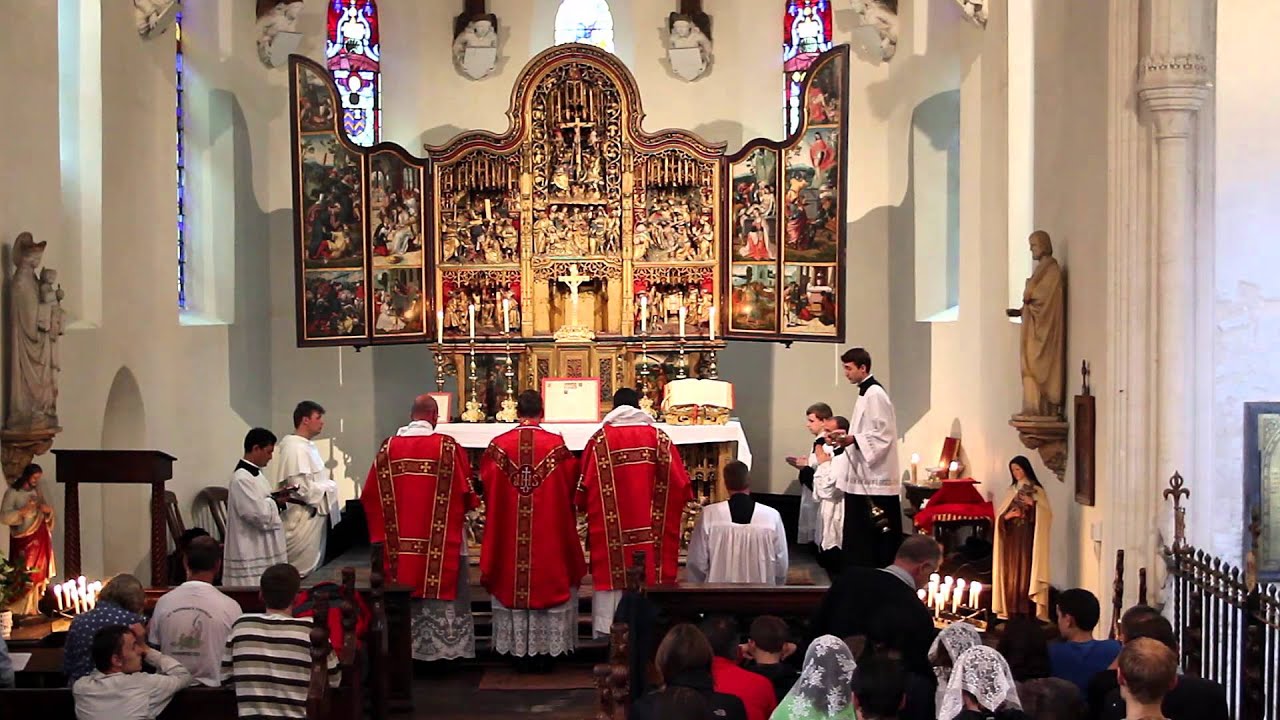
D. Brooklyn – New Co-Cathedral

There is an interesting piece at Hell’s Bible today about the Diocese of Brooklyn’s new Co-Cathedral, “the enormous, 102-year-old Church of St. Joseph on Pacific Street in Prospect Heights”.

I have visited too few churches in Brooklyn, but the next time I head east I will make a point of it.

Read the story.  I think that the article is subtly playing on criticisms of bishops whom libs think have “lavish” residences, but that isn’t over played.  What interested me was how the Diocese solved multiple problems in a creative way.  Their cathedral is quite small.  This huge church shouldn’t be lost.  They figured out ways to pay for it.  Everyone wins.

And, now that demographics are shifting in that part of Brooklyn again, they have huge potential in the area.  Again, everyone wins.

New Evangelization, as far as I can work out, includes keeping our beautiful old structures open and, if possible, also having the older, traditional form of Holy Mass.  This is working for Holy Innocents in Manhattan in the Garment District, which is experiencing a revitalization.  Moreover, do what St. Agnes did in St. Paul and St. John Cantius did, in Chicago.  Make use of the ethnic tradition of the people in a sense of true, authentic inculturation.

Look at this place.  What a shame it would have been to lose it.

Fr. Z kudos to Bp. DiMarzio.

Posted in "How To..." - Practical Notes, Fr. Z KUDOS, Just Too Cool, New Evangelization, Our Catholic Identity, The future and our choices | Tagged ,
10 Comments

The Traditional Latin Mass and the New Evangelization

The Institute of Christ the King had ordinations to the priesthood recently in St. Louis.  This promoted an article in the local paper.  The writer (thus, editor) seemed amazed that this sort of thing is going on.  Young people… Mass… Latin….?!!?  Does not computer.

A couple quotes in the article caught my eye.

First:

[Now Father] Altiere is originally from Pennsylvania with a degree from Harvard University. He says his decision to become a priest is owed in part to his discovery of the traditional Latin Mass in a church in downtown Boston.

“At this Mass I really understood the priesthood for the first time,” Altiere said. “The primary reason for the beauty of our churches and liturgical ceremonies is to give glory to God, but it is also such a powerful means of evangelization.”

Exactly so.

By learning this form of Holy Mass, new priests and vets learn something about priesthood and who they are at the altar which the Novus Ordo does not readily convey.  Even if priests wind up not using the Extraordinary Form all that often, they won’t say the Novus Ordo in the same way after having learned it.

The older form of Mass clearly stresses that the Mass is the Sacrifice of Calvary renewed and the celebrating priest is both priest offering the Sacrifice and victim upon the altar.  Priests are for sacrifice.  If you don’t have to have sacrifice, you don’t need a priesthood.  You can have ministers, instead.

His point about evangelization is tied to this.  When the priest knows better who he is, his way of saying Mass, his are celebrandi as Pope Benedict put it, shifts.  This will, over time, produce a knock on effect in the congregation.

Going on.

Those who attend St. Francis de Sales Oratory also say their faith is strengthened by the liturgy and by the feeling of solidarity experienced by those who attend the Mass.

“Everybody here believes what they’re doing is true, real,” said Tom Leith, 55, an engineer in St. Louis. “You’re among people who believe what the church teaches.”

If we don’t know our Faith and believe, if we are not clear about what we believe and who we are, we cannot evangelize effectively.  Why should anyone listen to us if we are uncertain about who we are?  If we have nothing clear to say to the world, why should the world listen to us?

Benedict’s Motu Proprio Summorum Pontificum was probably the most useful tool he provided for an effective New Evangelization.

Posted in Hard-Identity Catholicism, Liturgy Science Theatre 3000, Our Catholic Identity, SUMMORUM PONTIFICUM, The future and our choices | Tagged , , ,
18 Comments

Wherein the rejected Fr. Z shares his pain with the readership

Even after last year’s bitter experience being rejected by the LCWR,  I – eternal optimist that I am – once again applied for media credentials for their annual assembly.

The LCWR sisters will assemble in Nashville from 12-15 August.

Yes, I sent in my application again.  And even though more people read my blog each day than the whole circulation of some Catholic periodicals, once again I was rejected.

I am dejected because I was rejected.

Here is what I received:

Dear Fr. Zuhlsdorf,

We have reviewed your media credential application for the 2014 LCWR Assembly.

We find you do not meet the credentialing criteria of the posted Media Coverage Policy ( https://lcwr.org/sites/default/files/page/files/lcwr_media_coverage_policy_2014.pdf ).

I invite you to check the LCWR website since we will post some public statements on the assembly activities and events.

Blessings,

Sister Annmarie Sanders, IHM
Associate Director for Communications
Leadership Conference of Women Religious
8808 Cameron Street
Silver Spring, MD  20910

So, what’s really going on here?  LCWR will give outlets such as the National Schismatic Reporter credentials, so they can preach to their fans, to the already converted.  But they won’t be open and dialogue with those who are not already carrying their water for them?  Is that it?

How can they claim to be prophetic if they are so closed off and defensive?

Where’s the transparency?  What are they afraid of?

Are they afraid of not being able to control their news?  Are they afraid of reaching out?

Since I am now, once again, inconsolable, I place myself in your hands, dear readers.  Only you can pick me back up again.


Posted in Lighter fare, Magisterium of Nuns, Women Religious | Tagged
40 Comments

Dedication of St. Mary Major: Pope Liberius, St. Athanasius, and a miracle

That's a hoe, not a golf club.

Pope Liberius (352-366) was Bishop of Rome in difficult times.

In 350 the Emperor Constans was assassinated and Constantius became the sole Emperor by defeating Magnentius. Some bishops in the East who opposed St. Athanasius in Egypt appealed to Liberius to get involved with the Arian controversy in which Athanasius was embroiled.

The Arian heresy and controversy was raging. (Arians didn’t acknowledge Christ as consubstantial with the Father. Neither, apparently do liberals who rejected the new translation.) Liberius called a for a Synod in Rome, but the Synod came to nothing. Liberius then made an appeal to Constantius to call a council to be held at Aquileia.

Constantius had Athanasius condemned by both the Synod of Arles (353) and the Synod of Milan (355) and tried to win Liberius over to his side. When Liberius resisted, Constantius summoned Liberius to Milan and then exiled him to Bearea in Thrace. Liberius eventually acquiesced to Constantius once he was weakened from his sufferings in hardship and the Thracian cold.

St. Hilary of Poitier preserved letters of Pope Liberius attesting to what happened (Frag. Hist. 4,6).

Eventually Constantius let Liberius come out of his exile in Thrace. He went to Sirmium in 358 and then back to Rome. In Rome Felix II had taken over as bishop, but the people backed Liberius as the true Bishop of Rome.

Liberius had more than likely subscribed to the formula of Sirmium of 351 which was a “fundamentally” orthodox statement. Some Eastern bishops and “moderate” Arians met in the presence of Constantius to oppose Photinus. Photinus was condemned. Liberius did not subscribe to Sirmium 357, however. This meeting issued a pro-Arian statement. Nevertheless, St. Athanasius and St. Hilary and others considered Liberius to have erred gravely, but they were probably mistaken.

Granting that Liberius was weak and his pontificate was fraught with problems, partly of his own creation, Liberius seems to have been more sinned against than sinner.

Yes, Liberius did condemn Athanasius, that staunch defender of Nicaean faith against the heretic Arians. but he was forced under duress and perhaps even torture to give support to the Arians. Nevertheless, Liberius refused to subscribe to an obviously Arian formula of faith and instead signed on that, while not explicitly condemning Arianism, did support for the most part the Nicaean faith. Sometimes anti-Catholics will fling Liberius in our faces as an example of how the Pope cannot be thought to teach infallibly. SSPXers often invoke him and Athanasius as a way of justifying their disobedience to the Roman Pontiff.

Liberius, however, is a complex figure in difficult times and much of the “story” of his “fall” in weakness is not properly grasped.

After Constantius, the infamous Julian adopted a policy of toleration. Pope Liberius issued a letter to the bishops of Italy in 362 and a letter of reply to the bishops of the East in 366 which both affirmed the faith of the Council of Nicaea.

Pope Liberius is important to us today because of the feast we celebrate: the Dedication of St. Mary Major, known as the Liberian Basilica.

The Basilica is associated with Pope Liberius because of the famous story we all know about the miraculous snowfall on this day on the Esquiline Hill in Rome. Anyone who has been in Rome in August will not question that at a snowfall would be indeed a miracle. To give you an idea of how hot it is in Rome in August, the soles of a pair of my running shoes melted and the layers came apart.

In any event, the Basilica was completed by Pope Sixtus III and his archdeacon Leo (later Pope Leo I “the Great”). Here is what the Roman Martyrology says:

Dedicatio basilicae Sanctae Mariae, Romae in Exquilis conditae, quam in memoriam Concilii Ephesini, in quo Maria Virgo Dei Genetrix salutata est, Xystus papa Tertius plebi Dei obtulit….

The dedication of the basilica of Saint Mary founded in Rome on the Esquiline hill, which Sixtus III, Pope consecrated for God’s People as a memorial of the Council of Ephesus during which the Virgin Mary was hailed as Mother of God.

In the basilica you can see the great triumphal arch decorated with beautiful mosaics, having anti-Manichean themes, prepared and directed by the future Pope Leo I. On the summit of the curve of the arch you see the name of “Xystus Episcopus Plebi Dei” even to this day.

Posted in Liturgy Science Theatre 3000, Saints: Stories & Symbols | Tagged , , , , ,
9 Comments

IRS has a “Political Activities Referral Committee” which spies on preaching

While I was at the recent Napa Institute gathering, I got to know Kristina Arriaga, Executive Director of The Becket Fund, which defends religious freedom.  They guided the Hobby Lobby decision to a good conclusion and for that we owe them a lot.

I had this note from them today.  It included this:

Dear Friends,

I grew up in a household where we were expected to pepper all tales with a bit of Cuban exaggeration. This was, after all, essential for good storytelling.

So, in a way, I wish I were making this up.

Within the IRS, there is, no lie, a “Political Activities Referral Committee” unit that investigates whether preachers have said something from the pulpit in violation of the IRS rules regarding preaching. It even has an acronym: “PARC.”
How do I know this?

Because, in response to a lawsuit filed by the Freedom from Religion Foundation—a lawsuit where we, the Becket Fund, intervened–the IRS sent FFRF [the Madison, WI based stinky Freedom From Religion Foundation] documents to reassure the activist atheist group that they were really working hard on being very diligent in their monitoring of preachers. The public only knows about this because of the Becket Fund’s intervention, forcing these documents to become part of the public record.

Of course, the IRS rules on this matter are not very clear, so who knows exactly what the PARC unit really monitors or how.

The official IRS letter, which I link here, states: “With regard to these referrals that concern violations by churches, the PARC has determined that as of June 23, 2014, 99 churches merit a high priority examination. Of these 99 churches, the number of churches alleged to have violated the prohibition during 2010 is 15, during 2011 is 18, during 2012 is 65, and during 2013 is one.”

99 churches”? “Prohibition”? Really?

The reference to this “prohibition” is likely referring to the Johnson Amendment, a change made to the IRS code in 1954 to prevent non-profits from talking about politicians, and accidentally ensnared preachers who taught about moral issues with political implications.

Ironically, had this amendment been in place, it is very likely the IRS would have pressured Reverend Martin Luther King into censoring sermons he made from the pulpit. The IRS could have also intimidated Reverend Billy Graham to prevent him from preaching with Dr. King in 1953. Pastors that denounced the Vietnam era wars—they too could have been deemed to fall within the boundaries of the IRS “prohibition.”

Clearly, it is not the role of the government to censor what a preacher says from the pulpit to his/her congregation. Yet our government wants to give “a high priority examination” to 99 of them.

PARC reminds me of another committee I know well. In Cuba, the government established in each neighborhood block the “Committee for the Defense of the Revolution” in order to make sure all citizens complied with the state’s idea of moral and social order.

It seems like a bit of Cuban exaggeration to compare our situation—doesn’t it?

But, from where I sit, I am watching a government bureaucracy that is attempting to shove out—under the penalty of fines and threats– any person or group of persons who are driven by convictions that are different from the government’s convictions.

If the government decides that once you open a family business you give up your constitutionally guaranteed religious liberty, who are the owners of Hobby Lobby to disagree?

If the government determines that contraception is vital and certain employers must pay for it, who are the Little Sisters of the Poor to say they can’t and won’t pay or make anyone else pay for it?

If the government decides what makes acceptable preaching, who are preachers to disagree?

Well, I’ll tell you who they are. They are Americans with constitutionally guaranteed protections. And we at the Becket Fund exist to defend them.


Posted in Our Catholic Identity, Religious Liberty, The Coming Storm, The Drill, The future and our choices, The Last Acceptable Prejudice | Tagged , , , ,
39 Comments

JUST TOO COOL: Feast of the Transfiguration – special blessing of grapes

Go buy some grapes and take them to the priest  for the Feast of the Transfiguration (tomorrow, 6 August), with a page from the Rituale Romanum (go to p. 345 – Benedictio uvarum), or cut and paste the English text (below, or here) and ask the priest to bless them.

The Roman calendar has many little treasures which remind us of how our Faith and the Church’s calendar, the rhythm of temporal and spiritual life, are integrated in our seasons.

At the beginning of August we Romans remember the martyrs Pope Saint Sixtus and his four deacon companions.  This is the time of year with the first grapes of the harvest are blessed.  Together with the Transfiguration of our Lord, the blessing of grapes – an eschatological symbol – shows that Holy Church is already in the end time, though we wait for its completion.

Here is the text for the blessing of grapes, for those who don’t have Latin:

V. Our help is in the name of the Lord.
R. Who hath made heaven and earth.
V. The Lord be with you.
R. And with thy spirit.

Let us pray.

Bless, we beseech Thee, O Lord, this fresh fruit of the vine,
which Thou hast graciously brought to full ripeness
with the dew of heaven, abundant rain, and calm and fair weather.
Thou hast given them for our use;
grant that we may receive them with thanksgiving
in the name of our Lord Jesus Christ, the True Vine,
who liveth and reigneth with Thee in the unity of the Holy Ghost,
God for ever and ever.
R. Amen.

(And they are sprinkled with holy water.)

I was delighted by the reference to “dew of heaven… rore caeli“.  You might recall the controversy over the reference to “dew” when the new, corrected translation was being prepared.

The cultivation of certain types of grapes requires special conditions.  In a contrast to the benefits of dew lauded in the prayer of the blessing, however, dew isn’t always good for grapes.  Dew helps fungus get hold, through in the case of some grapes, certain fungi are welcome, as in the case of the “noble rot” in a very late harvest which produces wines of a spectacular sweetness and depth.  Also, it is important to harvest grapes after dissipation of dew.  But certainly the evocation of dew in the prayer refers to the necessary moisture grapes need for their proper development.  And of course, dew is a Scriptural image for the descent of God with graces.

The coming of and effects of the Holy Spirit, in Scripture and in the Fathers of the Church, are often described not by fire imagery, but rather by water images and, indeed, dew.  First, ros can come from above like rain.  Second, ros is dew which forms nearly imperceptibly.  In one case, rain flows across a thing and washes it.  Dew slowly dampens.  In both cases there results a penetrating soaking.  Arid ground yields to planting.  Seeds germinate and sprout.   The ros Spiritus in the 2nd Eucharistic Prayer can be both the cleansing and the moistening.

Our Catholic doctrine of sanctification teaches us that at baptism a person is both justified and sanctified by the washing/indwelling of the Holy Spirit.  That sanctification can be deepened through the course of one’s life.  It comes suddenly.  It comes gradually.

In Scripture the psalmist sings about the “King of Justice”. “May he be like rain (Vulgate ros) that falls on the mown grass, like showers that water the earth!” (Ps 72:6 RSV).  In the Song of Songs, we hear, “Open to me, my sister, my love, my dove, my perfect one; for my head is wet with dew (ros), my locks with the drops of the night. By night I have put off my coat, how shall I put it on? I have washed my feet, how shall I defile them” (Cant 5:2-3).  St. Augustine (+430) saw in the lover and beloved an image of Christ calling His ministerial Church to service.  From Isaiah we have an image which has come into the Latin Church’s liturgy, namely, “Rorate caeli desuper … Shower (rorate), O heavens, from above, and let the skies rain down righteousness; let the earth open, that salvation may sprout forth, and let it cause righteousness to spring up also; I the LORD have created it” (Is 45:8 Vulgate and RSV – Introit 4th Sunday of Advent).

The Fathers made much of ros through an allegorical technique of interpretation.  Origen (+254), via Rufinus’ translation of the Homilies on the Book of Judges (8.5) says: “But we also, if only we might offer our feet, the Lord Jesus is ready to wash the feet of our soul and cleanse them with a heavenly washing (rore caelesti), by the grace of the Holy Spirit, by the word of sacred doctrine.”  Saint Ambrose of Milan (+397), who drew much upon Origen’s writings as a starting point, in his work on the Holy Spirit wrote: “The Holy Scriptures were promising to us this rainfall (pluvia) of the whole world, which watered the orb under the coming of the Lord, in the falling dew of the divine Spirit (Spiritus rore divini)” (De spiritu sancto 1.8).

The imagery of grapes is also Scriptural.  The immediate association for Catholics is the Eucharist.  But grapes symbolize the end times.  They have an eschatological import.   In Revelation 14:19-20 we have an image of the end times and judgment when the grapes of wrath are pressed in the winepress:

And the angel thrust in his sharp sickle into the earth and gathered the vineyard of the earth and cast it into the great press of the wrath of God: And the press was trodden without the city, and blood came out of the press, up to the horses’ bridles, for a thousand and six hundred furlongs.

Of course the image of grapes is a happy one as well… obviously.  From the ancient Roman Church grapes are found in carvings in the catacombs and on sarcophagus reliefs.  Bunches of ripe grapes are symbols of completion, that the season has finally brought things to fruition.  Grapes remind us that Christ is the Vine, whence all our life and hope flows out to us, His branches and tendrils.

In those ancient depictions we sometimes see the harvest of grapes, which is the happy completion of life.  For example there is the relief of the famous 4th c. sarcophagus with the Good Shepherd from the Catacombs of Praetextatus which shows a harvest.  In the Catacomb of Priscilla there is a 4th century carving of a dove eating grapes, the dove being a symbol of the Christian soul and grapes the happy attainment of the goal of fulness in due time, heaven.  Remember that reference, above, to the dove from the Song of Songs?  It all fits together.  You can click on that image of the Good Shepherd for a larger view.

Grapes remind us that we shall be known from the fruits we both bear and we generate for the benefit of others.  Grapes remind us that we should not be sour grapes for others.  Grapes remind us that, if we do not live our vocations as the Lord’s branches well, then the grapes may be those of wrath.  Though mercy and forgiveness is what the Lord offers those who fall.

So, get your grapes and get them blessed if you can.

When you eat them consider:

  • how good God has been to you, even if some of the grapes are bitter;
  • whether or not, through the dew of God’s graces and the light He shines on you, you are developing well for your own eternal salvation;
  • whether or not you are producing fruits for the benefit of others, hopefully sweet fruits and not sour.
Posted in "How To..." - Practical Notes, Just Too Cool, Liturgy Science Theatre 3000, Our Catholic Identity | Tagged , , ,
7 Comments

Wm. Oddie on the upcoming Synod: no change in doctrine

At the UK’s best Catholic weekly, The Catholic Herald, William Oddie has his say about Card. Kasper, his odd notions about Communion for the divorced and remarried, the upcoming Synod and Pope Francis.

Read the whole thing HERE, but I can bring you in in medias res:

So why am I so sure that the Pope does support Cardinal Müller’s insistence that there will be no change in the teachings of the Church, despite his warm words about Kasper’s speech? [Remember?  Tolerated but not accepted?] For a start, Kasper’s speech is such that you could find it interesting, even to be commended as an intellectual exercise, without agreeing with a word of it. It’s tentative, speculative; I didn’t exactly find it “serene” (incidentally, I seriously wonder if the Holy Father wasn’t teasing Cardinal Kasper when he said that “It is pleasant to read serene theology”; he’s known for his sense of humour) and if Pope Francis had actually agreed with it, wouldn’t he have used rather different wording?

In an interesting opinion piece in the New York Times on Kasper’s proposal, which is roughly that a second “marriage” might be tolerated but not accepted, Ross Douthat comments that “whatever individuals and pastors decide to take upon their own consciences, declaring the reception of Communion licit for the remarried-but-not-annulled in any systematic way seems impossible without real changes — each with its own potential doctrinal ripples — to one or more of three theologically-important Catholic ideas: The understanding that people in grave sin should not generally receive the Eucharist, the understanding that adultery is always a grave sin, and/or the understanding that a valid sacramental marriage is indissoluble.

If he actually did effect some change of the kind being fondly touted by liberal Catholics, Pope Francis would be either dissolving important Church teachings into incoherence, or else changing them in a way that mainstream Catholics firmly believe that the Pope, any pope, cannot do. [Yep.]

Anyway, I confidently predict that there will be no change and that the Holy Father is NOT preparing the way for one. It’s a matter of his entire attitude to the Church’s doctrinal tradition. Not once has he cast any doubt on his support for what the Church teaches. [As I have been saying.] I draw your attention to one of his little sermons, preached at his daily Mass in the chapel of the Casa Santa Marta in January, and reported on this site but otherwise unnoticed, in which he made it quite clear that fidelity to Church teaching is a fundamental part of belonging to the Church and that we cannot, in his words, use Church doctrine “as we please.”

He defined the three “pillars” of belonging as “humility,” “fidelity” and “special service.” He said that fidelity was the “second pillar: “Fidelity to the Church, fidelity to its teaching; fidelity to the Creed; fidelity to the doctrine, safeguarding this doctrine. Humility and fidelity. We receive the message of the Gospel as a gift and we need to transmit it as a gift, but not as a something of ours: it is a gift that we received.”

[…]

Read the rest there.  There is a great Chesterton quote.

Posted in One Man & One Woman, Our Catholic Identity, The Drill | Tagged , , , , ,
11 Comments

Dublin’s Archbp. Martin criticizes young traditional priests

Across the pond at RU-486 (aka The Pill aka The Tablet), we find this:

‘Conformist’ younger clergy wary of Francis – Dublin archbishop

Pope Francis’ courage is causing disquiet among those with “a very conformist and closed Catholicism” the Archbishop of Dublin has warned.

In a speech given in Melbourne, Archbishop Diarmuid Martin referred to a young curate who recently told his parish priest he was not at all happy with some things the Pope had said.

The young priest felt they “were not in line with what he had learned in the seminary” and he suggested that they were “making the faithful insecure and even encouraging those who do not hold the orthodox Catholic beliefs to challenge traditional teaching.

The archbishop warned conservative and progressive Catholics [“conservative and progressive”?  Watch what happens now…] against becoming “closed in” within our own ideas. He also acknowledged that Irish Catholicism had a strong tradition of strict teaching.

Responding to the comments, Fr Seamus Ahearne of the Association of Catholic Priests said the Archbishop’s words were “apt” and that the Church in Ireland needs to hear more comments like this. [The Ass of Catholic Priests wants more warnings for progressives?]

He said the archbishop’s concern about the “young curate” was a familiar one as many were concerned that the few young priests there are in the Irish Church [Get that?] appear to embrace a very traditionalist view of Church.

They are “so locked into a past model of priesthood” he commented and said this manifested itself in “the way that they dress up, the way they celebrate Mass, and in their views.” [A “past” model of priesthood.  Imagine what he means by that.]

They didn’t, I notice, find a priest on the other side of the issue, a conservative or traditional priest, to react.   Conservatives get an additional pounding, but the progressives?  They get a pass.

Meanwhile, Ireland’s seminaries are empty.

At this point, I remind the readership about Pope Benedict’s heartfelt Letter to Catholics in Ireland.  The Pope was reacting to how Irish priests had abuse so many children, thus creating hurt and havoc in the Church there.  In paragraphs 14ff, Benedict asked for a return to traditional practices which had fallen away.  He saw the practices as a remedy for the many ills the Irish had experienced, which suggests that the dropping of those practices in way contributed to the problem.

The Tablet: Bitter Pill or Sour?

View Results

Posted in "How To..." - Practical Notes, Benedict XVI, Biased Media Coverage, Hard-Identity Catholicism, Our Catholic Identity, Sin That Cries To Heaven, The Drill | Tagged , , , ,
48 Comments

GUEST POST: “Ten Commandments of Reverence for the Most Blessed Sacrament”

An old friend of mine, Msgr. Charles Mangan noticed my answer about safeguarding the Blessed Sacrament and sent me this to share with you.

“Ten Commandments of Reverence for the Most Blessed Sacrament”

Monsignor Charles M. Mangan

1. Attend Holy Mass on Sundays and Holy Days of Obligation, even daily if possible.

2. Prepare well for every Mass by: abstaining from food and drink (medicine and water may be taken) for at least one hour before receiving Holy Communion; going to Confession to a priest and stating any and all mortal sins that you have not confessed before (a mortal sin is a thought, word, desire or action that concerns grave matter carried out with sufficient reflection and full consent of the will); praying before Holy Mass and performing acts of charity and self-denial Furthermore, only those persons who are practicing Catholics, who believe as the Church does regarding the Most Holy Eucharist and whose marriages are recognized as valid by the Holy Catholic Church may receive Holy Communion.

3. Genuflect when entering and leaving the Church and whenever passing before the Tabernacle or the Altar on which the Body and Blood of Christ rest. Dress modestly—avoiding revealing and sloppy clothes—and do not chew gum. Speak accurately about the Most Holy Eucharist, never referring to It as “bread and wine.” And if you assist with the sacred music in your parish, do all you can to ensure that the texts reflect the truth about the Real Presence.

4. Refrain from useless chattering before the Tabernacle before, during and after the Holy Mass in order to adore Him and to concentrate attention on the Risen Lord Jesus. Talking unnecessarily in the holy presence of the Most Blessed Sacrament destroys a golden occasion to learn at the Feet of the Master.

5. Receive Holy Communion with joy and fervor. We receive Jesus on our tongues or, in a country where it is permitted by the Episcopal Conference, in our hands (a profound bow before receiving Holy Communion is very appropriate). When we receive Jesus on our tongues, we simply say “Amen” and permit the priest, deacon or installed acolyte to place Christ there. If we receive in the hand, then we make a throne for the Lord, placing our “stronger” hand on the bottom and our “weaker” hand on top. Proclaiming “Amen,” we receive the Host (rather than lunging for It), take a step to the side, stop and place the Host in our mouth using the stronger hand underneath. We must never receive the Sacred Host “on the run.” [I’ll just add to this my hope that people will stop receiving in the hand altogether.  There.  I said it.]

6. Pass time with the Eucharistic Jesus outside of the Holy Mass. The Eucharist is always to be adored—before, during and after the Mass, whether exposed in the Monstrance or reposed in the Tabernacle.

7. Make frequent Spiritual Communions in which we invite the Lord into our souls in a similar manner as when we sacramentally receive Holy Communion. These may be made anytime and anywhere.

8. Cultivate a special relationship with Mary, the Woman of the Eucharist. Pray her Most Holy Rosary. Wear her Brown Scapular and her Miraculous Medal. Ask her for the virtue of chastity for yourself and in all your dealings with your neighbors. Purity is vital. If you fall grievously, go to Confession before receiving Holy Communion. [GO TO CONFESSION!]

9. Develop a friendship with the Saints who are remembered for their incredible love for the Holy Eucharist. To become aware of their affection for Holy Communion stimulates our capacity to develop in love for and adoration of Our Eucharistic Jesus.

10. Request the Holy Sacrifice of the Mass to be offered for the living and the dead. There is no gift more beautiful and effective than the Holy Mass.

Posted in "How To..." - Practical Notes, HONORED GUESTS, Liturgy Science Theatre 3000, Mail from priests, Our Catholic Identity | Tagged , , ,
6 Comments

“The priest has his back to the people!” (Not.) VIDEO

From Joseph Shaw of the Latin Mass Society in England.

YouTube thumbnailYouTube icon

Posted in Liturgy Science Theatre 3000, SUMMORUM PONTIFICUM | Tagged , , ,
6 Comments