Benedict XVI: “The only danger the Church can and should fear is the sin of her members”

Persecutors can kill our bodies. Only we can kill our own souls, extinguish the life of grace, separately ourselves for eternity from God.

I saw this in the UK’s best Catholic weekly, The Catholic Herald:

The Church should fear the sin of its own members more than hatred against Christians, Pope Benedict XVI said.

While the Church has suffered from persecution throughout its history, it “is supported by the light and strength of God” and will always end up victorious, he said.

Overcoming trials and outside threats shows how the Christian community “is the presence, the guarantee of God’s love against all ideologies of hatred and selfishness,” he said on the feast of the Immaculate Conception today.

“The only danger the Church can and should fear is the sin of her members,” the Pope said.

Pope Benedict marked the feast day by making an afternoon visit to a statue of Mary erected near the Spanish Steps.

He went from the Vatican to the heart of Rome’s tourist and shopping district to pay homage to Mary by praying before the statue, which commemorates Pope Pius IX’s proclamation in 1854 that Mary, by special divine favour, was without sin from the moment she was conceived.

The Pope offered a large basket of white roses, which was then set at the foot of the column topped by the statue. He also greeted and blessed the infirm and their caregivers.

He told the crowds gathered for the event that Mary is “free from every stain of sin [and] the Church is holy, but at the same time is marked by our sins”.

For that reason, Christians often turn to Mary for help and encouragement in living a truly Christian life, he said.

She also gives hope, “which we really need, especially at this very difficult time for Italy, Europe and different parts of the world”.

“Mary helps us see that there is a light beyond the blanket of fog that seems to envelop reality,” he said.

[…]

Posted in Our Catholic Identity |
11 Comments

Star Wars and the History of Vatican II

Bp. Vader

I think I’ll share this without much commentary of my own.

On the blog Vestal Morons a … interesting… case is made.

Star Wars and the History of Vatican II
Posted on December 4, 2011 by Remus
The outrageous but bizarrely supportable thesis statement that I lay before you is this: the Star Wars saga symbolizes the history of Vatican II. For those unschooled in the ways of Star Wars and recent Church History, this may not interest you … or will just be incoherent. But without further ado, let me start at the beginning, a long time ago, in an Ecumenical Council far, far away …
[…]

The rest is pretty … interesting.

To bring this full-circle, however, and personalize it, I had always planned that, were I ever forced to be a bishop, my first entrance into the cathedral would be to the accompaniment of the Imperial March.

I chuckled at the comparison made between one of the most annoying characters ever put on the silver screen, Jar Jar Binks and…. go there and find out!

Posted in Lighter fare | Tagged
35 Comments

QUAERITUR: Fulfilling obligation of the Office when visiting a religious community with their own way of doing things.

From a priest:

In the GILH, it is clear that a cleric meets his obligation if he
finds himself praying with a community following a different calendar or from a different rite (#242). Would this also include praying the Office with a religious community of the same rite who has a different order of psalms? Or should their provincial be informed of a wayward community doing their own thing?

I am pretty sure it would, for the visiting cleric who is doing as the house does.

However, if that house is not actually saying the Office their larger community has assigned, that could be a problem for them.

As a visitor there, however, I would not want to get involved with their internal politics.

Posted in "How To..." - Practical Notes, ASK FATHER Question Box | Tagged , , , ,
5 Comments

KC, MO: The Star continues its relentless biased attacks on the Church

Over at SERVIAM you can learn a great deal about what is going on in the Diocese of Kansas City-St. Joseph and the relentless attacks on Bp. Finn in particular and the Catholic Church in general.

Posted in Biased Media Coverage, The Last Acceptable Prejudice | Tagged , ,
4 Comments

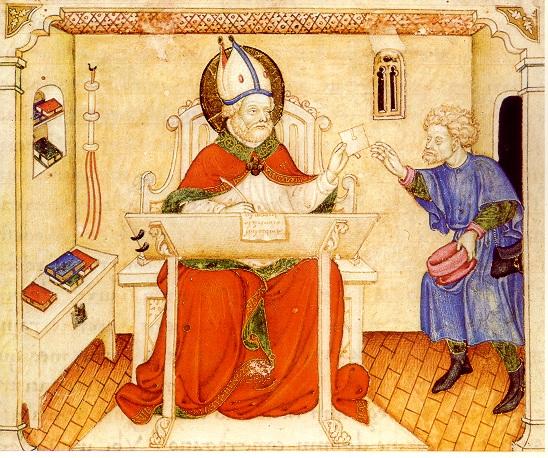
St. Ambrose: copycat, rookie, disliked by St. Jerome

St. Ambrose was a titanic figure in the Church in Italy in the 4th century.  Here is a post I wrote some time ago about him and another great figure of the patristic era, St. Jerome.

In the ancient world, invective was a standard tool of debate.  Interlocutors would often pour acid on each other in a way we today… well, perhaps not some who read blogs today… find quite unsettling.

St. Jerome (+420), not known for his easy-going, gentle character, genuinely had if out for St. Ambrose of Milan (+397) and didn’t spare him one little bit.

My conjecture is that Jerome was jealous of Ambrose, who had “made it” in the Church in Italy, whereas Jerome always played second fiddle. But I digress.

What’s with Jerome about Ambrose?

To get at this we have to bring in a third character, Tyrannius Rufinus of Aquileia.

You are no doubt aware that Jerome and his old friend of his youth Rufinus (+410) had a titanic clash over the writings and teachings of the early Alexandrian exegete Origen.

When Jerome and Rufinus were young, they were very close, forming part of a group of dedicated Christians at Aquileia and then later at Jerusalem. They began to argue over the theology of Origen, but they patched things together before Rufinus left Palestine for Italy.

However, once in Italy Rufinus began to translate Origen Peri archon (De principiis). In his preface Rufinus made the mistake of assuming that just because Jerome had translated some of Origen’s work, therefore Jerome was a fan of Origen. People around Jerome also thought Rufinus purposely made Origen sound more orthodox than he was. These folks wrote to Jerome to let him know what they thought Rufinus was up to and asked Jerome to explain what was going on.

In response Jerome translated Origen himself.

In a letter he strongly denied being a partisan of Origen’s theology, even though he admired Origen’s skill. Jerome focused his laser on Origen’s statements about the resurrection and the preexistence of souls, and how the Persons of the Trinity related to each other which made him sound like a subordinationist. Jerome, in this second phase of translation, interpreted Origen in a very strict and harsh way.

St. JeromeWhen you look at the way Jerome spoke of Origen the first time around, 12 years before, and what he did to him in the second round, it is pretty clear that this was a reaction to Rufinus’s written assumption about Jerome. Jerome was afraid that his own reputation was going to be damaged by a positive association with ideas which seemed very strange to many people, especially in the West.

In short, Jerome turned savagely on both Origen and Rufinus in order to defend his reputation. In defending himself Jerome was a little less than sincere.

Rufinus responded, of course. He had to. Rufinus pointed out, for example, that in a commentary on Ephesians Jerome had referred without objection to ideas of Origen about the preexistence and fall of souls into bodies. There are other points as well. Jerome responded with vitrolic force saying that some people (e.g., Rufinus), “love me so well that they cannot be heretics without me.”

Ouch.

Of course the ways of saints are strange and fraught with problems.

The postal service, or lack of one, actually plays an importance role in all of this.

Jerome wrote a friendly letter to Rufinus assuring him of his high esteem and speaking of their past friendship and the passing of his mother. He expressed his desire to avoid a public fight.

The letter never reached Rufinus. Jerome’s “friend” Pammachius kept it, and published instead a letter of Jerome which accompanied his translation of Origen’s De principiis.

Not having seen Jerome’s irenic gesture, Rufinus published his Apology, in response to Jerome the attacker.

And now we arrive finally at the point of this entry.

In Book II of his Apology, Rufinus points out how Jerome had attacked Ambrose. He mentions Ambrose’ work De Spiritu Sancto. Thus, Rufinus about Jerome’s view of Ambrose.

Rufinus relates more of Jerome’s disdain for his “rival” in Milan (Apology 2,23-25) as he digs into accusations of plagiarism which were being hurled around.

Rufinus says in 2, 23 that Jerome referred to Ambrose as a raven, a bird of ill omen, croaking and ridiculing in an strange way the color of all the others birds on account of his own total blackness…

praesertim cum a sinistro oscinem corvum audiam croccientem et mirum in modum de cunctarum avium ridere coloribus, cum totus ipse tenebrosus sit.”

Again, going on about Jerome’s accusation against Ambrose of plagiarism, in 2,25 Rufinus continues about Jerome’s treatment of Ambrose with his own counter charges:

25. You observe how (Jerome) treats Ambrose. First, he calls him a crow and says that he is black all over; then he calls him a jackdaw who decks himself in other birds’ showy feathers; and then he rends him with his foul abuse, and declares that there is nothing manly in a man whom God has singled out to be the glory of the churches of Christ, who has spoken of the testimonies of the Lord even in the sight of persecuting kings and has not been alarmed. The saintly Ambrose wrote his book on the Holy Spirit not in words only but with his own blood; for he offered his life-blood to his persecutors, and shed it within himself, although God preserved his life for future labours.

Suppose that (Ambrose) did follow some of the Greek writers belonging to our Catholic body, and borrowed something from their writings, it should hardly have been the first thought in your mind, (still less the object of such zealous efforts as to make you set to work to translate the work of Didymus on the Holy Spirit,) to blaze abroad what you call his plagiarisms, which were very possibly the result of a literary necessity when he had to reply at once to some ravings of the heretics. Is this the fairness of a Christian?

Is it thus that we are to observe the injunction of the Apostle, “Do nothing through faction or through vain glory”? But I might turn the tables on you and ask, Thou that sayest that a man should not steal, dost thou steal?

I might quote a fact I have already mentioned, namely, that, a little before you wrote your commentary on Micah, you had been accused of plagiarizing from Origen. And you did not deny it, but said: “What they bring against me in violent abuse I accept as the highest praise; for I wish to imitate the man whom we and all who are wise admire.” Your plagiarisms redound to your highest praise; those of others make them crows and jackdaws in your estimation. If you act rightly in imitating Origen whom you call second only to the Apostles, why do you sharply attack another for following Didymus, whom nevertheless you point to by name as a Prophet and an apostolic man?

For myself I must not complain, since you abuse us all alike. First you do not spare Ambrose, great and highly esteemed as he was; then the man of whom you write that he was second only to the Apostles, and that all the wise admire him, and whom you have praised up to the skies a thousand times over, not as you say in two, but in innumerable places, this man who was before an Apostle, you now turn round and make a heretic.

Thirdly, this very Didymus whom you designate the Seer-Prophet, who has the eye of the bride in the Song of Songs, and whom you call according to the meaning of his name an Apostolic man, you now on the other hand criminate as a perverse teacher, and separate him off with what you call your censor’s rod, into the communion of heretics. I do not know whence you received this rod. I know that Christ once gave the keys to Peter: but what spirit it is who now dispenses these censors’ rods, it is for you to say. However, if you condemn all those I have mentioned with the same mouth with which you once praised them, I who in comparison of them am but like a flea, must not complain, I repeat, if now you tear me to pieces, though once you praised me, and in your Chronicle equalled me to Florentius and Bonosus for the nobleness, as you said, of my life.

And from Jerome’s own pen we have this vicious attack on Ambrose (ep. 69,9).

Jerome was writing in the year of Ambrose’ death, 397, to a Roman named Oceanus who wanted Jerome to help him fight against a bishop in Spain who had married a second time. Jerome tells Oceanus to drop it, since that bishops’ first marriage had been before baptism.

However, Jerome uses the occasion to take a somewhat less than oblique swipe at Ambrose.

Ambrose had been popularly proclaimed bishop in Milan in 374 even though he had not even been baptized and had no theological training. The emperor, who wanted peace, acceded and within a week Ambrose was baptized and consecrated bishop.

Jerome, who had probably been disappointed that he hadn’t been made bishop of Rome, surely felt the sting of this meteoric rise of Ambrose.

In any event, listen to Jerome:

One who was yesterday a catechumen is today a bishop; one who was yesterday in the amphitheater is today in the church; one who spent the evening in the circus stands in the morning at the altar: one who a little while ago was a patron of actors is now a dedicator of virgins. Was the apostle ignorant of our shifts and subterfuges? Did he know nothing of our foolish arguments?

(Heri catechumenus, hodie pontifex; heri in amphitheatro, hodie in ecclesia; uespere in circo, mane in altari; dudum fautor strionum, nunc uirginum consecrator: num ignorabat apostolus tergiuersationes nostras et argumentorum ineptias nesciebat?)

Okaayyyy! That’s a big “NO!” vote from Jerome.

Regardless, today is the feast of St. Ambrose, who seemed to bring out both the worst and the best in people.

Posted in Linking Back, Saints: Stories & Symbols | Tagged , , , ,
27 Comments

QUAERITUR: Dalmatics on deacons! Maniples all around!

From a priest:

I enjoyed reading your post a month or so ago about how the use of maniples is really a sine qua non for the New Evangelization.  [Do I hear an “Amen!”?] As a relatively-new, hip, young priest, I have a few matching solemn high vestment sets, complete with maniples, and at my parish, we have 3 permanent deacons who are all quite active. [For the love of all that is holy… teach them the Extraordinary Form!] Therefore, at most Masses, even daily ones, we have at least one deacon, and sometimes two. My question is this: although the maniple is allowed but not required in the OF, if I’m going to wear one, should I have the deacon(s) wear one too?  [YES!] After all, it is proper to all the ordained, not just the priest, and it seems that I could potentially cause some confusion if only I wore one and not the deacon(s).  [I don’t know how much confusion it would cause, but surely the angels would weep.] Of course, another factor to consider is that the other priests in my parish, including the pastor, [the plot thickens] would definitely not wear a maniple, and so that could also cause confusion when the people see me wear one and not the other priests, and the deacons wearing one only when I’m the celebrant.  [Show ’em how it’s done, sonny.]

Another question, slightly related, has to do with dalmatics. We have two dalmatics of each color (including rose and black!), but the general practice is that they’re only worn on Sundays and feasts, and so at weekdays the deacon(s) just wears an alb and stole. Should they wear the dalmatic everyday? And would it be inappropriate for them to wear an alb, maniple, and stole, without a dalmatic? [Yahhhh… I can’t see them wearing the maniple without the dalmatic.  But it seems to me that the proper vestment of the deacon is the dalmatic, all the time.  If you have the dalmatic, use the dalmatic.  ]

I am reminded of a parody song the official WDTPRS parodohymnodist made up years before … I think before the internet.

Dalmatics on deacons and cassocks on priests,
habits on nuns and immovable feasts,
bishops in soutanes with big, gaudy rings –
these are a few of my favorite things.

[…]

Posted in "How To..." - Practical Notes, ASK FATHER Question Box, Liturgy Science Theatre 3000, New Evangelization, SUMMORUM PONTIFICUM | Tagged , , ,
28 Comments

QUAERITUR: Mixing Latin and English in the Ordinary Form

From a reader:

Last Sunday I attended a Mass where the priest used one Latin phrase during an English-language Novus Ordo: he sang “Mysterium Fidei” after the Consecration. Is this permitted?

Would that he had used more!

Latin is the true language of our liturgical worship in the Latin Church. It is always permitted.  (cf. can. 928)

The Fathers of the Second Vatican Council explicitly mandated (SC 54) that pastors of souls make sure that people can both speak and sing the parts that pertain to them also in Latin. This has not been obeyed.

The implementation of a new translation closer to the Latin original is also an opportunity to reattach our ourselves to our forebears and reclaim our patrimony… and obey the mandate of the Council.

This will also provide a way to reopen the vast treasury of sacred music that is part of our inheritance as Catholics. All these years we have been given the dross when the true riches have been kept from us.

In some places this reintroduction will mean taking baby steps. We can bring in Latin a little at a time until people are used to the idea again.

Posted in ASK FATHER Question Box, Brick by Brick, Liturgy Science Theatre 3000, New Evangelization, Our Catholic Identity, The future and our choices | Tagged , , , , ,
39 Comments

“BACK TO THE PEOPLE!” “AGAINST VATICAN II!” “COMMUNION IN THE HAND!” “PARTICIPATION!” “LATIN!”

For your amusement:

[wp_youtube]6khnt7DXOlY[/wp_youtube]

Posted in Liturgy Science Theatre 3000, New Evangelization, Our Catholic Identity, SUMMORUM PONTIFICUM, The Drill, The future and our choices | Tagged ,
43 Comments

Newt Gingrich clarifies the “implantation” remark. And a reminder about an “excommunication”.

Remember presidential candidate Newt Gingrich’s disturbing remark about “implantation”?   I wanted a clarification about that comment… coming as it did from a two-year, and therefore recent, convert to Holy Church.

In the meantime, Mr. Gingrich as made a clarification.  HERE at LifeSite:

In a new statement the Gingrich campaign sent to LifeNews.com over the weekend, the former House Speaker says repeatedly that he believes life begins at conception, that he is pro-life and that he would implement a pro-life agenda immediately after being sown in as president if he becomes the GOP nominee and defeats pro-abortion President Barack Obama.

“As I have stated many times throughout the course of my public life, I believe that human life begins at conception,” Gingrich said in the statement. “I believe that every unborn life is precious, no matter how conceived. I also believe that we should work for the day when there will be no abortions for any reason, and that every unborn child will be welcomed into life and protected by law.”

“That is why I have supported, and will continue to support, pro-life legislation that not only limits, but also reduces, the total number of abortions, with a view to the eventual legal protection of all unborn human life,” Gingrich continued.

[…]

In the 2012 presidential race, Gingrich has pledged to appoint pro-life judges to the Supreme Court, end taxpayer funding of abortion, de-fund Planned Parenthood and sign into law a federal Pain-Capable Unborn Child Protection Act.  Gingrich is also committed to repealing the pro-abortion Obama healthcare law, which contains massive abortion funding and threats of rationing.

In the meantime, canonist Prof. Ed Peters, the Canonical Defender, has a comment about this matter.  He doesn’t have a combox so do spike his stats with a visit:

A canonical comment on Newt’s oddball remark

[…]

In 1988, the Pontifical Council for Legislative Texts authoritatively (authentice) answered the question about whether deliberate destruction of pre-natal human beings “by any method at any time after the moment of conception” (quocumque modo et quocumque tempore a momento conceptionis) was an excommunicable offense under Canon 1398. The Council’s answer, approved by Pope John Paul II on 23 May 1988, was Yes. See AAS 80 (1988) 1818-1819.Since that ruling there has not been, of course, a rush to excommunicate women for, say, miscarriages, etc., etc., and not just because such things were never threatened in the first place, but for simple legal reasons that basically leave hard cases (and there are hard cases, although miscarriage is not one) in the confessional, where they belong, while preserving the principle that innocent human life, at any stage of dependency and irrespective of how it came to be, can never be intentionally targeted for death. CCC 2271, 2275.

Posted in 1983 CIC can. 915, Emanations from Penumbras, Our Catholic Identity, The Drill, The future and our choices | Tagged , , , , , ,
42 Comments

QUAERITUR: With what level of voice should priests say those quiet prayers?

From a priest:

A thought: In the rubrics of the Missal, would you agree that a change in a word signifies a change in action? Looking at the prayers that the priest says that are not directed to the congregation, I noticed a change. Three weeks ago, those prayers were to be said “inaudibly.”
Now, those prayers are to be said “quietly.” (Third typical edition) This includes at the Offertory (“With humble spirit…”), before the Agnus Dei (“May the mingling…”) and several times after the Agnus Dei. To me, a change of word does mean a change of action; otherwise, the rubrics would have kept the word “inaudible” as the direction to be followed. And clearly, “inaudible” is not equivalent to “quietly.”
Having said these words quietly now for two weeks, I find that when I say them quietly, I say each word…and with more reverence. And here is another point. The Latin-English Missals I used when growing up had the translations for ALL the words that the priest said at Mass; I have not found any Missal”ette” that has ever informed the congregation of these inaudible prayers that the priest prays at Mass…I thought one of the purposes of the vernacular Mass was to better inform those present what was happening at the Mass. I wonder why these prayers were never provided to the faithful…So, a question: is it proper for the priest to now say the formerly “inaudible” prayers in a quiet voice that could therefore actually be heard by altar boys and the first pew of congregants?

A good question.  You are very observant!  Thanks for Saying the Black and Doing the Red!

We must consider what the rubrics say in the Latin edition.   The priest is at times to say prayers “secreto” or as it is rendered at times “in a low voice”.   Parts to which servers must reply are to be just loud enough, in a subdued voice, to be audible to them.

In the Extraordinary Form there were two levels of voice.  At Low Mass the priest would either say texts aloud so that all could hear or  softly, as in a whisper so that the priest himself can hear but not others.   At a Solemn Mass much is sung, so, obviously, those texts are heard by all.  Other parts are with clara voce (aloud), or secreto (softly).  Parts to which servers must reply are to be in a subdued voice just loud enough to be audible to them.

I think we could take our cue from the way this was always done in the past, in our Latin, Roman tradition.

Certain texts requiring responses are addressed to the people and servers.  They should be audible to all who are to respond.  The other prayers, which the priest says on his own and which are not directed to people for a response, should be in the low voice, secreto as the Latin says.  Sometimes there is music during the offertory when the priest says prayers that need a response.  I would use a subdued voice so that a server/deacon nearby could respond, without necessarily being audible to the congregation over and against the music.

In my opinion, we should with the Novus Ordo, Ordinary Form, recapture something of the fact that, often, the priest is not talking to the congregation all the time.

Perhaps some priests will jump in with helpful observations.

Posted in "How To..." - Practical Notes, ASK FATHER Question Box, Liturgy Science Theatre 3000, Mail from priests, Our Catholic Identity | Tagged , , , , , ,
24 Comments