 Scottish archbishop tells Catholics not to kneel for communion
By David Kerr
Glasgow, Scotland, Aug 30, 2011 / 12:56 pm (CNA/EWTN News).- The Archbishop of Glasgow, Scotland has told Catholics in his archdiocese not to kneel to receive communion.
“The Faithful should follow the General Instruction of the Roman Missal, namely coming to communion in procession and standing to receive Holy Communion,” wrote Archbishop Mario Conti in a letter to all his priests, dated August 25. [I wonder if the GIRM for every conference has a direction to receive standing. I assume it does in Scotland.]
“Standing in our Western culture is a mark of respect: kneeling at the altar rails (where they continue to exist) is not the practice envisaged by the instructions in the Missal,” he stated. [With due respect to His Excellency, rather, His Grace, I am puzzled by this. Getting to one’s feet is a certainly a sign of respect at the entrance of a person. That is both liturgical and secular. However, we don’t just show respect to Christ in the Eucharist. We adore, venerate, worship, Christ in the Eucharist. Am I wrong to think that there is a qualitative difference between showing respect for someone important and adoring Someone divine?]
The archbishop’s letter was issued ahead of the introduction of the new translation of the Roman Missal, which comes into effect throughout the English-speaking world this coming November.
Ironically, his instruction comes only a year after Pope Benedict XVI celebrated Mass in Glasgow. At that papal Mass, all those receiving communion from the Pope did so kneeling on a pres-dieu.
“This is really awful,” one Glasgow priest, who wished to remain anonymous, wrote to CNA.
“The bishop is indeed the moderator of the liturgical life of the diocese. However, what concerns a number of the priests in Glasgow is that our Archbishop knowingly exceeds his legitimate authority when he attempts to remove liberties foreseen by the Roman Missal itself.”
The General Instruction of the Roman Missal states that “the faithful communicate either kneeling or standing, as determined by the Conference of Bishops.” [It seems that the Conference in Scotland has prescribed standing.] The Instruction adds, “(w)hen they communicate standing, however, it is recommended that they make an appropriate sign of reverence, as determined in the same norms, before receiving the Sacrament.”
In 2002, then-Prefect of the Congregation for Divine Worship, Cardinal Jorge Medina Estévez, attempted to clarify the issue after receiving complaints from lay Catholics who were being refused communion after kneeling to receive the host.
The Congregation, he wrote in an open letter, “considers any refusal of Holy Communion to a member of the faithful on the basis of his or her kneeling posture to be a grave violation of one of the most basic rights of the Christian faithful, namely that of being assisted by their Pastors by means of the Sacraments (Codex Iuris Canonici, canon 213).”
He went on to add that even when the Congregation has given its approval for a bishops’ conference to make a standing posture the norm, “it has done so with the stipulation that communicants who choose to kneel are not to be denied Holy Communion on these grounds.” [I don’t believe that Archbp. Conti said anything about his intention to refuse Communion to anyone if they kneel. I sounds as if he has simply expressed his own preference about what people should do.]
He also highlighted that Cardinal Joseph Ratzinger, now Pope Benedict XVI, believed the “centuries-old tradition” of kneeling to receive communion is a “particularly expressive sign of adoration, completely appropriate in light of the true, real and substantial presence of Our Lord Jesus Christ under the consecrated species.”
Cardinal Estévez concluded with a warning that “the Congregation will regard future complaints of this nature with great seriousness” and, if those complaints are verified, it would “seek disciplinary action consonant with the gravity of the pastoral abuse.”
“There is no question of anybody being refused communion if they choose to kneel,” a spokesman for the Archdiocese of Glasgow told CNA on Aug. 30. [Of course not. Hardly needs to be said.]
“The purpose of the bishop’s letter is to encourage, and certainly not diminish, devotion to the Blessed Sacrament by reminding people of the need to make an act of reverence before receiving Holy Communion standing and in procession – which is the overwhelming custom in the diocese and the rest of Europe.” [I am not sure that reference to numbers of people who do X is the best argument. I suspect that the overwhelming number of Catholics in Europe and Scotland commit the usual carnal sins as well, all the while going to Communion when and if they go to Mass, the overwhelming number of Europeans and Scots haven’t been to confession for years, and they go to Communion, and overwhelming numbers of Scots and Europeans, though baptized, have a sketchy notion of basic doctrines and catechism. What percentage of Catholics in Scotland and Europe go to Mass? Would I be wrong to find the argument by numbers to be a little weak?]
The latest development is not first time that Archbishop Conti has made headlines for his stance on liturgical matters.
In 2007, he sent an advisory note to all his priests following the publication of Pope Benedict’s document “Summorum Pontificum” on the provision of the older Tridentine Rite in parishes. The archbishop’s guidelines were dubbed the “coldest, most hostile I have read so far” by the renowned Catholic blogger Fr. John Zuhlsdorf. [Sadly.]
Archbishop Conti turned 77-years-old earlier this year and has already handed in his resignation to Pope Benedict. His replacement could be announced within the next few months.
Articles of this kind make me very sad.
The posture from receiving Holy Communion is certainly a matter for sometimes hot debate. My own views are well-enough known that I won’t repeat them. And, I must add, I am pretty much nobody in comparison with the lofty climes of curiae and chanceries.
In any event, whatever discussion we engage in about this very important issue, we should use charity and commonsense.

 When people hold something dear, they take pains to pass it one to the next generation.
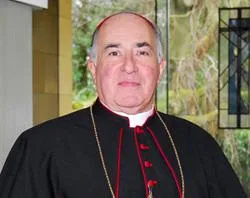 Scottish archbishop tells Catholics not to kneel for communion




























