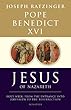
I have been reading the new, second volume of Benedict XVI’s book, Jesus of Nazareth. A preview copy was sent to me by the publisher.
I have been circling back over various passages which impedes my forward progress. I am circling back not because it is difficult to read, but because I want to remember it well. Also, I have been taking it to my evening visits to the Blessed Sacrament. The book is about Jesus, after all. Why not read it with Him? That has been helpful, though it slows my progress. So… I hold myself in check even as I strain forward.
The new book will be released worldwide for Lent 2011, with a date of 10 March. Just buy it.
You can click HERE or the image above to go to amazon (USA) and buy the book at a significant discount before its official release. The USA KINDLE edition is available HERE for even less than the hardback. If you don’t have a Kindle – I am really starting to like using this great tool – you can get a USA version HERE. It will work anywhere, globally. If you are in the UK or Europe, use THIS LINK for the Pope’s hardback and THIS for a Kindle, which will work everywhere. I haven’t found a link for the UK Kindle version of the Pope’s new book. BTW… you can also read the stuff you get for Kindle on your iPhone, iPad, laptop, etc., and they all synchronize.
This second volume looks at the period the Lord’s life from the entrance into Jerusalem to His resurrection. In other words – Holy Week.
There has been an embargo on using the text. Today, however, the publishers said we could use content from three sections.
Chapter 3, Section 4: “The Mystery of the Betrayer”
Chapter 5, Section 1: “The Dating of the Last Supper”
Chapter 7, Section 3: “Jesus Before Pilate”
I’ll share some observations about the book in the next few days, beginning with this general statement and then looking at somethings in “The Mystery of the Betrayer”.
As Pope, it is hard for Joseph Ratzinger to react publicly to things. He can’t just be an old man with experience of life, or a theologian or priest. As Pope, he is under many constraints. He cannot simply say what he thinks or – and this is the dangerous part for him – what he is thinking about. If you are smart, you mull over hard question, chew slowly, digest, chew more, consider, weigh. You think things through. In a conversation you may say what you think about something and you are expressing something about where you are with the question right now, not necessary meaning that you aren’t going to keep working on the problem. We saw what happened when the Pope in that interview book – O Lord, let there never be another – said something about condoms.
Papa Ratzinger has been thinking about Jesus for his whole life. He doesn’t consider Jesus to be static, or a subject, or a thing to be pondered. Jesus is a who, in whose image we are made. Years ago I heard Card. Ratzinger answer a question about some of Fr. Karl Rahner’s notions about God. After a brilliant exposition, Ratzinger concluded, “”What Fr. Rahner forgets is that you cannot pray to an Existenz-Modus!”
Throughout the book, the Holy Father continues in the vein he exposed in his first volume where, in the indispensable preface, he explains where the “technicians” (my word, not his) of Scripture go wrong in reading Scripture. You cannot simply apply tools of modern scholarship, such as the historical-critical method, form criticism, etc., without also concerning yourself with the who behind each word. What Papa Ratzinger is doing is showing us how to reconnect with Scripture in a way closer to that the of early Fathers of the Church.
I have been convinced that the Fathers are of growing importance precisely because they reconnect us with a way of reading Scripture. That’s one degree why I have a degree in Patristic Theology. At the same time as we can make great use of the tools of scholarship we have, and the Holy Father does use them extensively, we never lose sight of that other way of reading and listening. This is the Pope’s working method throughout.
Back to my contention that Pope’s are constrained. I have the sense in reading this book that the Pope is not simply writing about Jesus, but is also making subtle – sometimes not too subtle – allusions to questions or controversies in our day or even giving us us explanations about things he is doing as Pope. For example, his thoughts in the book about the Jews will both create controversies and also answer some questions about why he has done certain things. Have you ever wondered why the Holy Father made a change in the 1962 Missale Romanum to the Good Friday petition prayer about the Jews? What was he thinking when he inserted that new prayer? Pages 41 ff. provide some food for our chewing.
But I digress…
In one of the sections we who have the book are allowed – as of today – to write about, Chapter 3, Section 4: “The Mystery of the Betrayer”, the Holy Father writes about Judas. In his description, based on solid modern scholarship, of how people reclined to eat, so as to get at the Lord’s explanation of who would betray Him, the Holy Father pretty much guts the idiocy in the DaVinci Code, as well as some saccharine art wherein the the “beloved disciple” is depicted as resting against Jesus bosom. But that is lana caprina.
Fairly often while reading, I circle back over a text and wonder if the Pope isn’t giving his opinion on some issue without directly saying that that is what he is doing. Given my constant writing about the liturgical translations, I was struck by his section on the Last Supper about the Lord’s institution of the Eucharist and the words – and meaning of the words – when speaking about His own Precious Blood. WDTPRS readers will read some familiar things in those pages. But I digress.
In the section on Christ’s betrayer, the Pope also gives us a couple striking paragraphs useful for anyone who may consider receiving Holy Communion in the state of sin. That is not what he says he is doing. I am making that application. But I can’t help but think as I read that the Holy Father may have had something like that in mind.
I quote now in part, to give you a taste. The verse of the psalm Jesus uttered, to which the Pope is referring is “He who ate my bread has lifted his heel against me” (cf. Ps 41:9; Ps 55:13):
John gives a new depth to the psalm verse with which Jesus spoke prophetically of what lay ahead, since instead of the expression given in the Greek Bible for “eating”, he chooses the verb trôgein, the word used by Jesus in the great “bread of life” discourse for “eating” his flesh and blood, that is, receiving the sacrament of the Eucharist ( Jn 6:54–58). So the psalm verse casts a prophetic shadow over the Church of the evangelist’s own day, in which the Eucharist was celebrated, and indeed over the Church of all times: Judas’ betrayal was not the last breach of fidelity that Jesus would suffer. “Even my bosom friend, in whom I trusted, who ate my bread, has lifted his heel against me” (Ps 41:9). The breach of friendship extends into the sacramental community of the Church, where people continue to take “his bread” and to betray him.
Jesus’ agony, his struggle against death, continues until the end of the world, as Blaise Pascal said on the basis of similar considerations (cf. Pensées VII, 553). We could also put it the other way around: at this hour, Jesus took upon himself the betrayal of all ages, the pain caused by betrayal in every era, and he endured the anguish of history to the bitter end. (pp. 68-9)
In speaking about Judas, the Holy Father delves into something about which I wrote yesterday, blasphemy and final impenitence.
I must say I found the section on Judas disturbing. In many ways we can see ourselves in the figure of Judas. Throughout, the Holy Father is showing us what Jesus does for us in the incessant struggle between light and darkness. We are not exempted from the struggle for HE was in the struggle definitively. If we are HIS, we are in the battle.
And for anyone thinking about leaving Mass early after Communion for no better reason than personal convenience, here is how this now unembargoed section concludes:
John concludes the passage about Judas with these dramatic words: “After receiving the morsel, he immediately went out; and it was night” (13:30). Judas goes out—in a deeper sense. He goes into the night; he moves out of light into darkness: the “power of darkness” has taken hold of him (cf. Jn 3:19; Lk 22:53).
I will write more about other sections in the days to come.
The second volume may be “pre-ordered” at a reduced price through amazon.com. Click HERE. If you are in the UK or Europe, use THIS LINK.
Directly from Ignatius Press (without amazon) for US buyers HERE .
.
I believe Catholic Truth Society is the publisher for England and Wales.
The first volume is HERE.
Finally, do you want better sermons from your priests? These books would be good gifts to priests, useful for their preaching. Both volumes would be useful for your Lenten reflections.

 Pope Benedict is doing something about that. After decades of work which at best paved the way by changing how we talk with other groups, making it possible to have a conversation, the Holy Father is finding creative ways to engage in a true ecumenism. This is the ecumenism in continuity with both Mortalium animos as well as Unitatis redintegratio whereby, eventually, all are one in the Catholic Church.
 Ash Wednesday is around the corner. In the UK’s best Catholic weekly, the