CDW response to a dubium concerning role of priests and deacons at the Doxology

Also from the Newsletter of the USCCB’s Committee for Divine Worship, there was published a response to a dubium sent to the CDW in Rome.

My brother priests who are interested in concelebration may be interested in this:

Role of Concelebrating Priests at the Doxology of the Eucharistic Prayer

In this dubium, the question concerned the role of concelebrating Priests and whether they were permitted to take up the various chalices from the altar before the final doxology of the Eucharistic Prayer. Quoting from the General Instruction of the Roman Missal, the Congregation emphasized the proper role of the Deacon in holding up the chalice next to the Priest for the final doxology: “At the final doxology of the Eucharistic Prayer, the deacon stands next to the priest, holding the chalice elevated while the priest elevates the paten with the host, until the people have responded with the acclamation, Amen” (no. 180).

According to the Congregation’s response, “Therefore, the use is reprobated where all or many concelebrants at the altar proceed to take up the chalices at the time of the final doxology. Rather, it is the duty of the celebrant, or the deacon, or one concelebrant to elevate the [principal] chalice.” It is presumed by extension that the same could be said regarding the elevation of multiple ciboria or patens by various concelebrants. Given the response and the principles of the General Instruction of the Roman Missal, only the main paten and the main chalice are to be elevated by the celebrant assisted by the Deacon, or in the absence of a Deacon, by a single concelebrant.
(March-April 2009, pg. 171)

Posted in "How To..." - Practical Notes | Tagged , ,
15 Comments

A note about music from the USCCB’s Committee for Divine Worship

In the latest newsletter of the USCCB’s Committee for Divine Worship there is a focus on the Holy Father’s Post-Synodal Exhortation Verbum Domini, concerning Sacred Scripture.

I found this interesting:

In times of praise and thanksgiving, and in times of sadness and anxiety, the word of God always has something to say. “[W]ith a view to making the People of God ever more familiar with the word of God in the context of liturgical actions or, in any event, with reference to them” (no. 64), the Holy Father offers several other liturgical suggestions for highlighting the transformative power of the word and letting it enrich our lives:

Celebrations of the word of God are encouraged, particularly as part of liturgical formation, as preparation for the Sunday Eucharist, and as a time to pray and meditate on sacred Scripture. These types of celebrations are particularly recommended during Advent, Christmas, Lent, and Easter (see no. 65).

The celebration of the Liturgy of the Hours, particularly Morning Prayer and Evening Prayer, ought to become more widespread among the lay faithful. Pastors should give emphasis to such public celebrations, particularly the First Vespers of Sundays and solemnities. Clergy and religious communities should promote the Liturgy of the Hours with the participation of the lay faithful (see no. 62).

  • Whether during the Liturgy of the Word at Mass or at other occasions, the proclamation of the word of God “is to be celebrated in such a way as to promote meditation” (General Instruction of the Roman Missal, no. 56). Proclaiming the word of God also involves silence afterward, in order to allow the Holy Spirit to transform us in the Lord. In the Mass, sacred silence should take place before the Liturgy of the Word begins, after the First and Second Readings, and after the homily. [Frankly, I avoid too much silence after my sermons, lest people get the idea that I and what I say are the true focus.] Pastors are exhorted to foster moments of recollection so that the word of God can truly take root in people’s hearts (see no. 66).
  • In the selection of songs for the liturgy, “[p]reference should be given to songs which are of clear biblical inspiration and which express, through the harmony of music and words, the beauty of God’s word” (no. 70). These words should give new impetus to composers, and also inspire all to make greater use of Gregorian chant, [I am grateful for the reference to Gregorian chant.  But this is really too little, no?  Sacrosanctum Concilium is pretty clear that Gregorian chant is THE music par excellence.] “songs handed down to us by the Church’s tradition” (no. 70). [Consider with regret and horror what some people will claim are “traditional songs”.] The 2007 guidelines document of the USCCB, Sing to the Lord: Music in Divine Worship, can provide help in song selection.
  • In churches, the ambo should be paid special attention through its clearly visible placement, beautiful design, and aesthetically harmonious decoration with the altar. Also, if possible, the sacred Scripture (either a Bible or book of the Lectionary) could be displayed in a place of honor in the church, even outside of liturgical celebrations. This placement should not compete, however, with the centrality of the tabernacle (see no. 68).
  • Parishes should provide “every possible practical assistance” to those who are visually and/or hearing impaired, so that they too may actively participate in the liturgy and “experience a living contact with the word of the Lord” (no. 71).

Brick by brick, my friends, brick by brick.

Start forming Gregorian chant scholas.

Posted in Brick by Brick | Tagged ,
24 Comments

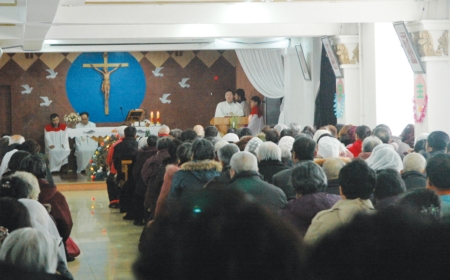
A Catholic (“Patriotic”) parish in China

The Holy Father spoke about religious liberty in his recent “state of the world” speech to the diplomatic corps.

I now want to draw your attention to an article in The Pilot, the newspaper of the Archdiocese of Boston.

Think about what our brothers and sisters in China face.  This concerns a parish in China that belongs to the “Patriotic” Church, not the Church in union with Rome.  That said, there are some regions in China where relations are closer with Rome than in regions.  The situation is not uniform across China.

Christmas in Jilin
By Neil W. McCabe

Editor’s note: This report was filed by Pilot reporter Neil McCabe, currently on active duty with the U.S. Army, who made a trip to China while on leave during the Christmas Season.

Despite bracing cold, Chinese worshipers in Jilin City, a city in the region once known as Manchuria, marked the birth of our Savior at Masses celebrated at Sacred Heart of Jesus Christ Church, a majestic structure with its doors facing the mighty Songhua River.

Sacred Heart is the only Catholic church in the city of 4 million and its parish community has grown in recent years to more than 5,000 believers, said Father Guo Sheng “Joseph” Wang, a parochial vicar at the parish and the director of its social services ministry.

Father Wang said for Christmas there were three Masses: Christmas Eve, Midnight Mass and Christmas Day.

Because of harsh temperatures that reached only 10 degrees during the day and lows of 15 degrees below zero at night, Father Wang said the Masses could not be held in the unheated 1926-built church because of concerns for elderly worshipers. Instead, the Masses were held in the parish hall chapel.

At the Christmas Day Mass, the chapel was packed with more than 500 congregants, who crowded the pews, aisles and open areas in the back. There were also more than two dozen parishioners lined up at the confessional.

When it was built by French missionaries, Sacred Heart was the local cathedral because Jilin was then a provincial capital. In the 1994, the diocesan seat was moved to Changchun, the current capital of Jilin Province. During the Cultural Revolution, 1966 to 1976, the church was closed and damaged. In 1980, it was allowed to reopen as part of the officially recognized Catholic Church in China. [Not the “underground” Church.]

Beginning in the 1990s, the government has funded repairs to both the church building and the other parish buildings.

The church and its surrounding fenced-in campus comprise a rectory, a parish hall and a performance stage along with ancillary storage sheds. Across the street behind the church, there is a health clinic for seniors.

During his August 2010 visit to the China, North Korean leader Kim Jong Il took a short tour of the church, where he said his father once sought sanctuary from the Japanese authorities during the Second World War. It is also a short walk from the Yumen Middle School, the elite Marxist school his father attended.

Father Wang said he has been a priest in Jilin Province since 1997. He grew up in Jilin City and was raised in a Catholic family. As a young man he was pressured by his father and a friend of his father to study for the priesthood, but he always resisted. Finally, he attended a religious festival and was overcome with the feeling that in fact it was his calling to be a priest.

Although he continued to resist it, he prayed for six months until accepting his vocation and he said he was admitted to Jilin Seminary in a class of 13 seminarians.

Since his ordination, Father Wang has had four assignments. For his first three years, he taught at the seminary, before his three stints at country parishes. He began his tenure at Sacred Heart of Jesus Christ Church Jan. 28, 2008.

At the parish, Father Wang shares duties with three other priests. There are two American Maryknoll priests who teach at the city’s Bei Hua University. [With the Patriotic Church? Interesting.]

“Our social services ministry will mark its fifth year in operation in February,” he said. He is the second director. “The vision for Tianji Social Services is to promote a warm, loving, peaceful and harmonious community for everybody”

In addition to raising the profile of the city’s Catholic population, the priest said the program provides student scholarships, youth activities and a home visit ministry for the elderly, poor families and those struggling with HIV/AIDS and other diseases.

Father Wang said the Church in Jilin Province and in the city is growing, but not quickly. In the province itself, there are more than 40 individual houses of worship for roughly 80,000 Catholics.

One of the 5,000 parishioners of Sacred Heart is 70-year-old Maria Qiao, who said she was baptized five years ago.

“I had a friend who was a Catholic and she told me to come to the church with her and see how having a relationship with God could help me,” she said.  [Never underestimate the power of a simple invitation.]

Posted in Our Catholic Identity | Tagged ,
12 Comments

More social engineering: passport applications

passportVia Fox News:

‘Mother,’ ‘Father’ Changing to ‘Parent One,’ ‘Parent Two’ on Passport Applications

By Todd Starnes
Published January 07, 2011

The words “mother” and “father” will be removed from U.S. passport applications and replaced with gender neutral terminology, the State Department says.

“The words in the old form were ‘mother’ and ‘father,’” said Brenda Sprague, deputy assistant Secretary of State for Passport Services. “They are now ‘parent one’ and ‘parent two.’”

A statement on the State Department website noted: “These improvements are being made to provide a gender neutral description of a child’s parents and in recognition of different types of families.” The statement didn’t note if it was for child applications only.

The State Department said the new passport applications, not yet available to the public, will be available online soon.

Sprague said the decision to remove the traditional parenting names was not an act of political correctness.

“We find that with changes in medical science and reproductive technology that we are confronting situations now that we would not have anticipated 10 or 15 years ago,” she said.

Gay rights groups are applauding the decision.

[…]

Read more there.

Posted in The future and our choices | Tagged
34 Comments

WDTPRS POLL: The Sign of Peace in the Novus Ordo

Choose the answer closest to your thought and then give your comments in the combox below.

You do not have to be registered to vote in the poll.

Let’s get a good response!  Perhaps other bloggers will help?

What do you think about the "sign of peace" during Mass in the Ordinary Form?

View Results

Posted in POLLS | Tagged
105 Comments

QUAERITUR: Avoiding the Novus Ordo “sign of peace”

From a reader:

My wife and I attend an Extraordinary Form Mass almost exclusively, but at times, whether due to weather or circumstance, are forced to attend the closer, Novus Ordo parish. As those go, it’s very good, but I digress. My question is whether it is mandatory to break from prayer or contemplation to shake hands during the time at which the priest asks us to do so. I find it terribly disturbing to have to greet everyone around me during the Canon, and generally try to just keep my eyes down, in prayer, during this time. I do not wish to offend anyone, however, and I surely do not wish to violate my obligations at Mass. It is simply that my style, sense of propriety and Asperger’s cause me to really prefer otherwise.

Am I out of line to just stand silently with my eyes closed? Is this acceptable? Perhaps in bad taste?

I am glad you are willing to go to a Novus Ordo Mass even though it is not your preferred form.

First, be clear about something.  The invitation to make a “sign of peace” is itself an option in the Novus Ordo, left to the discretion of the priest.  The priest gives a “sign of peace” as part of the rubrics.  He must do it.  The invitation for others to do so is an option.

Unfortunately, the option has become the norm, so much so that most people think it is obligatory.

Too bad for those who really don’t like this feature of the Novus Ordo.  They seem to have no rights regarding this rite.

After that, I suppose there is the issue of “manners”, involved here.  Most people in the pews simply won’t understand why you might want to pray or not grip someone’s clammy, germ-filled hand at this point during Mass.   You run the risk of being, unintentionally, rude, by declining that honor.  You have to decide what you think about that.

I am sure that some people will chime in saying that they fold their arms, they ignore people, they cough into their hand, etc., and they may even say this with a measure of glee with which we are supposed to be as impressed as they are with themselves.

In other places I have written that perhaps one way to see the TLM and the Novus Ordo is that the former is the grown-up Mass and the other is like the … you know.  Consider where you are, and make the necessary changes in your head to adapt to the situation.

Here is one way to help you get through it.

I am sure most parents – just as an example – when feeding their skeptical toddlers with the flying airplane spoon or the choo-choo, even tasting the nasty goo in the spoon with something like exemplary appreciation, don’t actually like the goo in the spoon.  They would prefer a steak and glass of Bonarda.  But they don’t, therefore, begrudge the choo-choo spoon to little stupor mundi just because they personally want grown-up food.

You adapt according to the occasion looking forward to when all that will be unnecessary.

Sometimes it isn’t possible to sit far enough from people so that you don’t have to do this.

In that case you should probably just bite the bullet and do it, remembering that you will be back at a TLM soon.

And to sooth your irritated nerves, have some Mystic Monk Coffee when you get home.

Posted in "How To..." - Practical Notes, ASK FATHER Question Box | Tagged
76 Comments

An eastward facing observation

Yesterday the Holy Father celebrated Holy Mass for the Feast of the Baptism of the Lord in the Sistine Chapel.

Not a peep from the usual corners about ad orientem worship.

It’s a given.

Therefore,…. it is time for the next step, your Holiness.

What’s next?

Posted in Brick by Brick | Tagged
27 Comments

Card. Burke, “home” in St. Louis

Raymond Card. BurkeJust a nice email:

His Eminence, Raymond Leo Cardinal Burke is in St. Louis in what he described as “home”.  He is here to give a retreat to (in his exact words), “our beloved seminarians”.  I presume he uses the word “our” since he noted in his homily that he takes great pride in the fact the  Holy Father named him “archbishop emeritus of St. Louis”.

Aside from the public Mass at the Cathedral Basilica of St. Louis today, at the invitation of Archbishop Carlson, his only other two public appearances are at the two  oratories who celebrate exclusively the Extraordinary Form of the Roman Rite.

Raymond Card. BurkeI am a former parishoner of the Oratory parish of Ss. Gregory and Augustine ( I now live in Chicago), so  I returned for the event at “Greg n’ Gus”.  I thought you would like to see  the pictures from Friday  evening. The temporary chapel was packed with parishoners.  The service was began with a  solemn entrance, vesting at the altar, sermon, Benediction, Litany of the  Most Sacred Heart of Jesus, and prayers  to Our Lady of Walsingham.

The parish is adminstered by the English Benedictine Monks of St. Louis Abbey and the rector is The Rev. Dom Bede Price, MA (Oxon).  The monastic community was present, provided the schola, served as mc’s and one as subdeacon.  The abbot, the Right Rev. Dom Thomas Frerking, PhD (Oxon) attended in choir and greeted the cardinal at the reception.

After Benediction, there  was a reception in the hall where  the children of the parish warmly greeted him first.  The gift  of a golden mitre was presented by the very first child baptized at the oratory.  His  Eminence  stayed  until 11pm until he finished greeting everyone who wanted to  see him.

Posted in Just Too Cool | Tagged
18 Comments

Benedict XVI’s “state of the world” speech

When I look at issues having to do with the Church, especially how the Church interacts with (or resists) the “modern world”, I will usually try to see the issue from two perspectives: ad intra (from within the Church herself) and ad extra (from the perspective of the world).

In December the Holy Father gave his “state of the union/Church” address during his annual pre-Christmas meeting with the Roman Curia.   Now the other shoe has dropped.  He has given his “state of the world” speech to members of the diplomatic corp.

Benedict XVI’s speech to the Roman Curia (ad intra) was a grim assessment in which he spoke of a faith that is asleep and used the phrase, “The very future of the world is at stake.”

Here is the Holy Father’s address to the members of the diplomatic corps.

This is really long.  I will edit and add emphases and comments.

Your Excellencies,

Ladies and Gentlemen,

[…]

The religious dimension is an undeniable and irrepressible feature of man’s being and acting, the measure of the fulfilment of his destiny and of the building up of the community to which he belongs. Consequently, when the individual himself or those around him neglect or deny this fundamental dimension, imbalances and conflicts arise at all levels, both personal and interpersonal.  [This will be about religious liberty.]This primary and basic truth is the reason why, in this year’s Message for World Day of Peace, [Benedict has used these messages for important teachings.] I identified religious freedom as the fundamental path to peace. Peace is built and preserved only when human beings can freely seek and serve God in their hearts, in their lives and in their relationships with others. [No religious freedom, no peace.  It is a sine qua non.]

Ladies and Gentlemen, your presence on this solemn occasion is an invitation to survey the countries which you represent and the entire world. [He is getting ready to give examples of places where things aren’t going well.]

[…]

Looking to the East, the attacks which brought death, grief and dismay among the Christians of Iraq, even to the point of inducing them to leave the land where their families have lived for centuries, has troubled us deeply. To the authorities of that country and to the Muslim religious leaders I renew my heartfelt appeal that their Christian fellow-citizens be able to live in security, continuing to contribute to the society in which they are fully members. In Egypt too, in Alexandria, terrorism brutally struck Christians as they prayed in church. This succession of attacks is yet another sign of the urgent need for the governments of the region to adopt, in spite of difficulties and dangers, effective measures for the protection of religious minorities. Need we repeat it? In the Middle East, Christians are original and authentic citizens who are loyal to their fatherland and assume their duties toward their country. It is natural that they should enjoy all the rights of citizenship, freedom of conscience, freedom of worship and freedom in education, teaching and the use of the mass media(Message to the People of God of the Special Asembly for the Middle East of the Synod of Bishops, 10). I appreciate the concern for the rights of the most vulnerable and the political farsightedness which some countries in Europe have demonstrated in recent days by their call for a concerted response on the part of the European Union for the defence of Christians in the Middle East. Finally, I would like to state once again that the right to religious freedom is not fully respected when only freedom of worship is guaranteed, and that with restrictions. [Note that “only”.  This isn’t about just being able to go to church without getting blown up or shot… though that’s a good start.  Above, be mentions “education, teaching and the use of the mass media”.  What else does he have in mind?] Furthermore, I encourage the accompaniment of the full safeguarding of religious freedom and other humans rights by programmes [“programmes” surely means “laws” and concrete measures] which, beginning in primary school and within the context of religious instruction, will educate everyone to respect their brothers and sisters in humanity. [A public education initiative in Islamic countries to teach children that killing Christians is wrong… hmmm.] Regarding the states of the Arabian Peninsula, where numerous Christian immigrant workers live, I hope that the Catholic Church will be able to establish suitable pastoral structures. [In other words, in a place where it is forbidden to have even an informal gathering, we would like to establish something like parishes, chaplaincies, something.  That’s going to happen.   But the fact that Benedict is bringing it up in this context points to the shameful injustice of those state’s where it is not possible for Christians to live openly as Christians.]Among the norms prejudicing the right of persons to religious freedom, particular mention must be made of the law against blasphemy in Pakistan: [My my!  VERY pointed condemnation of a specific law in a specific country.  The Pope is not holding back.] I once more encourage the leaders of that country to take the necessary steps to abrogate that law, all the more so because it is clear that it serves as a pretext for acts of injustice and violence against religious minorities. The tragic murder of the governor of Punjab shows the urgent need to make progress in this direction: the worship of God furthers fraternity and love, not hatred and division. [I guess it depends on which god you worship.] Other troubling situations, at times accompanied by acts of violence, can be mentioned in south and south-east Asia, in countries which for that matter have a tradition of peaceful social relations. The particular influence of a given religion in a nation ought never to mean that citizens of another religion can be subject to discrimination in social life or, even worse, that violence against them can be tolerated. In this regard, it is important for interreligious dialogue to favour a common commitment to recognizing and promoting the religious freedom of each person and community. And, as I remarked earlier, violence against Christians does not spare Africa. Attacks on places of worship in Nigeria during the very celebrations marking the birth of Christ are another sad proof of this. [While the comment about “south Asia” might include problems with radical Hindus, this is really about Islam, isn’t it.]

In a number of countries, on the other hand, [moving away from religiously dominated states….] a constitutionally recognized right to religious freedom exists, yet the life of religious communities is in fact made difficult and at times even dangerous (cf. Dignitatis Humanae, 15) because the legal or social order is inspired by philosophical and political systems which call for strict control, if not a monopoly, of the state over society. [This is mostly about China, I think.  It is at least about Communism.] Such inconsistencies must end, so that believers will not find themselves torn between fidelity to God and loyalty to their country. I ask in particular that Catholic communities be everywhere guaranteed full autonomy of organization [This concerns the repression of the Catholic Church in China v. the Patriotic Association, the Communist Party puppet church.] and the freedom to carry out their mission, in conformity with international norms and standards in this sphere.

My thoughts turn once again to the Catholic community of mainland China and its pastors, who are experiencing a time of difficulty and trial. I would also like to offer a word of encouragement to the authorities of Cuba, a country which in 2010 celebrated seventy-five years of uninterrupted diplomatic relations with the Holy See, that the dialogue happily begun with the Church may be reinforced and expanded.

Turning our gaze from East to West, we find ourselves faced with other kinds of threats to the full exercise of religious freedom. [We have seen the dictatorship of religious state-religion fundamentalism, and state-materialstic domination, … now for .. what? … the dictatorship of relativism?] I think in the first place of countries which accord great importance to pluralism and tolerance, but where religion is increasingly being marginalized[The ad intra issue here is probably “New Evanglization” and the revitalization of Christian (Catholic) identity and, for the ad extra dimension, its voice in the public square.] There is a tendency to consider religion, all religion, as something insignificant, alien or even destabilizing to modern society, and to attempt by different means to prevent it from having any influence on the life of society. Christians are even required at times to act in the exercise of their profession with no reference to their religious and moral convictions, and even in opposition to them, as for example where laws are enforced limiting the right to conscientious objection on the part of health care or legal professionals. [An issue for the USA.]

In this context, one can only be gratified by the adoption by the Council of Europe last October of a resolution protecting the right to conscientious objection on the part of medical personnel vis-à-vis certain acts which gravely violate the right to life, such as abortion.

Another sign of the marginalization of religion, and of Christianity in particular, is the banning of religious feasts and symbols from civic life under the guise of respect for the members of other religions or those who are not believers. By acting in this way, not only is the right of believers to the public expression of their faith restricted, [NB.  This is an important stream of thought for Benedict.  For Benedict, Europe, indeed the West, is separable from Christianity in general, but certainly Catholicism in particular.  Without the Christian dimension, functioning and free in all spheres of life, there can be no “Europe” properly understood.  Indeed, no “West”.] but an attack is made on the cultural roots which nourish the profound identity and social cohesion of many nations. Last year, a number of European countries supported the appeal lodged by the Italian government in the well-known case involving the display of the crucifix in public places. I am grateful to the authorities of those nations, as well as to all those who became involved in the issue, episcopates, civil and religious organizations and associations, particularly the Patriarchate of Moscow and the other representatives of the Orthodox hierarchy, as well as to all those – believers and non-believers alike – who wished to show their sympathy for this symbol, which bespeaks universal values.

Acknowledging religious freedom also means ensuring that religious communities can operate freely in society through initiatives in the social, charitable or educational sectors. Throughout the world, one can see the fruitful work accomplished by the Catholic Church in these areas. It is troubling that this service which religious communities render to society as a whole, particularly through the education of young people, is compromised or hampered by legislative proposals which risk creating a sort of state monopoly in the schools; this can be seen, for example, in certain countries in Latin America. Now that many of those countries are celebrating the second centenary of their independence – a fitting time for remembering the contribution made by the Catholic Church to the development of their national identity [there it is again] – I exhort all governments to promote educational systems respectful of the primordial right of families to make decisions about the education of their children, systems inspired by the principle of subsidiarity which is basic to the organization of a just society.

Continuing my reflection, I cannot remain silent about another attack on the religious freedom of families in certain European countries which mandate obligatory participation in courses of sexual or civic education which allegedly convey a neutral conception of the person and of life, yet in fact reflect an anthropology opposed to faith and to right reason. [I think this goes beyond contraception issues to the whole nasty homosexual agenda, the attempt to mainstream homosexuality as just another lifestyle choice.]

Ladies and Gentlemen,

on this solemn occasion, allow me to state clearly several principles which inspire the Holy See, together with the whole Catholic Church, in its activity within the intergovernmental International Organizations for the promotion of full respect for the religious freedom of all. First, the conviction that one cannot create a sort of scale of degrees of religious intolerance. Unfortunately, such an attitude is frequently found, and it is precisely acts of discrimination against Christians which are considered less grave and less worthy of attention on the part of governments and public opinion. At the same time, there is a need to reject the dangerous notion of a conflict between the right to religious freedom and other human rights, thus disregarding or denying the central role of respect for religious freedom in the defence and protection of fundamental human dignity. Even less justifiable are attempts to counter the right of religious freedom with other alleged new rights which, while actively promoted by certain sectors of society and inserted in national legislation or in international directives, are nonetheless merely the expression of selfish desires lacking a foundation in authentic human nature. Finally, it seems unnecessary to point out that an abstract proclamation of religious freedom is insufficient: [Actions, not words.] this fundamental rule of social life must find application and respect at every level and in all areas; otherwise, despite correct affirmations of principle, there is a risk that deep injustice will be done to citizens wishing to profess and freely practise their faith.

[…]Before this distinguished assembly, I would like once more to state forcefully that religion does not represent a problem for society, that it is not a source of discord or conflict. I would repeat that the Church seeks no privileges, nor does she seek to intervene in areas unrelated to her mission, but simply to exercise the latter with freedom. I invite everyone to acknowledge the great lesson of history: “How can anyone deny the contribution of the world’s great religions to the development of civilization? The sincere search for God has led to greater respect for human dignity. Christian communities, with their patrimony of values and principles, have contributed much to making individuals and peoples aware of their identity and their dignity, the establishment of democratic institutions and the recognition of human rights and their corresponding duties. Today too, in an increasingly globalized society, Christians are called, not only through their responsible involvement in civic, economic and political life but also through the witness of their charity and faith, to offer a valuable contribution to the laborious and stimulating pursuit of justice, integral human development and the right ordering of human affairs” (Message for the Celebration of World Peace Day, 1 January 2011, 7).

[…]

I have to cut it off here.   He goes on and on, great for the diplomatic corps, I’m sure, but lousy for a blog readership… especially a readership with a short attention span.

I recommend that to get a handle on the Holy Father’s views about the forces that undermine peace, that you take a look at Benedict’s first Message for the World Day for Peace, 1 January 2006.  He really lays it out there and many of these subsequent speeches echo that Message.

What struck me about this was how pointed he was.  He pointed a finger and named names.

Posted in Pope of Christian Unity, The future and our choices | Tagged
7 Comments

Louisiana: Mass workshop for priests

I picked this up from Vultus Christi:

News from the Diocese of Shreveport, Louisiana

The pursuit of the two forms of the Roman Liturgy

“What earlier generations held as sacred, remains sacred and great for us too, and it cannot be all of a sudden entirely forbidden or even considered harmful. It behooves all of us to preserve the riches which have developed in the Church’s faith and prayer, and to give them their proper place.”
(Pope Benedict XVI, Letter to Bishops, 7 July 2007)

Priests Formed by the Liturgy

In a humble effort to deepen priestly devotion to the Sacred Liturgy, you as a priest of the region are invited to be formed by the liturgy in an environment of prayer, study, and warm hospitality. During these series of days, we hope to inaugurate locally what is found in Presbyterium Ordinis #5: “Let priests take care so to foster a knowledge of and facility in the liturgy, that by their own liturgical ministry Christian communities entrusted to their care may ever more perfectly give praise to God, the Father, and Son, and Holy Spirit.”

Rev. Msgr. Andrew Wadsworth
Executive Director of ICEL

January 31 – February 3, 2011
Fairview House, part of the Diocesan Catholic Center
Sponsored by the Latin Mass Society of Shreveport

Cost: $50 (room-board-presenter)
(Finances should not be a prohibition for your coming. Let us know what we can do.)
Bring your own black cassock, surplice, amice, alb, cincture,
white and red stole, biretta, missal, missal cards.
Let us know if there is something you need to borrow.
There are only 20 spaces open to maximize our learning opportunity.
Therefore, please register ASAP to secure your spot.
Deadline to register: Jan 21

The Program: both classroom sessions and practical hands-on instruction.

Topics

? Mutual Enrichment
? Hermeneutic of Continuity – Reform of the Reform – Noble Simplicity
? Ars Celebrandi
? Discussion regarding resources and on-line resources
? Low Mass Practicum
? A comprehensive introduction to the Extraordinary Form of the Mass and its liturgical principles
? An overview of the 1962 Roman Missal and liturgical calendar
? A complete explanation and demonstration, with practical hands-on instruction, in the ceremony of Low Mass according to the 1962 Roman Missal
? Tips and strategies for gaining proficiency in Latin
? An introduction to Sung Mass and Gregorian Chant
? Hands-on instruction and training in the ceremonies of Sung (and Solemn) Mass
? Overview and practice in the chants of the Sung Mass
? Training in all the altar server positions for Sung Mass

Posted in Brick by Brick, The Campus Telephone Pole | Tagged
4 Comments