QUAERITUR: unbleached beeswax candles

From a reader:

My wife recently completed a course on how to make yellow beeswax candles.  My pastor has indicated he would love to receive them as a donation for requiem Masses, funerals, Tenebrae, All Souls, Good Friday, etc. (we have a weekly TLM during the week, but otherwise 100% ordinary form).  These things are ridiculously-cheap to make, so we might just start mass-producing them for the area, and even get the kids involved.

I consulted the GIRM, but there’s no candle rubrics there beyond the fact that there must be at least two at a Mass.

The Catholic Encyclopedia said that yellow beeswax candles are appropriate for the above Masses, and bleached ones for other Masses.  Admixtures of other ingredients are permitted.

I assume the candles should be blessed, ideally at a Candlemas.

Anything else we should know before we start cranking them out?

Keep in mind that the Catholic Encyclopedia online concerns the older way of doing things.  The GIRM has to do with the Novus Ordo.

That said, yellow, as you put it, or “unbleached” beeswax candles are a fine thing for Masses of the Dead, Requiems, etc.   They change the aspect of the Mass, as does the color of vestments (please, Lord, let it be black).   They smell marvelous.

I am all for getting the kids involved.   Some time ago when I visited Norfolk, VA to give a talk and celebrate a High Mass, I was given a pair of unbleached candles which the children of a friend had made.  They were very welcome and I used them for daily Masses of for the Dead.

Don’t forget the candles used for the blessing of throats on St. Blaise day.  Sometimes they are found twisted together in a special shape. There are also the small candles used for processions.   And you might think about some special candles for baptisms.  When I baptize, I suggest that people keep the candle and put a label on it with the occasion, place and name of the priest as well.  They can use that candle, perhaps, for Communion calls in years to come, or even as a candle on the altar at a future wedding or profession.

I don’t know what to add.  I hope you can create a market for the candles, perhaps at Church goods stores.

Keep in mind that there are different sizes of candlesticks.  Some of them are quite large, and go in the large holders along the sides of coffins.  Also, there are different sizes of candle followers.  The size of the follower does make a difference.  Candles burn better with the correct size of follower.  You might want to test your candles with followers.  Also, if they are pure beeswax, you might want to avoid making them very tall and thin.  Many are the large altar candles I have seen which list and are bent from the burden of a summer’s heat.

Perhaps some of the readers here have some experience of making candles for the altar.

Posted in "How To..." - Practical Notes, ASK FATHER Question Box | Tagged ,
7 Comments

US Military Catholic Chaplains: serious concerns

The paucity of priests serving in active duty in the US Military’s Chaplain Corps is nearing disaster.

I think there are three active duty priests in the Army in Iraq.  The number of Navy chaplains, who serve the Marine as well, is dropping.  It has been suggested that someone, somewhere, in the heights of the executive branch and military leadership, are trying to reduce the number of priests.  There will also be problems from a repeal of “Don’t ask don’t tell”.

That said, the Archbishop of Baltimore, H.E. Most Rev.Edwin O’Brien, former Archbp. for the Military Services wrote a column in his diocesan paper, The Catholic Review, about problems with the number of chaplains.

Here is an excerpt.

[…]

It is my understanding that my fine but frustrated successor as Archbishop for the Military Services, Archbishop Timothy Broglio, has pleaded with military leaders at very high levels to show some concern for those of our Faith, but the new mantra of the Chaplain Corps is said to be: A chaplain is a chaplain, is a chaplain, is a chaplain. In other words, it makes no difference what religious needs you have as long as there is a chaplain of any denomination nearby. For Catholics, this is unacceptable!

The result? Catholics are down to some 70 priests to serve our three sea services when the need is more than twice as many. And those “slots” no longer filled by priests are going over to chaplains of other denominations, some of whom are overeager to welcome our young, Catholic, spiritually hungry service men and women into their fold.

Posted in The future and our choices | Tagged ,
42 Comments

Remarks of prelates concerning marriage.

Biretta tip   o{]:¬)  to my friend the great Fr. Blake, parish priest of St. Mary Magdalen in Brighton.  He picked up something from the site of John Smeaton, director of Society for the Protection of Unborn Children (SPUC), which Fr. Finigan told me during my last visit is the oldest pro-life organization around.

These excerpts speak for themselves.

The Pope received the Hungarian ambassador during the week, he had some very important things to say on marriage.

“Marriage and the family constitute the decisive foundation for a healthy development of the civil society of countries and peoples,” the Pontiff affirmed.

He noted that “marriage as a basic form of ordering the relationship between man and woman and, at the same time, as basic cell of the state community, has also been molded by biblical faith.””Thus marriage has given Europe its particular aspect and its humanism, also and precisely because it has had to learn to acquire continually the characteristic of fidelity and of renunciation traced by it,” the Holy Father said.

On the other hand, the Pope added, it is “because of the different types of union which have no foundation in the history of the culture and of law in Europe.”

“The Church cannot approve legislative initiatives that imply a valuation of alternative models of the life of the couple and the family,” he stated.

“These contribute to the weakening of the principles of the natural law and, hence, to the relativization of the whole of legislation, in addition to the awareness of values in society,” the Pontiff said.Thus he affirmed that “the Holy See notes with interest of the efforts of the political authorities to elaborate a change in the constitution,” which would “make reference in the preamble to the legacy of Christianity.”

The Holy Father added, “Also desirable is that the new constitution be inspired by Christian values, particularly in what concerns the position of marriage and the family in society and the protection of life.”He asserted, “Europe will no longer be Europe if this basic cell of the social construction disappears or is substantially transformed.””We all know how much risk marriage and the family run today,” Benedict XVI acknowledged.
He explained that on one hand, these are at risk “because of the erosion of its most profound values of stability and indissolubility, because of a growing liberalization of the right of divorce and of the custom, increasingly widespread, of man and woman living together without the juridical form and protection of marriage.”John Smeaton contrasts his words with the EngCath presentation:

•Archbishop Nichols, the archbishop of Westminster, who said on BBC TV that he did not know “whether the Catholic church should one day accept the reality of gay partnerships”

•Archbishop Nichols who said on BBC TV, the day after Pope Benedict left Britain for Rome, that the Catholic Bishops of Conference of England and Wales “did NOT oppose gay civil partnerships, we recognised that in English law there might be a case for those. We persistently said that these are not the same as marriage”

•Bishop McMahon, the bishop of Nottingham, who is open to headteachers of Catholic schools being in same sex unions and who says the Church is not opposed to civil partnerships (Bishop McMahon is chairman of the Catholic Education Service of England and Wales)

•Archbishop Nichols who, questioned about his support for the provision of Masses for homosexuals who openly dissent from Catholic teaching, told those who oppose what’s going on to “hold their tongue”.Ummm….

Curious difference in approach, no?

That last part needs greater explication.  From the site of SPUC.

Vincent Nichols, archbishop of Westminster – and Bishops McMahon’s predecessor as CES chairman – was also interviewed by Mr Dowd. Archbishop Nichols was asked about the regular provision of Masses for a homosexual group in a central London parish, and the equally regular protests by faithful pro-life/pro-family Catholics against that provision.

Archbishop Nichols said:

“anybody from the outside who is trying to cast a judgement on the people who come forward for Communion [there], really ought to learn to hold their tongue.”Yet this totally ignores the evidence that the Soho Masses are organised by and for Catholics who dissent from the Church’s teaching on homosexuality,….

John Smeaton added on the SPUC blog:

Cardinal Raymond Burke, the prefect of the Apostolic Signatura, gave strong support to Catholics who refuse to hold their tongues about such matters. He said:

“Lying or failing to tell the truth, however, is never a sign of charity. A unity … not founded on the truth of the moral law is not the unity of the Church. The Church’s unity is founded on speaking the truth with love … “

You decide.

Posted in Our Catholic Identity, The future and our choices | Tagged , , ,
6 Comments

Brick by brick in Cincy

In Cincinnati H.E. Most Rev. Dennis Schnurr has undertaken to establish a parish for the Extraordinary Form.

Keep in mind that parish priests don’t need permission to establish celebrations of the TLM in their parishes, but only a bishop can establish a parish!

That said, it is important to remember that the establishment of a parish does not restrict the use of the older form of Mass to that parish.

Posted in Brick by Brick | Tagged ,
18 Comments

The Feeder Feed: different bird

TwitterI believe I have a new older-comer to the feeder today.  I happened to look up and spotted a less-familiar creature.

But first, a glimpse at FINCH MADNESS.

There are various finches feeding in a frenzy these days.

House finches and Goldfinches are flocking more or less together.

And they come in great numbers.

This might be hard to see, but I assure you it isn’t even close to half the finches that are coming around.

Now for the different bird.

The Goldfinches were not welcoming this this newcomer.

I am not sure who this is, exactly.  I am pretty sure this is a finch rather than a sparrow.  It doesn’t seem to be the enemy sparrow, House Sparrow, in any stage of development.

The black bib suggests but lack of red breast suggests that this a Hoary Redpoll, though you would think that the cap would be brighter red.  I have had Redpolls here in the past and their caps were pretty brilliant.  Could this be an immature bird? Perhaps an immature Common Redpoll?  There is streaking on the breast but the rump seems white.

This House Finch is waiting for your donations to the feed fund.

UPDATE: I asked around and the consensus is that the mystery bird is Common Redpoll.

<a href=”https://zuhlsdorf.computer/feedzbirds.htm” target=”_blank”><img src=”https://www.paypal.com/en_US/i/btn/x-click-but21.gif” border=”0″ alt=”” hspace=”20″ vspace=”20″ width=”101″ height=”21″ align=”right” /></a>
Posted in The Feeder Feed | Tagged
13 Comments

PRAYERCAzT 30: 3 tones of the Christmas Preface (1962MR)

Say The Black - Do the RedWelcome to another installment of What Does the Prayer Really Sound Like?

Today we will hear the three tones of the Preface for Christmas in the 1962 Missale Romanum and the 2002MR as well. I don’t speak them this time.  I just sing the ferial, solemn, and more solemn tones.

If I could make a recommendation to priests who sing prefaces.  When you get to the end of a phrase, and especially at the end before the Sanctus, soften the volume a little.  Few things are as nasty as hammering that last note of a phrase in any chant, but especially going into the Sanctus… even more especially if there is a bit of a gap while the choir is trying to figure out what to do next.

How can choirs be surprised that it is their turn to sing?  Why are they so often not ready? Why do they start look for a pitch after they were supposed to begin?  That is the stuff of another entry.

Also, I have the prayers for the Masses of Christmas in another PRAYERCAzT here.


https://zuhlsdorf.computer/prayercazt/071224_christmas.mp3

If priests who are learning to say the older form of Holy Mass can get these prayers in their ears, they will be able to pray them with more confidence. So, priests are my very first concern.

However, these audio projects can be of great help to lay people who attend Holy Mass in the Traditional, or extraordinary form: by listening to them ahead of time, and becoming familiar with the sound of the before attending Mass, they will be more receptive to the content of the prayers and be aided in their full, conscious and active participation.

Pray for me, listen carefully, and practice practice practice.

Posted in "How To..." - Practical Notes, PRAYERCAzT: What Does The (Latin) Prayer Really Sound L |
15 Comments

QUAERITUR: Nuptial blessing during a TLM

Nuptial MassFrom a reader:

For a traditional Latin Solemn High Nuptial Mass with three priests, are there any known restrictions on which priest may administer the nuptial blessing, and which priest may deliver the homily?

In other words, may the priest acting as deacon deliver the sermon in the middle of Mass, and the priest acting as subdeacon administer the nuptial blessing before the Mass? Or must the celebrant administer the nuptial blessing and deliver the homily?

My sources indicate that the nuptial blessing at the end of Mass is to be given by the celebrant even when another priest witnessed the marriage.  Since the rubric in the 1962MR connects the blessing and the little sermon at the end before the blessing, the celebrant is to give both.

A priest acting as the deacon, could give the sermon after the Gospel reading during Mass.

A priest acting as the subdeacon could witness the marriage before the Mass.

This was an interesting question for me.  I have never married anyone in the older rite, and so I haven’t studied the rubrics very carefully.  I look forward to doing this someday.

Posted in "How To..." - Practical Notes, ASK FATHER Question Box | Tagged
13 Comments

Pres. Obama’s speechwriter makes anti-Catholic joke

This is the sort of person Pres. Obama chooses for his speech writing staff.  Now we will have to wait to see what POTUS does about this.

From The Catholic League:

OBAMA SPEECHWRITER’S IDEA OF COMEDY
The winner at last night’s “Funniest Celebrity” competition in Washington D.C. was White House speechwriter Jon Lovett. In a quip he made about the TSA’s pat downs, he said, “it’s giving a way for, you know, defrocked priests to get their lives back together, giving back to the community, lend a…Well, not lend a hand, but you know.”

Catholic League president Bill Donohue responds as follows:

Had this been some flunky entertainer appearing in an urban comedy club, no one would blink an eye. But it is at least an interesting window into the mind of one of the speechwriters for the president of the United States: Jon Lovett could have chosen a million examples to poke fun at the TSA, so it is revealing that what he settled on was a former priest guilty of sexual molestation.

This is an administration that has bent over backwards not to offend Muslims. Even in a comedic forum, it would never countenance a joke of this sort that targeted an imam. But for Catholic priests, the White House obviously has a different standard.   [Does President Obama think that his staff can offend Catholics with impunity?]

At the very least, Lovett should never be given an assignment ever again that touches on matters Catholic. And quite frankly, a statement by President Obama on this issue is entirely warranted. We can’t have one standard for Muslims and another for Catholics.

At best this reveals a double-standard.  At worst this reveals gross anti-Catholicism.

He also used abused children as part of his “joke”.

This requires an explanation from the White House.

What do you think?  Am I wrong about this?

Posted in The Last Acceptable Prejudice | Tagged , ,
62 Comments

Friday Penances: a Catholic practice or not?

Last March, in the wake of sexual abuse of children by clergy, Benedict XVI wrote a pastoral letter to the people of Ireland.  He asked the Church in Ireland to do penance, especially on Fridays.

One of the practices that distinguished Catholic, of which everyone was aware, was the fact that on Fridays Catholics did not eat meat.  Some will argue that this is, in a wealthy society, not a very meaningful penance.  The rules should be flexible enough for people willingly to chose to perform something more meaningful so that it is from the heart.  On the other hand, abstaining from meat was a concrete way to do something.

This week in the UK’s best Catholic weekly, The Catholic Herald, there is an article and debate about whether or not we should return to a more serious observance of Friday penance.

Debate: Should the Friday Fast be restored?

Or should it be left up to individual Catholics to observe?

By The Catholic Herald on Friday, 3 December 2010

This week the Irish bishops urged the faithful to take up Friday penance again. They suggest abstaining from meat or alcohol, but also visiting the Blessed Sacrament, making the Stations of the Cross, or helping the sick, poor, old or lonely.

The English and Welsh bishops, meanwhile, considered whether to restore the Friday Fast at their plenary meeting last month.

They have asked Fr Marcus Stock, general secretary of the bishops’ conference, to investigate ways of revitalising Lent as a penitential season.

Of course, Catholics are meant to do some kind of penance on Fridays; the practice, though, is no longer widely observed. Should the bishops put more emphasis on it? The Friday Fast would be another way for Catholics to commit publicly to their faith. It would be an opportunity to remember Christ’s Passion and death, and, in a small way, to share in his suffering.

On the other hand, Friday Fasts, making the Sign of the Cross, saying grace before dinner – these are all external actions. What matters is our interior faith, our interior relationship with Christ.

So, should the bishops restore the Friday Fast? Or should it be left to individual Catholics to observe voluntarily, rather than being imposed?

WDTPRS POLL.

Chose the best of the two answers and give your reasons in the combox, below.

The (Latin) Catholic Church's rules for penance...

View Results

Posted in "How To..." - Practical Notes, New Evangelization, Our Catholic Identity, POLLS |
75 Comments

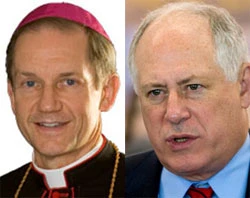
Catholic Gov. of Illinois suppoters unnatural unions bill. Bp. of Springfield warns him.

Bp. Paprocki Gov. QuinnFrom CNA:

Bishop calls out Catholic governor in Illinois for approving civil unions
By Benjamin Mann, Staff Writer

Springfield, Ill., Dec 2, 2010 / 08:13 am (CNA/EWTN News).- The Illinois legislature passed a bill on Dec. 1 that will establish same-sex civil unions in state law. While the state’s Catholic governor Pat Quinn said his faith prompted him to support the bill, [?!?] his bishop has warned that the governor’s actions clearly contradict Church teaching.

“If the Governor wishes to pursue a secular agenda for political purposes, that is his prerogative, for which he is accountable to the voters,” said Bishop Thomas J. Paprocki of Springfield, Ill., after the contentious vote.

[Here it comes…] “But if he wishes to speak as a Catholic, then he is accountable to Catholic authority,” he continued, “and the Catholic Church does not support civil unions or other measures that are contrary to the natural moral law.[Clear enough?] In the governor’s case, the local “Catholic authority” is Bishop Paprocki himself. [OORAH!]

The Springfield Journal-Register quoted the governor as saying, “My religious faith animates me to support this bill.”

He did not say what religious faith that would be,” Bishop Paprocki noted. “But it certainly is not the Catholic faith.[I would like to remind the readers at this point that Bp. Paprocki was, while an official in the chancery of Chicago and then an auxiliary bishop, a supporter of the older, traditional form of Holy Mass and was not rarely at St. John Cantius.  I not absolutely saying that there is a connection between this bishop’ clarity and his liturgical foundation.  But… ]

Governor Quinn has promised to sign the civil union measure into law, following its passage in the state’s House and Senate. Local reports indicated that the Democratic governor received a standing ovation from members of his own party, following the 61-52 vote in the Senate.  [Say he does.  What will Bp. Paprocki do, actually do?]

The governor joined Democratic Representative Greg Harris, the self-described “highest ranking openly gay elected official in the State of Illinois,” in supporting the initiative.

The bill drew opposition from Chicago’s Cardinal Francis George, as well as the Catholic Conference of Illinois, due to its potential impact on the Church’s work in adoption and foster care.  [What will Card. George do?]

Cardinal George and the conference also expressed concerns that the bill would diminish the status of marriage in public life, by granting most of its benefits to any two consenting adults. They warned that the bill could substantially alter the law’s definition of what constitutes a “family,” and said its supposed provisions for religious liberty were vague and subject to restrictive readings.

Robert Gilligan, Executive Director of the Catholic Conference of Illinois, spoke to CNA Dec. 1 about the new law. He predicted that future generations might have to learn some harsh lessons about the unintended consequences of using the law for what he called “social engineering.”

Civil unions, he said, indicate America’s trajectory toward a European model of living, in which adult romantic relationships have little or nothing to do with family or a lifetime commitment.

He noted that although individuals might enjoy this lifestyle or even deem it a “right,” a culture cannot sustain itself by functionally equating such arrangements with marriage. In time, he said, societies that choose to diminish marriage in this way will face the effects of shrinking populations and family breakdown.

If the Catholic governor of Illinois does this, after this warming, what will the bishops of Illinois do?

Posted in Our Catholic Identity, The future and our choices | Tagged , ,
49 Comments