Mantilla giveaway

It would be nice to see greater use by women of the chapel veil or mantilla.  While the chapel veil is no longer obligatory according to the canon law for of the Latin Church (I have written about that several times.  Here for example.), it is still a venerable custom and adds to the decorum for of the service.

From a reader:

Kelly from The Careless Catholic is having a giveaway on her blog, and the winner receives one of my crocheted mantillas! Be sure to visit her blog at http://www.thecarelesscatholic.com/2010/10/mantilla-monday-my-very-first-giveaway.html for your chance to be the winner!

Posted in The Campus Telephone Pole | Tagged ,
28 Comments

Lansing, MI: New TLM community has first Mass with Bp. Boyea

From a reader:

I have some news for your Brick by Brick File.

Today was the official opening Mass of the Blessed John XXIII Community at the Cathedral in Lansing Michigan, in the Extra-ordinary Form.

Bishop Boyea, Ordinary of Lansing, celebrated the Mass, with the chaplain of the community and another priest in choro. The Crypt of the Cathedral was overflowing with people, and there were many many young families with more than four children in attendance.

The Community was founded just recently (the first Mass was three weeks ago) partly because of Summorum Pontificum, and also partly because of requests of the faithful of Lansing.

Bishop Boyea has been known to be extremely favorable to the EF, having celebrated the EF in Detroit when he was Auxiliary Bishop of Detroit.

Today’s date was selected because it coincides with the founding of another Latin Mass Community in the diocese.

The Community’s website is: www.getholy.com  Please pray for the growth of our new Community and for spiritual growth of it’s members.

Posted in Brick by Brick | Tagged ,
13 Comments

MUGS GONE WILD! Mystic Monk and, wait for it, … maniple edition

A reader sent this:

This is inspired by recent posts. And that maniple is in my house so I can make a pattern.  It will soon rejoin the full set.

To My Burying Priest:

Say the Black and Do the Red,
Tie this on when I am dead.
To purge my soul free of gunk
Pray often and early with Mystic Monk!

maniple, mystic monk, mug

It is nice to see all three, mug, maniple, and Mystic Monk in one photo.   The reader is clearly making a set of vestments which will include a maniple, and wants her own funeral with black vestments.  Excellent.

I am very pleased at this flowering of monasticism in an area where I spent time when I was young. This is very good news for everyone. And so …

[CUE MUSIC]

When you’ve had a hard day of making maniples and thinking about your own death, sharpen your focus on mortality with  …

… Mystic Monk Coffee!

That’s right! With Mystic Monk, you’ll be able to thread needles more easily and contemplate your own demise all while enjoying a great cup of coffee, supporting the monks and helping Fr.  Z!

Tick… tick… tick…. Refresh that supply now!

Mystic Monk!

It’s swell!

Posted in Lighter fare |
4 Comments

When in Newark…

… find a procession!

I went for the afternoon and evening to find a priest friend in Newark.

There was a procession tonight at Our Lady of Mount Carmel for the Peruvian community in honor of El Senor de los Milagros, in Lima.

First we visited the cathedral.  Being with one of the priests of the diocese, and one who knew the cathedral well, we were able to look around pretty well.   I think the Cathedral of Newark my be the most beautiful cathedral church in the USA.

I am sure many of you know this church.  Here is a view most of you will never see.  A panoramic view from the pulpit.

Newark

Newark

Then off to Our Lady of Mount Carmel.

Newark

Newark

Newark

Newark

Newark

Newark

And some video…

Well… if I can get it converted, I’ll add it.

Posted in Brick by Brick, Our Catholic Identity | Tagged ,
12 Comments

Same-sex attraction doesn’t justify redefining marriage

Here is a CNA story that cuts to the chase.

My emphases and comments:

Same-sex attraction doesn’t justify redefining marriage, Minnesota bishops explain

St. Paul, Minn., Oct 10, 2010 / 07:44 am (CNA).- The Catholic bishops of Minnesota have issued a brief statement on marriage, saying that having same-sex attractions does not deprive anyone of basic human rights but also does not create the right to “marry” someone of the same sex.

The bishops’ catechetical statement, published in The Catholic Spirit on Thursday, urged the state government, all Catholics and those of good will in Minnesota to support marriage.

A constitutional amendment clearly defining marriage as a union of one man and one woman would be one practical measure, but redefining marriage and legitimizing same-sex unions would work against the “socially vital goal” to support marriage between one man and one woman, the bishops said.  [A redefinition of marriage would tear at the most fundamental bonds of society.]

Their catechesis also countered the claim that maintaining the definition of marriage as a man-woman union is discriminatory against homosexuals.

“Persons with same-sex attractions are our sisters and brothers, [NB:] and their same-sex attraction does not define them as persons nor deprive them of their authentic human rights, including the most fundamental rights of all — the right to life and the right to love,” the bishops said. “Consequently, we oppose any discrimination against persons based on their having a same-sex attraction.” [A key word there is “authentic”.  It cannot be argued that a homosexual civil union is a “human right”.  Something contrary to the will of God can be a “human right”.  Humans by their free will have the “right” so to speak, to chose to go against God’s will or to act against nature.  But free will pure and simple isn’t the ground for establishing a human right.]

However, meeting “authentic human needs” does not require changing the legal definition of marriage or creating a marriage-like status for those with same-sex attractions.  [Not just “marriage”, but also other sorts of homosexual “unions”.]

“As pastoral leaders within the state of Minnesota, we believe that efforts to bestow legal recognition on same-sex unions are mistaken,” they continued, saying it is “erroneous” to think that a “committed homosexual relationship” is a human right and can be legitimately defined as a marriage. [Ditto.]

“The specific privileges granted to married persons by the state are not granted for the personal advantage of spouses [Ditto:…] but to advance the common good,” they wrote. While protecting people from discrimination advances the common good, not recognizing a same-sex union as a marriage is not discrimination “because it does not deny a basic human right.”

The “natural right to love another and to marry” is limited significantly by the nature of the human person and the nature of the institution of marriage, the prelates explained.

In their catechesis Minnesota’s Catholic bishops also discussed Catholic teaching on marriage.

Based on God’s Word given in divine revelation, we believe that marriage creates a sacred bond between spouses. We hold this to be true not only for ourselves, but for all humanity,” they stated. [One should make an argument from nature as well, no?]

The bishops said that God willed marriage to mirror his love for the human family, underlining that Jesus raised marriage to “the dignity of a sacrament” and made it a sign of his sacrificial love revealed on the cross.

“(M)arriage is a constant reminder of God’s love for the human race, as well as a reflection of the permanent, faithful, and fruitful bond of love between Christ and the church,” their statement continued, citing the Manhattan Declaration as an indication that this perspective is shared by non-Catholic Christians and others.

Noting the “universally recognized” importance of stable marriages for the education and formation of children and the “obvious and intimate connection between the conjugal act and conception,” the bishops said that marriage is a public matter that is part of the common good. [Closer to the argument from nature.]

“Both faith and reason agree, then, that marriage is an institution central to the life of human society,” they continued. “The committed relationship between one man and one woman calls forth the best of the spouses, not only for their own sake, but also for the well-being of their children and for the advancement of the common good. It is neither possible for us to change the definition of marriage nor wise to attempt to do so.”

For further reading, the bishops recommended the U.S. Conference of Catholic Bishops’ website www.usccb.org/defenseofmarriage.

Posted in Emanations from Penumbras, The Drill, The future and our choices | Tagged ,
13 Comments

WDTPRS Collect 20th Sunday after Pentecost: “to live with a mind and conscience quiet”

This ancient Collect is found without variation in the Liber Sacramentorum Gellonensis, written perhaps in Meaux, near Paris, between 790-800. The Gellone Sacramentary, which has Frankish influences, is a strand in the complicated web of manuscripts descending from what we called the Gelasian Sacramentary, the source of so many of our ancient prayers found in the Roman Missal.  The Gellone seems to have been an attempt at a complete book for liturgical services.

COLLECT (1962MR)
Largire, quaesumus, Domine,
fidelibus tuis indulgentiam placatus et pacem:
ut pariter ab omnibus mundentur offensis,
et secura tibi mente deserviant
.

The pattern indulgentiam [X] et pacem reminds me of the post-Conciliar formula for absolution of sins spoken by the priest in regular auricular confession: Deus, Pater misericoridiarum… indulgentiam tribuat et pacem.   I found the same patter in ancient prayers with various verbs inserted in the X spot, such as tribuas and also consequatur as well as largiatur or largiaris.

Our prayers very often include requests for pardon, that God forgive our sins.   We ask for absolutio, remissio, indulgentia and in liturgical language we use verbs like largiri, tribuere, conferre, and as the priest speaks to God, he describes Him in terms of propitius, propitiatus, and placatus.

Largire looks like an infinitive but is really an imperative form of the deponent largior, “to give bountifully, to lavish, bestow, dispense, distribute, impart… to confer, bestow, grant, yield”.

The adjective securus, a, um, which the mighty Lewis & Short Dictionary says means first and foremost “free from care, careless, unconcerned, untroubled, fearless, quiet, easy, composed” is understandably found in conjunction with the Last Judgment.  We wish to be “free from anxiety” when see the Just Judge coming.  Think of the line in the sequence Dies irae used during Requiem Masses: “Quid sum miser tunc dicturus?  Quem patronum rogaturus? Cum vix iustus sit securus.  … What am I, a wretch, to say then? what patron am I to beseech? When the just man is scarely free from care [about his salvation – ]”.  Remember also from the Ordinary of the Mass after the Lord’s Prayer (my emphases): Libera nos, quaesumus, Domine, ab omnibus malis, da propitius pacem in diebus nostris, ut, ope misericordiae tuae adiuti, et a peccato simus semper liberi et ab omni perturbatione securi: exspectantes beatam spem et adventum Salvatoris nostri Jesu Christi… which in the new ICEL version approved by Rome will sound like this:

“Deliver us, Lord, we pray, from every evil, graciously grant peace in our days, that, by the help of your mercy, we may be always free from sin and safe from all distress, as we await the blessed hope and the coming of our Savior, Jesus Christ.”

Placo is “to appease, render favorable”, and is also connected with gifts (munera, dona) or sacrifice (immolatio).  Deservio is not simply “to serve”, but “to serve zealously, be devoted to, subject to”.  This takes a dative “object”.   Par, paris, n., means “a pair”, which logically gives us the adverb pariter, “equally, in an equal degree, in like manner, as well”.

In the first place, indulgentia indicates an attitude: “indulgence, gentleness, complaisance, tenderness, fondness”, and then what flows from that attitude, namely, “a remission” of something like punishment or taxation.  In the French language dictionary of liturgical Latin, we find the same idea, an attitude which brings a result: “abandon de sa sévérité”, or “a giving up of severity”.

It doesn’t take much thought to see why “security”, in the sense of being without anxiety, and “peace” are closely tied to God’s forgiveness, His indulgence.

If God were to judge us truly according to our own fruits, and not mercifully see us through the merits of Christ’s Sacrifice, life would become unbearable and each day would bring us closer to unspeakable terror as we awaited either death of Christ’s return.

LITERAL TRANSLATION:
Having been appeased, impart to Your faithful, O Lord,
we beseech You, remission and peace:
so that in an equal measure they may be cleansed from all sins,
and may zealously serve You with a mind free from anxiety
.

It is nice to look at old translations from old hand missals on occasion, just to see something smoother, language that doesn’t stick slavishly to the text.  Here is a version prepared by J. O’Connell and H.P.R. Finberg, the editors of …

The Latin Missal In Latin and English (1957):
Relent, Lord, we pray thee,
and grant thy faithful pardon and peace,
so that they may be cleansed from all their sins,
and serve thee with a quiet mind
.

What a grace it is to live with a mind and conscience quiet about the course of our lives and our coming judgment.

Christ gave us Holy Church and our sacraments as the ordinary means of salvation.

To each of us sufficient grace is offered for our salvation, but to us who are so favored as to belong to the Holy Catholic Church … so much more has been given.
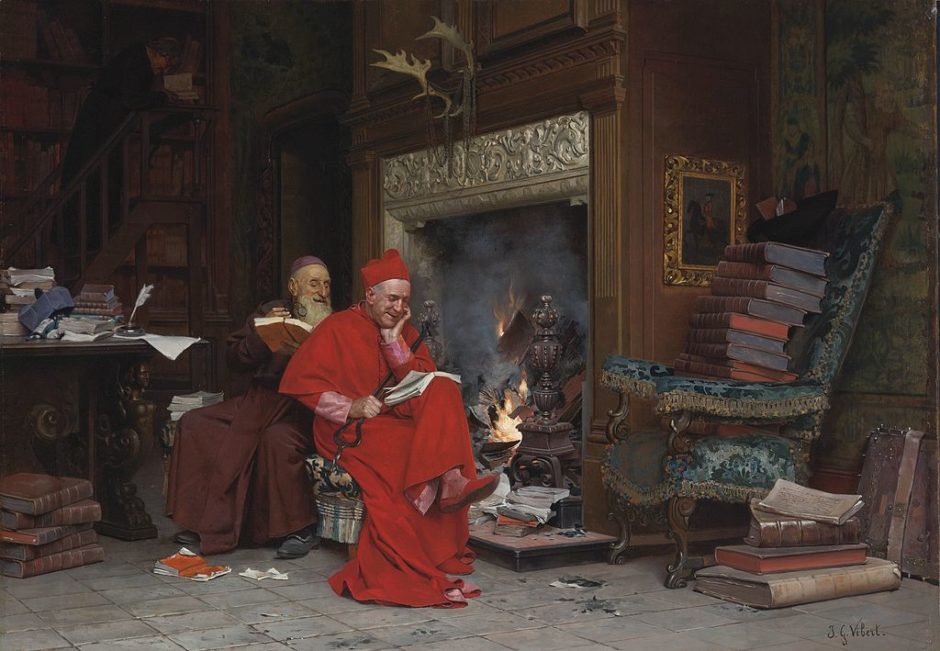
Posted in WDTPRS | Tagged
2 Comments

Bp. Loverde (D. Arlington) on the corrected translation

In The Catholic Herald of the Diocese of Arlington, His Excellency Most Rev. Paul Loverde has a piece about the new, corrected translation of the Roman Missal.  My emphases and comments:

The new translation — A call to deeper prayer

Some of you may recall, as I do, learning certain tenets of our faith from the Baltimore Catechism. The concise, memorable question-and-answer format assisted me as a boy in learning theological truths upon which I still reflect today[A catechetical approach to which we must return.] In light of the announcement from the United States Conference of Catholic Bishops (USCCB) that, after years of work, the new translation of the Roman Missal will be implemented in Advent 2011, the Catechism question “What is Prayer?” particularly resounds with me. The response, “Prayer is the lifting up of our minds and hearts to God,” highlights the opportunity for spiritual growth that the new translation will afford each of us (Baltimore Catechism, no. 1099).

[…] Yes, this translation means more than merely learning new responses to say during Mass, although the words have a particular purpose and are important. It is, ultimately, a call to strengthen our prayer to God during the liturgy and to more actively and authentically participate: to truly “lift our minds and hearts to God.”

It is my prayer that each of us will take time to reflect upon the changes being made and the true meaning of the words that the priest and the congregation pray at Mass. Consider, for example, the occasions in the Mass when the celebrant says, “The Lord be with you.” Instead of, “And also with you,” under the new translation the congregation will reply, “And with your spirit.” Far from being a reduction in meaning, this response, which is more true to the official Latin text from which all translations have been made, increases our understanding that we are asking the Lord to dwell in the souls of those gathered for the Holy Sacrifice of the Mass. In addition, since the priest (or deacon before the proclamation of the Gospel) greets the faithful with the words, “The Lord be with you,” the response, “And with your spirit” serves to mark those moments of truly priestly (or diaconal) ministry, that is, when the priest (or deacon) is about to do what he is ordained to do. These moments include: presiding over the entire prayer of the community at the beginning of the Mass; proclaiming God’s holy Word in His Gospel; offering the Eucharistic Prayer, which begins with the Preface; and imparting the final blessing. Our new response indicates that the priest (or deacon) is not acting on his own but only in the power of Christ and the Holy Spirit.

[…]

[This is nice…] Our participation in the liturgy is an essential part of our worship. Discussing the Mass, Pope Pius X taught that “the faithful assemble for no other object than that of acquiring this spirit from its foremost and indispensable font, which is the active participation in the most holy mysteries and in the public and solemn prayer of the Church” (Pope Pius X, Tra le Sollecitudini, 22 November 1903).  [Active participation is, first and foremost, about active receptivity.  The “acquiring”.  This lead to outward expression in a second step.  Receptivity has logical priority, though receptivity and outward expression can be chronologically simultaneous.] This liturgical theme was further developed by the Servant of God, Pope Paul VI during the Second Vatican Council when he wrote that the “Church consists in the full active participation of all God’s holy people in these liturgical celebrations, especially in the same eucharist, in a single prayer, at one altar, at which there presides the bishop surrounded by his college of priests and by his ministers” (Pope Paul VI, Sacrosanctum Concilium, 1963, no. 41). The new translation provides us with the opportunity, once again, to participate in the Mass in a deeper way. [Certainly deeper than we have seen in most places for the last few decades.]

[…]

During this time of fruitful transition, I ask you to dedicate yourself to active participation in the celebration of the Mass. As this new translation so beautifully emphasizes, Our Lord Jesus Christ died so that we may have life, a mystery which we celebrate at each and every Liturgy. He sacrificed Himself for us; let our response be one of prayerful participation in the celebration of the Eucharist, which He instituted in His Church.

WDTPRS kudos to Bp. Loverde.

We see from some corners these days an effort to poison the reception of the new, corrected translation.

It is good to see bishops reaching out past these naysayers in an effort to make the transition more appealing by painting it as an opportunity.

Posted in Brick by Brick, Fr. Z KUDOS, The Drill |
12 Comments

Benedict XVI on new technology, reality and communion. Fr. Z opines.

The Holy Father recently spoke to a group meeting for a conference about the tools of Social Communication.   Although during the conference there was some discussion of the blogosphere and new tools of media, the Pope’s speech didn’t attract very much attention.

I think we need to look at some of this speech.

[…]

The search for truth must be pursued by Catholic journalists with a passionate mind and heart, but also with the professionalism of competent staff who are equipped with adequate and effective means. This is even more important in the present historical moment, which asks of the figure itself of the journalist, as mediator of the flow of information, to undertake a profound change. Today, for example, the world of the image with the development of ever new technologies has ever greater weight in communication. But if on one hand this entails undoubtedly positive aspects, on the other hand, the image can also become independent of reality; it can give life to a virtual world, with several consequences, the first of which is the risk of indifference to truth.

[This is important…] In fact, the new technologies, together with the progress they entail, can make the true and the false interchangeable; they can induce one to confuse the real with the virtual. Moreover, the recording of an event, joyful or sad, can be consumed as a spectacle and not as an occasion for reflection. The search for the paths of an authentic promotion of man then takes second place, because the event is presented primarily to arouse emotions. [NB:] These aspects sound like an alarm bell: They invite consideration of the danger that the virtual draws away from reality and does not stimulate the search for the true, for the truth.

[I think it goes a bit off the rails here.   The one who wrote this goes off on a different topic… but let’s go on.] In this context, the Catholic press is called, in a new way, to express to the heights its potential and to give a reason day in and day out for its mission that can never be given up. The Church has a facilitating element, since the Christian faith has in common with communication a fundamental structure: the fact that the means and the message coincide; indeed, the Son of God, the Incarnate Word, is at the same time message of salvation and means through which salvation is realized. And this is not a simple concept, but a reality accessible to all, also those who while living as protagonists in the complexity of the world, are capable of preserving the intellectual honesty proper to the “little ones” of the Gospel. Moreover the Church, Mystical Body of Christ, present at the same time everywhere, nourishes the capacity of more fraternal and more human relations, being a place of communion among believers and, at the same time, a sign and instrument of everyone’s vocation to communion. Her strength is Christ, and in his name she “pursues” man on the roads of the world to save him from the “mysterium iniquitatis,” insidiously operating in him.

[…]

New technologies and the progress they entail and the amplification of these technologies, can… can… create confusion of virtual and reality.   They don’t need to absolutely, but they tend to.  This leads to false communion and false community. 

The essential value here is communion.  We are created for communion.  We are images of God, Trinity, who is Communion.  Human relations have the capacity for communion. True communion is experienced in the Church, mystical Body.

Communion in Christ is the locus of true relationships.  The Church promotes true communion in the liturgy.

Liturgical worship is the alternative to the fascination of the virtual and spectacle that is offered by the media.

How do we complete with their power?

We don’t do it with our own alternative new technologies, notwithstanding EWTN and this blog.  That is not where we combat the virtual reality that can be generated through the new technologies.

Where we combat the virtual reality Pope Benedict warns us about is principally in the sacred liturgy.

We must be in church for worthy worship.  We must be there to participate in The Real.  We smell the incense, see the movement, the hear the music, we listen to the Word.  We receive Communion.

We resist the danger of virtual reality through participation in worthy worship.

The Pew research suggests that Catholics don’t know what their participation in liturgical worship entails.  45% of Catholics don’t know they are receiving the Body and Blood of Jesus in the Eucharist.

Posted in New Evangelization, Our Catholic Identity, The Drill | Tagged , , ,
7 Comments

GREAT NEWS! Monastery plans approved for Wyoming Carmelites

You may not have noticed, but I have been pushing Mystic Monk Coffee, sold by a new group of Carmelite monks in northern Wyoming.  I have done this to help with their cash flow before they begin to build their new monastery.

The monks faced the problem of having their buildings plans approved, in the face of resistance.

There is news that the plans were approved!

There is a story by Deacon Keith Fournier about the developments.  Here are a few excepts:

Mount Carmel Monastery Approved! Good News for the Monks and for the Church

[…]

So, now the good news; on Tuesday, October 5, 2010 at 1:00 p.m., at an open public hearing before the Park County Board of Commissioners, the monks were given unanimous approval to proceed with the building of Mt. Carmel for America. The commissioners wanted to know whether the land will continue to be used for ranching. The monks were happy to report that it will. They intend to keep the property as a ranch as well as work the land for farming. Father Daniel Mary explained to me that with the growing resurgence of vocations to the lay brotherhood (not all monks are clerics) the Lord had already brought ranchers to the community who would help with 1,000 head of cattle that will graze on Mt. Carmel.

[…]

Here is a link to a story in a local paper.

I am very pleased at this flowering of monasticism in an area where I spent time when I was young.  This is very good news for everyone.  And so …

[CUE MUSIC]

When you’ve had a hard day of getting your monastery’s building project approved and helping monasticism be reborn in the 21st century, put your feet up and enjoy a mug of their …

… Mystic Monk Coffee!

That’s right! With Mystic Monk, you’ll be able  enjoy a great cup of coffee, support the monks and also help Fr. !

Mystic Monk!  Refresh your supplies or try it for the first time.

It’s swell!

Posted in Brick by Brick | Tagged ,
16 Comments

VORTEX REPORT: A MASSIVE SHIFT TO OCCUR!

You have followed the reports on …

The Vortex.

There is a portentous development.

One of the Originators of the ecclesial force vectors which opened that rift singularity, that rift in the space time continuum will be moving.

His Excellency Most Reverend Robert Finn, Bishop of Kansas City-St. Joseph has announced that the diocesan offices (that’s “chancery” or “curia”) will be moving.

When it moves, one of three things will happen.

  1. The Vortex will shift to a different location.
  2. The Vortex will not shift to a different location.
  3. The Vortex will close forever.

Or… the Vortex will expand and annihilate the PLANET!

Okay, that’s four things.

Or… maybe ecclesial forces will lash back at the remain fixed points and engulf them?

Okay, five things.

We will all have to sort this out with courage, patience and….

[CUE MUSIC]

Mystic Monk Coffee!

When you’ve had a hard day of moving several gigs of email and dancing around inflated sheep’s stomachs… when you’ve no idea if the planet is even going to survive… yes, its time for a WDTPRS mug filled to the brim with soothing, rich and aromatic Mystic Monk Coffee!

That’s right! With Mystic Monk, you’ll more quickly figure out where to run and hide when the Vortex threatens to vaporize your city.

When ecclesial forces shift, don’t be caught short.  Refresh your supply now!

Mystic Monk!

It’s swell!

Posted in Global Killer Asteroid Questions, Lighter fare | Tagged
12 Comments
























