We have had a few entries lately about the position of the altar. Let’s have a quick poll.
Please pick the best answer and share your reasons in the combox, below.
I believe non-registered reader may be able to vote.

From a seminarian:
I … have recently had some discussions with others in the house about implementing ad orientem style of the Mass. I think that the rubrics are very clear in assuming that the Mass is said ad orientem, regardless of whether we like or not (however, I love it!). We see this in sections of the rubrics, “versus ad populum.” I believe you recently put an article up about this. [He probably means this.]
However, the response was GIRM 299, “The altar should be built apart from the wall, in such a way that it is possible to walk around it easily and that Mass can be celebrated at it facing the people, which is desirable wherever possible.” [That is the errant phrase!]
This is from the USCCB website. I know that the key phrase “which is desirable whenever possible” offers some ambiguity, but it clearly sets up a basis in official Church documents which can be stretched to oppose the ad orientem style. Could I get your thoughts on this? I would like to see the implementation of ad orientem worship back in the Mass, but I am not sure how to respond to the GIRM statements. Thanks for your thoughts and God bless. Know of my prayers for you and your readers.
Thank you for the prayers.
Can that phrase, found on the USCCB website (and elsewhere) be used to prevent ad orientem worship?
No. Not if you are honest.
When we quote official Church documents, we must at a certain point refer to the Latin text. This is absolutely the case with GIRM 299.
The USCCB website uses an incorrect translation. This isn’t just WDTPRS’s opinion. It is the clear statement of the Congregation for Divine Worship and Discipline of the Sacraments, which responded to a dubium on this very matter (Prot. No 2036/00/L). The CDWDS actually went so far as to explain the Latin grammar. I find it astonishing that, to this date, the USCCB has not corrected their texts. What makes this worse is that the document Built of Living Stones – which quotes the errant translation of 299 was issued after the CDWDS response. I fear the unhappy translator fell into the schoolboy trap of merely sticking to the Latin word order. I can’t imagine that they did this … on purpose!
I have written about GIRM 299 several times.
Briefly, here is the skinny.
This is what GIRM 299 really says:
Altare maius exstruatur a pariete seiunctum, ut facile circumiri et in eo celebratio versus populum peragi possit, quod expedit ubicumque possibile sit.
The main altar should be built separated from the wall, which is useful wherever it is possible, so that it can be easily walked around and a celebration toward the people can be carried out.
The quod refers back to the first clause, the placement of the altar, and not to the ut clause.
Before the USCCB put out their document Built of Living Stones, with the incorrect translation you cited, the Congregation for Divine Worship responded to a question about this very paragraph and actually explained the Latin grammar.
Here is the meat of the CDWDS’s response about that which, I repeat, was made before the USCCB issued Built of Living Stones.
The Congregation for Divine Worship and the Discipline of the Sacraments has been asked whether the expression in n. 299 of the Institutio Generalis Missalis Romani constitutes a norm according to which the position of the priest versus absidem [facing the apse] is to be excluded. The Congregation for Divine Worship and the Discipline of the Sacraments, after mature reflection and in light of liturgical precedents, responds:
Negatively, and in accordance with the following explanation.
The explanation includes different elements which must be taken into account. First, the word expedit does not constitute a strict obligation but a suggestion that refers to the construction of the altar a pariete sejunctum (detached from the wall). It does not require, for example, that existing altars be pulled away from the wall. The phrase ubi possibile sit (where it is possible) refers to, for example, the topography of the place, the availability of space, the artistic value of the existing altar, the sensibility of the people participating in the celebrations in a particular church, etc.
The paragraph is talking about the construction of a new altar. New construction is to ensure that, wherever it is physically possible and it is a good thing to do, the altar is separated far enough from the wall that a person can walk around it, for example, to incense it or use if for Mass versus populum. That does not mean a) that existing altars must be changed or, b) that free standing altar must be used versus populum.
I believe the response of the CDWDS was in Communicationes of the Pontifical Council for Legislative Texts. You should be able to find it quickly in your seminary library.
One of the consequences of this, by the way, there is no obligation to set up a table in front of a main altar that is ad orientem. As a matter of fact, it would be a bad idea to do so, because of the important of having but one altar in the sanctuary.
I haven’t posted much from the feeder, these days.
Right now the baby Goldfinches are buzzing around, making noises like squeaky-toys and incessantly following their parents. They flap their wings, squeak, and beg.

More begging action.

A large flock of turkeys recently changed their roaming habits. They regularly troop the line in front of the house now.


These Chicakdees are doing their High Noon thing. The one on the right is particularly fearsome,  don’t you think?

Here is a finch having a splash in the base of the feeder after a heavy rain.

My friend Mr. Jeffrey Tucker has posted on his blog, Chant Cafe, videos with audio of new chants for the Novus Ordo in English according to the upcoming corrected translation. These are intended as tutorials.
Some people are claiming that the corrected English is not “singable”. Go over and check them out. Decide for yourselves.
A REMINDER TO LIBERALS: If you don’t like the new translation, you can always ignore it and use Latin.
From CNA:
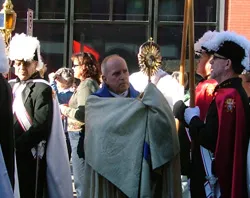 North Dakota bishop leads procession at abortion clinic amid protests
Fargo, N.D., Sep 29, 2010 / 12:51 am (CNA).- In time for the upcoming Respect Life Month of October, Bishop Samuel Aquila of Fargo, North Dakota presided over an annual Mass and led a procession over 700 people to a local abortion clinic last Saturday, encountering oppositional protestors for the first time.
The Diocese of Fargo estimated that on Saturday, 700 to 800 people from St. Mary’s Cathedral processed to the local Red River Women’s Clinic, North Dakota’s only abortion facility in downtown Fargo. Director of Communications for the diocese Tanya R. Watterud told CNA that Bishop Aquila led the procession several blocks, carrying a monstrance with Blessed Sacrament and also sprinkling the clinic with holy water amidst pro-abortion demonstrators.
During his homily at the Mass preceding the procession, Bishop Aquila stated that the purpose of the event was “to give witness to the gift of life and particularly the dignity of human life from the moment of conception to natural death.”
“Even reason and science would point to the truth that life begins at the moment of conception,” he noted. “For those who are unbelievers, they can come to know the truth of the dignity of human life through both reason and science.”
“We must also, when speaking of abortion, speak the truth about it,” and refrain from using terms such as “interruption of pregnancy” or “only a mass of cells.”
“Every time a child is aborted it is murder and it is important for us to call it by its proper name.” Individuals, he added, should not use the “politically correct language” of the media but “speak the truth and to speak it clearly.”
He then encouraged those present to pray for the gift of fortitude “to be those people who constantly remind our society and remind others that life is a gift…that every human being created is created in the image and likeness of God from the moment of conception…that every human being has the right to life.”
The bishop also explained that the holy water that would be used to sprinkle the facility showed “prayers for purification…in terms of reparation for what happens there because, ultimately, it is the murder of unborn that takes place there.”
Watterud told CNA that later at the procession following the sprinkling, Bishop Aquila again took the monstrance into his hands and continued back to the Cathedral, while parishioners in attendance prayed the Rosary while walking.
You have read about…
… The Vortex.
I have wondered where things go, if they are pulled into the Vortex and can’t get out.
I wonder.
Look at this portentous photo from Astronomy Pic of the Day.
This is a vortex on the planet Venus. At the southern pole …

Portentous.
I understand that the Venus Express spacecraft, which shot the photos, is powered on …
[CUE MUSIC]
… Mystic Monk Coffee!
When you’ve had a tough day of flying through space and shooting photos of planets with truly horrible atmospheres, refresh your spirits with some piping hot Mystic Monk Coffee!
Your own refreshing cup of coffee may not be as hot as the 758 K venusian surface temperature, but it’ll warm cockles of your heart all the same.
Mystic Monk! Refresh that supply right now!
It’s swell!

DATA REPORTS TO COME!
 From CNA:
USCCB pro-life chairman issues statement on upcoming Respect Life month
Washington D.C., Sep 28, 2010 / 03:03 pm (CNA/EWTN News).- In light of the upcoming Respect Life Month of October, Cardinal Daniel DiNardo of Galveston-Houston issued a statement on what he perceives to be the greatest threats to human dignity in society, calling on Catholics to work towards transforming culture “into one that welcomes every human person.”
Cardinal DiNardo, who serves as chairman for the U.S. Conference of Catholic Bishops (USCCB) Committee on Pro-Life Activities, opened his remarks on Sept. 28 by stating that with “each passing year, the need for personal and public witness grounded in God’s boundless love for each and every human being grows more urgent.”
“With over one million innocent children dying from abortion each year, the plague of abortion remains embedded in our culture. It is encouraging to see the continuing decline nationwide in the number and rate of abortions – due in large part to fewer teens becoming sexually active, and to growing recognition of the humanity of the unborn child.”
“Yet the loss of even one child,” he noted, “and the pain experienced by the child’s mother and father in the aftermath of abortion, should impel us to redouble our efforts to end legal abortion, and to ensure that every pregnant woman has whatever help she needs to turn away from this heartbreaking choice.”
“In many areas of public policy, the rift continues to widen between the moral principles expressed by a majority of Americans and the actions of government,” the cardinal continued.
For example, although “Americans oppose public funding of abortion by wide margins,” he said, in “March of this year, Congress passed a health care reform law that allows for federal funding of abortion in some programs and could pressure millions of Americans to help subsidize other people’s abortions through their health care premiums.”
[…]
Read the rest there. Discuss.
From a reader:
Wait, the sign of peace is an option, not a requirement?!?! How did I not know this? Am I bound by obedience to participate if the priest uses this option? Can I decline the invitation?
The so-called “sign of peace” during the Novus Ordo is an option, not a requirement. Initiating the sign of peace is an option left to the discretion of the priest celebrant. He is not obliged to use this option.
The rubrics in Latin GIRM no. 154 indicate that the invitation to the “sign of peace” is something made pro opportunitate. This is repeated in the rubrics in the Ordo at 128. The phrase pro opportunitate means “insofar as it is fitting, opportune, advantageous”, or otherwise, “as circumstances indicate”. The priest can determine that the circumstances to not call for a “sign of peace” on the part of the people, that it is not, in fact, advantageous. He can make this determination because, for example, the sign of peace is not carried out with the proper decorum and that it therefore is inappropriate.
Can you decline? I guess so.
The Latin for this invitation is “Offerte vobis pacem… Offer ‘the pax‘ to each other.” The pax here being the Roman kiss of peace or its legitimate substitution. That offerte is an imperative. Latin imperatives are not always strict commands. We use imperatives in addressing our liturgical prayers to God all the time. We are not actually bossing God around when we use imperatives. They can be a strong petition or invitation. In any event, offerte isn’t just a suggestion. You are being strongly urged.
So, yes, you can refuse to participate. I don’t, however, think that it is quite right simply to ignore that “Offerte“. That doesn’t mean you have to go bananas or contort yourself to greet everyone within possible reach. It certainly doesn’t mean leaving your place. And it should never mean doing something that is undignified, like the idiot wave at someone on the other side of the building, or overly invasive like hugs and kisses which usually involves the risk of either disease or disgust.
I think the very best option for the sign of peace is for the priest to leave people in peace.
From a reader:
Our last pastor decided we should all stand up before the Great Amen (going so far as to pause the Mass until all were standing -and some peoples refusal to stand became a horrible distraction and battle of wills between us and him …so we all eventually stood). People remained standing until everyone had received Communion. When he retired the new pastor (thankfully) instructed everyone to remain kneeling until after the Great Amen. But has retained the practice of standing until everyone returns from Communion. Everyone sits down when he sits down, even though the Blessed Sacrament has not yet been returned to the tabernacle. What is the purpose of standing after Communion? If there is some wonderful significance to it, it is lost on the congregation
It seems to me that kneeling is appropriate, not only to receive Holy Communion, but also to pray after having returned to one’s place in the pews.
In any event, we can look to the GIRM for some instruction on this question:
43. The faithful should stand from the beginning of the Entrance chant, or while the priest approaches the altar, until the end of the Collect; for the Alleluia chant before the Gospel; while the Gospel itself is proclaimed; during the Profession of Faith and the Prayer of the Faithful; from the invitation, Orate, fratres (Pray, brethren), before the prayer over the offerings until the end of Mass, except at the places indicated below.
They should, however, sit while the readings before the Gospel and the responsorial Psalm are proclaimed and for the homily and while the Preparation of the Gifts at the Offertory is taking place; and, as circumstances allow, they may sit or kneel while the period of sacred silence after Communion is observed.
In the dioceses of the United States of America, they should kneel beginning after the singing or recitation of the Sanctus until after the Amen of the Eucharistic Prayer, except when prevented on occasion by reasons of health, lack of space, the large number of people present, or some other good reason. Those who do not kneel ought to make a profound bow when the priest genuflects after the consecration. The faithful kneel after the Agnus Dei unless the Diocesan Bishop determines otherwise.
Is it possible that, since the GIRM says “unless the Diocesan Bishop determines otherwise”, the local bishop has thought to interpret the time after the Agnus Dei to include the time after reception of Holy Communion and that therefore he is imposing his will on people to require them to stand through the completed distribution of Communion?
Nahhhh…. that can’t be right. That would be just plain weird.
I cannot see the point in trying to force people to stand until every one has received Communion. What’s that all about? Can’t there be a little flexibility at this point… as there has always been?
Some people cannot receive and need to remain in place, perhaps to kneel and pray and make a spiritual communion, maybe or to reflect with sorrow on their black, soul-threatening unconfessed sins.
Perhaps you could drop a respectful note to the pastor and/or local bishop asking why people are being forced to stand until everyone has received Holy Communion.
ASK FATHER and the readers here would like to know what response you get.
 From a seminarian reader:
My present church is thinking on having a EF Mass as well as a Versus Deus [Deum] OF Mass. The Original High Altar is still in place with the Tabernacle.
There is however a smaller “fixed” “table” Altar in place a few feet in front of this. The “table” Altar is too small too accommodate a EF Mass. Is is still O.K. to celebrate a Mass in the OF & EF with the Old High Altar, while disregarding the “table” Altar.
It is always good idea to ignore iron-board altars whenever the main altar is still there and still usable. The next step is to get rid of the interloper-altar and use the original main-altar exclusively, as was intended in the church’s design.
There was never a directive that table altars were to be set up in front of main altars or that main altars were to be abandoned or destroyed.
Furthermore, in an issue of the Congregation for Divine Worship’s official publication Notitiae in May 1993 there was some years ago an editorial article which stated:
The principle of the unicity of the altar is theologically more important than the practice of celebrating facing the people.
Clearly the main altar was intended to be the focus in the design of the church. It is absurd to put up another altar, within the sanctuary, in front of the original altar.
But, yes, it is always appropriate to use the original, main altar of a church for either the Extraordinary or Ordinary Form.
As a matter of fact, celebration ad orientem is the way assumed in the rubrics of the Ordinary Form. For example, in GIRM 154 we read that the priest turns to the people if he is going to use the option of inviting the people to make a sign of peace. thus: “… extendens et iungens manus, pacem annuntiat, versus ad populum, dicens… opening and t hen joining his hands he announces ‘peace’, having turned toward the people, saying…“.
Finally, as a seminarian, you should run, not walk, to get yourself your very own copy of Joseph Ratzinger’s The Spirit of the Liturgy. In this useful book, the future Pope lays out the theological significance of ad orientem worship. You will want to study this section carefully and commit it to memory. I have a few PODCAzTs on Ratzinger’s view.

Coat of Arms by D Burkart
 emmatag1126 on Thoughts about the collision of the Holy See and the SSPX. Wherein Fr. Z rants.: “Also, the Declaration said that we can be saved only through the Roman Catholic Church, which unfortunately leaves out my…” on Thoughts about the collision of the Holy See and the SSPX. Wherein Fr. Z rants.: “I just wanted to say how much I appreciate your charity and well-worded wishes/prayers for hearts to change. Whenever I’m…”
 on ROME 26/5– Day 52: lace imitates God’s beauty enlaced in flowers: “Fr. Z: It wasn’t until I started reading your writings a few years back that I realized how important vestments…” on ROME 26/5– Day 52: lace imitates God’s beauty enlaced in flowers: “Speaking of age, I think I am lucky not to be in my teens or even early twenties right now.…”
 on ROME 26/5– Day 52: lace imitates God’s beauty enlaced in flowers: “The “seriously cool APP” Father Z is referring to is the Ava Maria Clock which if you have not downloaded…”
 on ROME 26/5– Day 53: Persevere!: “Black to move and mate in 4 1) … Qd1+ 2) RxQd1 (or Kh2) RxRd1+ 3) Kh2 (forced) Be5+ 4)…”
 on ROME 26/5– Day 52: lace imitates God’s beauty enlaced in flowers: “@Charivari Rob: How about calling it the Old Chestnut Award? It will probably only be slightly less feared than the…”
A Daily Prayer for Priests










They find you a pro-life agent in your area who commits to giving a portion of the fee to a pro-life group!

PLEASE subscribe via PayPal if it is useful. Zelle and Wise are better, but PayPal is convenient.
A monthly subscription donation means I have steady income I can plan on. I put you my list of benefactors for whom I pray and for whom I often say Holy Mass.
In view of the rapidly changing challenges I now face, I would like to add more $10/month subscribers. Will you please help?
For a one time donation...



Help Monks in Wyoming (coffee – UPDATED LINK) and Norcia (beer) and the wonderful "Soap Sisters" of Summit, NJ!


Please follow me on Twitter!










Visits tracked by Statcounter
since Sat., 25 Nov. 2006:


