QUAERITUR: Why call bishops “Monsignor”?

From a reader:

Why do people sometimes refer to Bishops as a “Msgr. [name]”? I’ve seen this occasionally, and never understood why. It seems the most logical way to do it would be “Bp. Name”, or “The Most Rev. Bp. [name]”, or something like that.

The title “Monsignor” is really just “My Lord”.

Bishops are commonly addressed as “Monsignor” in some countries.  In Italy, for example, they are normally called “Monsignore”.  If you run into someone using “Monsignor” for a bishop or an archbishop, they are probably doing so because of European influence.

Posted in ASK FATHER Question Box |
25 Comments

Pope invites a prayer vigil for unborn

From CNA:

Cardinals invite world to join Pope in prayer vigil for unborn

Vatican City, Oct 1, 2010 / 10:01 pm (CNA/EWTN News).- To encourage a commitment and witness within the Church to love and life, a prayer initiative to be led by Pope Benedict XVI is being promoted by a pair of cardinals. All bishops of the world are being asked to invite the faithful to pray for the unborn  during the prayerful season before Christmas.

On Nov. 27, to mark the start of Advent, Pope Benedict will preside over first vespers in St. Peter’s Basilica as is customary. According to a note from Vatican spokesman, Fr. Federico Lombardi, however, this will take place within a broader scope than usual.

Vespers will be included in Sunday’s “vigil for nascent life,” in light of the beginning of Advent and the proximity of the Lord’s Nativity.

Benedict XVI will not be the only one leading the vigil, as the initiative is being promoted through bishops’ conferences throughout the world. A letter from Cardinal Antonio Cañizares Llovera of the Congregation for Divine Worship and the Discipline of the Sacraments and Cardinal Ennio Antonelli of the Pontifical Council for the Family has been sent to the bishops of the world to invite a similar celebration and prayer initiative on a local level throughout the Catholic Church.

Fr. Lombardi said through Vatican Radio that the events will take place “in spiritual union with the Holy Father, to promote the commitment and the ecclesial witness for a culture of life and love.”

Posted in Emanations from Penumbras |
2 Comments

QUAERITUR: Can a newly built church have an altar “against the wall”?

From a reader:

This is in response to your recent post about GIRM 299 and ad orientam worship.

I was just wondering, because of what 299 says do altars have to be built so one can walk around them? Or in a new church can you build a high altar the way they used to? I remember them saying that when they redo the chapel at Christendom College the altar would be attached to the tabernacle, the gradines and all the rest behind it.

We also had a discussion on ad orientem in the house in this seminary recently; it would be amusing if this was actually the same discussion spoken of in the earlier post.

My understanding is that new construction is to provide for a free-standing altar.  This would apply also if there is significant reconstruction.

However, I know that this has been set aside in the case of several altars in churches that have been completely reconstructed their altars in the process of restoration or redecoration.  Off the top of my head I can think of St. Agnes in St. Paul, back in the ’80s.  Also, two churches of the Institute of Christ the King in the USA, St. Patrick’s in Kansas City, MO and St. Mary’s in Wausau, WI.  I was at the consecration of the St. Patrick’s.  Bp. Finn did the honors.  It was an amazing experience, btw.

I am sure you readers can provide other instances.

Thus, I think that this is one of those situations where, beyond the architectural issues also play a role, the pastoral necessity is what counts the most.  This is certainly what is suggested in the CDWDS editorial I have posted about here from time to time.

The main altar should be built separated from the wall, which is useful wherever it is possible, so that it can be easily walked around and a celebration toward the people can be carried out. (Emphases added)

GIRM 299 is clearly a strong suggestion rather than an absolutely mandate.

Sometimes traditionalists will complain that legislation from the Church is not clear enough these days, that it doesn’t spell things out without ambiguity.   Here is an instance in which this works to everyone’s advantage.

Posted in "How To..." - Practical Notes, ASK FATHER Question Box, Linking Back | Tagged
20 Comments

Google Translator v. Lame-Duck ICEL – COLLECT 27th Sunday

Google Translator has added Latin.  I am skeptical.

That said.

A reader sent this:

Noting your skepticism about Google Translate’s addition of Latin, I have a suggestion: What if we tried a head-to-head comparison of Google Translate to the old ICEL translation? Which would win?

One example:
Ecce Agnus Dei, ecce qui tollit peccata mundi. Beati qui ad cenam Agni vocati sunt.

old ICEL
This is the Lamb of God, who takes away the sins of the world. Happy are those who are called to his supper.

Google:
Behold, the Lamb of God, behold he that taketh away the sins of the world. Blessed are they that unto the supper of the Lamb are invited.

Google’s training set for this translator likely involved older, public domain translation, which would explain some of its style. Clearly it’s not perfect or always mellifluous, but still… compared with old ICEL…

Here is what they did with the Collect for the upcoming 27th Sunday of Ordinary Time.

LATIN:
Omnipotens sempiterne Deus, qui abundantia pietatis tuae et merita supplicum excedis et vota, effunde super nos misericordiam tuam, ut dimittas quae conscientia metuit, et adicias quod oratio non praesumit.

GOOGLE:
Almighty and everlasting God,
who in the abundance of Thy goodness
and exceed the proper and just punishment and vows,
pour it out upon us mercy,
‘so that the consciousness of forgive
what they fear him and will add to what we do not dare to ask.

After removing line break from the Latin:

GOOGLE AGAIN:
Almighty and everlasting God, who in the abundance of Thy loving kindness than either we desire or deserve, pour down upon us Thy mercy, that Thou mayest forgive things which our conscience is afraid, and apply what we are not worthy.

WDTPRS SLAVISHLY LITERAL VERSION:
Almighty and everlasting God, who in the abundance of Your goodness
surpass both the merits and the prayerful vows of suppliants,
pour forth Your mercy upon us,
so that You set aside those things which our conscience fears,
and apply what our prayer dares not.

LAME-DUCK ICEL:
Father,
your love for us
surpasses all our hopes and desires.
Forgive our failings,
keep us in your peace
and lead us in the way of salvation.

Discuss.

Posted in Lighter fare, WDTPRS | Tagged , ,
38 Comments

IRELAND 20-22 Oct: TLM Workshop for Priests

In his pastoral letter to the faithful in Ireland, Our Holy Father said that a return to traditional Catholic practices is necessary.

From a reader:

Seminar for Priests and Seminarians
who would like to learn to celebrate the
Extraordinary Form
of the Latin Rite
or who would like to do a revision course in the basics of liturgical Latin and
formation in the rubrics
conducted by Fr Fr Simon Leworthy  FSSP
in
ARDS CAPUCHIN FRIARY
Cresslough Co Donegal
In superb surroundings on Atlantic coast
Wednesday 20th  – Friday 22 October 2010
Cost  110 euro including full board
Contact Pronsias  074 97 37 307
Early Booking requested
Organised by
The Latin Mass Society of Ireland

Posted in "How To..." - Practical Notes, Brick by Brick, SUMMORUM PONTIFICUM, The Campus Telephone Pole |
4 Comments

Fr. Z rants about the Corrected Translation.

For those of you who missed it, I direct your attention to an important post at The Chant Cafe (whose motto is “Double Shots of Plainsong – No Foam”).  I am sure the cafe serves Mystic Monk Coffee, too!

Jeffrey Tucker did everyone a great service by posting video/audio tutorials demonstrating how the new, corrected translation can be sung.

What is interesting about this, is that no one has done this before.  This means that people can get, for the first time, an idea of how the Novus Ordo can be sung in English.

This will obviously annoy liberals, enemies of the new, corrected translation.  They are busily vilifying the new Roman Missal.  The last thing they want is for people to hear the translation and like it.  Why would they be incessantly running down the new, corrected translation?  Probably pride and fear.  They can’t stand not having their way and they know that a new clarity of Catholic teaching that will resound in the prayers will require that they too be consistent with the teaching, in living or in the case of clerics also in preaching.   For some who are older, this huge step demonstrates that their old ideas from the 60’s-80’s are being swept away.

“But Father! But Father!”, some of you hard-core trads are saying.   “I don’t care about the new missal or new translation or new Mass.  We want only the old Mass!  Why are you propping up something we don’t like?”

First, I want Holy Church to be successful in her mission.
Soap Box
Second, if you think this blog is only about the TLM, you haven’t been paying attention.  Take off the blinders and pull the earplugs.  There is a big picture to consider.

The Novus Ordo is a major tool of Holy Church’s mission right now.  Who knows what may happen in 50 years.  Could the tool be better?  Sure.  Would I prefer a different tool? Of course!

What I prefer doesn’t matter.

We work with the tools we have and we do what we can.  I will remind some of you who may have forgotten that my conversion to Catholicism was sparked by an experience of the Novus Ordo celebrated in exactly the sort of continuity described by Benedict XVI.  I respect what it can accomplish when it is celebrated with fidelity and with continuity.

This is the real world, folks, not traddie fantasy camp.  Every Mass, Novus Ordo, TLM, should be offered with the best we have.   The corrected translation is a huge improvement for the Novus Ordo.   The majority of Catholics who go to Mass are going to hear something vastly improved. I believe that, in this new translation, Christ’s voice will ring more truly.  People will respond.  What’s bad about that?  It may lead many of them to want more (read: the TLM).

The Novus Ordo is the experience of the vast majority of Catholics right now.  I may prefer the older, traditional form of Mass, but I know that when there are improvements to any liturgical worship we all benefit.  Rising tides raise all boats.

To use another metaphor, I prefer a nice steak and cabernet to baby-food goo in a jar.  Just because I don’t like goo, that doesn’t mean that the goo isn’t exactly what babies need to grow up and start preferring steak and cabernet.  No parent forces little Bundle-Of-Joy to have a porterhouse when what she really needs is milk and goo.

To extend this a bit, you can’t set a T-bone in front of a guy who has a broken jaw that is wired shut, or who doesn’t have the strength to raise his hands.   The faithful have been catholicly crippled for decades now, systematically starved.  They are undernourished and atrophied.  We are going to have to stick the steak in a blender for them so they can take it through a straw, or else cut it up for them and feed with with a spoon until they recover.  But they need better stuff through a straw than what they have been getting.  The new stuff out of the blender hasn’t had all the nutrients removed.  That’s what the lame-duck ICEL translation did: it extracted the nutrients.

Some of you who prefer the Novus Ordo may be about to have a sputtering nutty and start flinging comments about how insulting I am about the Novus Ordo, how condescending I am about the average people in the pew, blah blah blah.  No.   First, I’m not talking to you.  That should be obvious. Second, it is the liberals who are condescending and offensive.  They are the ones who have kept people down.  In fighting the new translation they are doing a grave disservice.  I believe people are hungry for more.  I trust that they will get it so long as they are not poisoned against it in advance.  The Novus Ordo can do a great deal for them.

Sure, I think the TLM could eventually do more, but… I live in the real world.

We have to get people into church with worship that is improved, with a more meaningful translation, with better music, with greater dignity, with solid preaching.  Once they are in… or back… there is a greater likelihood that they will ask for more.

Some people will be attracted into Church through the traditional forms.  That is why we need more and more and more of the traditional forms!

Others will be attracted by the Novus Ordo.  GREAT!  Get them in the doors.

Thus endeth my rant.

Again, for those of you who missed it, I direct your attention to an important post at The Chant Cafe.
Jeffrey Tucker did everyone a great service by posting video/audio tutorials demonstrating how the new, corrected translation can be sung.

Posted in "How To..." - Practical Notes, Brick by Brick, Linking Back, Wherein Fr. Z Rants |
49 Comments

St. Jerome’s final resting place

I have posted this is years past, but I worked so hard on it when I originally wrote it that I want to get as much mileage out of it as I can.  Besides, there are new readers here all the time!

Some time ago, there was a discussion on one of our splendid Catholic blogs making mention of the burial place of St. Jerome perhaps in the Major Basilica of St. Mary Major in Rome. This is an interesting story and I dug into it a little. This is what I found.

We read in J.N.D. Kelly’s work Jerome: His Life, Writings, and Controversies (Duckworth, 1975, p. 333 – emphasis mine) :

Apocryphal lives extolling [Jerome’s] sanctity, even his miracles, were quick to appear, and in the eighth century he was to be acclaimed, along with Ambrose, Augustine, and Gregory the Great, as one of the four Doctors of the Church.[2] In the middle ages his works were eagerly copied, read, and pillaged; while towards the end of the thirteenth century the clergy of Santa Maria Maggiore, at Rome, were to persuade the public, perhaps themselves too, that his remains had been transported from Bethlehem to Italy, and could be venerated close to certain presumed fragments of the Saviour’s crib.[3]

Note 2: This was formally ratified by Pope Boniface VIII on 20 Sept. 1295: see Corpus iuris canonici II, 1059 (ed. E. Freidburg, Leipzig, 1879-81). The original number four (the list was later to be greatly expanded) was chosen so that the Doctors could match the Evangelists.

Note 3: The story of their alleged translation, in response to a visionary appearance of Jerome himself, is set out by J. Stilting in Acta Sanctorum XLVI, Sept. VIII, 636 (Antwerp, 1762); it is reprinted in PL 22, 237-40. Stilting also provides a discussion of its date, veracity, etc. on pp. 635-49.

In the Acta Sanctorum for 30 September, under the entry for St. Jerome, we find the following section with its articles:

LXV. Corpus Sancti ex Palestina Romam translatum, depositumque in basilica s. Mariae Majoris. The body of the saint was brought to Rome from Palestine, and put in the Basilica of St. Mary Major.
LXVI. Inquiritur tempus quo Sancti corpus Romam delatum. An investigation is made into the time when the body of the saint was brought back to Rome.
LXVII. Corpus Sancti depositum prope aediculam Praesepis, conditum deinde ibidem altare, sub quo positum, ubi mansit usque ad pontificatum Sixti V, quando dicitur clanculum ablatum & absconditum. The body of the saint was placed near to the small chamber of the Crib, established then right at the same altar, under which it was placed, where it remained until the pontificate of Sixtus V, when it is said to have been secretly taken away and hidden.
LXVIII. Corpus Sancti clanculum ablatum & absconditum dicitur, ne transferretur alio a Sixto V: deinde frequenter frustra quaesitum. The body of the saint is said to have been secretly taken away and hidden lest it were to be transferred to another place by Sixtus V: aftward it is frequently sought in vain.
LXIX. An reliquae, sub altari principe S. Mariae Majoris inventae, videantur illae ipsae, quae ut corpus S. Hieronymi ad illam basilicam fuerunt translatae. When the relics found under the main altar of St. Mary Major which had been transferred to that Basilica seem to be the very same as the body of St. Jerome.
LXX. Admodum verisimile & probabile inventas esse S. Hieronymi. Clearly the [relics] found are most like and probably of Saint Jerome.
LXXI. Respondetur ad objectionem ex reliquiis Nepesinis: reliquiae, quae verisimiliter sunt S. Hieronymi sub mensa principis altaris depositae. An objection is answered about the relics at Nepi: relics placed under the main altar which more than likely are those of St. Jerome.
LXXII. Reliquiae Sancti in pluribus civitatibus Italiae, Galliae, Germaniae, Belgii, & aliis provinciis. The relics of the saint in more cities in Italy, France, Germany, Belgium and other provinces.
LXXIII. Cultus S. Hieronymi: festivitates eius & Officia. The veneration of St. Jerome: his feasts and offices.

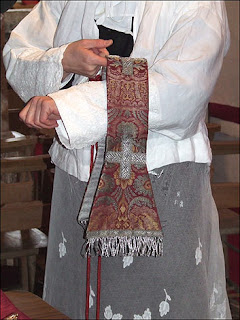
Here is the page where these articles begin. If you want to have a fuller experience of the joys (the chore) of reading the Acta Sanctorum for any length of time click here for a larger image.

Posted in Classic Posts, Saints: Stories & Symbols | Tagged ,
4 Comments

QUAERITUR: crossing stole and using maniple in Novus Ordo

ManipleFrom a priest reader:

I try to bring into the Novus Ordo as many elements from the old rite as I can, where permitted.

My question is:  is it licit for a priest celebrating Mass according to the new rite to cross his stole, as in the old rite?  Similarly, is it valid to wear a maniple while celebrate Mass according to the new rite?

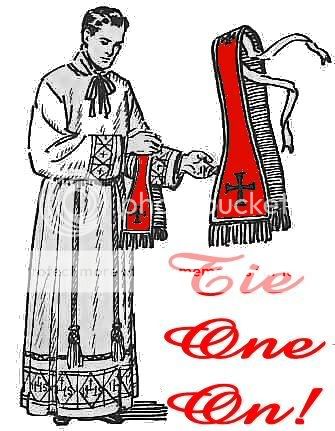
It is the immemorial custom that priests cross their stoles, right over left, when using the chasuble and the cope at Mass.  Priests in the West have been crossing their stoles since the 7th century, though it became widespread later in the medieval period.  Bishops and abbots don’t do this.  The symbolism of forming a cross over your heart is obvious.

For the Novus Ordo the GIRM 340 states:

340. Stola defertur a sacerdote circa collum et ante pectus pendens; a diacono vero ab umero sinistro per transversum super pectus ducitur ad partem dexteram corporis, ibique retinetur.

This paragraph says that the priest’s stole hangs in front of the chest from around the neck while the deacon’s crosses the chest from the shoulder.  It doesn’t say anything about whether the priest’s stole hangs straight down on either side.  A crossed priest’s stole still hangs down in front.

You can cross the priest’s stole for the Novus Ordo.

As a matter of fact, I highly recommend that you do so, especially when wearing the pianeta, the Roman chasuble.  The crossed stole serves also to “fill in” part of the square opening in front.  That is a practical reason, an aesthetic reason, but a good reason nonetheless.

The rubrics of the Novus Ordo are silent about the maniple.  Again, it is the custom of well over over a thousand years that the maniple is used in the Roman Rite.  It is a Roman vestment that goes back to the 6th c.

It was never abolished.

Whereas it was once obligatory for Mass, it no longer is (cf. 1967 Tres abhinc annos, 25.).

One of the consultors of the Office of Pontifical Ceremonies, Fr. Mauro Gagliardi, said during an interview with ZENIT that:

“The maniple is an article of liturgical dress used in the celebration of the extraordinary form of the Holy Mass of the Roman Rite. It fell into disuse in the years of the post-conciliar reform, even though it was never abrogated.”

I think Gagliardi is right.  For the Novus Ordo, put it one, leave it off as it pleases you to do so.

My practice is that if there is a maniple available, with the set, I’ll put it on.  If there isn’t a maniple, I don’t worry about it one way or another.  Maniples aren’t magic (though some people think they are… perhaps because they have attached so much significance to them because of the liturgical iconoclasm after the Council).

I think that these are very good elements – crossing the stole, using the maniple –  to bring into the Novus Ordo.  They could represent something of the “gravitational pull” that the expanding use of the traditional form of the Roman Rite will have on our general liturgical worship.

This is not a matter of maniples for maniples’ sake.  These detail contribute something to the priest’s self-awareness in his role in the sacred action.  They point his attention to his identity.  Some might say that he shouldn’t need pointers of this kind.  I respond, “Don’t they?”  Wedding rings don’t change your married state but they are signs to yourself and others about who you are.  We all, not being angels, benefit from reminders.  These details also send signals to the congregation that what is happening is not mundane.  Something special is happening.  They are all part of the ars celebrandi.

Tie One On

Posted in "How To..." - Practical Notes, ASK FATHER Question Box, Mail from priests, Our Catholic Identity, SUMMORUM PONTIFICUM | Tagged , , ,
11 Comments

RATS IN THE RECTORY: The mugs

Over at the blog Southern Orders I see that Fr. McDonald and Fr. Justin received their new WDTPRS coffee mugs.  These are Say The Black (Translation Edition) mugs.

coffee mugs

Posted in Linking Back, Mail from priests | Tagged , , ,
Comments Off on RATS IN THE RECTORY: The mugs

BLOG RENEWAL: Full Text in RSS Feed

I have activated the Full Text option for the RSS feed.

Enjoy the full text along a nice WDTPRS mug of hot Mystic Monk Coffee!

WDTPRS MUG

Posted in Just Too Cool |
16 Comments