QUAERITUR: how to address a deacon?

From a reader:

What is the correct form of address for a religious who is a deacon?  The internal lore of the community is that one retains "Brother" but some of the younger brothers are insisting on "Deacon."  I have a general aversion to calling deacons "Deacon" and bishops "Bishop", mostly because I have an aversion to calling you "Priest Z".  [Thanks!] In any case, the National Director for the Permanent Diaconate is the source which people cite on this score, but that says explicitly in the introduction that it doesn’t bind religious.  So, do you have any ideas?  This is a not-terribly-important question as most religious deacons will only be so for a few months, but it’s a good thing to get straight.


There are different customs for addressing Bishops.

In the USA we say "Your Excellency".  In the UK we say "My Lord".  An Archbishop,  I believe, would in the UK be "Your Grace". 

In the USA we say to Deacons "Reverend Mister".  I think that is the same in the UK.  However, I recall once at a gathering in London I addressed a deacon as "Reverend Mister" and he immediately snapped "Reverend DOCTOR". He had a rather high opinion of his own degree. 

I abhor this bare address "Bishop" or "Deacon".  It lacks decorum.

Posted in "How To..." - Practical Notes, ASK FATHER Question Box | Tagged , ,
66 Comments

Orthodox Bishop to Anglicans: you are doomed if you don’t stop

Remember what Card. Dias told the assembled Anglican leadership at Lambeth in 2008.  He said that their course indicates they are heading towards "spiritual Alzheimer’s" and "ecclesial Parkinson’s"

Now here is another warning.

This comes by of His Hermeuticalness, Fr. Finigan.

Metropolitan Hilarion of Volokolamsk is Chairman of the Moscow Patriarchate’s Department for External Church Relations. Recently he gave an address to the Annual Nicean Club Dinner at Lambeth Palace in which he politely but firmly pointed out that the dialogue between the Orthodox Church and the Anglicans,

"is doomed to closure if the unrestrained liberalization of Christian values continues in many communities of the Anglican world."

He referred particularly to the impact on this dialogue of the proposed ordination of women Bishops:

We have studied the preparatory documents for the decision on female episcopate and were struck by the conviction expressed in them that even if the female episcopate were introduced, ecumenical contacts with the Roman Catholic and the Orthodox Churches would not come to an end. What made the authors of these documents so certain?

He also referred to the ordination in the USA of Jim Robertson, an openly homosexual Bishop, leading to the suspension of contact with the Episcopalian Church, and to the rupture of relations with the Church of Sweden in 2005 as a result of the ordination of the lesbian Eva Brunne as "Bishop" of Stockholm.

Metropolitan Hilarion rightly analysed the differences within Christianity as being between traditional Christians and Christians of a liberal trend. Significantly, he referred to a growing co-operation between the Orthodox and the Roman Catholic Church with the aim of restoring a Christian soul to Europe:

We are not alone in our concern for the preservation of Christian values. Liberal tendencies in Protestant and Anglican communities present a challenge to those Christians and churches that have remained faithful to Gospel principles in doctrine, church order and morality. Certainly, we seek and find allies in opposing the destruction of the very essence of Christianity. One of the major tasks in our inter-Christian work today is to unite the efforts of Christians for building a system of solidarity on the basis of Gospel morality in Europe and throughout the world. Our positions are shared by the Roman Catholic Church, with which we have held numerous meetings and conferences. Together we are considering the possibility of establishing an Orthodox-Catholic alliance in Europe for defending the traditional values of Christianity. The primary aim of this alliance would be to restore a Christian soul to Europe. We should be engaged in common defence of Christian values against secularism and relativism.

From a Catholic point of view, it could be said that the close relationship of the Orthodox Church with Anglicanism, a relationship whose history Metropolitan Hilarion recalled warmly, was perhaps partly inspired by a resistance to closer links with the Roman Catholic Church. Now that it is apparent that the Anglican Communion is wantonly abandoning much of what is recognised as traditional Christianity in both sacramental and moral matters, it is very much to be welcomed that the Orthodox Church is discovering that the Roman Catholic Church is a true ally on many central questions. We have much to learn from the Orthodox Church too, in the celebration of the Sacred Liturgy. Pope Benedict has helped that rapprochement significantly.


Benedict XVI is the Pope of Christian Unity.

Posted in New Evangelization, Pope of Christian Unity | Tagged , , ,
34 Comments

An Alarming Development near… The Vortex

I was alarmed today to see an article in the National Catholic Fishwrap… Reporter  … wait for it and put down your freshly brewed Mystic Monk Coffee

… praising His Excellency Bp. Robert Finn of Kansas City-Joseph.

Alarming indeed.

I wondered: Did our recent foray to the very edge of The Vortex upset the delicate balance of ecclesial force vectors, thus either a) disturbing Bp. Finn or b) correcting the NCR?

Then I read the piece.

It is alarming… alarming, I repeat, to see Bp. Finn’s name in the same paragraph with Archbp. Hunthausen in the NCR.

The issue, more seriously, is about the building of a nuclear arms facility in the borders of Kansas City-St. Joseph and about which H.E. Bp. Finn has issued public comments.

Posted in Lighter fare | Tagged , ,
22 Comments

Overcome idolatry in life by kneeling at during Mass

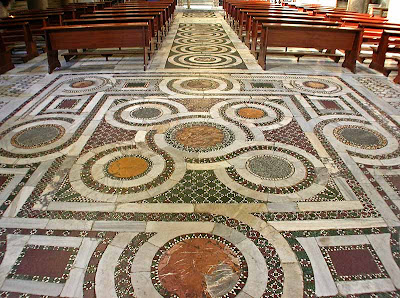
cosmatesqueFrom the gentlemanly Sandro Magister.

I love the opening salvo.

This splendid article reminds me of a story told by a priest friend about a very high American prelate.  On visiting his seminary, the prelate noted that no one was kneeling at the appropriate times.  He told the rector that he wanted the seminarians to kneel.  The rector expostulated that they had just spent a whole bunch of money to redo the chapel.  Putting kneelers in would be very expensive.   The prelate replied: "Who said anything about kneelers?"

My emphases and comments:

Why Kneel for Communion

Benedict XVI wants it that way, at the Masses he celebrates. But very few bishops and priests are imitating him. Yet this is one reason why churches were given ornate floors. [Interesting.] A guide to the discovery of their significance

by Sandro Magister

ROME, September 13, 2010 – The image [right] is a partial panorama of the immense mosaic that covers the floor of the cathedral of Otranto, on the southeast coast of Italy.

Walking across it from the entrance to the sanctuary, the faithful have as a guide the tree of salvation history, a history that is sacred and profane at once, with episodes from the Old Testament, from the Gospels, from the chronicle of Alexander the Great and the cycle of King Arthur.

The mosaic is from the twelfth century, an era in which the churches had no chairs or pews, and the faithful were able to see the entire floor. Even when they were not adorned with figurative art, the floors of churches incorporated expensive materials and elaborate designs. They were walked upon. Prayed upon. Knelt upon in adoration.

Today kneeling – especially on a bare floor – has fallen into disuse. So much so that Benedict XVI’s desire to give communion to the faithful on the tongue, and kneeling, is cause for amazement. [horribile dictu]

Kneeling for communion is one of the innovations that pope Joseph Ratzinger has introduced when he celebrates the Eucharist.

But rather than an innovation, this is a return to tradition. The others are placing the crucifix at the center of the altar, "so that at the Mass we are all looking at Christ, and not at each other," and the frequent use of Latin "to emphasize the universality of the faith and the continuity of the Church."

In an interview with the English weekly "The Catholic Herald," master of pontifical ceremonies Guido Marini has confirmed that the pope will stick with this style of celebration during his upcoming trip to the United Kingdom.

In particular, Marini has announced that Benedict XVI will recite the entire preface and canon in Latin, while for the other texts of the Mass he will adopt the new English translation that will enter into use in the entire English-speaking world on the first Sunday of Advent in 2011: this because the new translation "is more faithful to the original Latin and of a more elevated style" compared with the current one.

The attraction that the Church of Rome exercised over many illustrious English converts of the nineteenth and early twentieth centuries – from Newman to Chesterton to Benson – was in part the universalism of the Latin liturgy. An attraction to a solid and ancient faith that today is moving many Anglican communities to ask for admission to Catholicism.

The "reform of the reform" attributed to pope Ratzinger in the liturgical field is taking place partly in this way: simply, and with the example given by him when he celebrates.

But among the standard-setting practices of Benedict XVI, the one least understood – so far – is perhaps that of having the faithful kneel for communion.

This is almost never done, in any of the churches all over the world. In part because the communion rails at which one knelt to receive communion have been abandoned or dismantled almost everywhere.

But the sense of church flooring has also been lost. Traditionally, the floors were very ornate precisely in order to act as a foundation and guide to the greatness and profundity of the mysteries celebrated.  [Every element of a church should be considered for its potential content.  We must avoid merely utilitarian choices.]

Few today realize that these beautiful and expensive floors were also made for the knees of the faithful: a carpet of stones on which to prostrate oneself before the splendor of the divine epiphany.

The following text was written precisely to reawaken this sensibility.

Its author is Monsignor Marco Agostini, an official in the second section of the secretariat of state, assistant master of pontifical ceremonies and a scholar of liturgy and sacred art, already known to the readers of www.chiesa for his enlightening commentary on the "Transfiguration" by Raphael.

The article was published in "L’Osservatore Romano" on August 20, 2010.

__________________

KNEELERS OF STONE

by Marco Agostini

It is striking how much care ancient and modern architecture, until the middle of the twentieth century, devoted to the floors in churches. Not only mosaics and frescoes for the walls, but painting in stone, inlaid, marble tapestries for the floors as well.

I am reminded of the variegated "tessellatum" of the basilica of Saint Zeno, or of the floor of Santa Maria in Stelle in Verona, or of the vast, elaborate floors of the basilica of Theodorus in Aquileia, of Saint Mary in Grado, of Saint Mark in Venice, or the mysterious floor in the cathedral of Otranto. The shining, golden cosmatesque "opus tessulare" in the Roman basilicas of Saint Mary Major, Saint John Lateran, Saint Clement, Saint Lawrence Outside the Walls, of Santa Maria in Aracoeli, in Cosmedin, in Trastevere, or of the episcopal complex of Tuscania or of the Sistine Chapel in the Vatican.

And then there is the inlaid marble in Santo Stefano Rotondo, San Giorgio al Velabro, Santa Costanza, and Saint Agnes in Rome, and of the basilica of Saint Mark in Venice, of the baptistry of Saint John and of the church of San Miniato al Monte in Florence, or the incomparable "opus sectile" of the cathedral in Siena, or the white, black, and red shield designs in Sant’Anastasia in Verona, or the floor of the grand chapel of Bishop Giberti or of the eighteenth-century chapels of the Madonna del Popolo and of the Sacrament, also in the cathedral of Verona, and, above all, the astonishing and sumptuous stone carpet of the Vatican basilica of Saint Peter.

[Does your church have carpet?]

In reality, careful attention to the floor is not only a Christian concern: there are striking mosaic pavements in the Greek villas of Olynthus or Pella in Macedonia, or in the imperial Villa Romana del Casale in Piazza Armerina in Sicily, or those of the villas of Ostia or of the Casa del Fauno in Pompei, or the ornate Nile mosaic of the shrine of Fortuna Primigenia in Palestrina. But also the pavement in "opus sectile" of the senatorial curia in the Roman Forum, the fragments from the basilica of Giunio Basso, also in Rome, or the marble inlays of the "domus" of Cupid and Psyche in Ostia.

Greek and Roman attention to flooring was not evident in the temples, but in the villas, the baths, and the other public places where the family or civil society gathered. The mosaic of Palestrina was also not in a place of worship in the strict sense. The cell of the pagan temple was inhabited only by the statue of the god, and worship took place outside, in front of the temple, around the sacrificial altar. For this reason, the interiors were almost never decorated.

Christian worship is, on the other hand, an interior worship. Instituted in the upper room of the cenacle, decorated with rugs on the second floor of the home of friends, and propagated at first in the intimacy of the domestic hearth, in the "domus ecclesiae," when Christian worship took on a public dimension it turned the home into a church. The basilica of San Martino ai Monti was built on top of a "domus ecclesiae," and it’s not the only one. The churches were never the place of a simulacrum, but the house of God among men, the tabernacle of the real presence of Christ in the Most Holy Sacrament, the common home of the Christian family. Even the most humble of Christians, the most poor, as member of the mystical body of Christ which is the Church, in church was at home and was master: he walked on sumptuous flooring, enjoyed the mosaics and frescoes on the walls, the paintings around the altars, smelled the perfume of the incense, heard the joyful music and singing, saw the splendor of the vestments worn for the glory of God, savored the ineffable gift of the Eucharist that was administered to him from golden vessels, moved in procession and felt part of the order that is the soul of the world[Ineffable!]

The floors of the churches, far from being an ostentatious luxury, in addition to constituting the walking surface had other functions as well. They were certainly not made to be covered up by pews, which were introduced relatively recently with the intention of making the naves of the churches suitable for listening comfortably to long sermons. The floors of the churches were supposed to be fully visible: in their depictions, their geometrical designs, the symbolism of their colors they preserve Christian mystagogy, the processional directions of the liturgy. They are a monument to the foundation, to the roots.

These floors are primarily for those who live and move in the liturgy, they are for those who kneel before the epiphany of Christ. Kneeling is the response to the epiphany given by grace to a single person. The one who has been struck by the brilliance of the vision falls prostrate to the ground, and from there sees more than all around him who have remained standing. They, worshiping, or acknowledging that they are sinners, see reflected in the precious stones, in the golden tiles that were sometimes used in ancient floors, the light of the mystery that shines from the altar, and the greatness of the divine mercy.

To consider that those beautiful floors were made for the knees of the faithful is emotionally moving: a perennial carpet of stones for Christian prayer, for humility; a carpet for rich and poor without distinction, a carpet for pharisees and publicans, but which the latter can appreciate above all.

Today the kneelers have disappeared from many churches, and there is a tendency to remove the communion rails at which one could receive communion while kneeling. And yet in the New Testament, the act of kneeling is present every time the divinity of Christ appears to a man: one thinks of the Magi, of the man born blind, of the anointing in Bethany, of the Magdalene in the garden on the morning of Easter[Do I hear an "Amen!"?]

Jesus himself said to Satan, who wanted to make him kneel wrongfully, that it is only to God that one’s knees must bend. Satan is still forcing the choice between God and power, God and wealth, and is tempting even more profoundly. But in this way glory will not be given to God at all; knees will bend to those whom power has favored, to those to whom the heart has been bound through an act.

A good training exercise to overcome idolatry in life is to return to kneeling at Mass, [OORAH!] which is moreover one of the ways of "actuosa participatio" spoken of by the last council. The practice is also useful to realize the beauty of the floors (at least the older ones) in our churches. Some of them might even bring the urge to remove one’s shoes, as Moses did before God when he spoke to him from the burning bush.

Posted in "How To..." - Practical Notes, New Evangelization, Our Catholic Identity, The Drill | Tagged ,
36 Comments

QUAERITUR: Can the pastor tell the assistant what to preach?

From a reader:

I am newly ordained.  An issue has arisen between myself and my Pastor, and you could say, a small number of vocal parishioners. [Imagine my surprise.] It appears as though I am too orthodox for them and one of them [It’s almost always one.] has written a letter of complaint to my Pastor who might require that I give him advance copies of my homilies for his approval.  He has not required this YET.  My question is, does he, as the Pastor, have the right to dictate what I preach about or to approve ahead of time what I preach about?

This was not discussed in the seminary, and I always understood that my faculty to preach came from my Bishop and that he could do this, but nobody else.  Would you kindly offer your advice on this matter?

First, you cannot be too orthodox.   You can be too orthodox for someone else, perhaps.  But you cannot be too orthodox.

Ad rem: I think the pastor does have a certain measure of control over what you preach.  He is the pastor, even if he is an heterodox jackass.  The pastor, parish priest, parochus, is responsible for preaching in the parish.

For example, the pastor can determine that you are going to preach about topic X on Sunday Y.  As a young priest I went back to my home parish in the USA for the summer.  Sometimes the pastor had a project for preaching.  For example, he divided up the Cathechism of the Catholic Church and every Sunday all the priests had to integrate the designated paragraphs.  There are times when the bishop will designate a topic for preaching.

Also, turn the question around and look at it from the other point of view. 

Consider your question in the light of a solid orthodox pastor who has an assistant who is a heretic or an idiot.  After hearing a few bizarre and doctrinally questionable sermons, the pastor reasonably would have to exercise oversight.  I know a case where a priest in residence was absolutely going to the zoo when in the pulpit, not because he was heterodox, but because he wasn’t especially bright.  The pastor wanted to check his sermons for content before he preached so as to save everyone some problems.

That said, no one can require you to say anything that is demonstrably contrary to defined teachings of our Faith.  Use the Catechism of the Catholic Church as a reference.

You might want to contact the bishop or the personnel board for a transfer if the pastor wants you to say something that is contrary to the Catholic Faith.  Document everything.

These are personality issues as much as anything else.  I take the view no pastor should impose too much on the preaching of the assistants or guest, unless there as, as mentioned above, some ongoing project or, as mentioned above, the sermons are unacceptable.  The pastor should try to express concerns while leaving the priest’s freedom to preach intact, if possible. 

Approve a text in advance?  If it would come to that, I would say that he should only check for errors of doctrine, much in the way that a censor librorum would.  A censor librorum checks for errors against doctrine.  They do not pass judgments on style or quality of arguments, etc.

Don’t worry about this too much until it actually happens. 

I am guessing that you have a couple priest friends who are themselves pastors.  You might discreetly sound them out for advice.

If you are in a diocese where the local dean is strong (deans are not strong in all dioceses), and he is sound, you might ask his advice on this point of the pastor approving the actual text.

Lastly, remember that you are not the pastor.

Posted in "How To..." - Practical Notes, ASK FATHER Question Box | Tagged
18 Comments

Bp. Hubbard attends Solemn TLM

I received note of this from a reader.

This is for your brick by brick file.

Bishop Howard J. Hubbard Visits St. Joseph’s Parish, Troy, NY

Summorum PontificumSeptember 2010 marked the third anniversary of the promulgation of the Motu Proprio, Summorum Pontificum. In the letter to the bishops of the world accompanying the document Pope Benedict writes, "…I invite you, dear Brothers, to send to the Holy See an account of your experiences, three years after this Motu Proprio has taken effect."

To acknowledge this benchmark in the celebration of the ancient liturgy in the life of the Church, the Bishop of Albany Howard J. Hubbard presided over our Sunday Mass on September 12, 2010. The Extraordinary Form liturgy (offered by Father Romaeus Cooney) followed the rite of Mass in the Presence of the Local Ordinary. Bishop Hubbard delivered the Homily.

A positive event in the life of our parish, and specifically the community gathered around the ancient liturgy, this event demonstrated our relationship with the local Church. It also indicates the Bishop’s support for our place in the diocese. This liturgy also invites us to be "the light of the world; a city set on a hill that cannot be hid!" At St. Joseph’s we have a unique gift and a treasure to offer our parish, the diocese, and the larger community.  We also have reason to be thankful.  We have the resources to celebrate the fullest forms of the ancient liturgy by using the gifts, talents, and dedication of those who are indigenous to our community.

Posted in Brick by Brick, SUMMORUM PONTIFICUM | Tagged
18 Comments

The Holy Father’s special Popemobile for the upcoming visit to England

My good friend His Hermeueticalness, Fr. Tim Finigan, the parish priest of mighty Blackfen, has alerted me to this entry of great importance.

A special Popemobile has been developed for the Holy Father’s visit to England.  It seems it will reflect the recent identification of England as being the "geopolitical epicentre of the culture of death".

Thank you, Your Hermeneuticalness, for the heads up!

Please visit his site and greet him in his combox from WDTPRS!

Posted in Lighter fare, Mail from priests |
Comments Off on The Holy Father’s special Popemobile for the upcoming visit to England

QUAERITUR: Non-Catholic choir singing at St. Peter’s Basilica

From a reader:

In your valued opinion, and those of your readers, is it permissible/proper/desirable/good for a Protestant choir to sing at Mass in St Peter’s Basilica? Certainly the controversy over bad Catholic choirs being allowed to sing for Mass was addressed by the directives of the Prefect of the Musical Chapel  issued in December of 2006 (cf. http://musicasacra.com/pdf/vaticannorms.pdf). But do the norms assume that non-Catholic choirs that meet the criteria are eligible to sing? I ask because the choir at our Lutheran affiliated institution is advertizing that they will be "participating" in Mass at St Peter’s next January. I have two doubts: 1. that the choir has been in touch with the proper authorities at the Vatican and 2. that  Protestant choirs are allowed to sing at all in the Basilica.


I don’t have a problem with a non-Catholic choir singing in St. Peter’s or any other church.

So long as they sing what needs to be sung and sing well, what’s the problem?

Professional musicians are often non Catholic.

Musics sometimes are moved to want to know more about the Church.

And non-Catholics who are at Mass do participate to a degree, particularly if validly baptized.  Their participation may not perhaps be the fullest they could have, but if they are there with good will and tuned in and reverent… that’s a start. 

That’s good, right?

What’s not to like?

Posted in ASK FATHER Question Box, New Evangelization, Pope of Christian Unity | Tagged ,
52 Comments

Australia’s Catholic church bans pop songs at funerals

From Reuters:

Australia’s Catholic church bans pop songs at funerals

– Fri Sep 10, 2:46 am ET

MELBOURNE (Reuters Life!) – Football club songs and pop or rock music have been banned from funerals in Catholic churches in Australia under new guidelines distributed this week to priests and funeral directors.

A funeral should not be a "celebration" of the deceased’s life, Archbishop of Melbourne Denis Hart said in the rules, but a final sacred farewell. Celebrations of that life should be held at social occasions before or after the funeral, he said.

"The wishes of the deceased, family and friends should be taken into account … but in planning the liturgy, the celebrant should moderate any tendency to turn the funeral into a secular celebration of the life of the deceased," the guidelines state. [Do I hear an "Amen!"?]

"Secular items are never [never] to be sung or played at a Catholic funeral, such as romantic ballads, pop or rock music, political songs, football club songs."

Some funeral directors, however, said the directive was insensitive to relatives’ needs as many grieving families wanted to incorporate multimedia presentations, including photographs and video of the deceased person’s life as well as music. [Funeral directors don’t get to make these decisions.  And that sort of thing could be done at the funeral home.]

"Funerals have become a celebration of people’s lives and there aren’t many that don’t include a DVD presentation," John Fowler, the general manager of Le Pine Funerals, told Melbourne’s Herald Sun newspaper.

"It really gives you a sense of the joy that this person has brought to the world."  [I hate to say this, but that is not the reason for a funeral.]

Pop songs have become more common at funerals as new technology allows churches and funeral parlors to install sound systems and more people opt for services conducted by celebrants [Yet another reason why we need to get rid of the word "celebrant".] instead of religious ministers.

Centennial Park, a leading provider of cemetery, crematorium and memorial services in Australia, in 2008 compiled a list of the 10 most popular songs at Australian funerals.

The top song was Frank Sinatra’s version of "My Way," [My God… think of the lyrics.] followed by "Wonderful World" by Louis Armstrong, "Time To Say Goodbye" by Andrea Bocelli and Sarah Brightman, and "Unforgettable" by Nat "King" Cole.  [My God… nice song, but how shallow have Catholics become about the meaning of life and death if this is the stuff they chose.]

Rounding out the top 10 were "The Wind Beneath My Wings" by Bette Midler, "Amazing Grace," "We’ll Meet Again" by Vera Lynn, "Over the Rainbow" by Judy Garland, "Abide With Me" by Harry Secombe, and "Danny Boy."  [Stop.  Just. Stop.]

The list of top 10 most popular unusual funeral songs included listed as Queen’s "Another One Bites the Dust," AC/DC’s "Highway to Hell, "Always Look on the Bright Side of Life" by Monty Python, and "Ding Dong the Witch is Dead" from "The Wizard of Oz." [Shoot me now.]

(Reporting by Belinda Goldsmith)

Posted in Brick by Brick |
85 Comments

Priest, publisher, calls “pro multis… for many” heretical

On the site of UCANEWS.com Fr. William Grimm (Tokyo-based publisher of UCA News, former editor-in-chief of “Katorikku Shimbun,” Japan’s Catholic weekly) opines about the new, corrected English translation.

My emphases and comments.

Small word, big problem

Published Date: September 10, 2010
By William Grimm

People who have studied English as a second language tell me that three of the biggest challenges they encounter are pronouns, prepositions and articles.

Articles (a, an, the) are the most difficult. Which one to use or even whether to use one or not causes them anguish. The use or non-use of such a short word can make a huge difference in the meaning of a phrase or sentence.

One example of the problem can be found in the translation of the Mass that Rome has recently declared must be used for celebrations in English[The writer makes a good point.  Rome made this decision.  That’s it.]

That is relevant to the Church in Asia because in large parts of the continent, English is often used in worship. In South Asia and other parts of the former British Empire as well as in the Philippines, English remains a living language[I suspect this "living language" point is important to Grimm, much as it is for Bp. Trautman.  In that camp, the translation of Mass should be changing to match language trends.  The norms used to correct the translation state that we need a sacred style, which means that it must not be constantly shifting.]

In just about every country of Asia, overseas workers from the Philippines worship in English. English is also the language of the Federation of Asian Bishops’ Conferences, [1] the FABC. [Perhaps they should have Latin.  That would solve a lot of problems.  Why would it be so hard for people who congregations in which there are so many languages to read the other side of the page.]

The new translation has been criticized on many points. In an attempt to follow as closely as possible a Latin original, the English is stilted, verbose and at times nonsensical because of poor grammar. [I suspect he is simply parroting what he picked up from the other wagons he has been following on the trail.]

The whole process of its development has been marked by secrecy and by spinelessness [?] on the part of most of the world’s English-speaking bishops who acquiesced in the destruction by non-English speakers of generally acclaimed new translations prepared a decade or more ago. [It was not generally acclaimed.  First, no one except a few insiders knew about it.  Second, Rome didn’t acclaim it.  Rome shelved it.  Not long after, Rome restructured ICEL.]

Tens of thousands of Catholics have signed a petition asking that the new translation not be imposed until after a period of trial to see if it “works.” Of course, the petition has been ignored by the bishops and curia. [Of course.  The decision has been made.]

An ancient principle of theology is “lex orandi, lex credendi.” The way we pray is the way we believe. [Not quite.  There is a reciprocal relationship.] If our prayer is not in accord with the faith of the Church, it will lead people away from that faith.  [Closer.  Yes.  And the fact is the older, incorrect ICEL translation has done just that.  The corrected translation will slowly provide a corrective to the distortions we have experienced for decades.]

[This is where the write postively goes to the ZOO.  Get this…] The worst problem of the new translation is that it will, in fact, bring heresy into the Mass, and all because of an article[Fr. Grimm say the new, corrected translation is… heretical.]

Currently, the words over the cup during the Eucharistic Prayer speak of the Lord’s blood being spilled “for you and for all.” That translates the idea of the probable Aramaic words of Jesus and the Catholic faith that God’s will is that all be saved. The Latin text reads, “pro multis,” which also implies all-inclusiveness.  [First, we don’t know the words in Aramaic spoken by the Lord, or if he used Aramaic.  The writer is apparently unaware of how thin Joachim Jeremias’s argument was.  Second, if God willed that all be saved, then all will be saved.  God has a prescriptive will and a permissive will.]

Ever since the currently-used English translation appeared, some people have objected to its inclusiveness. I have run across those who object precisely because they neither believe nor want God to desire the salvation of all[I think that isn’t true.  I suspect he made that up.]

When the new translation was being prepared, it was decided by someone [by the name of Pope Benedict XVI] that the word “multis” must be rendered literally as either “many” or “the many.” [Only the Roman Pontiff approves the translations of forms of sacraments.  How poorly informed is this fellow?]

There are two possibilities because Latin does not have articles.

The secrecy of the whole process precludes knowing who made decisions or what their qualifications to do so are, but apparently because Latin does not use articles, the English translation will not do so, either.

Good Latin but heretical English will have priests proclaiming that Christ shed his blood “for you and for many.”

The problem arises from omitting that three-letter word, “the.”

In English, “many” without the article is an indeterminate word. It can mean a handful, a few dozen, a few thousand. It never means, however, the majority, let alone everyone[I actually agree.  I argued on this blog that the translation should be "for the many".  But I argued that "the many" could indicate a vast number, even nearly all, but leaving open the probability that not every soul who ever lived was actually saved.]

On the other hand, “the many” can mean everyone. In order to be slavishly faithful to Latin grammar, Rome is telling us that we must pray heresy, saying in effect that Jesus shed his blood for quite a few, but certainly not all. [This is embarrassing.  The Church says clearly that Christ shed His Blood for all.  The Church clearly teaches that not all will in fact be saved.  The Church believes that many, not all will actually be saved.  I hope that Fr. Grimm simply doesn’t understand what he is talking about.  He has accused the Church of heresy?]

That presents priests with a dilemma. We can obey men who obviously do not know what they want us to talk about or we can continue to proclaim the actual faith of the Church. [Again, the decision about the consecration form was made by the Vicar of Christ.  Fr. Grimm is suggesting that people defy the POPE in the matter of the valid form for the consecration of the Precious Blood.  Who. Does. He. Think. He. Is?]

I have talked with priests about this and find that many (the many?) say that fidelity to the faith of the Church and their mission to proclaim God’s love will force them to disobedience [Get that?  Force them to disobedience.  Remember when I said that it was only a matter of time before certain figures began to urge disobedience?] to the liturgical rule [not just liturgical] of that same Church.

None are happy about that, not least because it might result in their suffering at the hands of their bishops[Well… well… the shoe is on the other foot, isn’t.  How many conservative priests who tried to be obedient to the Church and to the regula Fidei suffered at the hands of their liberal bishops?  Where was Fr. Grimm then?]

There is, however, reason for these priests to take heart. Though he certainly did not intend it, Pope Benedict has shown the way to go. [He showed you the way to go with giving us a correct form of consecration, too.]

In his apostolic letter Summorum Pontificum [THIS should be interesting…] broadening the use of the 1962 Latin Mass he says, “in some regions, no small numbers of faithful adhered and continue to adhere with great love and affection to the earlier liturgical forms” and goes on to say that such dedication (and some 40 years of defiance that accompanied it) deserve to be rewarded[ROFL!  Can you see where it is going?   Please, someone, tell me that he has been having us on!  Is he really about to suggest that people appeal to continue to use the incorrect lame-duck translation because it is a tradition, like unto the use of the form of Mass used for centuries?  Didn’t I predict this?  Also, that "rewarded" is not really right, is it?  Let these folks come back in 30 years and ask for a special permission to use the lame-duck translation.  After they have had a little pain, perhaps Benedict XIX will "reward" them.]

The clergy and laity of Germany have refused to accept a newly-translated funeral rite and the bishops there reported to Rome that “the new ritual must be considered a failure.”

The result is that the new translation of the funeral rite has been abandoned. This is probably just the beginning of a movement in the Church, a movement that may be of the Holy Spirit[I’m sorry.  But that is just plain dumb.]

It appears to me that when the new English Mass translation becomes mandatory, many priests, if not the many, will continue to proclaim the good news that Christ died for all[Just plain dumb.]

The Church today, as in every age, will have new insights into the meaning of the Lord Jesus’ Sacrifice. New insights must be in harmony with and deepen the previously defined and clear teachings in our Tradition and Magisterium, not confuse them.

Look at it this way: if the Pope or a new Council chose to explain a new emphasis using a document of sufficient weight and authority, and if the Holy See then changed the Latin of the Missale Romanum to say “pro vobis et pro universis”, then there would be a linguistic justification for saying “for all” as an accurate translation of the Missale Romanum.

But the Church cannot change the Latin from pro multis to pro universis.

That would explicitly contradict the Church’s teaching as expressed in Latin by the Council of Trent (cf. Catechism of the Council of Trent, Part II, 4).

Such a change would contradict doctrine and not simply change emphasis about an aspect of that doctrine. Clear English must reflect the clarity of the Latin.

Many arguments have been forwarded to justify the choice to translate pro multis as “for all”. 

In Latin pro multis means “for many”.  All the Latin rites, historical or modern, have pro multis and not pro omnibus or pro universis

The English translations of the Eastern Catholic Rites say "for many".

We get “pro vobis et pro multis … for you and for many” in the formula of consecration from a blending of the accounts in Mark 14:24 (translated from Greek: “this is my blood of the covenant (diatheke) shed for many (tò peri pollôn)”) and Matthew 26:28 also says “for many” together with Luke 22:20 (translated from Greek: “Likewise also the cup, after the supper, saying ‘This cup is the new covenant (diatheke) in my Blood which will be poured out for you.’”  

The choice to fuse these together had theological significance. 

Our patristic sources, such as the writings of the 4th c. Doctor of the Church St. Ambrose of Milan, when describing the words of consecration in the Eucharistic liturgy, has pro multis and not pro omnibus, etc.  The liturgical formulas were from Scripture.  The 4th c. Doctor of the Church St. Jerome, who translated from Greek and Hebrew texts into Latin giving us a Bible translation called the Vulgata, chose to use pro multis when translating the Greek tò peri pollôn (genitive plural of polus) in describing Jesus’ words at the Last Supper.  

In Greek polus means “many” or “much” or even “most” as in the majority: it does not mean “all”.  In the ancient Church, no one said “for all” instead of “for many”.  In the Greek Gospel accounts of the Last Supper, Jesus uses a form polus “many”.   The liturgical rites of the East retained a form of polus.  The rites of the Latin West have ever used pro multis.

The Lutheran Scripture scholar Joachim Jeremias, whose philological fan dance formed the basis for the claims that words in Greek meant something they have never meant in the history of Greek because of his guess about what Jesus may have said in Aramaic, said in the Scripture dictionary article on this matter that he was trying to avoid an interpretation he considered offensive.  He tailored his article according to his predetermined idea.

“This is the question whether the broad interpretation of polloí­ corresponds to the original sense of Mk. 10:45; 14:24 or whether we have here a secondary and more comprehensive understanding designed to avoid the offence of a restriction of the scope of the atoning work of Jesus to ‘many’” (pp. 543-44).

The foundation for our present translation was the Lutheran Jeremias’ rereading of Scripture so as to avoid the offense in Catholic doctrine.

Theological challenge, especially heresy, forces us to reevaluate our doctrines and their formulations. Theological revolt and heresy constrain Catholics to go deeper.  Disputes bear great fruits in the long run. 

During the 16th c. the Church was compelled to battle the Protestant heresies concerning the Eucharist, grace, and justification, the nature of man, etc.  The long process of the Council of Trent (1545-1563) deepened our understanding of the faith and gave clear expression to what we believe.  We find the Church’s teaching enunciated succinctly by the Roman Catechism or Catechism of the Council of Trent (1566), the practical guide for pastors of souls.  

This is what the Roman Catechism says about the pro multis topic. 

But the words which are added for you and for many (pro vobis et pro multis), were taken some of them from Matthew (26: 28) and some from Luke (22: 20) which however Holy Church, instructed by the Spirit of God, joined together.   They serve to make clear the fruit and the benefit of the Passion.  For if we examine its value (virtutem), it will have to be admitted that Blood was poured out by the Savior for the salvation of all (pro omnium salute sanguinem a Salvatore effusum esse); but if we ponder the fruit which men (homines) will obtain from it, we easily understand that its benefit comes not to all, but only to many (non ad omnes, sed ad multos tantum eam utilitatem pervenisse).  Therefore when He said pro vobis, He meant either those who were present, or those chosen (delectos) from the people of the Jews such as the disciples were, Judas excepted, with whom He was then speaking.  But when He added pro multis He wanted that there be understood the rest of those chosen (electos) from the Jews or from the gentiles.   Rightly therefore did it happen that for all (pro universis) were not said, since at this point the discourse was only about the fruits of the Passion which bears the fruit of salvation only for the elect (delectis).   And this is what the words of the Apostle aim at: Christ was offered up once in order to remove the sins of many (ad multorum exhaurienda peccata – Heb 9:28); and what according to John the Lord says: I pray for them; I do not pray for the world, but for those whom you gave to Me, for they are Yours (John 17:9).   Many other mysteries (plurima mysteria) lie hidden in the words of this consecration, which pastors, God helping, will easily come to comprehend for themselves by constant meditation upon divine things and by diligent study. 

(My translation and emphasis. Part II, ch. 4 (264.7-265.14) from the Catechismus Romanus seu Catechsimus ex decreto Concilii Tridentini ad parochos ….  Editio critica.  Libreria Editrice Vaticana, 1989, p. 250. Cf. The Catechism of the Council of Trent.  Cf. trans. John A. McHugh & Charles J. Callan. Joseph F. Wagner, Inc.: New York, 1934, pp. 227-28.)

So… now Fr. Grimm say that the new, corrected translation is heretical.

People will start pressing for continued use of the lame-duck ICEL translation because it is a) not heretical and it is b) their tradition.

It is too strange to make up.

Posted in SUMMORUM PONTIFICUM, Throwing a Nutty, WDTPRS | Tagged ,
110 Comments