Wouldn’t it be fun to…

… tooooo… for example…

Rent a car with camper-trailer and follow the Giro d’Italia or Tour de France?

Sans head butts.

Great scenery, interesting people, fantastic food or ingredients for those who cook, fresh air.

I am channeling my experience here, of course.  And in the depths of time I seriously rode bikes, until a blow out on a downhill sprint.  I still have gravel in my shoulder.  brrrrr

Share your one-liners… wouldn’t it be fun to… [FILL IN THE BLANK!]

Posted in Lighter fare |
35 Comments

Pelosi to receive award from Planned Parenthood

From LifeSite…. you can’t make these things up.

Catholic Pelosi to Receive Planned Parenthood Award for Stopping Stupak Abortion Funding Ban

By John Jalsevac

July 15, 2010 (LifeSiteNews.com) – U.S. House Speaker Nancy Pelosi, a self-professed devout Catholic, will receive an award from abortion giant Planned Parenthood at a reception Thursday evening. The award will be given in recognition of her efforts in passing the federal health care legislation, and, in particular, for her help in ensuring that the Stupak abortion funding ban was not inserted in the bill.

A spokesperson for Planned Parenthood confirmed with LifeSiteNews.com that Pelosi would be receiving the Champion for Women’s Health award, which recognizes "efforts to support women and their reproductive health."

Congresswoman Rosa DeLauro (D-CT), and Senator Debbie Stabenow (D-MI) will also receive the award. […]


What do the bishops of these Catholic women have to say about this award?

UPDATE:

Correction… Stabenow is Methodist.

Posted in Clerical Sexual Abuse | Tagged
38 Comments

Of St. Bonventure and how Pope Benedict is “Bonaventuran”

Today is the feast St. Bonaventure.

You might check out an oldie PODCAzT I did in 2008.

PODCAzT 64: Bonaventure on Christ “the door”; Interview – Fr. Timothy Finigan

Also, I posted this back in 2006 about how the "Pope of Christian Unity" is influenced by St. Bonaventure.  A few years have passed, so I think this should be reviewed and verified:

Are you looking for insight into how Pope Benedict is going to treat the SSPX or make other decisions concerning dissent or practices that require correction?  We can learn something about how Pope Benedict operates through a glimpse at how he studied St. Bonaventure.  As you know, today is the Feast of St. Giovanni di Fidanza, otherwise known as Bonaventure Bagnoregio (+1274), Doctor of the Church.

Way back when, His Holiness Pope Benedict explored St. Augustine’s theology of the House and People of God (Volk und Haus Gottes in Augustine Lehre von der Kirche, 1954).  Steeped in Augustine, Joseph Ratzinger made significant theological/ecclesiological contributions to the Second Vatican Council.  After his work on Augustine, Ratzinger turned his considerable attention to St. Bonaventure for his Habilitationsschrift (his second doctoral dissertation).  Ratzinger was interested in exploring questions having to do with the relationship of salvation history to metaphysics. In other words, how are God’s nature and this universe created under God’s plan related?   In short, Ratzinger (and many others) were interested in a theology of history.  It was natural to turn to St. Bonaventure for these questions.  His work called Geschichtstheologie des heiligen Bonaventura or (The Theology of History in Saint Bonaventure) was published in 1959.

BonaventureBack in the 13th century, Bonaventure, in his role as a theologian and the Minister General of the Franciscans, had written about this subject as part of a response to the Calabrian writer Joachim of Fiore.  Joachim and his followers were creating great tensions amongst the Franciscans themselves and theology at large.  Joachim was making claims that the world was about to enter into a new “charismatic” phase, a reign of the Holy Spirit, during which people would receive unmediated graces.  For Joachim, St. Francis of Assisi had been the forerunner of this new age.  While St. Thomas Aquinas’ response totally rejected Joachim’s ideas, Bonaventure’s own response in Collationes in Hexameron sought to apply corrections to the theory.  The radical followers of Joachim were interpreting Joachim in a way that was contrary to the Church’s theological tradition.  Bonaventure, on the other hand, attempted to interpret Joachim’s ideas in a manner consonant with tradition.

In the 20th century, as a theologian, Joseph Ratzinger used the same technique as Bonaventure.   He sought to correct rather than reject.  For example, Ratzinger sought as a theologian to make good use of what could be salvaged from Liberation Theology which, as the Prefect, he had had to correct but also repress in some of its aspects.  For example, in his work A New Song For The Lord, Ratzinger lays the groundwork for a liturgical theology taking ideas from positive ideas gleaned Liberation Theology.    I think it is fair to say that, as Prefect, Ratzinger came to know Liberation Theology better than anyone else in the world, including its own proponents.   He was in a good position, therefore, to make judicious use of the good things that Liberation Theology produced while rejecting the dross.
Another example might be to go back to his first encyclical Deus caritas est and consider his discussion of eros and agape.  This and the exitus/reditus theme were constant considerations of the neo-Platonising theologians of the Augustinian tradition, such as Bonaventure.   But I digress…

This could be instructive about Pope Benedict’s modus operandi both as a theologian and as a disciplinarian and, now, legislator, etc.  It might be useful to regard Pope Benedict through this lens as he follow his dealing with the SSPX and matters of liturgical discipline, even curial appointments.  It might be helpful to keep in mind when thinking about how Pope Benedict acts to remember that he is in some respects “Bonaventuran” and decidedly eclectic in his influences.  I am not alone in making this observation.   There was an interesting article about this idea last year in Commonweal (not my usual reading material, please note) by Joseph A. Komonchak. 

Posted in Linking Back, Pope of Christian Unity | Tagged
4 Comments

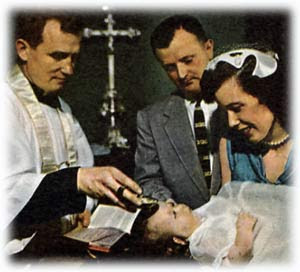
QUAERITUR: Baptisms in Advent

From a reader:

Our fifth child is due on November 24.  To allow for the possibility that he might be late, we attempted to schedule a private baptism on Gaudete Sunday. My pastor says that no baptisms can be celebrated during Advent or Lent.  I don’t know if this is a norm or just his understanding. What are my obligations here?  Am I misunderstanding that it is my duty to have the child baptized within 3 weeks or so. My pastor is actually moving towards embracing tradtion, and I don’t know if this is a fight (however minor) that I should pick. 

This is not something to "pick a fight" over.

To my knowledge, there is no legal prohibition of baptism during Advent.

At the same time, it was the tradition of the Church not to baptize or marry (solemnly) during Advent and Lent. These seasons have their character and that character, which is penitential, should be respected.  Of course none of this applied to emergency baptisms or, ehem, marriages that had to take place rather quickly or mixed marriages (which were usually informal and often not in church).

Back to baptism.  There is no hard and fast rule about the length of time after birth for the baptism of a newborn.  In centuries past, due to high infant mortality and a strong sense of the critical importance of baptism for salvation, people would sometimes take infants directly to church for nearly immediate baptism.  Infant mortality rates have dropped in most places (may God be praised) and, alas, so as the sense of the need for baptism for salvation.  People are taking longer to bring their bundles of joy to church.

His dictis, if your pastor is concerned about the character of Advent, you might consider hanging on just a little longer and having your baby baptized around the time of Epiphany, which is associated with three manifestations of the Lord’s divinity, including His baptism.  In the new, post-Conciliar calendar, there is the Feast of the Baptism of the Lord which marks the conclusion of the Advent/Christmas cycle.

Posted in ASK FATHER Question Box | Tagged ,
55 Comments

Some comments on the new norms concerning Graviora Delicta

The Holy See has revised some norms concerning "exceptionally serious" crimes against faith and morals.

All the delicts will be handled by the tribunal of the Congregation for the Doctrine of the Faith.  Besides the Church’s three great tribunals (Segnatura, Rota, Penitentiary), Congregations also have juridical sections.  The CDF has both a doctrinal section and a juridical section.

The revised norms were approved by Pope Benedict XVI on 21 May.  They were distributed to all the bishops.

Among the major changes are an increase in the "statute of limitations" for certain crimes from to 20 years and also the possibility of waiving the limitation completely depending on the case.  Requests can be made to the Pope to dismiss clerics from the clerical state without an canonical trial. Also, the CDF will now be able to try and judge cardinals, patriarchs, and bishops at the Popes behest.

Keep in mind that the new norms deal with crimes against morals, but also of faith.  In addition to the sexual abuse of minors crimes – which will probably be the sole focus of much of the press – the new norms also cover heresy, apostasy, schism, not just direct but also indirect violation of the seal of Confession, recordings of a sacramental confession done with malice, the attempted ordination of a woman to Holy Orders, and the acquisition, possession or distribution of pornographic images of minors under the age of 14, a clerico turpe patrata [shamefully accomplished by a cleric], in any way and by any means.”

The following graviora delicta – more serious crimes – are reserved to the CDF:

  • throwing away, taking or retaining the consecrated species for a sacrilegious purpose, or profaning the consecrated species (Tell that to priests and others who know better when they pout the Precious Blood down sacristy sinks and sacraria!)
  • attempting the liturgical action of the Eucharistic sacrifice or the simulation thereof [citing Canon 1378, this norm applies to persons who have not been ordained priests] (Read: pretending to say Mass)
  • concelebrating the Eucharistic Sacrifice together with ministers of ecclesial communities which do not have Apostolic succession nor recognize the Sacramental dignity of priestly ordination (what has been called communicatio in sacris)
  • The more grave delict of the attempted sacred ordination of a woman is also reserved to the
    Congregation for the Doctrine of the Faith.  Those who attempt to ordain and be ordained incur automatic excommunication.
  • consecrating one matter without the other in a Eucharistic celebration or both outside of a Eucharistic celebration
  • absolution of an accomplice in the sin against the sixth commandment of the Decalogue
  • solicitation to sin with the confessor against the sixth commandment of the Decalogue, in the act of, context of or pretext of the Sacrament of Penance
  • direct violation of the Sacramental seal
  • the violation of the sixth commandment of the Decalogue, committed by a cleric with a minor under the age of 18.
  • All of these things are sins again faith and/or morals.  Sometimes one, sometimes both.

    One of the reasons why the norms have been so complicated in the past, and words such as "secrecy" have been used – to the delight of Hell’s Bible which distorted the reality behind the objective of secrecy – was to protect the dignity of the sacrament of penance, the internal forum, and the people involved.

    NOTA BENE:

    Another thing you will perhaps will see in the press, secular and Catholic, are criticisms of the list of crimes.  They may complain that, for example, trying to ordain a woman is not nearly as horrible as abusing a minor and it shouldn’t simply be lumped in with other sins, as if they all did they same damage.  In a sense, they are right, especially from the perspective of the victim of abuse.  But they are wrong from another perspective.  Critics might assert that pouring the Precious Blood down the sink or selling a Host or pretending to ordain a woman is a "victimless" crime, bad to be sure but really not that bad.  They are wrong. 

    There are still victims: the whole Church suffers because all the crimes involved attack who and what the Church is. 

    The crimes do belong together when seen in the correct perspective.

    All of the crimes here involve sacred things. 

    Even the crime of abusing a minor outside the context of confession involves something sacred because it involves an ordained person, a sacred person. 

    Abuse of the Blessed Sacrament is the worst of all, because it involves God truly sacramentally present.  Simulation of Mass or Ordination or any other sacraments is an abuse of the sacred.  All these crimes tear at the very heart of the Church herself and they therefore merit being called graviora or "more serious". 

    The abuse of the young can leave hideous scars.  These crimes are so serious that they demand the most serious attention and measures.  They also deserve serious attention not just because of the harm done to the individual victims but because, since they involve priests (and sometimes the sacrament of penance when people are at their most vulnerable) and therefore the fabric of the Church herself.

    That said, John Allen, the fair-minded and nearly ubiquitous columnist still sadly writing for the NCFishwrap, covering the presser for the release of the documents, reported that:

    At a Vatican briefing this morning, Maltese Monsignor Charles Scicluna, an official at the Congregation for the Doctrine of the Faith, denied that the Vatican equates women’s ordination with the sexual abuse of children. An illicit ordination, Scicluna said, is a “"sacramental" crime, while abuse is a "moral" crime.

    Frankly, I think that attempted ordination of women and abuse of the Blessed Sacrament, violation of the seal are all also moral crimes. But let’s move along.

    Since graviora delicta are so terrible, there is now a more robust way of dealing with them. 

    Also, modern communication methods and travel make it possible to move more swiftly. 

    Furthermore, the lengthy process of dismissal of a priest from the clerical state had to be unsnarled. In justice, the norms had to be revised. 

    Furthermore, measures had to be taken to protect the good name of those who were falsely accused, as has been known to happen.

    In any event, there is also a long history of the development of these new norms available, which you would do well to read in order to gain some perspective about what the Holy See has done in the past and what it is doing now.

    Some links.

    UPDATE 19:56 GMT:

    I mentioned that some would freak out that women’s ordination was included in the list.  Note in Hell’s Bible‘s article by Rachel Donadio:

    But in a move that infuriated victims’ groups and put United States bishops on the defensive, it also codified “the attempted ordination of women” to the priesthood as one of the church’s most grave crimes, along with heresy, schism and pedophilia.

    And as I have said in these electronic pages many times, for Pope Benedict’s detractors and the Church’s habitual critics, nothing the Church does can ever be good enough.  To wit:

    Bishopaccountability.org, which tracks cases of sex abuse by priests cases worldwide, said the changes “amount to administrative tinkering of a secretive internal process.”

    Then there is this from deservedly excommunicated Roy Bourgeois, Maryknoller and perhaps not yet ex-priest:

    “What I did, supporting the ordination of women, they saw as a serious crime,” Father Bourgeois said. “But priests who were abusing children, they did not see as a crime. What does that say?”

    It is patently false that the Church didn’t see the abuse of children as a crime. 

    Roy Bourgeois is a liar and Hell’s Bible doesn’t correct the manifest lie because it the truth in this matter isn’t the news that fits.

    Thus, the journalistic integrity of Rachel Donadio, Laurie Goodstein, and her editorial overlords at Hell’s Bible.

    Posted in Brick by Brick, Clerical Sexual Abuse, Our Catholic Identity, The Drill | Tagged
    39 Comments

    Chances are you’ll next hear something anti-Catholic if first you hear…

    CMR has an amusing post which you should check out.

    Top ten clues that you’re about to hear something anti-Catholic. …

    Broken down by percentage points here are the chances you’re about to hear something anti-Catholic if you hear:

    • 44% chance if someone says "I’m not religious but I’m very spiritual."
    • 49% chance if someone says, "The Pope during WWII…"
    • A 53% chance if someone says "I read in the New York Times…"
    • 57% chance if someone says "I don’t need an intermediary between me and God…"
    • 68% chance if a representative of Barack Obama’s Faith Based Advisory Council office is quoted.
    • 83% chance if you hear from your television, "You’re watching Hardball…"
    • 84% chance if someone says "Richard Dawkins said…"
    • 89% chance if someone says "I don’t normally watch "The View" but Joy Behar said…"
    • 94% chance if there’s any mention of a flying spaghetti monster.
    • 98% Any mention of The Inquisition or the Crusades.
    • 100% If someone says "I was raised Catholic so…" anything that follows is guaranteed to be anti-Catholic.

    Don’t forget Galileo…

    Kudos to CMR for the chuckle.

    Posted in Lighter fare, Our Catholic Identity |
    38 Comments

    Obamacare in fact funds abortions

    I hope the sisters of the CHA are proud of themselves.

    I found this story on the site of Jill Stanek.

    Obamacare to fund abortions in Pennsylvania; heat on Dahlkemper

    Quote:

    … less than 4 months after Obamacare’s passage, and with Obama his executive order supposedly banning public funding of abortions, we get confirmation it was a fraud.

    Posted in Emanations from Penumbras | Tagged
    32 Comments

    New Michael Voris video and WDTPRS POLL

    The latest from Michael Voris.

    Watch this first.

    [youtube:http://www.youtube.com/watch?v=d11PpFwI8RY]

    Then vote in the poll and….

    … tell us about your vote in the combox!

    {democracy:73}

    Posted in POLLS | Tagged
    110 Comments

    Archbp. Gill Hellin (Spain) calls for civil disobedience of new abortion law

    From CNA, which does a good job reporting news where Spanish is spoken:

    Spanish archbishop calls for civil disobedience of new abortion law

    Madrid, Spain, Jul 13, 2010 / 01:11 pm (CNA).- Archbishop Francisco Gil Hellin of Burgos warned this week there is no right to kill an innocent human being and therefore no obligation to obey to the new law on abortion. Rather, “direct opposition without distinction” must be mounted, he said.
     
    “Let’s be clear: this law is not a law, although it is presented as such by some politicians and lawmakers.  It is no law because nobody has the right to take the life of an innocent human being. For this reason it is not obligatory.  Moreover, it demands direct opposition without distinction,” the archbishop said in a letter.
     
    He underscored that reason cannot recognize abortion as a right because it constitutes the killing “of a person who is not guilty.”  “The right of a person to exist who has already been conceived, although not yet born, is not a belief stemming from any religion.  One does not need to be a believer to hold that an innocent person has the right to be defended and respected in his or her integrity.  Common sense dictates that one cannot take a human life in order to solve another problem or to “get money or votes,” he said.
     
    The archbishop went on to say it is a “fallacy to assert that this law was passed by a majority in Parliament and that it represents the will of the majority of citizens, or if the Constitutional Court upholds it, that opposing it would be disobedient and would warrant sanction.”
     
    “The fallacy consists in giving politicians, judges or citizens a right they do not have.  And nobody has the right to legislate the killing of an innocent person,” Archbishop Gil Hellin said.  He urged Spaniards to help all mothers who are in difficult situations and to support motherhood “with all the means at our disposal” in order to “halt this plague of abortion that, in Spain alone has already destroyed more people than all those who live in the cities of Zaragoza, Cordoba and Burgos.”


    I wonder what His Excellency would say to openly Catholic politicians who vote for such laws and who then present themselves for Holy Communion.

    Kudos to Archbishop Gil Hellin.

    Posted in Emanations from Penumbras | Tagged ,
    13 Comments

    King Arthur’s Round Table identified?

    From The Daily Mail:

    King Arthur’s Round Table ‘found’ – except it’s not a table, but a Roman amphitheatre in Chester

    By Nigel Blundell

    His is among the most enduring ­legends in our island’s history.

    King Arthur, the gallant warrior who gathered his knights around the  Round Table at Camelot and rallied Christian Britons against the invading pagan Saxons, has always been an enigma.

    But now historians believe they have uncovered the precise location of Arthur’s stronghold, finally solving the riddle of whether the Round Table really existed.

    And far from pinpointing a piece of furniture, they claim the ‘table’ was in fact the circular space inside a former Roman amphitheatre.

    The experts believe that Camelot could in fact have been Chester Amphitheatre, a huge stone-and-wood structure capable of holding up to 10,000 people.

    They say that Arthur would have reinforced the building’s 40ft walls to create an imposing and well fortified base.

    The king’s regional noblemen would have sat in the central arena’s front row, with lower-ranked subjects in the outer stone benches.

    Arthur has been the subject of much historical debate, but many  scholars believe him to have been a 5th or 6th Century leader.

    The legend links him to 12 major battles fought over 40 years from the Scottish Borders to the West Country. One of the principal victories was said to have been at Chester.

    Rather than create a purpose-built Camelot, historian Chris Gidlow says Arthur would have logically chosen a structure left by the Romans.

    The first accounts of the Round Table show that it was nothing like a dining table but was a venue for upwards of 1,000 people at a time,’ he said.

    ‘And we know that one of Arthur’s two main battles was fought at a town referred to as the City of the Legions. There were only two places with this title. One was St Albans, but the location of the other has remained a mystery.’

    Researchers, who will reveal their evidence in a television documentary this month, say the recent discovery at the amphitheatre of an execution stone and a wooden memorial to Christian martyrs suggests the missing city is Chester.

    Mr Gidlow said: ‘In the 6th Century, a monk named Gildas, who wrote the earliest account of Arthur’s life, referred both to the City of the Legions and to a martyr’s shrine within it.

    ‘That is the clincher. The discovery of the shrine within the amphitheatre means that Chester was the site of Arthur’s court – and his legendary Round Table.’

    Posted in Just Too Cool | Tagged ,
    14 Comments