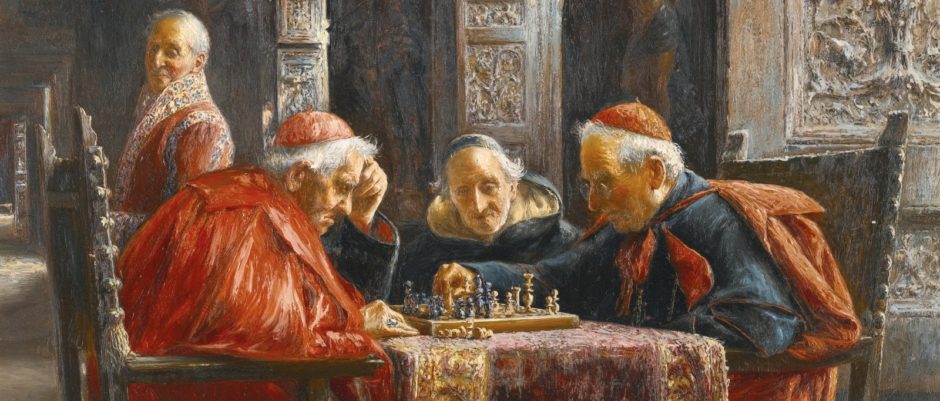
Guest rant about priests and then Fr. Z rants about priests

Our friend at Recovering Dissident Catholic, "Cathy of Alexandria" has a particularly good rant, which I feature here (with edits) as a "guest rant".  My emphases and comments.

A good priest is hard to find. Heck, a PRIEST can be hard to find.

I "do process" for a living but there are times you just need flexibility around the process so you can just jump to the terminator.

Death and serious illness are one of those times.

[…]

There is too much of an effort these days to give lay people more control over the administration of the sacraments then they should. There is a huge difference between a parish administrator role and the priest. The parish administrator or business adminstrator or office secretary should not be controlling access to Father to the point that they are, in essence, stonewalling people under the guide of "not wanting to bother Father with more stuff"

For instance, and this has loooong been a source of anger for me, you want FATHER to visit a loved one in the home or in the hospital or in the nursing home and the immediate response of the ‘gatekeeper’ in the parish is: "I’ll send one of our LAY ministers" There are times where, I’m sorry, I just don’t WANT a lay minister. I want a PRIEST. I get even more furious if they continue on and get down to it: "Father doesn’t DO those types of calls" WTH?

[…]

We’ve probably all know (well, I do) of priests who are surprised to hear that people can’t access him when he’s needed because Father had no idea the office was pushing folks away from him. Father ends up giving his cell phone number and PERSONAL email address out so people can bypass the "office". Is that acceptable? It’s ridiculous. [Especially with our new tools of communication.]

In my opinion, the authority in the parish, the last word, the COO, is the pastor. God is the CEO and ultimate word. The pretenders can all go home. I know it’s harsh. There it is[And when they do, Father will be even less available because he will also have their work to do.]

More and more people are bypassing the church weddings and funerals in favor of doing them at commercial wedding chapels and funeral home entirely. The commercial business world has figured out something we forgot: Give the people what they want AND what they need.


We need more vocations to the PRIESTHOOD.

Since one good rant deserves another, here is a little rant of my own.

Let’s be careful about prayers for vocations.

At times we should pray strictly for vocations to the priesthood. PRIESTHOOD!   Deacons are great, but they are not priests.   Religious women are great, but they are not priests.  Religious men are find, but that is its own vocation.  Married people are wonderful, but with a super small number of exceptions it is morally tedious to recount, they are not priests.

Often prayers for "vocations" are all lumped together, probably so as to avoid one of the great modern mortal sins: not being inclusive. 

Fine.  Do that.  Pray for "vocations".

But let us pray for PRIESTS…. priestly vocations… vocations to the PRIESTHOOD.

And another thing… this is the Year for Priests.  Yet I see this project and that effort for prayer for bishops, seemingly all the time.   Great!  Pray for bishops.  Bishops are priests too.    Bishops need constant prayers.  I too am constantly telling people, imploring people to pray for our bishops, upon whom so much depends.  I pray for a list of bishops after every Mass.   But can priests have their year?  Please?  We pray for bishops all the time.  It seems like every year is the year for bishops, right?  At every Mass we pray for bishops by name, for heaven’s sake!   

Okay… I must get back to work.

Thus endeth the rant.

Posted in Wherein Fr. Z Rants, Year of Priests | Tagged , ,
47 Comments

WDTPRS – Ember Saturday in Lent – (1962MR)

There are several Collects in today’s extended edition of Holy Mass for Ember Saturday.  There are five lessons before we even get to the Epistle and each lesson is followed by a Gradual and Collect.

After the the fifth lesson, the same as that for Ember Saturday of Advent (in case anyone doubted that Advent is a penitential season) about the three young men in the fiery furnace, and then the hymn of thanksgiving from Daniel, we have this:

COLLECT:
Deus, qui tribus pueris mitigasti flammas ignium:
concede propitius; ut nos famulos tuos
non exurat flamma vitiorum.

SLAVISHLY LITERAL VERSION:
O God, who tamed the flames of the fires for the three young men,
mercifully grant that the flame of vices
not consume us your servants
.

St. Thomas Aquinas taught that one of the reasons the Lord went into the desert and permitted Himself to be tempted was to teach us that none of us are free from temptation.

Even those who are spiritually advanced experience the testing of temptations.  Even seemingly small sins can be serious indeed when a person is well-along the spiritual road.

The enemy of the soul has bested better than you.

The world, the flesh and the devil exert their incessant pressures.

Let no one think he is immune to temptation.

If you give in to a particular temptation repeatedly, sin repeatedly in a certain way, you develop a habit of that sin.  That habit, the opposite of a virtue, is a vice.

With clear and even brutal honesty examine yourselves for vicious habits.  "Vicious" is the adjective related to "vice".

If you can’t picture your vices as if they were a burning fire about to sear the flesh from your bones and fry your guts, then perhaps the image of a pack of "vicious" animals might do.

We must be vigilant and disciplined and ask the help of Almighty God, especially during our annual Lenten discipline.

This is war.

A vice can destroy you, consume your soul like fire.  Many vices, greater danger.

To rid yourself of one habit (a vice) you must drive it out with another habit (a virtue) or at least some beneficial activity.

Identify your habitual fault.  Watch yourself for the recognizable patterns leading to the sins.  Form a plan of what you are going to do ahead of time.

Repeat the process until you have a new habit that won’t destroy your soul and which will be pleasing to God and edifying to your neighbor.

Stay close to the sacraments.

Do not forget that you have an angel guardian.  Thank him and ask him for help throughout the day.

Posted in LENT | Tagged
11 Comments

WDTPRS – Ember Friday in Lent – (1962MR)

This is Ember Week in Lent. 

I had a PODCAzT which spoke about Ember Days.

During the week after the 1st Sunday of Lent we observe the Ember Days of Lent.  “Ember” derives from Anglo-Saxon ymbren, “a circuit or revolution (from ymb, “around”, and rennen, “to run”), the annual wheel of the sun.”

Winter, spring, summer and autumn all had their Ember Days.  These days of fasting and abstinence on Wednesday, Friday and Saturday fell during the weeks after the first Sunday of Lent, after Pentecost, around the time of the feast of the Exaltation of the Holy Cross on 14 September, and after the third Sunday of Advent (more or less St. Lucy’s day, 13 December). 

There is a medieval couplet in rather degenerate Latin about the times they fell rendered in archaic English that is just about as bad: “Fasting days and Emberings be / Lent, Whitsun, Holyrood, and Lucie.”  Rood is Middle English for a Crucifix.  Whitsunday is Pentecost, from Old English hwita sunnandæg, “white Sunday” for the color of vestments once used for that feast. 

The Fathers of the Church (e.g., St. Leo the Great (+461) and St. Jerome (+420) spoke of this custom, which perhaps stemmed from a Jewish practice of fasts at different times during the year.  As far back as Pope Gelasius (+496) Ember Days were often auspicious for ordinations. 

In Latin we call the Ember Days the Quatuor Tempora, or "four times" of the year.  This Latin term gave rise to a form of food which I am sure you all know.

In the 16th c. Spanish and Portuguese missionaries settled in Nagasaki, Japan.  From their interest in inculturation and out of sensitivity for the ways of the people, they tried to make meatless meals for Embertide, which is a fast time.  They started deep-frying shrimp.  The Japanese ran with and developed it to perfection.  This is “tempura,” again from the Latin term for the Ember Days "Quatuor Tempora". 

POSTCOMMUNION:
Per huius, Domine, operationem mysterii,
et vitia nostra purgentur,
et iusta desideria compleantur.

SLAVISHLY LITERAL VERSION:
Through the working of this mystery/sacrament, O Lord,
both let our sins be purged,
and let our righteous desires be fulfilled
.

Mysterium and sacramentum are often interchangeable in liturgical prayers.  But when we do interchange them, be careful not to lose touch with the other term.  It should ring in your ear as an echo.

At Holy Mass, when we celebrate the sacrament of the Eucharist, we are also having an encounter with that which is mysterious, indeed, mystery itself.

This is an encounter which should leave us transformed.

Posted in LENT | Tagged ,
4 Comments

Rubrical Olympics

A reader offered this:

A light hearted proposal in the Olympic Spirit…
 
The Inaugural Rubrical Olympics would be held at the Blackfen Minor Basilica and accept teams of clergy and servers from any Rite, Form, or Use approved by the Holy See. Priests with bi-ritual faculties or taking advantage of the motu proprio Summorum Pontificum may enter multiple events.
 
Individual events to include Censing (chain clinks a key judging point) and Blessing (Byzantine priests should pay particular attention to finger positions).
 
Team events would, of course, revolve around Masses and Divine Liturgies with marks awarded for sychronicity and reverence. Post Consecration thumb-forefinger action would be an important skill. Innovation, creativity, or artistic license would result in point deductions. The use of guitars would result in disqualification.
 
Periodic testing for banned substances (i.e. polyester, felt, ceramic) would see any offending priests sent to rehab with Msgr. Marini, the Master of Papal Ceremonies.
 
The Holy and Ancient Order of Rubricarians would, of course, act as judges for all events.

Posted in Lighter fare |
20 Comments

The Feeder Feed

Back at last for a time at home, I have been able to note the changes at the feeder.

The first thing to note is how much they can eat.  Holy cow.

His scriptis, I note with pleasure that House Finches are back from whatever cruise they went on.

I hope it wasn’t on Celebrity.

This Chickadee lost its snack in the wind.Twitter

Posted in The Feeder Feed | Tagged , , ,
3 Comments

QUAERITUR: Can laypeople own a monstrance?

From a reader:

I trust your judgment and I would like to know if it is ok to own a miniature monstrance.  Sites online sell them. [Image attached for reference.]  It’s a miniature monstrance which is not the same as one used in Mass.

Most of these small "monstrances" are really reliquaries.  They are "monstrances" insofar as they "show" relics, but they are not monstrances for display and adoration of the Sacred Host, more technically an ostensorium.  The terms for these sacred vessels come from words "to show".

Nevertheless, it would not be "bad" to own a large monstrance for a Host.   Of course you could not use it privately for displaying a Host for adoration except with the permission of the local bishop, who could authorize a private chapel with reservation of the Blessed Sacrament.

There is also the question of the consecrated nature of this sacred vessel.  A monstrance is a sacred vessel.  The traditional view of sacred vessels is that they should be touched only by hands which have also been consecrated to handle sacred things, such as the Host Itself and the vessels which contain the Eucharist.  The implication is, of course, if your hands are not consecrated, as those of a priest, then you should not handle a monstrance except in great need.  However, were a sacred vessel to be sold it would lose its consecrated character.  It would be "desecrated".  It would need to be re-blessed.

So, it is not "bad" for people to own these vessels, but great care must be exercised in their regard that they be treated with due reverence.

Posted in ASK FATHER Question Box | Tagged , , ,
14 Comments

Thugs at the Cathedral of Chicago

From LifeSite:

Monday February 22, 2010

Gay Mob Protests Wedding Vow Renewal at Chicago Cathedral

by James Tillman

CHICAGO, February 22, 2010 (LifeSiteNews.com) – Last Valentine’s day, Feb 14, Chicago’s Holy Name Cathedral offered married couples a chance to celebrate their spousal fidelity by renewing their vows to each other during Mass.  Yet in order to do so, couples had to pass through an angry crowd of "gay rights" protestors who marched by the steps of the cathedral, accusing Church hierarchy of hatred toward gays and telling parishioners to "stop funding the bigots!" 

Police refused to interrupt the demonstration, despite laws that prohibit protesting near places of worship while services are ongoing. [And this is the problem, isn’t it.  What would people be saying to the city of Chicago if the police had not shut down a protest on the steps of a mosque where some stupid thing was being said?]

Chicago lawyer Nora Doherty, who was present during the demonstration, recounted via Renew America’s Matt Abbott how "one of the particularly angry protesters yelled at my three-year-old daughter, ‘Little girl, I hope you grow up to be gay so that your mother will disown you and you can know how I feel!’”

"There were some kinder protesters standing next to her trying to make excuses for her behavior," she continued, "but she was inexcusably uncivilized and there was literally frothy saliva visibly draining from the corners of her mouth."  [My favorite protestors are always spittle-flecked.]

The demonstration was organized by the Gay Liberation Network (GLN), which proclaims that the protest was meant "to draw attention to the Catholic hierarchy’s continued opposition to equal rights within the church and in society at large." [And the Church will continue to teach that homosexual sex and attraction is a perversion of the natural order.]

In particular, the protest was intended to target Chicago’s Cardinal Francis George, current President of the Conference of Catholic Bishops, and the "anti-civil rights posture of the current Pope."

"We want to drag the Church’s bigotry out of the closet," Andy Thayer, a well-known militant co-founder of the group, told the Chicago Tribune.

At one point, a speaker with a microphone and blow-horn asserted that "the Catholic hierarchy, particularly in the Knights of Columbus [sic] [!] and the organization of bishops, have regularly been clear that they want people who love people of the same gender … to stay in the closet; also, to not get jobs." [Not to get…. jobs….   Okay.  They are going to target the Church for discrimination suits.  Just watch.]

Protestors held signs proclaiming "the Pope is anti-women and anti-gay," "anti-equal Rights =’s hate," and "love transcends doctrine."   They also chanted "Holy Name, Holy Shame," "Stop the harm. Stop the hate. Separate the Church and State!" and other similar mantras.  [Pretty stupid, all in all.] The noise was audible from within the church.

[NB] The Chicago Municipal Code states that someone is punishable for disorderly conduct whenever he "pickets or demonstrates on a public way within 150 feet of any church, temple, synagogue or other place of worship while services are being conducted."

When Doherty asked an officer why they were permitting the protest to continue immediately outside the cathedral, she recounts, he "said that the organizer of the protest currently has 20 lawsuits pending against the city of Chicago and he tends to name officers personally as defendants in his civil suits."

For this reason, says Doherty, he went on to say that "unless the Commander gave explicit instructions to move the protestors to the other side of the street, he intended to do nothing."  [So, these homosexuals are effectively thugs, rather like organized crime.]

Ironically, Chicago rigorously enforces protection of its abortion mills with the "bubble zone" ordinance, which prohibits pro-life counselors within 50 feet of an abortion facility from approaching within 8 feet of an individual entering the facility, without that individual’s explicit consent.

Holy Name Cathedral’s pastor has asked the archdiocese to look into why Chicago police allowed the demonstration to take place
.

Colleen Dolan, spokeswoman for the Archdiocese of Chicago, said that the protestors’ efforts were misguided.

"They may not like it, but it’s the teaching of the Church that marriage is between one man and one woman," she said. “Those of us in the Church don’t get to choose what the teachings are."

Posted in The Last Acceptable Prejudice, Throwing a Nutty | Tagged ,
49 Comments

WDTPRS – Wednesday 1st Week of Lent – Oratio super populum (2002MR)

ORATIO SUPER POPULUM (2002MR):
Tuere, Domine, populum tuum,
et ab omnibus peccatis clementer emunda,
quia nulla ei nocebit adversitas,
si nulla ei dominetur iniquitas
.

This "Prayer over the people" was in the Liber sacramentorum Augustodunensis for Ash Wednesday, and it seems to have been inspired in some measure by St. Leo the Great’s s. 57.

SLAVISHLY LITERAL VERSION:
Protect your people, O Lord,
and mercifully cleanse it from all sins,
for no adversity will harm it,
if it is dominated by no iniquity
.

OR:
O Lord, protect Your people,
and cleanse us from every sin,
because no adversity can harm us,
if we are not dominated by sin
.

This comes at the end of a Mass in which we hear also of the Sign of Jonah and hear Christ’s words about the evil generation, how the men of Nineveh will arise in judgment.

I think you have probably heard the darkly facetious quip that if God does not punish us now, He will owe Sodom and Gomorrah and apology.

Do penance.  

Posted in LENT | Tagged
11 Comments

More on curling

Posted in Lighter fare | Tagged
10 Comments

Brick by brick at Georgetown

Here is some brick by brick new from Georgetown University sent by a reader.

My emphases and comments:

Student Push to Reinstate Campus Latin Mass Succeeds
By Lenard Babus Feb 09 2010

A renewed push by students for the reintroduction of regular celebrations of the Tridentine Mass, or a traditional Mass conducted in Latin, will provide the Georgetown community with a new option for Roman Catholic worship on campus.

Starting Feb. 11, the traditional Latin Mass will be offered one weekday per week every other week. This will be the first time that this Mass has been offered on campus since May 2008.

The main advocate for the pre-Vatican II Mass (Mass said entirely in Latin]) Kieran Raval (COL ’13) describes the Latin Mass as a way to feel a greater connection to the long historical and religious traditions of the Catholic Church as well as to grasp a greater understanding of the Novus Ordo Mass (post-Vatican II Mass).

“I gained a sense of our Catholic spiritual and liturgical heritage by attending the traditional Latin Mass, which has helped me better understand the Novus Ordo,” Raval said.  [Get that?   This is my constant theme.  The older Mass is what we need to go deeper and to have continuity.]

He stressed that neither Mass is spiritually superior to the other, but that they can work in unison to enhance one’s overall religious experience. The two Masses are aesthetically different, and preference for one over the other is based upon personal choice[hmmm]

In the traditional Latin Mass, the Mass is celebrated in Latin and the priest faces away from the congregation as a gesture symbolic of leading the congregation toward God. The traditional Latin Mass uses Gregorian chants as well as a more complex set of actions, gestures and postures by the priest.

Fr. Stephen Fields, S.J., the priest who celebrated the traditional Latin Mass when it was previously offered on campus, indicated that the traditional Mass is very popular among young people, possibly due to its contemplative nature.

My assumption is that, in a world of constant [noise], [young people] find that the contemplative silence of the Extraordinary Form nourishes their lives of prayer,” Fields said.

The traditional Latin Mass will be celebrated by Fr. G. Ronald Murphy, S.J. when it resumes this week. Murphy agreed that aesthetics are an important factor underlying personal preference for either Mass. He said he believes that more important than individual preference for either Mass is the realization of what Mass itself signifies, however.

“I like any type of worship that helps people come to a realization about what they are saying,” Murphy said.

Murphy also described the difference between the two types of Masses as a shift in focus.

The old liturgy is very much God-centered and believes, in a way, that the best way to worship is to stand together and face God. The new liturgy wants us to face God and each other,” Murphy said.

Student support has been integral in reinstituting the Mass. According to Raval, approximately 30 students have shown enthusiasm for the Extraordinary Mass. Additionally, a lecture series that aims to educate the community about the traditional Latin Mass and to address any questions or concerns is planned for the future.

Andrea Pittaluga (SFS ’10), a student organizer of the lecture series, said that lecture topics may include explanations of the steps of the traditional Latin Mass, the different vestments and the connection to ancient Jewish temple worship. Dan Galloway (SFS ’13), another student lecture series organizer, indicated the lecture series would provide the community with knowledge about the subtleties of the traditional Latin Mass and would benefit observers’ religious experiences when in Mass.

Raval stressed that apart from providing an additional means of worship, the traditional Latin Mass will enhance religious experience on campus.

“Finally, I would like to note that all, Catholics and non-Catholics, are welcome to come and experience the beauty and reverence of this liturgy. By coming to a celebration of the Traditional Latin Mass, even those who prefer the Novus Ordo will gain tremendous insight into the mystery of the Eucharist and the liturgy as a whole,” Raval said.

Posted in Brick by Brick | Tagged
18 Comments

























