A miracle approved for Ven. J.H. Newman?

This is in The Telegraph:

Cardinal John Newman poised for beatification after ruling
The Vatican has cleared the way for the beatification of John Henry Newman, the English Roman Catholic Cardinal.

By Simon Caldwell
Last Updated: 4:29PM BST 24 Apr 2009

A panel of theological consultors agreed unanimously that the inexplicable healing of an American man who was "bent double" by a severe spinal disorder came as a result of praying to Newman for a miracle, according to sources. Their decision was the final hurdle before Pope Benedict XVI can declare him "Blessed".

The Pope, who is known to be keen to make Newman a saint and who asks about the progress of his cause on a regular basis, was informed of the panel’s decision straight away.

The vote means that the Pope can now beatify Newman at a date of his choosing. A second miracle will be required before Newman can be declared a saint.

The move was welcomed by Oxford University theologian Father Ian Ker, the author of the definitive biography of Cardinal Newman.

Father Ker said: "Newman was definitely a saint and he was a very English saint. He had a great sense of humour like St Thomas More.

"He also had a great gift for friendship which has been lost in the modern age." The priest said Newman was a significant figure to Catholics worldwide because he pre-empted the reforms of the Second Vatican Council of the 1960s that modernised the Church.

Father Ker added: "As soon as he is canonised he will definitely be made a theological "doctor of the Church" and he will be seen as a doctor of this period we are living in.

"He would thoroughly agree with Pope John Paul II’s and Benedict’s understanding of the reforms of the council. While Newman was open to new ideas he was extremely loyal to the authority and the tradition of the Church."

A formal announcement by the Vatican on Newman’s beatification is expected within the next two months.

He could be beatified as early as the autumn but it is more likely to go ahead next year.

When Gordon Brown visited the Vatican in February he invited Pope Benedict to Britain to perform the ceremony in person, possibly at Wembley Stadium.

But there have also been suggestions that the beatification should take place in St Peter’s Square, Rome, because of Newman’s international significance as a modern theologian.

The breakthrough concludes the work of the theological consultors who spent six months examining doctrinal issues surrounding the healing of Jack Sullivan, 69, a deacon from Marshfield, Massachusetts.

A panel of medical experts had earlier concluded there was no scientific explanation for the healing.

All that remains for the beatification to go ahead is the miracle to be rubber-stamped by the cardinals of the Vatican’s Congregation for the Causes of Sainthood and the Pope’s signature.

Benedict XVI has been an admirer of the writings of Cardinal Newman since the 1940s, especially his "theology of conscience".

He learned about this from a German scholar called Theodor Haecker, who translated Newman’s works from English into German, and who was close to the White Rose, a German resistance movement in the Second World War.

It was revealed last month that German academics have discovered that Newman’s writings on conscience were a key inspiration of the White Rose – in particular of Sophie Scholl, a student beheaded in 1943 at the age of 21 for distributing leaflets urging students at Munich University to rise up against "Nazi terror".

Newman was born in the City of London in 1801. He became a Church of England vicar and led the "Oxford movement" in the 1830s to draw Anglicans to their Catholic roots.

He converted to the Catholic faith at the age of 44 after a succession of clashes with Anglican bishops made him a virtual outcast from the Church of England.

He continually clashed with both Anglicans angry about his conversion and Catholics who suspected him of being "half-Protestant" but his brilliant mind combined with his care for the poor won him his cardinal’s red hat from Pope Leo XIII in 1879.

He died in his room at Oratory House, Birmingham, at the age of 89 years and more than 15,000 lined the streets for his funeral a week later. His cause for sainthood was opened in 1958.

Last October undertakers attempted to exhume his body from a grave in Rednal, Worcestershire, but found that it had completely decomposed.

If Newman’s cause progresses swiftly he could become the first English saint since 1970 when Pope Paul VI canonised 40 martyrs of the Protestant Reformation.

The last British saint was St John Ogilvie, a Scottish Jesuit martyr, canonised by Pope Paul VI in 1976.
Posted in Brick by Brick, Just Too Cool, Saints: Stories & Symbols |
28 Comments

How to light the really tall candles

The other day we were talking about candles and their composition.

You know the old phrase… don not try this at home?

From a priest reader:

Fr Z. now that altars are becoming higher and higher, so to speak, some practical difficulties ensue.
 
I heard this practical tip on how to light really high candles from an old priest … . It makes me think that this is not something you should try at home, lest you burn your house down!
 
Take a little chunk of wax, melt it in a pot. An electric stove is safer for this… Then put a tiny amount of petrol (gasoline) [this is where things get interesting] into the pot away from the stove. [Good tip.] Mix it well. Let it dry. Put tiny globs of this on the wicks of the impossibly high candles to be lit long before Mass. When it comes time to light them just before Mass, one merely has to touch the flame to the wick and it begins to burn nicely immediately.

Otherwise….what happens?


Posted in "How To..." - Practical Notes, Just Too Cool | Tagged , , ,
42 Comments

ZzzzzzzzAP! RAY GUN!

I want one of these.   I will use it while driving the 789.


While the US Air Force is dead set on shooting down missiles with airborne lasers, it looks like their colleagues in the Army are busy cooking up a little something called the Multimode Directed Energy Armament System (see our artist’s conceptual rendering, above). According to Wired, this device uses an ultra-short pulse laser to create an ionized channel through the air, which it can use to send bursts of energy, conduct electricity, or act as a waveguide for an intense pulse of microwaves. If you’re looking to knock out an IED, an oncoming vehicle, or an enemy combatant, this bad boy should do the trick just fine. The Army’s Armament Research Development and Engineering Center (ARDEC) plans on having a working prototype operating in a the real world sometime in 2011.

Posted in Just Too Cool |
8 Comments

QUAERUNTUR: some questions about Mass

From a reader, some questions.

I  usually don’t like to tackle more than one question at a time, because multiple questions make subsequent moderation to difficult.

So, I will be brief.

Is it permissible for the following;

1.  At the Offertory to consecrate the bread and wine together as: "Blessed are you, Lord, God of all creation.  Through your goodness we have this bread and wine to offer.  They will become the body and blood of Christ."  [That is not what the official liturgical books say.  The books indicate that the offering of the bread and wine are separate.  Furthermore, between the offering of the bread and wine, the chalice must be prepared.  So, more than one thing is being violated.]

2.  When did the Entrance Hymn, the communion prayer, and the prayer after  communion disappear.   [They didn’t.  You will find them in the Roman Missal.]

3.  Is it correct for the people to say :  May the Lord accept the sacrifice at our hands instead of May the Lord accept the sacrifice at your  hands.  [That is not what the book says.  Also, this version twists the theology of the consecration.  The way the priest offers sacrifice is not the same as the way the congregation, as baptized people, participated.]


Posted in ASK FATHER Question Box |
Comments Off on QUAERUNTUR: some questions about Mass

How to receive Communion on the tongue (or “Don’t bite the priest!”)

Talk about biting the hand that feeds you!

I was alerted by a reader to a post by Fr. Mark Mossa, SJ, in Cambridge, MA.

Father wrote, with my emphases and comments.

I wrote a post a while back in which I spoke about some of the challenges involved in distributing communion. And lately I’ve been noticing that more and more people are choosing to receive communion on the tongue rather than in the hands. After almost a year as a priest, I’ve just about got the technique down for giving communion on the tongue without too much worry of "flying host incidents," which I also wrote about before. But now there is another challenge–people who receive communion neither in the hand nor on the tongue, but between the teeth! At a recent mass, I almost lost my finger a couple of times! I’m thinking that since more people are choosing not to receive in the hand any more, it might be a good time to offer some catechesis as to how to receive on the tongue. I know that since as a child I learned how to receive communion on the tongue only shortly before communion in the hand became more common, there are probably lots of people younger than me who, though they’ve decided to stop receiving in the hand, may never have been taught how to receive on the tongue. And not to lay it all on the young people, there are some older folk who seem to have forgotten how. If I could just make one suggestion: get that tongue out there, enough with the teeth!

Amen and amen.

Please don’t bite the priest.  Bad for him… bad for you.

Stick your tongue out far enough that the priest can actually give you Communion.  And please don’t go all Gene Simmons and make it a moving target.

This isn’t hard.  It is far more reverent and, practically speaking, by far reduces the risk of profanation.

Posted in "How To..." - Practical Notes | Tagged
96 Comments

QUAERITUR: Justify ad orientem worship in light of GIRM 299

From a reader:

I’m a student at ___, studying Psychology and Theology. First off, IMy name’s __, and I’d like to thank you for your blog. I’ve learned a lot that I’ve been able to share with my friends about the Sacred Liturgy.

The topic of ad orientam worship seems to come up a lot on your blog. Personally, I would prefer that Holy Mass be celebrated that way, but while studying the GIRM (I was in the seminary for a 3 semesters) I ran across paragraph 299:

“The altar should be built apart from the wall, in such a way that it is possible to walk around it easily  and that  Mass can be celebrated at it facing the people, which is desirable wherever possible…”. 

You speak a lot about following the rubrics and the GIRM, saying mass the way Holy Mother Church commands us to. You’ve cited the GIRM to encourage things like chalice veils. How can you reconcile your endorsement of ad orientam worship in the Ordinary Form with your insistence on “Say the Black, Do the Red”? Not attacking you of course, Father, just wondering what your rationale is?


I have written about GIRM 299 several times.  Here is a good link to one entry: What Does GIRM 299 Really Say?

The short answer is that you have been duped, probably on purpose. 

The English translation you reference, even though it might be on an official site or in a document, is wrong.  It does not accurately translate the Latin of the GIRM, which is a serious problem.  As you will see… it caused you confusion.

It is sad when we cannot trust entirely the translations of important paragraphs in important documents.   But the folks who put that together didn’t like what the Latin expressed.

Briefly, here is the skinny.

This is what GIRM 299 really says:

Altare maius exstruatur a pariete seiunctum, ut facile circumiri et in eo celebratio versus populum peragi possit, quod expedit ubicumque possibile sit.

The main altar should be built separated from the wall, which is useful wherever it is possible, so that it can be easily walked around and a celebration toward the people can be carried out.

Before the USCCB put out their document Built of Living Stones, with the incorrect translation you cited, the Congregation for Divine Worship responded to a question about this very paragraph and actually explained the Latin grammar.  I unfold that in the entry I linked.

Here is the meat of the CDWDS’s response about that which, I repeat, was made before the USCCB issued Built of Living Stones.

The Congregation for Divine Worship and the Discipline of the Sacraments has been asked whether the expression in n. 299 of the Institutio Generalis Missalis Romani constitutes a norm according to which the position of the priest versus absidem [facing the apse] is to be excluded. The Congregation for Divine Worship and the Discipline of the Sacraments, after mature reflection and in light of liturgical precedents, responds:
 
Negatively, and in accordance with the following explanation.
 
The explanation includes different elements which must be taken into account. First, the word expedit does not constitute a strict obligation but a suggestion that refers to the construction of the altar a pariete sejunctum (detached from the wall).  It does not require, for example, that existing altars be pulled away from the wall. The phrase ubi possibile sit (where it is possible) refers to, for example, the topography of the place, the availability of space, the artistic value of the existing altar, the sensibility of the people participating in the celebrations in a particular church, etc.

I hope that clear up your question!

Posted in "How To..." - Practical Notes, ASK FATHER Question Box, Linking Back |
76 Comments

QUAERITUR: choosing not to go to Sunday Mass if it is not a TLM

From a reader:

Recently, after reading this post on traditional Catholicism, I posted the link on Facebook and got into a debate with a few friends of mine.  Basically, it boiled down to the following three questions:  [there were three questions, but the second was the important one…]

2. Whether some people are dispensed from fulfilling their Sunday obligation at a Novus Ordo mass by the idea of "spiritual danger" attached to going to that rite.

A couple of my friends say yes, a couple say no.  What do you think?

I think that God cannot be fooled.

If people who are obliged are truly impeded from attending Holy Mass on a day of obligation, then they don’t sin by not attending.

There can be physical impediments (e.g., the bridge was washed out in a flood), or impediments of health (e.g., too ill to go out) or "psychic" impediments (e.g., an old person is afraid to fall on ice in the winter) or circumstantial impediments (e.g., you are traveling on a close schedule and have no idea where to go), etc.

But there are other kinds of moral impediments.  For example, say you are part of a small parish and something really bad happened with the priest or parishioners and the thought of going there is just too much, but the next parish a great distance.

Say, for example, the liturgical abuses at your parish are so bad that you simply cannot stand going and there is no place else to go within a reasonable distance.

Now… this is where things get thorny.  Some people have come to the conclusion that the Novus Ordo itself is a liturgical abuse which they cannot bear.  If they are truly convinced, based on adequate information and sound reasoning, that is one thing, but… if they are making intellectual excuses or were lazy in their choices – because they just don’t like some things that happen, that is another. 

I think some people start out disgusted at liturgical abuses they have experienced and then, slowly but surely, come to convince themselves that the problem is the Novus Ordo itself.  They harden in their position over time.  Sadly, many people who do that often don’t have the legitimate basis in fact to make such a decision in the first place, but they gradually harden their minds and hearts in it.

I say that people in this dilemma should examine their consciences and discern whether they have been just to the issues.  Deliberately choosing not to fulfill one’s obligation by refusing to attend Holy Mass, properly celebrated in an approved Rite of the Church, is a pretty serious step.

I think that God cannot be fooled.

This response is sure to bring out all sorts of knuckle-headed stuff, so I will close the combox.  People can e-mail me if they have something well-considered, measured, and respectful to contribute.

Posted in ASK FATHER Question Box |
Comments Off on QUAERITUR: choosing not to go to Sunday Mass if it is not a TLM

QUAERITUR: moving up the age of (Latin Rite) confirmation

From a reader:

A bit related to your post about seeking Confirmation from another diocese, I was wondering what you thought of seeking out the sacrament of Confirmation for my children before they receive Holy Communion for the first time. 

As I understand it, Holy Communion traditionally stood as the culmination of the process of entering the Church.  Baptism – Confirmation – Holy Communion.  Indeed, that’s the order of reception at the Easter Vigil and, I think, is the way those three sacraments are presented in the Catechism of the Catholic Church.  With the movement of the reception of Holy Communion for the first time to an earlier age (by Pius X, I believe), was there any intention to also move Confirmation to a correspondingly earlier age?  If not, would it be recommended/proper/pious to seek out Confirmation before First Holy Communion?


In the ancient Church and still in the Eastern Churches, those entering the Church would receive all three sacraments of "initiation".  Thus, even the very young, even infants were confirmed.

When the numbers of people to be "initiated" became too great for the lone bishop to handle everyone, practical solutions were adopted and the sacraments were separated.

In the Latin Church we have been separating Baptism, Confirmation and Communion for quite some time now.  The age of Communion has been moved to the "age of reason", to be be determined primarily by parents in consultation with their pastor.

The age of Confirmation has been pushed later and later.  The 1983 Code of Canon Law c. 891 sets the age for Confirmation "at about the age of discretion unless the conference of bishops has determined another age … ".   In the USA the Latin Rite bishops set the age for Confirmation at between the age of discretion (considered to be about age seven) and "about sixteen years of age."

Many people argue that late teens is too late for the sacrament.  They think it should be earlier.   The idea is that the sacrament of Confirmation, the strengthening it gives, is really needed before the turbulent years of adolescence. Canon Law supports this possibility, but the local bishops conference might have set other guidelines.

I don’t see why there could not be an exception, but it seems to me that this should be worked out carefully with your pastor and, perhaps, with the bishop who would confirm.

So, unless you really have a compelling reason to do otherwise, how about following the directives of the bishops according to the program your pastor determines? 

In the meantime, form your children well!  Giving them the gift of Faith, the Faith in which we believe, will make their deepening of the Faith by which we believe that much richer and effective in their lives.  This is your honor and duty.

Posted in ASK FATHER Question Box |
40 Comments

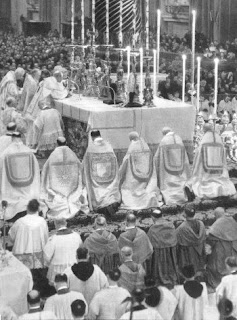
Lateran – Cañizares – TLM – Brick By Brick

Once upon when a Cardinal celebrated Holy Mass in one of the Roman Major Basilicas at the Papal Altar it was a special event.  Only the Pope could celebrate at those altars.  A special bull from the Pope had to be posted above the altar to show that he had permission.

These days it is not so special anymore to see a Cardinal celebrating at those altars. 

But it is special when that Cardinal is pontificating in the fullness of the traditional Roman Rite.

This morning, Antonio Card. Cañizares Llovera, Prefect of the Sacred Congregation for Divine Worship, celebrated Pontifical High Mass in the older, traditional use at the Archbasilica of St. John Lateran.  The ceremonies were handled by the the Franciscan Friars of the Immaculate.

That makes two times in one week the older Mass has been celebrated in the Lateran Basilica. 

The eye-candy specialists will have more images, but this one struck me.

It had to start slowly, folks. 

Posted in Brick by Brick |
23 Comments

QUAERITUR: acts of piety during Consecration/Elevation

From a reader:

I wanted to inquire about a pious habit I have acquired from my parents who have acquired it from their parents.

At the Mass, immediately following the words of Consecration when the Host is lifted up, when the bell is wrung thrice we have always struck our breasts once and said silently to ourselves, "Lord I am not worthy to receive you, etc."

Now my knowledge of the rubrics for the Novus Ordo are not exhaustive, but I don’t recall ever reading this. I did, however, recall seeing at a TLM a reference within the Missal explaining that one should say at the elevation: "My Lord and my God." I have also noticed a few ladies and gents over the years with a bit more gray in their hair than the rest also strike their breasts at this moment, but it’s relatively rare. My question is, is this anywhere within the rubrics or merely a pious action that developed over the years, much like the modern holding of hands during the Our Father at Novus Ordo Masses?


Frankly, I think you can do what you want at that moment.

Some people prefer to do nothing external.  Many say "My Lord and my God!", echoing St. Thomas the Apostle.

I know that there were directives against the priest who is saying Mass from doing this, but the laity may do as they please.

I have no problem at all with these acts of piety, which are intimately personal and harm no one.   In a similar way, if people want to hold hands during Mass, at any time, fine!  Just don’t try to compel anyone else to do it.  Moreover, people are never to be directed to hold hands.

It would be interesting to know what practices people have for this mysterious moment during Holy Mass.

Posted in ASK FATHER Question Box |
105 Comments
























