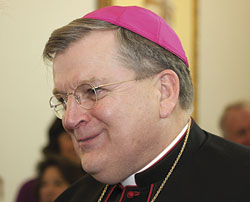
A fortunate flock in Grand Rapids, MI

A reader sent the following.  It is posted on the parish website as a PDF, but he took the time to send me the text, which aided me in posting what comes below.

This parish priest has made a determination for the good of his flock.  Let’s read what he has to say with my emphases and comments.  First comes the intro from the man who sent this piece:

Fr. Z, this is from this Sunday’s bulletin from the Sacred Heart of Jesus parish in Grand Rapids, Mich. Sacred Heart has a weekly Sunday TLM at 12:30pm. They alternate celebrants from our diocese and have a rotation of Low Mass, High Mass with (mixed sexes) choir and High Mass with schola. (The column is titled "Twin Towers" because the church has two, large bell towers.)

TWIN TOWERS

Last month, on the 15th of January, I celebrated a weekday Mass a bit differently. The appropriate word for what I did is described by the Latin term ad orientem. That means "towards the east". Or some would say, "the priest turning his back to the people". Why am I doing this?

To celebrate the current Mass properly, the Liturgy of the Word is done with the priest at the chair. [He is talking about the Novus Ordo, of course.] He only comes to the Altar for the preparation of the Gifts and then the Eucharistic Prayer. After Communion he normally goes back to the chair for the concluding rites. So the time at the altar is not that long[Nor would it be for a solemn Mass with, say, orchestral music.]

I was ordained in 1979, so I always celebrated the Mass in this manner. But to be very honest with you, I’ve never understood why. What was there to see? [good] It takes Faith, belief that bread and wine become the Body and Blood of Christ. Our human eyes cannot see that happen – only our hearts & souls do. So again, what is there to "see"?

Unfortunately, what has happened to the Mass – which has been a topic of some objections to the reforms that began in 1964 – is that at times, the Mass has become a human-priest centered event. But the human-priest is a physical stand-in for the true priest of the Mass, Jesus Christ the Eternal High Priest. The Mass is HIS; He leads us all to the Father in worship, in the Eucharistic Sacrifice. The idea is for the human-priest AND the rest of the worshiping community to stand in the same direction "following Jesus" to the Father. Picture Moses leading the Hebrews to the Promised Land.  [So… here is one image: the priest is leading the people toward something.]

"Ad orientem", literally "facing the East", comes from the Book of Ezekiel in which the People of God await the coming of the Lord FROM THE EAST (43:2). And St. Matthew declared the return of the Lord Jesus: "As the lightening from the east flashes to the west, so will the coming of the Son of Man be" (24:27).

Churches used to be built purposely facing the direction of the coming of the Lord – the East. [There is a second point: the Lord is coming from the East, so we face that direction in expectation.] The point of all this is not that we have to all face the East – although that would seem to be the most desirable direction – but that the priest and people are on a spiritual journey together. [Right!  "East" in this sense is not limited to geographical East, as some enemies of ad orientem worship will at times obtusely blither.] The priest is not an entertainer that he has to face an audience, unless he is specifically talking to them: when he says "The Lord be with you", reading the Scriptures, or giving a homily or some other liturgical instruction. Otherwise, the priest is NOT TALKING TO OR LOOKING AT THE PEOPLE. The prayers of the Mass for the most part are addressed to God the Father, not the people.  [This reminds me of a something that happened to me once at St. Peter’s Basilica… but.. another time…]

It has taken me some time to come to an understanding, that "facing the people" as if I were doing a cooking show on TV seemed to go against what the Mass was all about. Looking at the congregation as I pray and talk to God just didn’t make sense.

The fact is however, that that’s the way Mass has been celebrated for nearly 40 years now and little old Edie Hankiewicz is not about to change things. But then something else has happened, Pope Benedict, from time to time, celebrates Mass "ad orientem"! What I believe he has been trying to do, among other changes he’s made in celebrating Mass (like insisting people kneel for Communion and receive only on the tongue) is the fulfillment of a lot he was written about Roman Catholic Liturgy for many, many years.  [Yes… this priest gets it.  Also, the so-called "Benedictine arrangment" of the altar is really a transitional arrangement back to true ad orientem or ad Deum worship.]

I believe I’ve made this change (once a month) for good, spiritual reasons, not whim or simply to be different. I will continue to do so, with advance notice, (with the Latin words, "ad orientem" next to the Mass time) so if anyone doesn’t like this idea, one can go to another Mass in the area. That will be the case this coming Thursday, 12 FEB at the 7:30am Mass.

Father [Edward] Hankiewicz

Big WDTPRS kudos to Fr. Hankiewicz and his fortunate flock in Grand Rapids.

Posted in Brick by Brick |
29 Comments

New uses for unused confessionals

A reader sent me this photo of a confessional.

CLICK the photo to find out how it is being used now!

What signal does this send to people about the importance of the sacrament of penance?

I’m just askin’…

Posted in I'm just askin'... |
94 Comments

POLL: Tempus fugit

Tracking time is how we track change.  It is salutary thing to consider how we are slipping toward the future.

Tempus fugit.

How do you do it?

Do you use a wristwatch?  A clock?  Just your cellphone? 

Sundial?

Just look out the window at the bank’s clock on the corner?

I actually once used an astrolabe for a time, for kicks.

Are you asking people all the time?

Okay… that’s not really the point.

If you use a gadget for telling time, is it digital or analog?

Yah.. yah… my watch has both, but it is mainly analog.

POLL CLOSED

My usual timepiece is …

  • Analog (64%, 499 Votes)
  • Digital (36%, 276 Votes)

Total Voters: 775

Posted in POLLS |
32 Comments

A Friday evening

Pretty evening. 

Tonight I have moved from

"Oh Jo, please don’t say awful; it’s slang." … during the sweet squash and curry soup I made today from an old squash about to go bad…

(the prep photos didn’t turn out for some reason)
… to…

"They put creatures in our bodies!", for the main course of perch fillets from the freezer with wilted lettuce.  Just a touch of wine to deglaze and wilt.

On to Battlestar Galactica!

I wonder what Fr. L had.

Posted in Fr. Z's Kitchen |
18 Comments

Soooo… Fr. Longenecker is going after Fr. Z, is he?

I have – with brow furrowed and full of concern – received word that Fr. Dwight Longenecker, for whom I have such great esteem, has decided to toss darts at WDTPRS!

He was wondering aloud if, given that I do not restrict myself to serious subjects only… though how fixing good food isn’t serious I can’t tell, …  if WDTPRS perhaps will next have a fashion section.

Then, he slings yet another barb! After provoking me with the title "King" he then contumaciously posted a photo of himself in a spiffing cappa!

QUAERITUR: Is this anything but a toss of the chiroteca?

Fine…  have it your way!

I too have a cappa.

Here is a shot from a couple years ago on my way to do an Epiphany house blessing.

And please note, Reverend and Dear Father, that I am walking on water in this photo as well.

How about a ferraiuolo?  I trust, Father, that you have one of those too!

o{]:¬)

In the meantime, please vote for WDTPRS in the Bloggers Choice Awards!

WDTPRS always needs your kind help.

Posted in Mail from priests |
62 Comments

QUAERITUR: non-concelebrating priests and Communion

From a priest reader:

Except when the Archbishop (or another Bishop) is celebrating here at the parish I am not inclined to concelebrate. I prefer to attend in choir as does my associate when one or the other or a visiting preacher is the celebrant ( special feasts, school masses, etc.). What is the protocol for the reception of Holy Communion for when a priest attends in choir dress? We know what it is when a Bishop is present but unsure if the same concessions go to a priest.


I agree. Concelebration should be safe, legal and rare.  Attendance in choir is better on most occasions.

In that case wear proper choir dress, which is cassock and surplice, with biretta.  If you are a canon or rector, etc. that would be a little different.

For reception of Communion, I don’t think there is anything to note, other than priests should always receive Communion wearing a stole.  In the older form (there is no concelebration of course) you would go to the altar and receive kneeling at the step below the footpace.  In the Novus Ordo, I suppose you could do this also, or Communion could be brought to you as you kneel.

I remember in Rome some years ago at a papal Mass in the Basilica of St. Peter seeing a line of canons/clerics receiving from the Holy Father.  One would receive, remove his stole, kiss it, hand it to the next man who kissed it, put it on… received… removed the stole… kissed it… handed it to the next man…

Posted in "How To..." - Practical Notes, ASK FATHER Question Box, Mail from priests |
14 Comments

Another problem bishop

Some critics of the Pope are suggesting that the Vatican is open to the hard-liners on the right, but closed and cold to the warm-hearted forward-looking progressive thinkers on the left.

The Pope is willing to bend over backward for Bishop Williamson, while those over on the righteous long-suffering progressivist side are treated sternly.

How many times did Rome try to reconcile Bp. Milingo?

I forget.

I’m just askin’….

Posted in I'm just askin'... |
9 Comments

A diocesan paper makes distinctions: liturgical and devotional music

In the official newspaper of the Diocese of Columbus, OH, there is an interesting notice from the Office of Worship.

It is a brief piece, and therefore cannot drill to depth, but it is useful nonethess.

And the topic couldn’t be a better one.

LITURGICAL MUSIC VS. DEVOTIONAL MUSIC

Music in the Catholic Church can be divided into two categories.

Liturgical music is appropriate for a Mass or any other ritual action that is under the jurisdiction of the diocesan bishop. Devotional (worship) music is music that has been produced to be used in worshiping God, but not in a liturgical setting

The third edition of the General Instruction of the Roman Missal suggests [I think it does more than suggest…] that Gregorian chant is proper to the Roman Liturgy and should be regarded as the music that is proper to a liturgical setting. It also says that other types of music, such as polyphony, are appropriate if they “correspond to the spirit of the liturgical action” and “foster the participation of all the faithful.” [We have to understand what "participation" really means, when it comes to music.  Participation isn’t only through everyone singing everything.  That requires music which is simplistic.  A deeper participation is possible by some (well-trained) people singing (artistic sacred liturgical music) to which others carefully listen.]  Going hand in hand with the types of music used for liturgy is the types of instrumentation used. In a later paragraph, the Instruction states that the preferred instrument for liturgy is the organ. Other wind, stringed or percussion instruments may be used as long as they can be rendered “truly apt for sacred use.”  [Some instruments have connotations which shift only slowly.  Some cannot fill a large space without amplification.]

In other words, liturgical music should adhere to, and be used within, the context for which it was created. Liturgical music, traditionally, has been written for the organ or for the small ensemble of instruments it is designed to mimic. Many pieces have been written to include both the organ and the ensemble. Instruments that do not require amplification are preferred within the liturgy. This is so that we may complement the sacrifice of Jesus Christ with our own sacrifices. It takes more work to create music that can properly fill the church without amplification. Any instrument that requires amplification is a failure to live up to our prayer that this sacrifice of not only the bread and wine but our labor to give glory and praise is truly the work of our human hands.  [Still.. the bagpipe, which will fill a space, doesn’t have a liturgical connotation.]

Devotional music and authentic devotion is supposed to lead us back to the mystery of the Mass and to draw us deeper into the mystery of Christ. As we said last week, authentic devotion can be done anywhere.  [Except, musically, in the context of Mass, as the writer was explaining.]

Therefore, devotional music can exist anywhere. Whether we are caught in a traffic jam, shopping or participating in the parish charismatic praise and worship group, this music keeps Christ fresh in our minds. It also helps to lead us into a greater understanding of our participation in the gift of life. Like devotion in general, devotional music takes a free form and can be played with a variety of instruments. Amplification is not an issue with devotional music because the assembly is usually smaller, [hmmm… how about for rallies of young people?]  and the sense of sacrifice reserved for the Mass is replaced with the idea of giving praise and thanksgiving to God for his many gifts.

Since devotional music is intended for a smaller group, [hmmm] this community should have greater control over what types of music and instruments are played. The devotional setting is the proper place for instruments such as guitars and for groups that prefer to play “rock” style music.  [Exactly, though not so much because the group is smaller.]

Christian “praise bands”, and the songs that they play should be reserved for the devotions of the Church. This is so that the people attending may participate as they wish. A question that should be answered before devotional music is used, and before authentic devotion may take place is; “How does this activity lead us back to the life, death and resurrection of Christ that is present in the Mass?”

Next week, we will complete this series of articles by discussing the prayers of the Church when it comes to liturgy and devotion, and also the places where liturgy and devotion take place.

Well done!
 

Posted in Brick by Brick, Mail from priests |
39 Comments

Archbp Burke: “They’re using the Eucharist as a political tool”

This from LifeSite.

Vatican Official: Bishops Have no Choice But to Refuse Communion to Pro-Abort Politicians
By Hilary White

ROME, January 30, 2009 (LifeSiteNews.com) – Archbishop Raymond Burke, in an exclusive interview last week, told LifeSiteNews.com that the issue of pro-abortion politicians continuing to receive Holy Communion is still one of major concern and that it is the duty of bishops to ensure that they are refused.

He told LifeSiteNews.com, "I don’t understand the continual debate that goes on about it. There’s not a question that a Catholic who publicly, and after admonition, supports pro-abortion legislation is not to receive Holy Communion and is not to be given Holy Communion."

"The Church’s law is very clear," said Archbishop Burke, who was appointed last year by Pope Benedict XVI as the head of the Church’s highest court, the Apostolic Signatura. "The person who persists publicly in grave sin is to be denied Holy Communion, and it [Canon Law] doesn’t say that the bishop shall decide this. It’s an absolute."

Among the US bishops directly to address the issue, Archbishop Burke was one of around a dozen who vigorously supported a directive of the Vatican that said pro-abortion Catholic politicians "must be refused" Holy Communion if they attempt to receive at Mass. Others have refused to abide by the Vatican instruction and the Church’s own Code of Canon Law, saying they would rather focus on "education" of such politicians.

Archbishop Burke called "nonsense" the accusation, regularly made by some bishops, that refusing Holy Communion "makes the Communion rail a [political] battle ground". In fact, he said, the precise opposite is true. The politician who insists on being seen receiving Holy Communion, despite his opposition to the Church’s central teachings, is using that reception for political leverage.

In 2004, when self-proclaimed Catholic and candidate for the Democrat party, Sen. John Kerry, was frequently photographed receiving Holy Communion despite his vigorous support of abortion, the US Bishops Conference issued a document which said only that it is up to individual bishops whether to implement the Church’s code of Canon Law and refuse Communion. The issue has remained prominent with the appointment of Joe Biden, another pro-abortion Catholic politician, as Vice President of the United States of America.

Archbishop Burke recalled previous experiences with Kerry, pointing to the several occasions when the senator was pictured in Time magazine receiving Communion from Papal representatives at various public events. Burke said that it is clear that Kerry was using his reception of Holy Communion to send a message.

"He wants to not only receive Holy Communion from a bishop but from the papal representative. I think that’s what his point was. Get it in Time magazine, so people read it and say to themselves, ‘He must be in good standing’."

"What are they doing? They’re using the Eucharist as a political tool."

In refusing, far from politicising the Eucharist, the Church is returning the matter to its religious reality. The most important reasons to refuse, he said, are pastoral and religious in nature.

"The Holy Eucharist, the most sacred reality of our life in the Church, has to be protected against sacrilege. At the same time, individuals have to be protected for the sake of their own salvation from committing one of the gravest sins, namely to receive Holy Communion unworthily."

Archbishop Burke also dismissed the commonly proffered excuse that such politicians need more "education". [RIGHT!] Speaking from his own direct experience, he said that Catholic politicians who are informed by their pastors or bishops that their positions in support of pro-abortion legislation makes it impossible for them to receive Holy Communion, "I’ve always found that they don’t come forward."

"When you talk to these people, they know," he said. "They know what they’re doing is very wrong. They have to answer to God for that, but why through our pastoral negligence add on to that, that they have to answer to God for who knows how many unworthy receptions of Holy Communion?"

Archbishop Burke said that the issue had been debated enough. He rejected the idea that the matter should be left to the US Conference of Catholic Bishops, saying the Conference has no authority in the matter. "This is a law of the universal Church and it should be applied."

"I think this argument too is being used by people who don’t want to confront the issue, this whole ‘wait ’til the Conference decides’…well the Conference has been discussing this since at least 2004. And nothing happens."

When asked what the solution was, he responded, "Individual bishops and priests simply have to do their duty. They have to confront politicians, Catholic politicians, who are sinning gravely and publicly in this regard. And that’s their duty.  [Thus, do not wait for direction from your local bishop?  Or bishops wait for the conference?]

"And if they carry it out, not only can they not be reproached for that, but they should be praised for confronting this situation."

Thank you, Archbishop Burke.

Posted in The future and our choices |
68 Comments

POLL: It’s time for breakfast

It’s a busy world, right?  You are in a hurry.

For that meal everyone says is sooooo important, what do you usually do?

Grab a slice of the cold pizza from last night?

Are you farmer, or eat like one, and have a couple eggs, toast, bacon, hashbrowns?

Are you in Hong Kong and have some fried bread sticks and a bowl of milk and rice?

How about the Italian thing: some coffee with milk in some fashion and something bready?

Just a cup of coffee?

What do you usually do for breakfast?

Of course breakfast can be a little different for people who sleep during the day and work during the night.

So, let’s break this down by the number of things you have.

POLL CLOSED

What sort of breakfast do you usually have?

  • Small (one or two things) (64%, 813 Votes)
  • Just a cup of something (coffee, tea, juice, scotch, etc.) (15%, 189 Votes)
  • Large (three or more items) (12%, 151 Votes)
  • Nothing (9%, 115 Votes)

Total Voters: 1,268

Posted in POLLS |
32 Comments