Bp. Morlino: “There is no place in the priesthood today for ‘wimpish-ness.’”

From the diocesan paper of the Diocese of Madison, comes some reflections from His Excellency Most Reverend Robert Morlino about the priesthood and last week’s “Good Shepherd Sunday”.

Excerpts and with my emphases.

It takes bravery to follow Christ as priests
Bishop’s Column
Thursday, May. 03, 2012

This past Sunday is often called, “Good Shepherd Sunday.” The word the Scriptures use is really not adequately translated in English as simply, “good.” The word really means, “honorable, worthy, noble,” or, “so excellent in every way that its goodness is itself beautiful.”

And, in particular, our Gospel for this past Sunday (Jn 10:11-18) points out that the shepherd is willing to lay down his life for his sheep; he is honorable, worthy, and noble in his bravery — even laying down his own life for the sheep. And toward the end of that Gospel passage, Jesus says, “No one takes my life from me, I lay down my life, and I take it up again.”

The shepherd is indeed a brave shepherd. And so, in some ways, as the years go by, I hope that we start to call this, “Brave Shepherd Sunday,” for the bravery of the shepherd is one of the key virtues focused upon that help us to call him, “good.”

This past Sunday was also the World Day of Prayer for Vocations — it always falls on Brave Shepherd Sunday. And it is a day of prayer, in particular, for vocations to the priesthood. Of course we pray that everyone can be faithfully successful in finding his or her vocation, but we pray especially for an increase in vocations to the priesthood. The priesthood is not one vocation amid many. The vocation to be a priest is the vocation to coordinate the other vocations in the Church, to recognize, to call them forth, to help discern them, and to serve them.

The priest’s vocation is all about the fullness of the vocation of everyone else. The priest has a special call to discern and to direct those other vocations, so that the Church might be one, so that there might be one flock and one shepherd. So, the priest is as concerned about everybody else’s reception of the Grace of Christ, as his own. And, the priest has a very good motive for his concern about everyone else’s reception of God’s Grace, for Jesus Christ will hold him to account for that on Judgment Day.

The priest must do what is necessary to build unity in the flock and to call the flock to holiness, so that he himself might receive a “good account before the fearsome judgment seat of Christ,” when the time comes. It is only in doing his best for everybody else’s holiness that the priest can do the best for himself. And to do that today it takes bravery.

When we look for candidates to the priesthood and as we pray for vocations, we are looking for men who are brave in their willingness to seek holiness, to speak the truth, to lay down their lives. There is no place in the priesthood today for “wimpish-ness.” There is no place for an attitude that just wants to please people, no matter what they think and no matter what they want. Today the priest has to stand up and be brave, preaching the Truth with love. He has to be willing to be unpopular. And if it comes to it, he has to be open to martyrdom.

[…]

Our world is in such a state that even the government wants to make sure that everybody — perhaps even little girls — have access, free of charge, to artificial contraception and they call it “preventive services.” Preventive medicine is medicine that protects someone from an illness (like a vaccination against the flu). What disease does artificial contraception protect a woman from? Pregnancy? Our government would have us think that pregnancy is a disease, and that instead of finding fulfillment in her motherhood, a woman must have the absolute freedom to turn against her motherhood — as if the fruits of being a mother were a disease.

Bravery means standing up for moral truth
It’s time for all of us to be brave in admitting what the moral truth is about artificial contraception. It’s not a time to by shy, retiring, and politically correct. Sometimes people come up to me and say, “in my parish it’s not permitted to talk about that.” How sad. Where is the sign of the brave shepherd?

[…]

Read the rest there.

Posted in Mail from priests, New Evangelization, Our Catholic Identity, Priests and Priesthood, Religious Liberty, The future and our choices | Tagged , , , , , , , , ,
35 Comments

The 2020 annual LCWR Assembly

I picked this up from a future edition of the National catholic Reporter.

Breaking down barriers, affirming freedom

Jamie O’Brien

12 August 2020

HONOLULU (NcR) The 2020 annual national assembly of the Leadership Conference of Women Religious is underway in Honolulu, under the swaying palms and by the sparkling sandy beaches. Once again the gathered sisters have met to affirm each other in their respective callings.

Beth Mackee, LCWR co-mentor, introduced this year’s national assembly speaker Dyna Moore. Moore, the latest in a series of transgendered Daughters of Charity to profess vows, told the assembly in her keynote speech how liberating it was for her now to be a woman.

However, Moore directed the majority of her remarks to the Assembly’s theme, “Age: The Final Frontier“.

Picking up on the assembly’s strong anticipation of President Obama’s fourth term, Moore reminded the group that “much still needs to be done to carry forward the liberation of women from all forms of oppression, especially sexual oppression”.

Congratulating the LCWR for its defeat a decade earlier of the CDF’s attempted 5-year takeover, Moore recalled the women religious who in the meantime “heroically fought the male hierarchy’s strong support of legislation banning polygamous lesbian marriages”.

Yet Moore challenged the assembled sisters to intensify their efforts in support of a national law aimed at lowering the age of sexual consent to 11.

In her talk, Moore, a professor of linguistics at Notre Dame, surveyed the negative history surrounding language concerning women’s rights.

Moore claimed that “terms such as abortion and prostitution and polygamy, and now pedophilia, have been used by men to stigmatize women in their search for sexual liberty”.

After fighting for the right of women of all ages to have abortions without parental knowledge or consent, Moore suggested that women religious should “lead the battle for the relational freedom of females of every age”.

The assembly rose in a standing ovation when Moore declared that “the human right of girls to choose sexual partners regardless of age represents the final frontier of women’s sexual and reproductive freedom”.

While Moore was speaking, members of the Survivors’ Network of those Abused by Nuns, SNAN (formerly known as SNAP) protested outside Honolulu’s most expensive hotel, where the Assembly was held.

“They are compromising the future repressed memories of countless children,” said a SNAN spokesperson.


Posted in Classic Posts, Lighter fare, The future and our choices | Tagged , , ,
17 Comments

Georgetown Jesuits invite Kathleen Sebelius

Please use the sharing buttons!  Thanks!

Jesuits.

They have effectively said to the US Bishops: “Screw you!”

From the CNS:

Kathleen Sebelius to Speak at Georgetown Commencement Ceremony

In what can only be interpreted as a direct challenge to America’s Catholic bishops, Georgetown University has announced that “pro-choice” Catholic Kathleen Sebelius, Secretary of the Department of Health and Human Services (HHS) and lead architect of the Obama administration’s assault on religious freedom through the HHS contraception mandate, has been invited to speak at one of Georgetown’s several commencement ceremonies.

The Cardinal Newman Society has posted a petition to protest this outrage here: GeorgetownScandal.com. It has also alerted Washington Cardinal Donald Wuerl and sent a letter to Georgetown President John DeGioia urging him to immediately withdraw the invitation.

Last week The Cardinal Newman Society released a list of 11 scandalous commencement speakers at Catholic colleges and universities, as well as a report on homosexual “lavender graduations” including one at Georgetown.

The nation’s oldest Catholic and Jesuit university has chosen to honor Sebelius by granting her a prestigious platform at its Public Policy Institute commencement ceremony, despite her role as the lead architect of a healthcare mandate that will force Catholic institutions to pay for contraception, abortifacients and sterilization against their religious beliefs. The United States Conference of Catholic Bishops has termed the mandate “an unwarranted government definition of religion” that is “alien both to our Catholic tradition and to federal law,” “a violation of personal civil rights” and “a mandate to act against our teachings.”

But Secretary Sebelius’ record on abortion is at least as troubling as the mandate. When Governor of Kansas, Sebelius supported abortion rights and vetoed pro-life legislation. In 2008, Archbishop Joseph Naumann of Kansas City reportedly told Sebelius, a Roman Catholic, to stop receiving the Eucharist until she publicly recants her position on abortion and makes a “worthy sacramental confession.”

Posted in Dogs and Fleas | Tagged , , , , , ,
64 Comments

Interesting observations about that Council

Observations about that Council.

Tune your ear for what he says about the UN.

[wp_youtube]E9o5LUURsTE[/wp_youtube]


Posted in Linking Back, The Drill | Tagged , ,
24 Comments

NEW “Pray For More Priests” SWAG added to Swag Store

I added another option to the “We Love Our Priests” (etc.) swag store.

There are bumperstickers and car magnets.  You can buy one at a time or in packs for distribution.


Posted in Our Catholic Identity, Priests and Priesthood, The Campus Telephone Pole | Tagged , , ,
3 Comments

RECENT POSTS and THANKS

Here are links to recent posts which have scrolled along off the front page.

First…

Mother’s Day Gift Ideas

Also, please continue to use the “sharing” buttons at the top of posts.  I know some of you don’t do this sort of thing but… using them does help.

And now…

I also want to thank readers who sent donations.  I hope I have everyone’s initials of the most recent donors:

JR, PT, SS, RB, AR, JS, LH, TT, LC, MK, JB, WH, EM, DD, JV, LT, CR, ER, MT, RR, MG, KT, LB, NH, MLF, BG, AM, LG

Also, thanks to NEA who sent the copy of Aidan Nichols newest book, The Chalice of God  and to the kind person who sent The Patrick O’Brian Muster Book (UK link HERE).  I look forward to exploring both.

I am deeply grateful for the gestures of kindness which pick me up when I am down.  Thanks.  It is my pleasure and duty to pray for benefactors.

I will have my list in hand as a ready myself to say Holy Mass on Saturday.

Don’t forget to examine your consciences well so you can make a good confession on Saturday, if possible.  Also, refresh your coffee supply while your at it.

Mystic Monk Coffee!  It’s swell!


Posted in SESSIUNCULA |
Comments Off on RECENT POSTS and THANKS

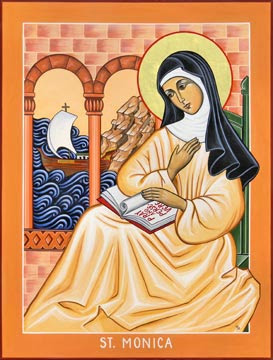
St. Monica and her incipient alcoholism with some Latin

From Serge Lancel’s Augustine, the best biography I know of the great Bishop of Hippo (p. 8 ff – emphases mine):

Before devoting himself entirely to Mother Church, as he approached the age of forty, Augustine had had a concubine for about fifteen years, of whom he had been very fond and who had given him a son; then, at the same time as a fleeting engagement, a second short-lived liaison.  But only one woman really counted in his life, and that was his natural mother, Monica.

As we may guess from reading a few pages of Book IX.8 of the Confessions, Patricius – Augustine’s father – had taken a wife in Thagaste from a milieu close to his own.  He had married Monica, as his would describe it in a phrase borrowed from Virgil, “in the fullness of her nubility”, which means that he had not married a child, a practice that was in any case more rare then in Africa that in Rome itself.  The couple had three children, in what order we do not know: a girl, who remains anonymous to us, but who, once widowed, would later become the superior of a community of nuns, and two boys, Augustine and Navigius, whom we shall find with his brother in Italy, at Cassiciacum, then at Ostia at their dying mother’s bedside.  …

So Monica had been born into a Christian family and was, as we would say today, a practicing believer.  The religious practices of Christians at that time, in North Africa, sometimes included aspects that would be surprising to us, such as the custom of taking offerings of food to the tombs of martyrs, for agapes that only too often degenerated into orgies; an obvious survival of the pagan festival of the Parentalia.  Of course, Monica did not indulge in those excesses.  If the baskets she brought to the cemetery contained, besides gruel and bread, a pitcher of unadulterated wine, when the time came to share libations with other faithful, she herself would take only a tiny amount, diluted with water, sipped from a goblet in front of every tomb visited.  Was this sobriety a memory of some experience in her early youth?  Augustine tells this story which he says he heard from the lady herself.  Raised in temperance by an old serving-woman who enjoyed the complete trust of Monica’s parents, she had fallen into a bad habit.  Well-behaved girl that she was, she was sent to the cellar to fetch wine from the cask, but before using the goblet she had brought to fill the carafe she would just wet her lips with the wine, not because she liked it, says Augustine, but out of childish mischief.  But gradually she had acquired a taste for it, to the point where she was drinking entire goblets of it with great gusto.  Fortunately she had cured herself of this incipient liking for drink in a burst of pride: the maidservant who accompanied her to the cellar, having fallen out one day with her young mistress insultingly called he a “little wine bibber”.  Stung to the quick, Monica had immediately stopped her habit.

Think now about the spiritual works of mercy: admonish the sinner.  Consider how that servant affected WESTERN CIVILIZATION because of what she did for the future mother of St. Augustine, arguably one of the most influential figures in history.


Here’s the Latin from conf 9.8.18.  A few interesting words in bold:

8. 18. Et subrepserat tamen, sicut mihi filio famula tua narrabat, subrepserat ei vinulentia. [“an inclination for getting drunk on wine slithered into her”] Nam cum de more tamquam puella sobria iuberetur a parentibus de cupa vinum depromere, submisso poculo, qua desuper patet, priusquam in lagunculam funderet merum, [wine uncut with water – in the ancient world wine was always cut and it drinking merum was a sign of low manners, etc, as Cicero accused Mark Antony] primoribus labris sorbebat exiguum, quia non poterat amplius sensu recusante. Non enim ulla temulenta [archaic word for wine] cupidine faciebat hoc, sed quibusdam superfluentibus aetatis excessibus, qui ludicris motibus ebulliunt et in puerilibus animis maiorum pondere premi solent. Itaque ad illud modicum quotidiana modica addendo; quoniam qui modica spernit, paulatim decidit; in eam consuetudinem lapsa erat, ut prope iam plenos mero caliculos inhianter hauriret. [with a gaping mouth she quaffed whole cups of uncut wine] Ubi tunc sagax anus [wise old woman] et vehemens illa prohibitio? Numquid valebat aliquid adversus latentem morbum, nisi tua medicina, Domine, vigilaret super nos? Absente patre et matre et nutritoribus tu praesens, qui creasti, qui vocas, qui etiam per praepositos homines boni aliquid agis ad animarum salutem. Quid tunc egisti, Deus meus? Unde curasti? Unde sanasti? Nonne protulisti durum et acutum ex altera anima convicium tamquam medicinale ferrum [reproach like a cautering iron] ex occultis provisionibus tuis et uno ictu putredinem illam praecidisti? Ancilla enim, cum qua solebat accedere ad cupam, litigans cum domina minore, ut fit, sola cum sola, obiecit hoc crimen amarissima insultatione vocans meribibulam. [The old servant woman threw this crime (at Monica) with the bitterest reproach calling her a drunk (“wine-swiller”).] Quo illa stimulo percussa respexit foeditatem suam confestimque damnavit atque exuit. Sicut amici adulantes pervertunt, sic inimici litigantes plerumque corrigunt. Nec tu quod per eos agis, sed quod ipsi voluerunt, retribuis eis. Illa enim irata exagitare appetivit minorem dominam, non sanare, et ideo clanculo, aut quia ita eas invenerat locus et tempus litis, aut ne forte et ipsa periclitaretur, quod tam sero prodidisset. At tu, Domine, rector caelitum et terrenorum, ad usus tuos contorquens profunda torrentis, fluxum saeculorum ordinans turbulentum, etiam de alterius animae insania sanasti alteram, ne quisquam, cum hoc advertit, potentiae suae tribuat, si verbo eius alius corrigatur, quem vult corrigi.

In the online Pusey translation… a little dated:

And yet (as Thy handmaid told me her son) there had crept upon her a love of wine. For when (as the manner was) she, as though a sober maiden, was bidden by her parents to draw wine out of the hogshed, holding the vessel under the opening, before she poured the wine into the flagon, she sipped a little with the tip of her lips; for more her instinctive feelings refused. For this she did, not out of any desire of drink, but out of the exuberance of youth, whereby it boils over in mirthful freaks, which in youthful spirits are wont to be kept under by the gravity of their elders. And thus by adding to that little, daily littles (for whoso despiseth little things shall fall by little and little), she had fallen into such a habit as greedily to drink off her little cup brim-full almost of wine. Where was then that discreet old woman, and that her earnest countermanding? Would aught avail against a secret disease, if Thy healing hand, O Lord, watched not over us? Father, mother, and governors absent, Thou present, who createdst, who callest, who also by those set over us, workest something towards the salvation of our souls, what didst Thou then, O my God? how didst Thou cure her? how heal her? didst Thou not out of another soul bring forth a hard and a sharp taunt, like a lancet out of Thy secret store, and with one touch remove all that foul stuff? For a maid-servant with whom she used to go to the cellar, falling to words (as it happens) with her little mistress, when alone with her, taunted her with this fault, with most bitter insult, calling her wine-bibber. With which taunt she, stung to the quick, saw the foulness of her fault, and instantly condemned and forsook it. As flattering friends pervert, so reproachful enemies mostly correct. Yet not what by them Thou doest, but what themselves purposed, dost Thou repay them. For she in her anger sought to vex her young mistress, not to amend her; and did it in private, either for that the time and place of the quarrel so found them; or lest herself also should have anger, for discovering it thus late. But Thou, Lord, Governor of all in heaven and earth, who turnest to Thy purposes the deepest currents, and the ruled turbulence of the tide of times, didst by the very unhealthiness of one soul heal another; lest any, when he observes this, should ascribe it to his own power, even when another, whom he wished to be reformed, is reformed through words of his.

Posted in Patristiblogging | Tagged , ,
2 Comments

Star Wars Day

I understand that today is Star Wars Day.

Honestly, I prefer Talk Like Shakespeare Day or even Talk Like a Pirate Day.

In my opinion the best part of Star Wars is that great and ominous march which, I have already determined, must be played in the cathedral if I am ever consecrated bishop.   You know… just to set the tone for my reign.  But I digress.

It seems that the origin for this observance of Star Wars Day came from some wag who, upon this fourth day of May, form his beery genius quipped “May the fourth be with you”.

One of my emails suggested that the best response would be…

… c’mom…

… you can do it!

EVERYBODY NOW! …

“And alsoooooo….. “

Posted in Lighter fare | Tagged
22 Comments

Where are the Catholics? What are you going to do about them?

I am sure you have heard that on Sundays the largest Catholic congregations are actually at fundamentalist mega-churches.

I saw this on Catholic Culture:

Roughly one-fifth of the Catholics in the US are not associated with a parish, a new study has found.

While there are about 75 million Catholics in the US, “fewer than 60 million are associated with a specific Catholic church,” reports Clifford Grammich of the Glenmary Research Center. Thus at least 15 million people who identify themselves as Catholic but not with any parish.

The Glenmary study found that drop of 3.1 million in the Catholic population since the 2000 census. There are now 58.9 million Catholics registered in 20,589 parish congregations. The number of congregations, like the number of registered Catholics, has dropped by about 5% since 2000.

If you are reading Catholic blogs, you are more than likely dedicated to your Catholic faith and identity, or you are trying to be more dedicated.  One of the most urgent dedicated and practicing Catholics need to do right now – whether their parish priests or bishops have a program to help them or not – is to do concrete things to help fallen-away or non- practicing Catholics back into the fold.

We all know people who are not practicing their faith or who have drifted into some nearly doctrineless sect.

What are you going to do about it?

Posted in "How To..." - Practical Notes, New Evangelization, Our Catholic Identity | Tagged , ,
68 Comments

1st Friday of May

Don’t forget that today is a First Friday.

You might do a very careful examination of conscience today in preparation for going to confession tomorrow.

Posted in SESSIUNCULA |
4 Comments