I haven’t yet figured out Fr. Weinandy’s motives for the seemingly inexplicable and most odd attack on the Vetus Ordo some time ago.
The Parisian Blasphemy and the Sacred Heart of Jesus
Fr. Thomas G. Weinandy, OFM, Cap.
Many people, including Catholic bishops and numerous Christians throughout the world, have condemned the blasphemous event that took place during the opening ceremonies of the Summer Olympics in Paris.
[…]
Amidst all the condemnations and claims of the display’s offensiveness, what has not been stated, even by Christians, is that those who planned, orchestrated, and perpetrated such a blasphemous portrayal, [NB] unless they repent, will not die a happy death. At the very moment of their death, they will be about to face the very one that they blasphemously mocked and demeaned. And contrary to the sentimentalized Christianity of many today, Scripture itself tells us that He will be their judge – the holy and risen Lord Jesus Christ. [The Four Last Things, my friends.]
Moreover, God the Father will not allow His beloved incarnate Son, Jesus Christ, to be blasphemed. France, and particularly Paris, and maybe even the Olympic games themselves, will not go unpunished. Jesus declared to his disciples: “‘Truly, I say to you, all sins will be forgiven the sons of men, and whatever blasphemies they utter; but whoever blasphemes against the Holy Spirit never has forgiveness, but is guilty of an eternal sin’ – for they had said, ‘He has an unclean spirit.’” (Mark 3:28-30) [God the Father allows His Son to mocked constantly. However, for God, a thousand years is as a day. It is not going to go unpunished, eventually. Meanwhile, the Lord’s Passion continues in the Church.]
Although all sins can be forgiven, even blasphemy against God, yet to blaspheme against the Holy Spirit cannot be forgiven. [QUAERITUR…] What is this blasphemy against the Spirit and why can’t it be forgiven?
To blaspheme the Holy Spirit is to deny that Jesus is the Spirit-filled Messiah. Unbelieving Jews declared that Jesus was possessed by an unclean spirit, the devil, and in so doing, they blasphemed the Holy Spirit who dwelt within Jesus in all of his fullness. To blaspheme the Holy Spirit is to deny that Jesus is the Father’s beloved incarnate Son. Again, such blasphemy the Father will never tolerate, but eternally condemn.
[QUAERITUR…] Now, did those who made mockery of Jesus and his apostles not know that Jesus is the Spirit-filled Messiah? The answer to this question is “No.” [But we don’t buy that. And neither does the writer…] If they did not know, what they did may be unseemly and tasteless, but they would not, because of their ignorance, be guilty of the unforgivable sin of blaspheming the Holy Spirit. However, it is precisely because they did know that Jesus is the Father’s incarnate Spirit-filled Son that they mocked him, and so blasphemed the Holy Spirit. Contempt was the whole point of their blasphemous portrayal.
Thus, the entire event was demonic. The devil desires nothing more than for Jesus to be blasphemed, for Jesus, through his saving death and glorious resurrection, destroyed Satan’s kingdom. Satan clearly knows who Jesus is and what he is about. “Ah! What have you to do with us, Jesus of Nazareth? Have you come to destroy us? I know who you are, the Holy One of God.” (Luke 4:34)
Jesus of Nazareth, the Holy One of God, destroyed Satan’s dominion of sin and death. To this day, Satan and his demonic thugs, demons and human beings alike, continue to seek revenge, and they do so by fermenting blasphemy against him. This demonic provocation was fully on display in Paris at the Olympic opening ceremony – a demonic liturgical rite.
Was it, then, by happenstance that the blasphemous display was the portrayal of the Last Supper? No! Satan not only wanted to blaspheme Jesus, but he also desired to blaspheme the Eucharist. The Eucharist is the making present of Jesus’ one saving sacrifice, a sacrifice which vanquished sin and death. In the Eucharist, the faithful receive the risen body and risen blood of Jesus, and so come into living communion with Him.
The Mass is the ultimate exactment of Satan’s kingdom being ever destroyed, and the definitive expression of God’s kingdom being ever made present. For all times, the Mass sacramentally signifies Satan’s demise and Jesus’ triumph. It is an ever-present visible outrage to Satan and an insult that he cannot endure – but he is helpless.
On Montmartre, …
[…]
If there ever was a time when, before the Blessed Sacrament, reparation needs to be made to the Sacred Heart of Jesus, this is such a time. Jesus’s heart was pierced out of love for all. From His heart flows out an abundance of mercy and forgiveness. All Christians need to call upon Jesus, as the Sacred Heart, to cast out all demons from Paris and the Olympics. All Christian groups need to pray that Jesus would fill everyone, especially the athletes, with the love of his Holy Spirit.
The Olympics, as an international athletic event, symbolize the entire world, and it is not only France and Paris that need Jesus but the whole of humankind.
Back to the other thing.
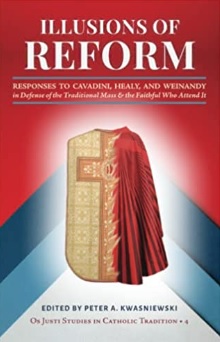
Here’s a strong refutation of the puzzling pieces by Cavadini, Healy, and Weinandy, who ought to have known better than to wade into this topic unprepared:



 Well put in many respects.







 Francisco12 on Catholics must read the entire Tradition in light of the Council in order to remain within the Church.: “Fantastic commentary here, Father. Thank you! The portion you shared from Lumen Gentium 36 is especially enlightening. Important to single…”




























