St. Paul/Mpls: Archdiocesan Corpus Christi Procession – Sunday 26 June

Archdiocesan Corpus Christi Procession, Sunday, June 26, 2:00-3:30 p.m., Little Sisters of the Poor to the Cathedral of St. Paul. Bring your family and friends for this festive walk with our Eucharistic Lord. Ice cream social follows. Park in the Cathedral parking lot and ride a free shuttle bus to Little Sisters’ from 1:15 to 1:45 p.m. Details at www.WalkWithHim.net or call (651) 239-8574.

Spread the word
Tell others; post a flyer at your church or elsewhere, available at www.WalkWithHim.net (English and Spanish).

Volunteer
Could you help us with any of the following?
* Parking and busing: we need a full crew to direct traffic and help people on and off buses
* Set-up and take-down
* Medical assistance: doctor, nurse, EMT

Support
You or your business can sponsor buses, flower arrangements for the altars, and ads.

Pray: A Short Novena for Corpus Christi (starts Friday)
O Lord Jesus Christ, You who have given us Your precious Body and Blood to be our meat and drink, grant that through frequent reception of You in the Holy Eucharist, I may be strengthened in mind and body to do Your holy will. Amen.

More details and resources (including catechetical resources, prayers, reflections by the saints, and excerpts from the texts of Pope Benedict XVI and Pope John Paul II) are available at www.WalkWithHim.net.

Posted in The Campus Telephone Pole | Tagged ,
4 Comments

What Does GIRM 160 for the USA Really Say?

When the new English translation of the Roman Missal is released, it will sport a new translation of the GIRM, the General Institution/Instruction of the Roman Missal.

There are, of course, adaptations for the USA and other Anglophone regions.

As it happens, the Congregation for Divine Worship has … tweaked some items.  I am sure this was to harmonize the language of the GIRM with the language of the rest of the Roman Missal.  However, tweaks may have been tweaked for other reasons.

For example, take a look at GIRM 160 for the USA.  The Latin is found on the USCCB website.

LATIN:
… Fideles communicant genuflexi vel stantes, prout Conferentia Episcoporum statuerit. Cum autem stantes communicant, commendatur ut debitam reverentiam, ab iisdem normis statuendam, ante susceptionem Sacramenti faciant.

OLDER USA ADAPTATION VERSION:
… The norm for reception of Holy Communion in the dioceses of the United States is standing. Communicants should not be denied Holy Communion because they kneel. Rather, such instances should be addressed pastorally, by providing the faithful with proper catechesis on the reasons for this norm.

NEWER USA ADAPTATION VERSION:
… The norm established for the Dioceses of the United States of America is that Holy Communion is to be received standing, unless an individual member of the faithful wishes to receive Communion while kneeling (Congregation for Divine Worship and the Discipline of the Sacraments, Instruction, Redemptionis Sacramentum, March 25, 2004, no. 91).

The rest of GIRM 160 remains as it was.

There is no mention of addressing the instances “pastorally” or giving “properly catechizing” people who kneel to receive their GOD.

In other words, when people kneel to receive Almighty GOD, priests and other ministers are to give Communion to the person and keep their mouths shut.

Posted in "How To..." - Practical Notes, WDTPRS | Tagged , ,
26 Comments

Visiting a Roman basilica? There’s an app for that.

It would be nice to have some silence during visits to beautiful churches in Europe.

This comes from CNA:

Vatican hopes iPod can bring silence to Rome’s churches

Rome, Italy, Jun 24, 2011 / 06:10 am (CNA/EWTN News).- The Vatican has introduced a new way of keeping silence in their churches while also informing tourists – the iPod.

Today is the first full day of a trial which sees pilgrims to the basilica of St. John Lateran given the audio-guide with a special app explaining the 1,700-year history of the church, which serves as the Pope’s cathedral.

“I can easily say that in Italy there are no examples of experiences like this in religious contexts, probably not even those in museums,” Jelena Jovanovic said to CNA. Her company, Antenna International, created the handheld device.

The multi-lingual guide offers audio, video, photos and texts to give an interactive experience to pilgrims. It also provides historical re-enactments narrated by actors.

Tourists can now listen to the experience of their fellow pilgrims from centuries past or even a “first-hand” account of the Battle of the Milvian Bridge in 312, when the Emperor Constantine saw a cross in the sky and converted to Christianity.

But the primary purpose of the guide is not entertainment or even education – it’s prayer and silence.

Bishop Luca Brandolini, the head of Pastoral Care for the Diocese of Rome, explained to CNA that “Unfortunately, our basilicas have become more like noisy meeting places at many times.”

“We need to bring back a place and time for silence. So I think this audio-guide will help achieve that.”

The Managing Director of the Opera Romana Pellegrinaggi, the Vatican body that oversees all pilgrim activity in the Diocese of Rome, agrees.

“Those who want to enter into a basilica to pray must be able to pray. So this multimedia guide helps with that,” said Fr. Caesar Atuire.

“Everyone can now do what they have to do without disturbing others.”

There is no charge for the use of the guide, but pilgrims do have to leave a document, such as a passport, as security.

The Vatican will monitor the experiment at St. John Lateran until December. Then officials will decide whether or not to roll the scheme out to other basilicas and churches in the Diocese of Rome.

Posted in Just Too Cool | Tagged
3 Comments

Close asteriod flyby – 27 June

From Space Weather.

ASTEROID FLYBY: Newly-discovered asteroid 2011 MD will pass only 12,000 kilometers (7,500 miles) above Earth’s surface on Monday, June 27th. NASA analysts say there is no chance the space rock will strike Earth. Nevertheless, the encounter is so close that Earth’s gravity will sharply perturb the asteroid’s trajectory.

GEOMAGNETIC OUTLOOK: A fast-moving stream of solar wind is buffeting Earth’s magnetic field. The combined effect of this stream plus a CME expected to arrive on June 24th has prompted NOAA forecasters to declare a ~30% chance of high-latitude geomagnetic storms during the next 24 hours.

Storm alerts are available from Spaceweather.com in two forms: voice (http://spaceweatherphone.com) or text (http://spaceweathertext.com).

Posted in Global Killer Asteroid Questions, Just Too Cool |
Comments Off on Close asteriod flyby – 27 June

Re-orienting a church

For your Brick By Brick file from the Mercury News, with my emphases and comments.

Developer renovates Pittsburg [California] Catholic church
By Rick Radin

PITTSBURG — A 41-year-old Catholic church that was showing its age has a new look thanks to its most prominent parishioner.

Albert Seeno III, an executive with the construction company named after his grandfather, renovated the interior and exterior of the Good Shepherd Catholic Church, helping the Rev. Helmut Richter complete a long-term goal of converting the church from the way it was originally built — with the altar in the middle of the sanctuary — to having the altar against the wall[Now that’s what I’m talkin’ about!]

“The church was built with the pews encircling the altar,” [blech] Richter said. “After I came here in 1997, I moved the altar, but people were still looking at each other, which is not liturgically correct.”

For the first time, there is an aisle leading to the altar, so the church is better equipped to host weddings and funerals.

Besides the refurbished and realigned pews, there are new doors, tile, carpeting, paint and energy-efficient lighting, as well as a handicapped ramp behind the altar.

“Everything that is visible is new,” Richter said.

The church exterior was painted and a protective surface placed over the stained glass. Much of the landscaping has been replaced with drought-resistant plants that will help the parish lower its water bills.

“The outside had nothing done to it since the church opened in 1970, not even any paint,” Richter said.

Richter has commissioned a new wooden crucifix from his native Germany that will be mounted behind the altar once it arrives.

The marble top of the altar was retained, but Seeno had a new wooden base built and installed.

Richter tried for several years to raise money for the renovation, but the campaign lapsed after the recession began in 2008. He said he received word from the Seenos in fall 2009 that they would take care of the whole project.

Seeno had crews working on the exterior of the building late that year and began the interior work about two months ago.

“Once we got the basic concept down, Albert just did it,” Richter said. “I’ve never gone and asked him ‘Can you do this, or can you do that?’ ”

Richter celebrated the first Masses in the new church last weekend.

“It’s not the same church,” he said. “People were speechless.”

The renovation was not the first project Seeno has undertaken for the parish. Shortly after the church hosted the funeral of family patriarch Albert Seeno Sr. in 2001, Albert Seeno III refurbished a park, with a baptismal pond, on church property used by both the parish and the surrounding community.

“We’re devoted Catholics, and I have been attending the church since I was a little boy,” Albert Seeno III said. “My youngest son is going to be baptized there this weekend.”

WDTPRS kudos.

Remember… changes to churches, nay rather, the upkeep of churches is not free.  If you want a parish, pay for a parish.   If you want some changes, pay for the changes.

Posted in "How To..." - Practical Notes, Brick by Brick | Tagged ,
32 Comments

Vespers for Corpus Christi (BrevRom)

No frill vespers read from the Breviarium Romanum.

Posted in SESSIUNCULA |
Comments Off on Vespers for Corpus Christi (BrevRom)

WDTPRS: Corpus Christi – Post Communion – using God

The Solemnity of the Body and Blood of the Lord, or Corpus Christi, Corpus Domini in some places, actually falls on the Thursday after Trinity Sunday, not on Sunday.  It is supposed to correspond to the Mass of the Last Supper on Holy Thursday.

In the 1975 Missale Romanum, after the texts for the Mass, there is a note that the observance of the feast of Corpus Christi can be transferred to Sunday.

In the newest edition, the 2002MR, we read not about the transferal of the feast, but rather:

Expedit ut processio fiat post Missam, in qua hostia in processione deferenda consecretur. Nihil tamen impedit quominus processio peragatur etiam post publicam et protractam adorationem quae Missam sequatur… It is advantageous that a procession be held after the Mass, in which the Host to be borne in procession is consecrated. However, nothing prevents the procession from being held after the public and extended adoration which follows Mass….

Really, folks, you should have a procession!

The Solemnity of the Most Holy Body and Blood of the Lord celebrates the institution of the Eucharist in a more focused way than it is even on Holy Thursday, in the context of the Triduum.

It was established by Pope Urban IV in 1264 and its Mass and Office composed by St. Thomas Aquinas. The feast itself was inspired by a great miracle. In 1263 a German priest, Peter of Prague, making a pilgrimage to Rome stopped at Bolsena. He was having serious doubts about the Real Presence of Christ in the Host. While celebrating Holy Mass in Bolsena at the tomb of the virgin martyr St. Christina, at the consecration blood began to drip from the Host. The Host bled over his hands onto the altar and the corporal (the linen cloth spread under the Host and chalice during Mass). Fr. Peter stopped the Mass and asked to be taken to the neighboring city of Orvieto, where Pope Urban was in residence with his court (also there were St. Bonventure and St. Thomas). The Pope listened to the priest’s account then began a complete investigation. Afterward, Urban ordered the bishop of the diocese to bring to Orvieto both the Host and the linen corporal stained with the blood. The Pope made a great procession with the entire papal court out of Orvieto to meet the other procession approaching with the Host and corporal. He brought the relics to Orvieto, where the great new cathedral church or “Duomo” was raised for their display, the cornerstone laid in 1290. They are still visible in Orvieto today. The gold reliquary is one of the wonders of medieval craftsmanship and religious aspirations. Pope Urban prompted the drafting of an Office and Mass for the new feast which he instituted in August 1264. Anyone going to Rome would do very well to travel north also to Orvieto, which is not far at all, to see the magnificent cathedral with its bas reliefs by Lorenzo Maitani (1255-1330) and also a chapel decorated with frescoes by Luca Signorelli (1441-1523) and Fra Giovanni da Fiesole – “Beato Angelico” (1387-1455) whose tomb is at S. Maria sopra Minerva in Roma and who was beatified by Pope John Paul II in 1984. Bolsena is also not far, with the church and tomb of St. Christina where there is also a fine small catacomb you can visit.

We saw the Collect and Super Oblata in other entries.

Let’s now see the …

POST COMMUNION…

LAME-DUCK ICEL VERSION:
Lord Jesus Christ,
you give us your body and blood in the eucharist
as a sign that even now we share your life.
May we come to possess it completely in the kingdom
.

This is what you hear in most parish churches on this feast. But is this what the prayer really says?

Let us take a look now at the Latin version which was and is the Postcommunio for Corpus Christi in the 1962MR.

LATIN: (2002MR):
Fac nos, quaesumus, Domine,
divinitatis tuae sempiterna fruitione repleri,
quam pretiosi Corporis et Sanguinis tui
temporalis perceptio praefigurat
.

I suspect that there is more to this Latin prayer that the lame-duck ICEL version suggests. Sliding the hefty Lewis & Short Dictionary a little closer we can examine some of the vocabulary and pry its treasures loose.

The first word we should dig into is fruitio which means, “enjoyment”. It is derived from the deponent verb fruor, famous to Latin students as one of the several deponent verbs (utor, abutor, fruor, fungor, potior, vescor) whose “object” is usually in the ablative case, rather than the accusative or (in the case of 65 verbs) the dative. Fruor (infinitive frui) is “to derive enjoyment from a thing, to enjoy, delight in (with a more restricted significance than (utor) uti, to make use of a thing, to use it)”.

One might remember the use of “use” in the Early Modern English of Shakespeare such as when Brutus says to the peevish Cassius in the tent before the battle, “By the gods / You shall digest the venom of your spleen, / Though it do split you; for, from this day forth, / I’ll use you for my mirth, yea, for my laughter, / When you are waspish. (Julius Caesar IV.iii.51-55)” or when the Bawd says to Marina in Pericles Prince of Tyre, “Pray you, without any more virginal fencing, will / you use him kindly? He will line your apron with gold” (IV.vi.51-2).

Note that the L&S definition I cite above makes a distinction between utor and fruor. Both mean “use” but fruor has the added note of enjoyment.

St. Augustine of Hippo in Book I of his magisterial De doctrina christiana makes some distinctions about uti and frui. Before he became Pope, our Holy Father John Paul II wrote a book in 1960 entitled (in its English translation of 1981) Love and Responsibility which grew out of his lectures during 1958-59 at the Catholic University of Lublin. He explores the difference between uti and frui in the context of human sexuality.

Taking a cue from St. Augustine, Karol Wojtyła explained that, since human beings are images of God, they are consequently the dignified subjects of actions. They must not be objectified and turned into the objects of uti – of “use” – for “utilitarian” purposes. That sort of “use” must never be applied to a human being in any sphere of human activity, whether sexual, economic, or other. As a contrast, the other way of “use” which is more aligned with frui use, includes the element of “enjoyment”, by which is meant far more than mere sensory pleasures.

Proper “enjoyment” includes an appreciation of what things (or people) truly are.

This sort of enjoyment-use is found in interpersonal relationships only when there is genuine love, in the sense of charity. Thus, all utilitarian-use (uti) of another person is wrong while enjoyment-use (frui) is proper when subordinated to authentic love. Simply put, people cannot be used as a means to an end without any respect for the fact that they, too, are “acting agents”, the acting subjects of their own actions. All “use” of others must be subordinated to the good of the persons involved.

We also have the word perceptio, (from the verb percipio) which basically signifies a “a taking, receiving; a gathering in, collecting.” It is also, by extension, “perception, comprehension”. St. Ambrose in his Commentary on Luke 4, 15 uses this noun with “frugum fructuumque reliquorum… a gathering of the produce of the earth and of the remaining fruits”. Both frux (which gives us the genitive plural frugum) and fructus (whence comes fructuum) are both related/derived from fruor, frui, fructus.

At the time of his own Holy Communion in the 1962MR the priest said silently (and may say with the 1970MR in a truncated version):

“Perceptio Corporis tui, Domine Iesu Christe, quod ego indignus sumere praesumo, non mihi proveniat in iudicium et condemnationem: sed pro tua pietate prosit mihi ad tutamentum mentis et corporis, et ad medelam percipiendam…Let not the partaking of Your Body, O Lord Jesus Christ, which I, unworthy, presume to receive turn out to be unto my judgment and condemnation: but by Your goodness, may it become a protection of soul and body and remedy to be received.…”

LITERAL WDTPRS VERSION:
Cause us, we beseech you, O Lord,
to be filled with the eternal enjoyment of your divinity,
which the worldly reception of Your precious Body and Blood prefigures
.

NEW CORRECTED ICEL (2011):
Grant, O Lord, we pray,
that we may delight for all eternity
in that share in your divine life,
which is foreshadowed in the present age
by our reception of your precious Body and Blood
.

Reception (perceptio) of the Host at Mass is the climatic moment in a sacred action which, glorious as it is, constitutes but a foreshadowing of our participation in the heavenly liturgical banquet before the throne of God. We receive Communion in this life (temporalis perceptio) as a token or promise of future glory (praefigurat). We want this gift of God to transform us in such a way that we will never loose this perceptio. We all have our own role to play in this transformation.

The words fruitio and perceptio both have a subtle agricultural overtone. We gather grain for bread that will be made into hosts for Mass, grapes for wine. Spiritually we reap what we sow as well. We must cultivate our relationship with God in the Eucharist, carefully and loving, with even greater attention than we might give to cultivating earthly relationships. Indeed our earthly relationships, for devout Catholic Christians, must reflect the bond of love and unity we have with Christ.

In our prayer we have the phrase divinitatis tuae sempiterna fruitione which speaks of the eternal “use-enjoyment” of God’s divinity. This sort of use implies an interpersonal relationship built on charity.

God loves us in His own divine way of loving His creatures. We, on the other hand, are often at fault in how we treat God and His gifts to us, even His sacrificial self-gift in the Eucharist.

We must avoid simply “using” the Eucharist by, for example, knowingly and purposefully receiving Holy Communion when not in the state of grace. We cannot, for another example, present ourselves to the priest and knowingly, willingly, omit confessing mortal sins and then expect to be forgiven. We must never presume on God’s love and mercy when faced with a temptation by saying something like, “I’ll just do it. I can always go to confession later.” These are ways of “using” God in a utilitarian way rather than giving Him the respect, love and worship which is His due. And we reap what we sow.

In the prayers we say before the Blessed Sacrament during Exposition we sing with the priest the verse and response, “Panem de caelo praestitisti eis… Omne delectamentum in se habentem… You have given to them bread from heaven… Having within itself every delight.”

Truly the sacrament of the Body and Blood of the Lord contains every delight, for of all the sacraments this sacrament of the Eucharist actually is what it signifies: Jesus Christ truly with us, Body, Blood, Soul, Divinity even in the smallest fragment or tiny precious drop.

Our consideration of who gives and who is being given in this sacred gift must draw forth from us our very best in every aspect of our lives.

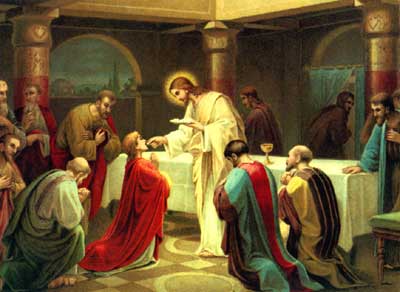
Posted in WDTPRS | Tagged , ,
6 Comments

WDTPRS: Corpus Christi – Super Oblata – Eucharist: sign of unity, flashpoint of discord

The Roman calendar observes Corpus Christi today.  In another place I drilled into the Collect.   Let’s look at the Super Oblata, or “Prayer over the gifts”, in the new, corrected translation called the “Prayer over the offerings”.

SUPER OBLATA (2002MR):
Ecclesiae tuae, quaesumus, Domine,
unitatis et pacis propitius dona concede,
quae sub oblatis muneribus mystice designantur
.

LAME-DUCK ICEL (1973):
Lord,
may the bread and cup we offer
bring your Church the unity and peace they signify
.

LITERAL WDTPRS TRANSLATION:
We beseech You, O Lord
graciously grant to Your Church gifts of unity and peace
which are mystically signified under offered gifts.

NEW CORRECTED ICEL (2011):
Grant your Church, O Lord, we pray,
the gifts of unity and peace,
whose signs are to be seen in mystery
in the offerings we here present.
Through Christ our Lord
.

The vocabulary of today’s prayer doesn’t drive us scratching our heads to the informative Lewis & Short Dictionary, so let’s consider what the prayer is really saying in its content.

In Thomas Aquinas’ beautiful sequence for Corpus Christi, the Lauda Sion, we hear sung, “Signs, not things, are all we see… here beneath these signs lie hidden priceless things.”  We can use this to pry open the prayer, seeking also insight from the Doctor of Grace, St. Augustine of Hippo (+430).

Augustine looks at the Eucharist in his monumental City of God (ciu.) Book X where he is examining the kind of worship which is due to God (latreia).   He reminds us that God does not need sacrifices offered to Him.  We need the sacrifices.

He wrote in a letter, “God commands nothing for His own benefit but for the benefit of the person to whom He gives the command”. Sacrifices are, “…signs of gifts God has bestowed either for imbuing the soul with the virtues or for attaining eternal salvation, and by the celebration and performance of them we carry out acts of piety useful to us, not to God” (ep. 138.6).

The outer physical actions of sacrifices are signs of something else: “The visible sacrifice is the sacrament, the sacred sign, of the invisible sacrifice” (ciu. 10.5).

Augustine says that in the Eucharist Christ, who is the mediator, accepts the Church’s sacrifice “in the form of God”.  However, Christ, “in the form of a servant” also is the sacrifice He receives.  Christ is both priest and victim who commanded the Church to continue this sacrifice in the celebration of the Eucharist, the sacramental sign.  “

The Church, being the body of which He is the Head, learns to offer itself through Him” (ciu. 10.20).  Christ’s Sacrifice unifies Christians in offering themselves to God through their participation in the inner reality perceived in outward sacramental signs, sacramenta.

For Augustine sacramenta fall into three categories:

1) the rites of the Law and those commanded by Christ;
2) symbolic figures or types, such as the Red Sea which was parted;
3) mysteries like the Trinity or resurrection.

This three-fold division wasn’t Augustine’s idea.  Augustine did, however, give a definition for a sacrament.

In ep. 138.7 he says “signs are called sacraments when they have reference to divine things (ad res divinas pertinent)”.

For Augustine, in his theory of signs, a sign is an intermediary which causes something to enter into our thoughts.  Signs do not distract from the truth of things.  They lead us away from the sign itself onward to something greater, the res.  Similarly, a sacramentum which is a rite leads us beyond the rite itself.

Later, in Medieval theological reflection founded on Augustine, we get the tripartite distinction of sacramentum (the outward sign of a greater spiritual reality) and res (the invisible reality it points at) and res et sacramentum (in the Eucharist at least, how Christ is truly present).   Augustine, however, considers only sacramentum and res.  This is why some people get confused into thinking that when Augustine speaks about the Eucharist in terms of sacramentum he thought they were merely symbols and not really the Body and Blood of Christ.

On the contrary, Augustine in an Easter Sunday sermon (s. 229.2), describes to newly baptized Catholic neophytes what is going on in the Eucharistic section of the Mass to which they were not previously admitted.  He describes the effect of the consecration by the priest’s “word” (i.e., the Eucharistic Prayer):

“And from there we come now to what is done in the holy prayers which you are going to hear, that with the application of the word we may have the Body and Blood of Christ.  Take away the word, I mean, it’s just bread and wine; add the word, and it’s now something else.  And what is that something else?  The Body of Christ, and the Blood of Christ.  So take away the word, it’s bread and wine; add the word and it will become the sacrament.  To this you say, Amen.  To say Amen is to add your signature.”

Most of the time when discussing the Eucharist Augustine doesn’t dwell on the change from bread and wine to Christ’s Body and Blood.  Instead, he moves quickly to talk about what the Eucharist means to us and what effect it has, that is, our unity with Him and in Him with each other in the Body of the Christ the Church.

This is the gift of the Eucharist, what later theology called res tantum whereas the Real Presence would be called res et sacramentum.  The res tantum is the effect in us.

Let’s listen to another Easter sermon (s. 229A, 2).   Remember, there were stenographers writing his words down as he preached and this is exactly how we have his sermons today!  Augustine compares the people of his flock, especially those just baptized during the night, to the Eucharistic species:

“What you can see on the Lord’s table, as far as appearance of the things goes, you are also used to seeing on your own tables; they have the same aspect, but not the same value.  I mean, you yourselves are the same people as you used to be; you haven’t brought us along new faces, after all.  And yet you’re new; the same old people in bodily appearance, completely new ones by the grace of holiness – just as this too is new.  It’s still, indeed, as you can see it, bread and wine; come the consecration, that bread will be the Body of Christ, and that wine will be the Blood of Christ.  This is brought about by the name of Christ, brought about by the grace of Christ, that it should continue to look exactly like what it used to look like, and yet should not have the same value as it used to.  You see, if it was eaten before, it would fill the belly; but now when it’s eaten it nourishes the spirit.”

Augustine then explains that on many altars there can be many loaves but in reality all are just one loaf.  So too in the Church there are many people but one Body of Christ (cf. 1 Cor 12:27).

“What you receive is what you yourselves are, thanks to the grace by which you have been redeemed; you add your signature to this, when you answer Amen.  What you see here is the sacrament of unity.”

Thousands of altars.  Millions of Hosts.  Thousands of chalices.  Millions of faithful.  One Christ.

The Eucharist is our sign of unity.

It is also the flashpoint of division.

Pride is the catalyst of discord.

Many kernels of grain go into the one bread offered at the altar for the renewal of Christ’s Sacrifice.

Many grapes make one wine.

Wheat and grapes, the individual elements, are crushed and brought into a deeper unity.

Humility is the catalyst of unity.

Posted in WDTPRS |
5 Comments

NYC, Manhattan 23 June: Corpus Christi with procession

Today, Thursday, 23 June at 6 pm there will be a Solemn Mass in the Extraordinary Form, followed by a procession with the Blessed Sacrament, in Manhattan, NYC, at the Church of the Holy Innocents (128 W 37th – btw Broadway and 7th).

If you are in the area, please consider going.

There should be beautiful polyphony and the famous Gregorian chants for the day, not to mention the Eucharistic Procession in the streets of Manhattan.

For the Music click HERE.

The procession will be followed, of course, by Benediction of the Blessed Sacrament.

There will be a reception in the church hall afterward.

If things go as I hope, I may be there.  If you are in the region, you should be too!

Pray for good weather!

If during Holy Thursday in the Sacred Triduum we commemorated the institution of the Eucharist, we also were more focused on the Passion of the Lord.  On Corpus Christi Thursday we give the Lord in the Blessed Sacrament more focused honor.

Posted in The Campus Telephone Pole | Tagged , , ,
9 Comments

Corpus Christi no frills Matins (Breviarium Romanum)

No frill Matins for Corpus Christi with the Roman Breviary.  Perhaps the weary brethren can make use of it.  The hymn is particularly nice.

You can follow on Divinum Officium or your iPhone app BrevMeum.

In recording, I had a few interruptions, but it should all be there.

Posted in PRAYERCAzT: What Does The (Latin) Prayer Really Sound L |
Comments Off on Corpus Christi no frills Matins (Breviarium Romanum)