Te Deum

A biretta tip   o{]:¬)  to Jeffrey Tucker over at The Chant Cafe.

Here is a version of the Te Deum.  It is  the Maîtrise of Notre-Dame in Paris (I have the CD).

If you have headphones on, you will want to turn the volume down.  No… really.

Otherwise, especially if you have big speakers, turn the volume up!

Play video

Posted in Just Too Cool | Tagged , , ,
22 Comments

Archbp. Nichols about the upcoming ordination of former Anglican bishops

I found this on the site of The Catholic Herald:

A Statement from Archbishop Vincent Nichols
President of the Catholic Bishops’ Conference of England and Wales

THE ORDINATION TO THE CATHOLIC PRIESTHOOD OF THREE FORMER ANGLICAN BISHOPS AND THE ESTABLISHMENT IN ENGLAND AND WALES OF A PERSONAL ORDINARIATE

On Saturday 15th January, it will be my privilege to ordain John Broadhurst, Andrew Burnham and Keith Newton to priesthood in the Catholic Church. This ceremony will take place in Westminster Cathedral.

On or before this date, I expect the Holy See to announce the establishment of the first Ordinariate for groups of former Anglicans and their clergy who seek full communion in the Catholic Church. The three men ordained on Saturday will be the first priests of this Ordinariate.

This is a unique moment and the Catholic community in England and Wales is privileged to be playing its part in this historic development in the life of the Universal Church.

We offer a warm welcome to these three former bishops of the Church of England. We welcome those who wish to join them in full communion with the Pope in the visible unity of the Catholic Church. We recognise the journey they are making with its painful departures and its uncertainties. We salute their depth of searching prayer and the desire which leads them to seek to live within the community of the Catholic Church under the ministry of the Bishop of Rome. This is the faith we share.

We are deeply grateful for the depth of the relationship which exists here between the Catholic Church and the Anglican Communion. This firm, positive and on-going relationship is the context for Saturday’s important initiative. We are grateful, too, for the sensitive leadership of the Archbishop of Canterbury. He graciously acknowledges the integrity of those seeking to join the Ordinariate and has assured them of his prayers. This is the noble spirit of true ecumenism between the followers of Christ.

Pope Benedict has made clear his own intentions: that the Ordinariate can serve the wider cause of visible unity between our two churches by demonstrating in practice the extent to which we have so much to give to each other in our common service of the Lord. With this in mind he describes this step as ‘a prophetic gesture.’

With great trust in the Lord, we look forward to Saturday, to the new phase of Church life it brings and we ask God’s blessing on its future development.

Posted in SESSIUNCULA | Tagged ,
7 Comments

CDW response to a dubium concerning role of priests and deacons at the Doxology

Also from the Newsletter of the USCCB’s Committee for Divine Worship, there was published a response to a dubium sent to the CDW in Rome.

My brother priests who are interested in concelebration may be interested in this:

Role of Concelebrating Priests at the Doxology of the Eucharistic Prayer

In this dubium, the question concerned the role of concelebrating Priests and whether they were permitted to take up the various chalices from the altar before the final doxology of the Eucharistic Prayer. Quoting from the General Instruction of the Roman Missal, the Congregation emphasized the proper role of the Deacon in holding up the chalice next to the Priest for the final doxology: “At the final doxology of the Eucharistic Prayer, the deacon stands next to the priest, holding the chalice elevated while the priest elevates the paten with the host, until the people have responded with the acclamation, Amen” (no. 180).

According to the Congregation’s response, “Therefore, the use is reprobated where all or many concelebrants at the altar proceed to take up the chalices at the time of the final doxology. Rather, it is the duty of the celebrant, or the deacon, or one concelebrant to elevate the [principal] chalice.” It is presumed by extension that the same could be said regarding the elevation of multiple ciboria or patens by various concelebrants. Given the response and the principles of the General Instruction of the Roman Missal, only the main paten and the main chalice are to be elevated by the celebrant assisted by the Deacon, or in the absence of a Deacon, by a single concelebrant.
(March-April 2009, pg. 171)

Posted in "How To..." - Practical Notes | Tagged , ,
15 Comments

A note about music from the USCCB’s Committee for Divine Worship

In the latest newsletter of the USCCB’s Committee for Divine Worship there is a focus on the Holy Father’s Post-Synodal Exhortation Verbum Domini, concerning Sacred Scripture.

I found this interesting:

In times of praise and thanksgiving, and in times of sadness and anxiety, the word of God always has something to say. “[W]ith a view to making the People of God ever more familiar with the word of God in the context of liturgical actions or, in any event, with reference to them” (no. 64), the Holy Father offers several other liturgical suggestions for highlighting the transformative power of the word and letting it enrich our lives:

Celebrations of the word of God are encouraged, particularly as part of liturgical formation, as preparation for the Sunday Eucharist, and as a time to pray and meditate on sacred Scripture. These types of celebrations are particularly recommended during Advent, Christmas, Lent, and Easter (see no. 65).

The celebration of the Liturgy of the Hours, particularly Morning Prayer and Evening Prayer, ought to become more widespread among the lay faithful. Pastors should give emphasis to such public celebrations, particularly the First Vespers of Sundays and solemnities. Clergy and religious communities should promote the Liturgy of the Hours with the participation of the lay faithful (see no. 62).

  • Whether during the Liturgy of the Word at Mass or at other occasions, the proclamation of the word of God “is to be celebrated in such a way as to promote meditation” (General Instruction of the Roman Missal, no. 56). Proclaiming the word of God also involves silence afterward, in order to allow the Holy Spirit to transform us in the Lord. In the Mass, sacred silence should take place before the Liturgy of the Word begins, after the First and Second Readings, and after the homily. [Frankly, I avoid too much silence after my sermons, lest people get the idea that I and what I say are the true focus.] Pastors are exhorted to foster moments of recollection so that the word of God can truly take root in people’s hearts (see no. 66).
  • In the selection of songs for the liturgy, “[p]reference should be given to songs which are of clear biblical inspiration and which express, through the harmony of music and words, the beauty of God’s word” (no. 70). These words should give new impetus to composers, and also inspire all to make greater use of Gregorian chant, [I am grateful for the reference to Gregorian chant.  But this is really too little, no?  Sacrosanctum Concilium is pretty clear that Gregorian chant is THE music par excellence.] “songs handed down to us by the Church’s tradition” (no. 70). [Consider with regret and horror what some people will claim are “traditional songs”.] The 2007 guidelines document of the USCCB, Sing to the Lord: Music in Divine Worship, can provide help in song selection.
  • In churches, the ambo should be paid special attention through its clearly visible placement, beautiful design, and aesthetically harmonious decoration with the altar. Also, if possible, the sacred Scripture (either a Bible or book of the Lectionary) could be displayed in a place of honor in the church, even outside of liturgical celebrations. This placement should not compete, however, with the centrality of the tabernacle (see no. 68).
  • Parishes should provide “every possible practical assistance” to those who are visually and/or hearing impaired, so that they too may actively participate in the liturgy and “experience a living contact with the word of the Lord” (no. 71).

Brick by brick, my friends, brick by brick.

Start forming Gregorian chant scholas.

Posted in Brick by Brick | Tagged ,
24 Comments

A Catholic (“Patriotic”) parish in China

The Holy Father spoke about religious liberty in his recent “state of the world” speech to the diplomatic corps.

I now want to draw your attention to an article in The Pilot, the newspaper of the Archdiocese of Boston.

Think about what our brothers and sisters in China face.  This concerns a parish in China that belongs to the “Patriotic” Church, not the Church in union with Rome.  That said, there are some regions in China where relations are closer with Rome than in regions.  The situation is not uniform across China.

Christmas in Jilin
By Neil W. McCabe

Editor’s note: This report was filed by Pilot reporter Neil McCabe, currently on active duty with the U.S. Army, who made a trip to China while on leave during the Christmas Season.

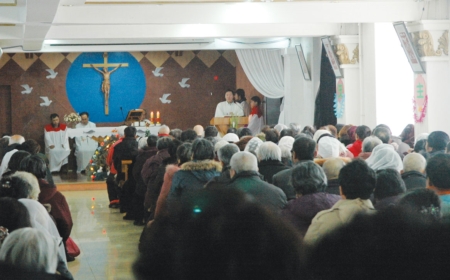
A Catholic ("Patriotic") parish in ChinaDespite bracing cold, Chinese worshipers in Jilin City, a city in the region once known as Manchuria, marked the birth of our Savior at Masses celebrated at Sacred Heart of Jesus Christ Church, a majestic structure with its doors facing the mighty Songhua River.

Sacred Heart is the only Catholic church in the city of 4 million and its parish community has grown in recent years to more than 5,000 believers, said Father Guo Sheng “Joseph” Wang, a parochial vicar at the parish and the director of its social services ministry.

Father Wang said for Christmas there were three Masses: Christmas Eve, Midnight Mass and Christmas Day.

Because of harsh temperatures that reached only 10 degrees during the day and lows of 15 degrees below zero at night, Father Wang said the Masses could not be held in the unheated 1926-built church because of concerns for elderly worshipers. Instead, the Masses were held in the parish hall chapel.

At the Christmas Day Mass, the chapel was packed with more than 500 congregants, who crowded the pews, aisles and open areas in the back. There were also more than two dozen parishioners lined up at the confessional.

When it was built by French missionaries, Sacred Heart was the local cathedral because Jilin was then a provincial capital. In the 1994, the diocesan seat was moved to Changchun, the current capital of Jilin Province. During the Cultural Revolution, 1966 to 1976, the church was closed and damaged. In 1980, it was allowed to reopen as part of the officially recognized Catholic Church in China. [Not the “underground” Church.]

Beginning in the 1990s, the government has funded repairs to both the church building and the other parish buildings.

The church and its surrounding fenced-in campus comprise a rectory, a parish hall and a performance stage along with ancillary storage sheds. Across the street behind the church, there is a health clinic for seniors.

During his August 2010 visit to the China, North Korean leader Kim Jong Il took a short tour of the church, where he said his father once sought sanctuary from the Japanese authorities during the Second World War. It is also a short walk from the Yumen Middle School, the elite Marxist school his father attended.

Father Wang said he has been a priest in Jilin Province since 1997. He grew up in Jilin City and was raised in a Catholic family. As a young man he was pressured by his father and a friend of his father to study for the priesthood, but he always resisted. Finally, he attended a religious festival and was overcome with the feeling that in fact it was his calling to be a priest.

Although he continued to resist it, he prayed for six months until accepting his vocation and he said he was admitted to Jilin Seminary in a class of 13 seminarians.

Since his ordination, Father Wang has had four assignments. For his first three years, he taught at the seminary, before his three stints at country parishes. He began his tenure at Sacred Heart of Jesus Christ Church Jan. 28, 2008.

At the parish, Father Wang shares duties with three other priests. There are two American Maryknoll priests who teach at the city’s Bei Hua University. [With the Patriotic Church? Interesting.]

“Our social services ministry will mark its fifth year in operation in February,” he said. He is the second director. “The vision for Tianji Social Services is to promote a warm, loving, peaceful and harmonious community for everybody”

In addition to raising the profile of the city’s Catholic population, the priest said the program provides student scholarships, youth activities and a home visit ministry for the elderly, poor families and those struggling with HIV/AIDS and other diseases.

Father Wang said the Church in Jilin Province and in the city is growing, but not quickly. In the province itself, there are more than 40 individual houses of worship for roughly 80,000 Catholics.

One of the 5,000 parishioners of Sacred Heart is 70-year-old Maria Qiao, who said she was baptized five years ago.

“I had a friend who was a Catholic and she told me to come to the church with her and see how having a relationship with God could help me,” she said.  [Never underestimate the power of a simple invitation.]
Posted in Our Catholic Identity | Tagged ,
12 Comments

More social engineering: passport applications

passportVia Fox News:

‘Mother,’ ‘Father’ Changing to ‘Parent One,’ ‘Parent Two’ on Passport Applications

By Todd Starnes
Published January 07, 2011

The words “mother” and “father” will be removed from U.S. passport applications and replaced with gender neutral terminology, the State Department says.

“The words in the old form were ‘mother’ and ‘father,’” said Brenda Sprague, deputy assistant Secretary of State for Passport Services. “They are now ‘parent one’ and ‘parent two.’”

A statement on the State Department website noted: “These improvements are being made to provide a gender neutral description of a child’s parents and in recognition of different types of families.” The statement didn’t note if it was for child applications only.

The State Department said the new passport applications, not yet available to the public, will be available online soon.

Sprague said the decision to remove the traditional parenting names was not an act of political correctness.

“We find that with changes in medical science and reproductive technology that we are confronting situations now that we would not have anticipated 10 or 15 years ago,” she said.

Gay rights groups are applauding the decision.

[…]

Read more there.

Posted in The future and our choices | Tagged
34 Comments

WDTPRS POLL: The Sign of Peace in the Novus Ordo

Choose the answer closest to your thought and then give your comments in the combox below.

You do not have to be registered to vote in the poll.

Let’s get a good response!  Perhaps other bloggers will help?

What do you think about the "sign of peace" during Mass in the Ordinary Form?

View Results

Loading ...
Posted in POLLS | Tagged
105 Comments

QUAERITUR: Avoiding the Novus Ordo “sign of peace”

From a reader:

My wife and I attend an Extraordinary Form Mass almost exclusively, but at times, whether due to weather or circumstance, are forced to attend the closer, Novus Ordo parish. As those go, it’s very good, but I digress. My question is whether it is mandatory to break from prayer or contemplation to shake hands during the time at which the priest asks us to do so. I find it terribly disturbing to have to greet everyone around me during the Canon, and generally try to just keep my eyes down, in prayer, during this time. I do not wish to offend anyone, however, and I surely do not wish to violate my obligations at Mass. It is simply that my style, sense of propriety and Asperger’s cause me to really prefer otherwise.

Am I out of line to just stand silently with my eyes closed? Is this acceptable? Perhaps in bad taste?

I am glad you are willing to go to a Novus Ordo Mass even though it is not your preferred form.

First, be clear about something.  The invitation to make a “sign of peace” is itself an option in the Novus Ordo, left to the discretion of the priest.  The priest gives a “sign of peace” as part of the rubrics.  He must do it.  The invitation for others to do so is an option.

Unfortunately, the option has become the norm, so much so that most people think it is obligatory.

Too bad for those who really don’t like this feature of the Novus Ordo.  They seem to have no rights regarding this rite.

After that, I suppose there is the issue of “manners”, involved here.  Most people in the pews simply won’t understand why you might want to pray or not grip someone’s clammy, germ-filled hand at this point during Mass.   You run the risk of being, unintentionally, rude, by declining that honor.  You have to decide what you think about that.

I am sure that some people will chime in saying that they fold their arms, they ignore people, they cough into their hand, etc., and they may even say this with a measure of glee with which we are supposed to be as impressed as they are with themselves.

In other places I have written that perhaps one way to see the TLM and the Novus Ordo is that the former is the grown-up Mass and the other is like the … you know.  Consider where you are, and make the necessary changes in your head to adapt to the situation.

Here is one way to help you get through it.

I am sure most parents – just as an example – when feeding their skeptical toddlers with the flying airplane spoon or the choo-choo, even tasting the nasty goo in the spoon with something like exemplary appreciation, don’t actually like the goo in the spoon.  They would prefer a steak and glass of Bonarda.  But they don’t, therefore, begrudge the choo-choo spoon to little stupor mundi just because they personally want grown-up food.

You adapt according to the occasion looking forward to when all that will be unnecessary.

Sometimes it isn’t possible to sit far enough from people so that you don’t have to do this.

In that case you should probably just bite the bullet and do it, remembering that you will be back at a TLM soon.

And to sooth your irritated nerves, have some Mystic Monk Coffee when you get home.

Posted in "How To..." - Practical Notes, ASK FATHER Question Box | Tagged
76 Comments

An eastward facing observation

Yesterday the Holy Father celebrated Holy Mass for the Feast of the Baptism of the Lord in the Sistine Chapel.

Not a peep from the usual corners about ad orientem worship.

It’s a given.

Therefore,…. it is time for the next step, your Holiness.

What’s next?

Posted in Brick by Brick | Tagged
27 Comments

Card. Burke, “home” in St. Louis

Raymond Card. BurkeJust a nice email:

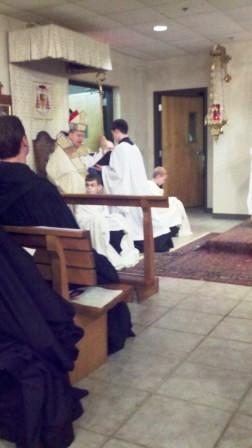
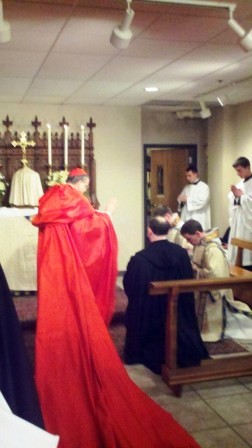
His Eminence, Raymond Leo Cardinal Burke is in St. Louis in what he described as “home”.  He is here to give a retreat to (in his exact words), “our beloved seminarians”.  I presume he uses the word “our” since he noted in his homily that he takes great pride in the fact the  Holy Father named him “archbishop emeritus of St. Louis”.

Aside from the public Mass at the Cathedral Basilica of St. Louis today, at the invitation of Archbishop Carlson, his only other two public appearances are at the two  oratories who celebrate exclusively the Extraordinary Form of the Roman Rite.

Raymond Card. BurkeI am a former parishoner of the Oratory parish of Ss. Gregory and Augustine ( I now live in Chicago), so  I returned for the event at “Greg n’ Gus”.  I thought you would like to see  the pictures from Friday  evening. The temporary chapel was packed with parishoners.  The service was began with a  solemn entrance, vesting at the altar, sermon, Benediction, Litany of the  Most Sacred Heart of Jesus, and prayers  to Our Lady of Walsingham.
The parish is adminstered by the English Benedictine Monks of St. Louis Abbey and the rector is The Rev. Dom Bede Price, MA (Oxon).  The monastic community was present, provided the schola, served as mc’s and one as subdeacon.  The abbot, the Right Rev. Dom Thomas Frerking, PhD (Oxon) attended in choir and greeted the cardinal at the reception.

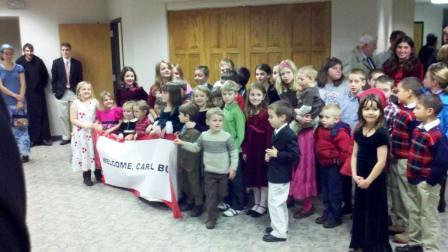
After Benediction, there  was a reception in the hall where  the children of the parish warmly greeted him first.  The gift  of a golden mitre was presented by the very first child baptized at the oratory.  His  Eminence  stayed  until 11pm until he finished greeting everyone who wanted to  see him.

Card. Burke, "home" in St. Louis

Posted in Just Too Cool | Tagged
18 Comments