The site of the Archdiocese of Denver has a story by George Weigel about St. Jeanne Jugan. I confess I don’t know much about her. It would be nice to know
I happily send a biretta tip to engaging Creative Minority Report for this. o{]:¬)
By George Weigel
During the brutally hot summer of 2003, thousands of French vacationers remained on holiday rather than returning home to bury their recently deceased parents, who had died from the extraordinary heat and were being stashed in air-conditioned storage lockers. Those acts of filial impiety cast into sharp relief the October canonization of Jeanne Jugan, foundress of the Little Sisters of the Poor.
Born during the virulently anti-Catholic French Revolution, Jeanne Jugan learned early in her life that fidelity to Christ and his Church could be costly. A history of the period of her childhood sums things up neatly: “In spite of the persecution, the people of Cancale kept the faith. During dark nights, in an attic or a barn, or even in the middle of the countryside, the faithful gathered together, and there in the silence of the night, the priest would offer the Eucharist and baptize the children. But this happiness was rare. There were so many dangers.”
Jeanne Jugan knew poverty as well as persecution, and developed a marked sensitivity to the humiliation that those who have fallen through the cracks of society’s net of solidarity can feel. She declined an offer of marriage because, as she put it, “God…is keeping me for a work which is not yet known, for a work which is not yet founded.” That work came into clear focus when, at age 47, [… think about that…] she met an elderly, blind and sick woman, whom she took into her care; from that seemingly random encounter was born a tremendous work of charity. The congregation of women religious she founded dedicated itself to the care of the poor and elderly—and supported itself by begging, with the foundress, Jeanne Jugan, as chief beggar. The Little Sisters of the Poor spread rapidly throughout Europe, America and Africa, but the going was never easy for Jeanne Jugan.
In 1843, Jeanne Jugan’s re-election as superior was quashed by the community’s priest-advisor, Father Augustin Marie Le Pailleur. Refusing to contest what others would have deemed an injustice (but which she thought to be the will of God), Jeanne Jugan accepted this curious decision and went on the road, supporting her sisters by begging. For the last 27 years of her life, she lived at the order’s motherhouse in retirement, again according to the orders of Father Le Pailleur; her role as foundress was never acknowledged during her lifetime. Yet the novelist [get this] Charles Dickens could write, after meeting Jeanne Jugan, that “there is in this woman something so calm, and so holy, that in seeing her I know myself to be in the presence of a superior being. Her words went straight to my heart, so that my eyes, I know not how, filled with tears.”
To enter a house of the Little Sisters of the Poor today is to recapture what Dickens experienced. Elderly men and women with no one else to care for them are given exquisite attention; the dignity of every patient is honored, no matter how difficult that dignity may be to discern amidst the trials of senility and disease. The Little Sisters of the Poor and their patients are living reminders that there are no disposable human beings; that everyone is a someone for whom the Son of God entered the world, suffered and died; and that we read others out of the human family at our moral and political peril. [our moral and political peril… This is why we cannot, with the Kmiec Catholics, the Kennedy/Kerry/Sebelius/Pelosi/Biden Catholics, think that we can leave the unborn as secondary to other social projects.]
Yet that is the temptation facing the United States, and every other affluent society confronting a graying population, longer life expectancies, and spiraling medical costs. Where this temptation can lead is brutally displayed in the Netherlands, where euthanasia has been legal for years; and as the late Father Richard John Neuhaus said of such travesties as the Dutch “death with dignity” laws, what is permitted will soon become mandatory. That is precisely what has happened in Holland and indeed wherever euthanasia is legally permitted.
St. Jeanne Jugan, Sister Marie of the Cross in her religious life, is thus a powerful—and badly needed—intercessor for all who would defend the gift of life from conception until natural death.
George Weigel is Distinguished Senior Fellow of the Ethics and Public Policy Center in Washington, D.C. Weigel’s column is distributed by the Denver Catholic Register, the official newspaper of the Archdiocese of Denver.
Fine article.
Thank you, St. Jeanne Jugan.
A miracle through the intercession of St. Jeanne Jugan:
Cure of Doctor Edward Erwin GATZ
of an Adenocarcinoma of the Oesophagus
Doctor Edward GATZ is a retired anaesthetist who lives in Omaha, Nebraska, in the United States of America. He was born on 19th April 1937 in O’Neil, Nebraska.
At the age of 51 he began to feel dyspeptic (digestive) problems with a loss of weight and the appearance of growths on his hands. The diagnosis was interpreted as a paraneoplastic syndrome due to an occult cancer.
An endoscopy on 9th January 1989 revealed the presence of a cancerous lesion in the lower part of the oesophagus. Dr Gatz was hospitalised at the Mayo Clinic in Rochester, Minnesota, and had surgery on 18th January 1989 for a partial oesophago-gastrectomy. The biopsy showed a 3rd degree adenocarcinoma, and the examination specified that there was an aneuploid tumour. Doctor Gatz was advised to have chemotherapy but he refused. He also refused to have radiotherapy.
On the day that Dr Gatz’ cancer was diagnosed his wife spoke with a priest, Fr Richard D McGloin SJ to tell him about her husband’s illness and to seek some consolation. This priest encouraged Mrs Gatz to pray, and gave her the novena prayer to Blessed Jeanne Jugan, whom he knew through the Little Sisters of the Poor, since he had formerly been their chaplain at their Home in Milwaukee, and whom he held in veneration. Along with him, Mrs Gatz began to pray to Jeanne Jugan every day, even after the check-up on 8th March.
In fact, the first endoscopic examination took place on 8th March 1989. The biopsy showed the presence of chronic gastritis, but no signs of recurrence of the tumour.

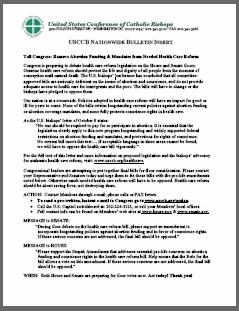
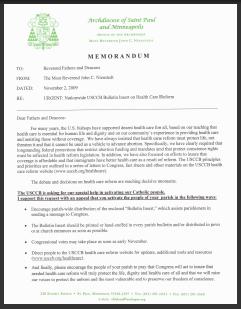 Here is the meat of the PDF the Archbishop sent out:



 fac on Daily Rome Shot 1118 – Paddywhack!: “Speaking of the disputatio back on October 31st between Archbishop Vesco and Bishop Barron (Vesco saying the Catholic Church was…”




























