Report on Fr. Reginald Foster

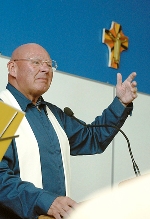
Report on Fr. Reginald FosterA couple weeks back I was in Milwaukee and I went to visit the famed Latinist, Fr. Reginald Foster, OCD.     He has been recovering from a long and what was a very life-threatening illness.  Fr. Foster has made simply amazing progress and it is possible that he will return to Rome.

Fr. Foster is not able to get around a bit with walker and he has physical therapy every day.  The staff there clearly thinks he is great, as do other people staying there and families who visit them.  He had, as he always did, STACKS of letters received and also answered, waiting to be mailed.  His characteristic colored pens were lined up next to the stack, of course.

One of the things Fr. Foster told me is that his superiors at the Teresianum, the HQ of the Carmelites on the Gianicolo, want him to have space there, at the institute, so that he can teach Latin.   This is GREAT news for students of Latin everywhere.  I hope this comes to pass.

Fr. Foster told me by phone today that there is an article about him in the Archdiocesan newspaper of Milwaukee, The Catholic Herald.  It is by CNS Rome correspondent John Thavis.

Recovering Milwaukee priest leaves hole in Latin office in the Vatican

Written by John Thavis, Catholic News Service Friday, 18 September 2009 09:30

VATICAN CITY (CNS) – The Vatican’s Latin letters office has been struggling lately with a big hole in its roster – U.S. Father Reginald Foster, considered by many the world’s finest Latinist, has been away for more than a year.

Father Foster, a 69-year-old Carmelite and one of the Vatican’s most colorful characters, [we need not limit that to the Vatican!] is recuperating from health issues in his native Milwaukee. He said in a phone interview in September that he’s slowly getting better and hopes to return to Rome, but doesn’t know when that will happen.

For now, the baton has been provisionally passed to another American, Father Daniel Gallagher, a Michigan native who was once one of Father Foster’s best students. He has been working half-time in the Latin office since June.

"Of course, I’m not anywhere near worthy to stand in for him. But then again, nobody is. He’s one of a kind," Father Gallagher said. People in the office are still anxiously awaiting Father Foster’s return, he added.

When Father Gallagher began filling in for Father Foster, he found his office furnished as sparsely as a monastic cell – a phone on the floor, a photo of the pope on the wall and a Lewis and Short Latin dictionary on the desk. Father Gallagher said he’s left that pretty much unchanged.

Father Foster came to Rome to study in the 1960s and was summoned to the Vatican in 1969 when word of his academic achievement spread. By then, the office once known as Secretary for Briefs to Princes had been renamed more prosaically as the Latin Language Department of the First Section of the Secretariat of State. No longer headed by a cardinal, it had lost some of its luster, but it remained the real communications hub at the Vatican.

Over the last four decades, even as Latin declined as the common language of the church, the Latin section has continued to translate and publish virtually everything that comes off the pen of the pope and much more – everything from congratulatory letters to papal bulls. Father Foster did much of the heavy lifting, but he never really adopted the Roman Curia style. For one thing, he showed up for work in a trademark blue workman’s outfit, purchased annually at J.C. Penney.

Today, the office’s seven Latinists have a steady stream of work, and sometimes they fall behind. When Pope Benedict XVI’s latest encyclical, "Charity in Truth," was published in July, for the first time in memory no Latin text was released. The Latin team was still working on the document, and the Latin version was published only at the end of August – after it had been sent by DHL to Father Foster for corrections.

Although it was reported that the delay in the Latin translation slowed down the encyclical’s release, insiders say that wasn’t the case. That in itself confirmed what everyone at the Vatican has known for some time: that although the Latin version of documents is still considered "definitive," it is not being used as the basic text for translations into other languages. That role has been taken over by Italian or English.

Pope Benedict has spoken about the importance of Latin in the church, and the Vatican is committed to keeping its Latin letters section. But church officials know that a renaissance in Latin depends largely on teachers, and that’s where Father Foster has been especially missed in Rome.

Father Foster began teaching in 1973, and his were not ordinary classes. Known as "Reggie" to his students, his approach was to throw them into the language and let them swim, disdaining grammatical textbooks, tests and rote memorization. His Latin was a living language, and he reminded anyone within earshot: "Latin is not reserved for experts! Every bum and prostitute in ancient Rome spoke Latin!"

Father Foster’s method was unorthodox in other ways. He would announce to his increasingly large classes at the beginning of the academic year that if any students were there only to fulfill an academic requirement, he’d sign whatever piece of paper they needed and they could leave. He didn’t want them wasting valuable space in his classroom.

Nor was he bothered that a good percentage of his students were not registering and paying for his classes at the Pontifical Gregorian University. That led the Gregorian to bid goodbye to Father Foster and his small army of students in 2006. Undaunted, the Carmelite found a benefactor and a headquarters for a new Latin academy in central Rome. Meanwhile, his summer classes held "sub arboribus" (under the trees) drew Latin teachers from all over the world.  [And I was among them from the early ’80’s on!]

Father Foster’s serious health problems began when he broke his thighbone in 2008. After a fitful recovery, he was hospitalized with an infection early in 2009 and had heart surgery. He returned to Milwaukee last spring, where he has been in physical rehabilitation.

His students have suffered his absence, waiting for news and hoping for his return. Carmelite superiors, meanwhile, have offered to host his international academy at the Teresianum theological faculty in Rome, which is also Father Foster’s residence. That’s something Father Foster wants to happen, the sooner the better.

"I’m very excited about that. My dream is to get back and start teaching again," he said.


I am sure you, with me, will say a prayer for Fr. Foster’s continued recovery.

Nulli secundus!

Posted in SESSIUNCULA | Tagged
13 Comments

Italian edition of Mosebach’s “The Heresy of Formlessness”

I Italian edition of Mosebach's "The Heresy of Formlessness"understand that at last the black ball imposed by Italian published has finally been lifted on Martin Mosebach’s The Heresy of Formlessness. 

If you haven’t read this book, I recommend it.  There are wonderful insights herein even for the non-scholar.  Good straight talk with common sense and from the heart as well as the head.

Conclusion from the section called "Does Christianity need a liturgy?" (op.cit. 72-73):

We know that tradition’s mysterious work, making present things that are long past, has been painfully disturbed. Things that are sacral are by definition untouchable, and this untouchability has been gravely damaged; indeed, it is being injured every day, whether by malice or folly. Even among those who will not and cannot abandon the old rite, there is a kind of reforming zeal that can only be attributed to the yearning for self-destruction that sometimes afflicts unsuccessful opposition groups. The highly charged term "pastoral" is always used when liturgical changes are to he introduced. "Pastoral" means pertaining to a shepherd’s care, but we have long become used to translating it differently: "We, the clergy, decide how much of the splendor of truth the stupid and confused lay people can take."

No one, however, who has found his way, through sacrifice and trials, to the great Christian liturgy will allow any progressive or conservative cleric to deprive him of it. We must not think of the future. The prospects for a liturgical Christianity are poor. From today’s perspective, the future model of the Christian religion seems to be that of a North American sect–the most frightful form religion has ever adopted in the world. But the future is of no concern to the Christian. He is responsible for his own life; it is up to him to decide whether he can turn away from the gaze of the liturgical Christ–as long as this Christ is still shown to us.

Intriguing?

Posted in SESSIUNCULA |
9 Comments

QUAERITUR: If I kneel for Communion, am I in rebellion?

From a reader:

I was told by a pastor in the Dallas Diocese today that I was in rebellion because I genuflected before I received Communion at his Novus Ordo church.  He also criticized those few who knelt for Communion.  He stated that the "norm" in the US is to stand and receive in the hand, and that anything else is rebellion and an act of pride.  He stated that the point of Communion was to "build community," and thus we should all do the same thing – to genuflect or kneel somehow violates the spirit of that community, in his mind. 
 
Is he right?  Could those who kneel or genuflect at Communion reasonably be interpreted as being in rebellion for those practices?

You might offer to that priest a copy of the CDW’s 2004 Redemptionis Sacramentum:


[90.] “The faithful should receive Communion kneeling or standing, as the Conference of Bishops will have determined”, with its acts having received the recognitio of the Apostolic See. “However, if they receive Communion standing, it is recommended that they give due reverence before the reception of the Sacrament, as set forth in the same norms”.

[91.] In distributing Holy Communion it is to be remembered that “sacred ministers may not deny the sacraments to those who seek them in a reasonable manner, are rightly disposed, and are not prohibited by law from receiving them”. Hence any baptized Catholic who is not prevented by law must be admitted to Holy Communion. Therefore, it is not licit to deny Holy Communion to any of Christ’s faithful solely on the grounds, for example, that the person wishes to receive the Eucharist kneeling or standing.

[92.] Although each of the faithful always has the right to receive Holy Communion on the tongue, at his choice, if any communicant should wish to receive the Sacrament in the hand, in areas where the Bishops’ Conference with the recognitio of the Apostolic See has given permission, the sacred host is to be administered to him or her. However, special care should be taken to ensure that the host is consumed by the communicant in the presence of the minister, so that no one goes away carrying the Eucharistic species in his hand. If there is a risk of profanation, then Holy Communion should not be given in the hand to the faithful.

If you are deeply concerned about this, you might write to the local bishop and ask him if he agrees with the priest. Ask him if you are in rebellion because you desire to kneel for Communion.

You might also ask the bishop if he agrees that the point of Communion is to "build community".

If you write, you might want to consider some of my tips for writing such a letter.

Finally, I think we should avoid terms like "Novus Ordo church".  A church is a church is a church.  Some are more or less suited to sacred rites, but I think that sort of distinction is unhelpful – even though it may simply and innocently be used to identify a place where only the Novus Ordo is used rather than the older, traditional for the Roman Rite.

Posted in ASK FATHER Question Box, SESSIUNCULA |
42 Comments

National Day of Prayer… questions

I understand that President Obama endorsed the Muslim "National Day of Prayer". 

Did he do so for the Christian "National Day of Prayer"?

Posted in SESSIUNCULA |
8 Comments

One sentence about Jews revised in U.S. Catholic Catechism for Adults

From America a useful note:

Vatican Approves Catechism Revision

The Vatican Congregation for Clergy has approved a small change in the U.S. Catholic Catechism for Adults clarifying teaching about God’s covenant with the Jewish people. The U.S. Conference of Catholic Bishops announced in late August that the Vatican had granted its recognitio to a one-sentence revision of the catechism that was approved by the U.S. bishops at their meeting in June 2008. The revised sentence reads: “To the Jewish people, whom God first chose to hear his word, ‘belong the sonship, the glory, the covenants, the giving of the law, the worship and the promises; to them belong the patriarchs, and of their race, according to the flesh, is the Christ.’” The original sentence read: “Thus the covenant that God made with the Jewish people through Moses remains eternally valid for them.” In a statement, the bishops’ conference said that “the clarification reflects the teaching of the church that all previous covenants that God made with the Jewish people are fulfilled in Jesus Christ through the new covenant established through his sacrificial death on the cross.”

Posted in SESSIUNCULA |
22 Comments

A sour article from The Tablet about possible reintegration of the SSPX

With my emphases and comments from the recent number of RU–486 (aka The Bitter Pill aka The Tablet) in the news section for…

FRANCE

Faint hopes on outcome of SSPX talks

Tom Heneghan in Paris
Christa Pongratz-Lippitt in Vienna

CARDINAL ANDRÉ VINGT-TROIS, the Archbishop of Paris, has expressed scepticism about the coming doctrinal discussions at the Vatican that will examine whether the Society of St Pius X (SSPX), which rejected the Second Vatican Council, can be reintegrated into the Church. [First, while I agree with "reintegrate" and not sure about "into the Church".  I don’t think anyone will say that they are "out" of the Church i a definitive way.   But whatever their connection with the Church, a far more manifest unity is necessary. Second, anyone can express "scepticism".  As a matter of fact, I have some skepticism about both sides of the talks: the talks will require great humility and clarity of purpose.  The talks must not be turned into something they are not.  Moreover, I can express skepticism and still be both positive and dedicated to the idea.  I think the editors and writers of RU-486 are perhaps not very positive.]

The cardinal, who is also head of the French bishops’ conference, recalled that a precondition of the discussions, clearly stated by Pope Benedict XVI, was the acceptance of Vatican II, which SSPX continues to reject. The cardinal noted that only about 20 SSPX priests had rejoined the Church since Pope Benedict began making conciliatory gestures towards the society, a fact that showed the split was not simply over liturgical questions.  [First, 20 is not nothing.  Second, while is a wonderful that individuals might want to come on their own, there is value is trying to get the whole group to come together.  Second, I don’t think we quite know what "acceptance" means, yet.  Card. Vingt-Trois is not a member of the theology commission which will talk with the SSPX about points of concern.  I am not sure that His Eminence is in the very best position to know what "acceptance" means, in reference to these talks.  The talks themselves are merely a step towards reintegration.  The theological talks about to begin will not be able to deal every possible question.]

Despite the uproar sparked by Pope Benedict’s 2007 motu proprio liberalising the use of the Tridentine Rite and the lifting of the excommunications of the four SSPX bishops, Cardinal Vingt-Trois told journalists, “There has not been a ‘tsunami’ in French religious practice. Some arrangements have been made here and there, but overall Catholic practice in France has not been profoundly modified.”  [That really isn’t anything to be very proud of, is it.  First, both John Paul II and Benedict XVI think that desire for the older forms is a legitimate aspiration.  Secondly, let’s admit that since Summorum Pontificum there hasn’t been a "tsunami’.  Is there a tsumani of Frenchmen rushing to churches on Sundays for the Novus Ordo?  What is the level of Sunday Mass attendance in France?  What? 2%?  Amd I wrong?  Is it more?  Of those who go to Mass, what percent of those would attend the older Mass if it were available?  Third, if priests aren’t able to offer the older form of Mass, is that acceptable?  It seems to me that a clergy ignorant of… incapable of celebrating their own Rite is not something to be very proud of.]

The German branch of SSPX this month said the Second Vatican Council had adopted the ideas of the French Revolution. In a sixpage article in their monthly newsletter they said the Catholic Church had become a “religion of brotherliness”. “Liberty, Equality and Fraternity are the [words] of enlighteners, freemasons, humanists and modern do-gooders which were first proclaimed by the raging masses at the French Revolution. This triumvirate of freemasonry was taken over by the Second Vatican Council albeit in a moderate form. The congruity is easy to spot. Equality means all religions are equal – that is so-called ecumenism,” they said.  [Surely that was a stupid article to print, given what is going on.  However, in very many cases what is passed of as "ecumenism" has in fact been much as was described.  I think that is rarer and rarer now.  The old generation of ecumaniacs is passing and a smarter form of ecumenism is taking form, one which is more in continuity with our Church’s teachings and traditions.]

On Wednesday evening the Swedish television network that aired an interview with SSPX’s Bishop Richard Williamson in which he denied the Holocaust, was to broadcast a follow-up documentary claiming the Vatican had known about his views before the excommunications were lifted. The state-owned channel SVT says Cardinal Walter Kasper, head of the Pontifical Council for Promoting Christian Unity, said he knew of Williamson’s views and was surprised that the Pontifical Commission Ecclesia Dei, which oversees SSPX’s relations with Rome, did not. It also says the Catholic Bishop of Stockholm, Anders Arborelius, said he passed the information on to “the papal representation”.  [All very hard to imagine.  I sure knew when I worked there.]

+ Cardinal Vingt-Trois said the French Church was planning a campaign in preparation for the fiftieth anniversary of the opening of Vatican II in 1962, to enable the French to refamiliarise themselves with the Council teachings. He said: “In the 1970s, we thought it was enough just to apply the conclusions of the Council. Now we see the Council is a fundamental part of the life of the Church, but putting it into practice demands a lot of integration work … We now have a majority of Catholics who weren’t born, or were just born, at the time of the Council.”  

Wouldn’t it be a great way to honor the anniversary of Vatican II by urging the whole of the French hierarchy to reach out in a friendly way to the priests of the SSPX and their many followers?

If Vatican II is so great… if Vatican II is so much to be embraced… if Vatican II was such a Spirit-filled moment…. if you are convinced of these things, then why not demonstrate the great benefits of embracing Vatican II by embracing those who have trouble with some of its teachings?

Posted in SESSIUNCULA, The Drill |
17 Comments

Has anyone read this book?

Has anyone read this book?Has any one read this book?

Spies in the Vatican: The Soviet Union’s War Against the Catholic Church by John Kohler?

I take conspiracy books with large blocks of salt.

However, there were some summers in Rome when my resisdence was closed for a while and I had to find a temporary billet.  Two of the places I went were the Czech College and a Ukrainian monastery on the Aventine.  In both cases it was before the fall of the Soviet Union.

In both places, people were very suspicious and reserved until they got to know me.  At the Czech College listening bugs had been found in the walls after some repairs.  The older Ukranian priests, from Ukraine, had horror stories, as did the Czechs. 

There is little doubt in my mind that there was a plan to infiltrate the Church with sleeper agents, hoping they would rise to power.  Communists were not the only ones to do this.

However, people can get a little unhinged about these tales.

If anyone has read this book and has an opinion, I would welcome insights.


Posted in SESSIUNCULA |
16 Comments

Out for a stroll

Our friend John Sonnen posted a photo of a priest in Rome who is one of the Canons of the Basilica of St. Peter.

Out for a stroll

What John didn’t mention is that this is the renowned theologian and long time professor at the Lateran University Msgr. Brunero Gherardini, 85.

Msgr. Gherardini has been involved in, for example, the cause of Bl. Pius IX and has also written about the questionable decision to say that the Anaphora of Addai and Mari is acceptable as a valid prayer for consecrating the Eucharist.

Recently, Msgr. Gherardini’s book Vatican Council II: An Open Discussion (Casa Mariana Editrice) stirred some discussion.  Gherardini is, as more and more authors these days, questioning the received school of interpretation of the Council, the event and its documents.  His book comes with a forward by H.E. Most Rev. Mario Oliveri, Bishop Albenga-Imperia diocese and an introduction by the former Secretary of the CDWDS, Archbishop Malcolm Ranjith, now in Colombo, Sri Lanka..

Msgr. Gherardini thinks that the Council must be interpreted correctly, that it has been distorted in many respects.

Hopefully, his book will soon be in English.

Posted in SESSIUNCULA |
7 Comments

Cardinal Castrillon’s reaction to Swedish Bp. Arborelius: “calumny”

I don’t have the time and energy to do the translation at the moment, but I thought I would help get this interesting piece from Fides et Forma

His Eminence Cardinal Castrillon, former President of the Pont. Comm. Ecclesia Dei had an interview with the Süddeutsche Zeitung.

Some readers can chip in.

CASTRILLON: QUELLA DI ARBORELIUS E’ UNA "CALUNNIA"

di Francesco Colafemmina

Come volevasi dimostrare il Cardinal Castrillon si rivela un vero Cardinale, ossia un uomo che (a differenza di altri omuncoli) veste color porpora per ricordare il sangue che egli è disposto a versare per la Chiesa di Cristo. Oltretutto il Cardinale non è uno sprovveduto e nonostante l’età (80 anni) è uomo esperto di software e computer (magari non così tanto da mandare emails ai giornalisti…).
Castrillon afferma al Suddeutsche Zeitung in una lunga intervista la sua posizione. Quella di Anders Arborelius la bolla come una "calunnia". E aggiunge: "Mi dispiace ma questa dichiarazione è molto dubbia, perché è sbagliato (…) noi archiviamo tutti i documenti che abbiamo ricevuto in forma digitale. Il Vescovo Arborelius dovrebbe dire, come, chi e quando ha comunicato questa informativa, e se ciò è accaduto per via scritta o orale".  [Bp. Arborelius ought to say how, who and when this information was communicated, and if this happened in a written or oral form.]

Come già detto sarà opportuno cercare i responsabili nell’ufficio preposto alle relazioni con i Nunzi Apostolici: Prima Sezione per gli Affari Generali della Segreteria di Stato! In quale cassetto di quell’ufficio si è smarrito il report sull’affaire Williamson inviato da Arborelius?
Aggiunge poi Castrillon sulle sue relazioni con Benedetto XVI: "Abbiamo sempre lavorato gomito a gomito. Il papa è un teologo eccellente, un campione della fede, un amico che ha sempre fiducia in me". Leggere anche questa intervista pubblicata da Pontifex.

L’intervista a Castrillon non è disponibile integralmente sul sito on line della rivista. Ne ho tradotto gli estratti resi noti che chiaramente illustrano con chiarezza la posizione che la Chiesa di Cristo deve avere in merito alla questione.

In un’intervista al Süddeutsche Zeitung il Cardinal Castrillon Hoyos prende posizione:

SZ: Lei ha affermato di non essere a conoscenza dell’intervista di Williamson. Cosa avrebbe fatto il Papa se lo avesse saputo?

Hoyos: Non vorrei accampare ipotesi riguardo a quello che il Papa avrebbe potuto fare. Mi riferisco solo a ciò che egli sapeva, al momento in cui la revoca della scomunica è stata resa pubblica. In quel momento nessuno di noi conosceva minimamente le affermazioni di Williamson. Nessuno di noi! E nessuno aveva il dovere di conoscerle!

SZ: Lei condivide le posizioni della FSSPX?

Hoyos: La FSSPX pensa che loro stiano difendendo la verità sulla tradizione sacra e che non possono essere scomunicati per questo. Ciò può essere compreso, sebbene non condivida tali opinioni. Quanto a questo è indiscutibile che loro abbiano spezzato una legge fondamentale della Chiesa.
SZ: Lei si è mai domandato se le vostre decisioni potevano avere delle conseguenze politiche?

Hoyos: La scomunica di quattro vescovi non è un atto politico. E’ un atto di misericordia. E’ quindi un problema pastorale e teologico, non una interferenza della Chiesa nella sfera politica. Perciò non mi preoccupo. Il mio lavoro non è quello di giudicare un mio fratello vescovo. Questo è il compito della Congregazione per i Vescovi e della Congregazione per la Dottrina della Fede.

SZ: Ma la Chiesa cattolica ha una sua opinione su antisemitismo ed olocausto.

Hoyos: Il rigetto da parte della Chiesa di ogni violenza ingiusta subita dal Popolo Ebraico è piuttosto chiara. Tale tippo di genocidio razziale è un crimine immorale contro l’umanità.

SZ: Perchè allora non ha bloccato la revoca della scomunica ad un negatore dell’Olocausto?

Hoyos: Williamson è stato scomunicato per la sua ordinazione episcopale illegittimam non per le sue teorie, giudizi o affermazioni sull’Olocausto. Guardare i problemi in un altro senso è un tipico errore tedesco!

Posted in SESSIUNCULA |
11 Comments

Wanna read some comments under an NCR post?

I am sure you remember how the NCR instrumentalized an old priest of the Diocese of Kansas City, MO, to attack his bishop… NCR’s bishop… His Excellency Most Rev. Robert Finn.

NCR published a letter from a priest of the Kansas City, MO diocese, Fr. Michael Gillgannon to Bishop Finn.  The letter reveals the thought processes and categories of the deeply entrenched left-leaning Catholic liberal democrat now evolving into a mean-spirited whiner in the face of a shifting American episcopate.

As a little followup, you might want to see what some of the comments say on the NCR site in support of Fr. Gillgannon’s positions.

The deeper aims of NCR is to pit the laity against faithful bishops and "John Paul II priests" – who terrify the editors into incontinence – and pit "discontinuity and rupture priests" of yesteryear against faithful bishops and "John Paul II priests", and pit disconunity priests against faithful priests, etc.  You get the idea.

A WDTPRS reader made a selection:

Submitted by Fr Francis O (not verified) on Sep. 19, 2009.

Did you not see the famous painting by DaVinci based on a genuine photo of the Last Supper. Brown and Howard made a film of it [And we’re off to the races!] and turned St. John into Mary Magdalene as the token female priest of the Twelve who seduced Jesus according to some true-fictional stuff based on a fgake List in the French National Library (Brown explained it both ways) Judas was so shocked he did the Opus Dei (Work of God) and turned Jesus in to the Hierarchy. Peter was ashamed and used very bad language and denied knowing Jesus ( maybe still angry that He cured Peter’s mother in law?). Only John was at the Cross with Mary, Jesus’ Mother and the same Mary of Magdala to be with Jesus when He died. Nothing much has changed since. The Hierarchy are not there for Jesus so often, but [Here it comes!…] they probably would object if the Magdalene wanted to use birth control or have an abortion. The Holy Spirit finally got to their hearts and they did the GOSPEL OF LIFE and protected Life from Womb to Tomb – did not selectively decide who received pastoral care.  [And Paul VI issued Humanae vitae…] Jesus served them FISH for breakfast Easter morning (John 21) – McDonald’s one assumes so Domino’s Pizza was not on the menu. [!? … huh?] Way to go Father Michael. 

ROFL!  The writer identifies himself as "Fr".  Fun!

Submitted by Fr. Bill Taylor (not verified) on Sep. 22, 2009.

Re Anonymous Sept. 15. When I was in the seminary, I learned that the most solemn Spirit-filled moment in the Church occurred at an ecumenical council. There was no council as spectacular as Vatican II, where the pope gathered in consultation with thousands of bishops from throughout the world. It never happened before on such grand scale.  Its impact on priest of my generation was like a thunder-clap. The Church had become a narrow medieval curiosity spouting answers to questions nobody was asking. Because of the Council, I felt liberated and a whole new future seemed to be opening in the Church. Pope John Paul did everything possible to diminish its impact. This put me into a spiritual quandary: If the Spirit was not present in a great council, and its powerful aftermath, why should I believe the Spirit is present in the almost unreadable ponderings of Pope John Paul? And above all, why should I listen to a mere bishop who seems to imagine that he is the voice of God?

This guy passes these judgments, but admits that he doesn’t understand the writings of John Paul II.  Smart, huh?   If he can’t understand John Paul II’s writings, he probably doesn’t have a clue about what the Council’s documents say.   

Here is a real winner.  Just sit back and read this with a beer, or cup of tea, or something.  Enjoy!

Submitted by Aileen (not verified) on Sep. 21, 2009.

After reading through all of the comments again this past weekend,   I was struck with a curious thought.  [A thought curious to whom?]   It would be most revealing if everyone who made a comment had included their year of birth and the year of their first holy communion…   and whether they are laity or ordained. My real life experience has been that those who so fervently desire to return to the old traditions and ways of pre-Vatican II (or how they imagine it), are too young to actually remember it,   and just how burdensome and depressing it could be to live under such repressive and unforgiving rules. [LOL!  Excellent.  What she doesn’t understand is that people want "continuity" with our tradition, not rupture.]   Today’s retro-uber-orthodox would have a rude awakening if they achieved their wish.   Most Catholics today are not aware (or perhaps have forgotten?) just how oppressive the situation was.     One example among many (for those of us who do remember):   ANY divorced person was formally excommunicated for the mere fact of divorce; [Really?]  even the wronged spouse who had been left for another person through no fault of their own, nor had they remarried.  [?!?]   Marriage tribunal to address such an injustice was virtually unheard of for the average Catholic in the pew. [Why would they?  People would have recourse to the tribunal if they were thinking about divorce.]    Pope Paul VI (post-V2) changed that unjust rule,   thankfully.  [What rule was that?] Because laity were considered an inferior sub-culture below clergy,   the list of misery perpetuated upon them was long and final.  ["misery"?]   One reason there was a bumper crop of clergy in those days was because,   for Catholics,   it was the only game in town.   Being ordained,   or having a child or sibling who was ordained,   provided some modest ‘status by association’ for their family members among the laity.  [Ahhh… that‘s why men were ordained!]   Some folks today have the illusion that people in the old days were just "more spiritual".     Actually,   they were pragmatic. In those supposedly good old days,   laity "paid and obeyed" without question…   and got their ticket punched for Mass.     They got ‘zero’ input on anything   (forget any pastor/parish council).     A woman’s only Catholic badge of honor was hinged to remaining continually pregnant during her entire reproductive span.     Infertility had the reverse effect,   and was considered a disgrace… even carrying a ‘suspicion of secret sin’.   Babies born dead (and so unbaptized) were denied a funeral Mass or burial in consecrated ground…   the same denial held true for the mentally ill who committed suicide (they were consigned to hell). [Wow… lot’s of baggage here.]  For women,   the only ‘holy’ alternative to marriage and marathon procreation was to ‘take to the cloth’ in a convent.     Those are just a few of the nostalgic “goodies” of the good old days that some in today’s Church long for so fervently.     There was much more than just the "old" Mass in Latin or the happy black and white Bing Crosby movies.     Like so many romantic notions,   they tend to fade in the harsh light of day and actual practice.  No one was a bit more “spiritual” as a result — only intimidated and guilt-ridden.     To desire a return to those former ways actually approaches being pathological…   possibly masochistic.  [ROFL!] When Pope John XXIII “opened the doors and windows of the Church” and convened the Second Vatican Council,   it was this dark oppression and joyless legalism that he sought to remedy.  [Ahhh….that‘s what he did.]   How ironic that today there are some who would take the Church back to that dark,   enclosed place where only those who could perfectly keep the rules were welcome,   and the hierarchy’s imposed unjust suffering on laity was believed to be the will of God.     I can understand why certain bishops would love that arrangement.     I cannot understand the appeal to laity.

I bet you can’t. 

There is more baggage in these comments than in the hold of a 747.

Okay… this is the opposition lined up against those who desire continuity and reform, rather than discontinuity and rupture.

There will always be one or two of these last types in a parish.  They will rise up against anything that does not fit their total rupture model, which is usually fueled by anti-clericalism and low theology, if any theology at all.

Forget the dopey errors.  People on both sides get things wrong about details of Church law or the Church’s teachings.

How do you bring people like this around?

I propose that the Five Rules could be of use.  You know the Rules?  From when Summorum Pontificum was released?

Fr. Z’s 5 Rules of Engagement for after the Motu Proprio is released:

1) Rejoice because our liturgical life has been enriched, not because "we win".  Everyone wins when the Church’s life is enriched.  This is not a "zero sum game".

2) Do not strut.  Let us be gracious to those who have in the past not been gracious in regard to our "legitimate aspirations".

3) Show genuine Christian joy.  If you want to attract people to what gives you so much consolation and happiness, be inviting and be joyful.  Avoid the sourness some of the more traditional stamp have sadly worn for so long.

4) Be engaged in the whole life of your parishes, especially in works of mercy organized by the same.  If you want the whole Church to benefit from the use of the older liturgy, then you who are shaped by the older form of Mass should be of benefit to the whole Church in concrete terms.

5) If the document doesn’t say everything we might hope for, don’t bitch about it like a whiner.  Speak less of our rights and what we deserve, or what it ought to have been, as if we were our own little popes, and more about our gratitude, gratitude, gratitude for what God gives us.

Posted in "How To..." - Practical Notes, Linking Back, SESSIUNCULA |
32 Comments























