More thoughts on health care
By Archbishop John C. Nienstedt
Wednesday, 23 September 2009
While my schedule did not give me the opportunity to listen to President Obama’s address to the joint session of Congress on health care Sept. 9, I did read the talk as published by the White House Office of the Press Secretary.
I was grateful to find his statement “under our plan, no federal dollars will be used to fund abortions” (presumably, this also means no federally funded embryonic stem-cell destruction). [Destruction of embryos. A good reminder. The point is that federal money must not pay for the purposeful destruction innocent human beings.] Equally gratifying was his next statement, “and federal conscience laws will remain in place.” In addition to these, the president’s support for Medicare assistance to senior citizens brings much relief.
It was also encouraging that President Obama made the words of Sen. Ted Kennedy his own: “What we face is above all a moral issue. . . .” This was the reason behind my column in The Catholic Spirit on Aug. 27. It is the sole reason that I brought the topic before the Catholics of this archdiocese.
As I have said before, health care reform is needed — that is not the question. But the real question is:
How will this health care reform define us as a nation and as a people?
The answer must include: [Nota bene:…]
1.) A statement disallowing taxpayer dollars to fund abortions and, necessarily connected to this prohibition, embryonic stem-cell destruction.
2.) A statement forbidding the practice of euthanasia.
3.) Allowing the federal conscience laws to stand.
Still time to weigh in
While the president’s words were encouraging, the process is not yet over. There are, at least, three versions of House and Senate bills being worked on, and none are in their final form. This means that Catholics must continue to monitor the process as it goes forward and [Get this:] contact their representatives in Washington, D.C., with their thoughts.
It is obvious that doing so is having an effect. (For the Senate, call (202) 224-3121 and ask to speak with your senator; call (202) 225-3121 to speak with your representative. If you do not know the name of either, give the operator your zip code and you will be connected to the correct office.) [Q: Do you know the names of your Senators and your Congressman?]
Reading the commentaries of my brother bishops, I realized that I did not mention another essential Catholic principle that should have been included in my last column: subsidiarity, which posits that health care ought to be determined, administered and coordinated at the lowest level of society whenever possible.
In other words, those intermediary communities and associations that exist between the federal government and the individual must be strengthened and given greater control over policies and practices rather than being given less and less control.
To usurp this “hierarchy of communities” is terribly damaging in the long run, both to society as a whole and the individual citizen (See Catechism of the Catholic Church, No. 1883, Compendium of the Social Doctrine of the Church, No. 185 ff).
Papal insights
Two quotes from Pope John Paul II and Pope Benedict XVI are instructive in this regard:
Pope John Paul II has written:
“By intervening directly and depriving society of its responsibility, the Social Assistance State leads to a loss of human energies and an inordinate increase of public agencies, which are dominated more by bureaucratic ways of thinking than by concern for serving their clients, and which are accompanied by an enormous increase in spending” (Pope John Paul II, “Centesimus Annus,” No. 48).
Pope Benedict writes:
“The State which would provide everything, absorbing everything into itself, would ultimately become a mere bureaucracy incapable of guaranteeing the very thing which the suffering person — every person — needs: namely, loving personal concern. We do not need a State which regulates and controls everything, but a State which, in accordance with the principle of subsidiarity, generously acknowledges and supports initiatives arising from the different social forces and combines spontaneity with closeness to those in need . . . . In the end, the claim that just social structures would make works of charity superfluous masks a materialist conception of man: the mistaken notion that man can live ‘by bread alone’ (Mt 4:4; cf. Dt 8:3) — a conviction that demeans man and ultimately disregards all that is specifically human” (Pope Benedict XVI, “Deus Caritas Est,” No. 28).
To neglect the principle of subsidiarity inevitably leads to the excessive centralization of human services, which leads to higher costs, less personal responsibility for the individual and a lower quality of care.
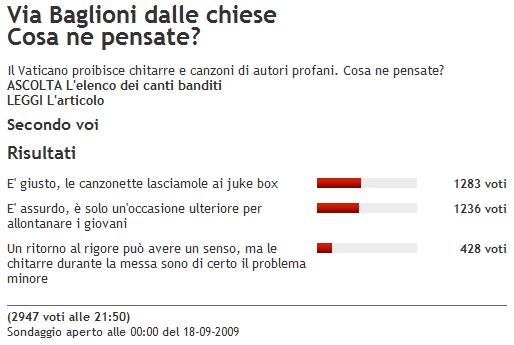
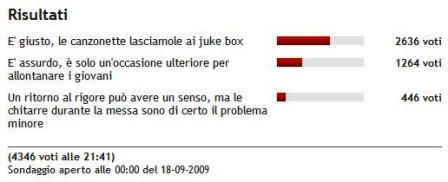
 The affliction many people experience each week in church from the music choices and choosers is not limited to the Anglophone world. You should hear the stuff they play in churches in Italy.



 Today is the Feast of Our Lady of Walsingham.


 fac on Daily Rome Shot 1118 – Paddywhack!: “Speaking of the disputatio back on October 31st between Archbishop Vesco and Bishop Barron (Vesco saying the Catholic Church was…”




























