Easter Lamb

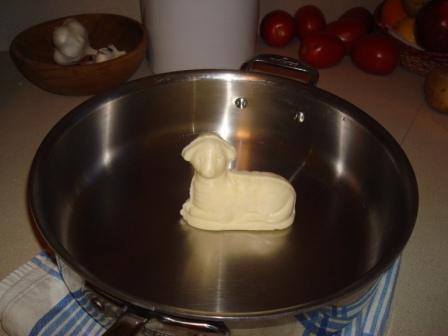
A different lamb which was slain, helped with our Easter supper!

Easter Lamb

Yah…. I know… he looks a little like a George Washington Sphinx. 

Easter Lamb

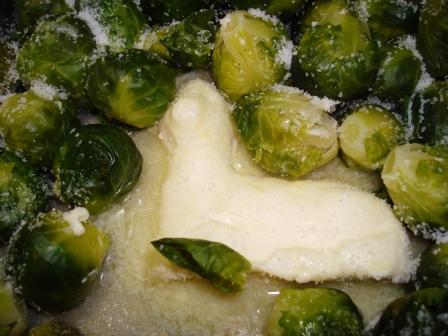
In verdant pastures…

Easter Lamb

Speaking of lamb…

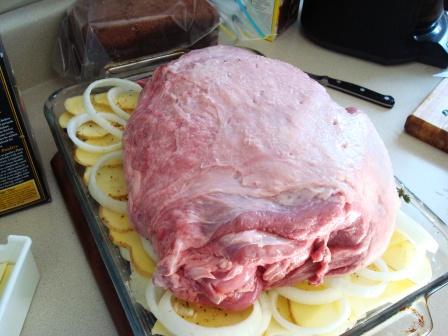
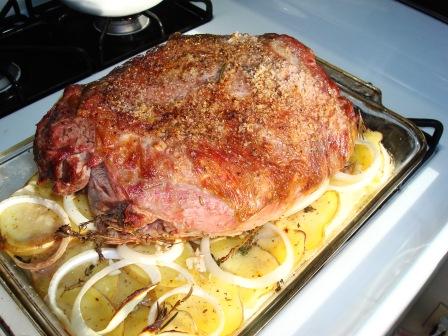
Start with a base of thinly sliced potatoes with onions and herbs… in this case thyme and rosemary.

Build it in layers.

Easter Lamb

Then put on top the nice big juicy leg of lamb, seasoned.

Easter Lamb

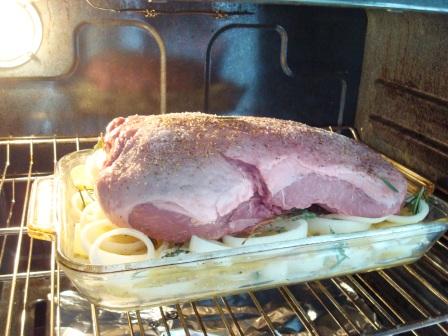
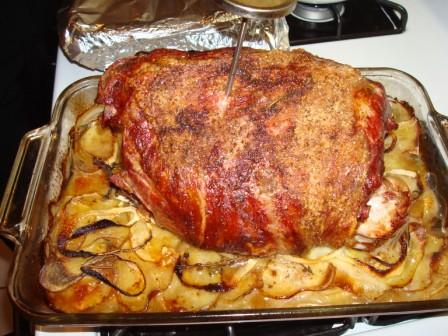
Into the oven.

Easter Lamb

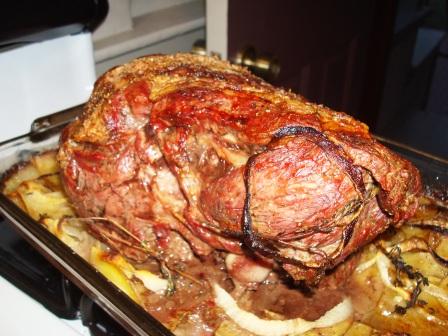
The result sometime later…

Easter Lamb

Then it is tented with foil.

And finished…

Easter Lamb

Easter Lamb

Feeds: Four very hungry priests and leaves lots of left overs.

Posted in SESSIUNCULA |
39 Comments

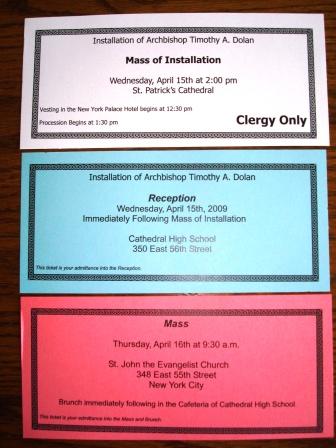
Sometimes a Mass needs tickets

Sometimes a Mass needs tickets

Posted in SESSIUNCULA |
Comments Off on Sometimes a Mass needs tickets

Happy Chicken Easter

You just can’t make some things up…

Happy Chicken Easter

I find that chickens are generally funny.

Posted in SESSIUNCULA |
10 Comments

When only images can convey our sorrow

Some things are simply too tragic for words.  Only images can convey our sorrow.

Disaster barely averted… but only through a self-less, chilling sacrifice.

Posted in Lighter fare |
25 Comments

Oddity during the broadcast of the Pope’s Easter

A reader sent the following observation.

Apparently during the EWTN re-broadcast of the Holy Father’s Easter Mass, the announcer opined that the reason the Holy Father distributes Holy Communion only to people kneeling is… wait for it… because he is short and it is easier for him that way.

?!?

It might be good for him to explain this.

I didn’t see the broadcast of the Mass, being busy with other things.  I don’t know if that comment was made or not.

But if it was….

The Holy Father is distributing Holy Communion to people kneeling to give positive reinforcement to a deeper reverence of the One whom we receive.

Posted in SESSIUNCULA |
83 Comments

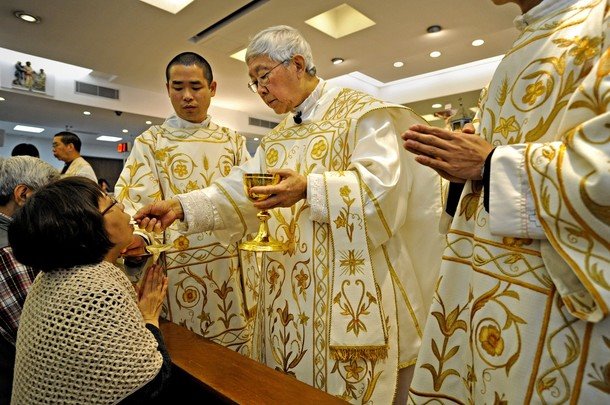
The great Bishop of Hong Kong Joseph Card. Zen

A tip of the biretta to NLM.     o{]:¬)

The great Bishop of Hong Kong Joseph Card. Zen.

Happy Easter indeed!

The great Bishop of Hong Kong Joseph Card. Zen

Posted in SESSIUNCULA |
42 Comments

Benedict XVI’s Easter Urbi et Orbi message

The Holy Father’s Easter Urbi et Orbi Message… to the City (Rome) and to the whole world.

My emphases and comments.

Dear Brothers and Sisters in Rome and throughout the world,

From the depths of my heart, I wish all of you a blessed Easter. To quote Saint Augustine, "Resurrectio Domini, spes nostra – the resurrection of the Lord is our hope" (Sermon 261:1). With these words, the great Bishop explained to the faithful that Jesus rose again so that we, though destined to die, should not despair, worrying that with death life is completely finished; Christ is risen to give us hope (cf. ibid.).

Indeed, one of the questions that most preoccupies men and women is this: what is there after death? To this mystery today’s solemnity allows us to respond that death does not have the last word, because Life will be victorious at the end. This certainty of ours is based not on simple human reasoning, but on a historical fact of faith: Jesus Christ, crucified and buried, is risen with his glorified body. Jesus is risen so that we too, believing in him, may have eternal life. This proclamation is at the heart of the Gospel message. As Saint Paul vigorously declares: "If Christ has not been raised, our preaching is in vain and your faith is in vain." He goes on to say: "If for this life only we have hoped in Christ, we are of all men most to be pitied" (1 Cor 15:14,19). Ever since the dawn of Easter a new Spring of hope has filled the world; [a fact sometimes very hard to recognize] from that day forward our resurrection has begun, [but it is not yet fully realized] because Easter does not simply signal a moment in history, but the beginning of a new condition: Jesus is risen not because his memory remains alive in the hearts of his disciples, but because he himself lives in us, and in him we can already savour the joy of eternal life.  [juxtaposition of already and not yet]

The resurrection, then, is not a theory, but a historical reality revealed by the man Jesus Christ by means of his "Passover", his "passage", that has opened a "new way" between heaven and earth (cf. Heb 10:20). It is neither a myth nor a dream, [I would love to chat with him about Tolkien’s assertion to Lewis that Christianity is the "myth that is true".] it is not a vision or a utopia, it is not a fairy tale, but it is a singular and unrepeatable event: Jesus of Nazareth, son of Mary, who at dusk on Friday was taken down from the Cross and buried, has victoriously left the tomb. In fact, at dawn on the first day after the Sabbath, Peter and John found the tomb empty. Mary Magdalene and the other women encountered the risen Jesus. On the way to Emmaus the two disciples recognized him at the breaking of the bread. The Risen One appeared to the Apostles that evening in the Upper Room and then to many other disciples in Galilee.

The proclamation of the Lord’s Resurrection lightens up the dark regions of the world in which we live. I am referring particularly to materialism and nihilism, [The Holy Father has been engaging these different strains in his whole pontificate… think, for example, of his first Message for the World Day of Peace.] to a vision of the world that is unable to move beyond what is scientifically verifiable, and retreats cheerlessly into a sense of emptiness which is thought to be the definitive destiny of human life. It is a fact that if Christ had not risen, the "emptiness" would be set to prevail. [When I talk about Easter, I will often make the point that all creation would ultimate be overwhelmed in the ultimate conclusion of entropy… in a perfect stillness of perfect cold without change… a hideous imitation of the peace and harmony that comes with resting in God, to whom our love as our weight.. our proper gravity… draws us, as Augustine would put it.] If we take away Christ and his resurrection, there is no escape for man, and every one of his hopes remains an illusion. Yet today is the day when the proclamation of the Lord’s resurrection vigorously bursts forth, and it is the answer to the recurring question of the sceptics, that we also find in the book of Ecclesiastes: "Is there a thing of which it is said, ‘See, this is new’?" (Ec 1:10). We answer, yes: on Easter morning, everything was renewed. "Mors et vita, duello conflixere mirando: dux vitae mortuus, regnat vivus – Death and life have come face to face in a tremendous duel: the Lord of life was dead, but now he lives triumphant." This is what is new! A newness that changes the lives of those who accept it, as in the case of the saints. This, for example, is what happened to Saint Paul.

Many times, in the context of the Pauline year, we have had occasion to meditate on the experience of the great Apostle. Saul of Tarsus, the relentless persecutor of Christians, encountered the risen Christ on the road to Damascus, and was "conquered" by him. The rest we know. In Paul there occurred what he would later write about to the Christians of Corinth: "If anyone is in Christ, he is a new creation; the old has passed away, behold, the new has come" (2 Cor 5:17). Let us look at this great evangelizer, who with bold enthusiasm and apostolic zeal brought the Gospel to many different peoples in the world of that time. Let his teaching and example inspire us to go in search of the Lord Jesus. Let them encourage us to trust him, because that sense of emptiness, which tends to intoxicate humanity, has been overcome by the light and the hope that emanate from the resurrection. The words of the Psalm have truly been fulfilled: "Darkness is not darkness for you, and the night is as clear as the day" (Ps 139 [138]:12). It is no longer emptiness that envelops all things, but the loving presence of God. [interesting… see my comment about entropy, above]  The very reign of death has been set free, because the Word of life has even reached the "underworld", carried by the breath of the Spirit (v. 8).

If it is true that death no longer has power over man and over the world, there still remain very many, in fact too many signs of its former dominion. Even if through Easter, Christ has destroyed the root of evil, he still wants the assistance of men and women in every time and place who help him to affirm his victory using his own weapons: the weapons of justice and truth, mercy, forgiveness and love. This is the message which, during my recent Apostolic Visit to Cameroon and Angola, I wanted to convey to the entire African continent, where I was welcomed with such great enthusiasm and readiness to listen. Africa suffers disproportionately from the cruel and unending conflicts, often forgotten, that are causing so much bloodshed and destruction in several of her nations, and from the growing number of her sons and daughters who fall prey to hunger, poverty and disease. I shall repeat the same message emphatically in the Holy Land, to which I shall have the joy of travelling in a few weeks from now. Reconciliation – difficult, but indispensable – is a precondition for a future of overall security and peaceful coexistence, and it can only be achieved through renewed, persevering and sincere efforts to resolve the Israeli-Palestinian conflict. My thoughts move outwards from the Holy Land to neighbouring countries, to the Middle East, to the whole world. At a time of world food shortage, of financial turmoil, of old and new forms of poverty, of disturbing climate change, of violence and deprivation which force many to leave their homelands in search of a less precarious form of existence, of the ever-present threat of terrorism, of growing fears over the future, it is urgent to rediscover grounds for hope. Let no one draw back from this peaceful battle that has been launched by Christ’s Resurrection. For as I said earlier, Christ is looking for men and women who will help him to affirm his victory using his own weapons: the weapons of justice and truth, mercy, forgiveness and love.

Resurrectio Domini, spes nostra! The resurrection of Christ is our hope! This the Church proclaims today with joy. She announces the hope that is now firm and invincible because God has raised Jesus Christ from the dead. She communicates the hope that she carries in her heart and wishes to share with all people in every place, especially where Christians suffer persecution because of their faith and their commitment to justice and peace. She invokes the hope that can call forth the courage to do good, even when it costs, especially when it costs. Today the Church sings "the day that the Lord has made", and she summons people to joy. Today the Church calls in prayer upon Mary, Star of Hope, asking her to guide humanity towards the safe haven of salvation which is the heart of Christ, the paschal Victim, the Lamb who has "redeemed the world", the Innocent one who has "reconciled us sinners with the Father". To him, our victorious King, to him who is crucified and risen, we sing out with joy our Alleluia!
Posted in SESSIUNCULA |
Comments Off on Benedict XVI’s Easter Urbi et Orbi message

Happy Easter!

Happy Easter, everyone!

Posted in SESSIUNCULA |
89 Comments

A seminarian writes about Good Friday hijinx

From a seminarian reader (edited):

Dear Fr. Z,

I’m a seminarian studying for ____.  We all go home for Holy Week and last night I went to my home parish for Good Friday.  … [E]very year I’ve gone there they always have liturgical dancers on Good Friday.  I was appalled even when I didn’t know any better, and now that I do know better I’m doubly appalled.

They use a long red sheet of nylon to represent the spilled blood of Christ.  When the service begins it’s spread out in the sanctuary, making it look like someone just tossed their old bedsheet in there.  When the dancing starts, one of the deacons draped one end of it over an arm of the bare wooden cross.  At the end they stretch it across the entire church and start walking towards the narthex.  I think it’s supposed to represent the blood of Christ washing over all of us.  I’d tell you more about it, but as soon as I see them prancing towards the sanctuary, I tend to close my eyes and begin asking our Lord to have mercy on them for they know not what they do.

Needless to say, if I am ordained by God’s grace, one of the first things I would do as a pastor is tell them their services are no longer required.  Thank you so much for all that you do for God’s Church Father!  Your blog is considered required reading among the seminarians!  Not so much with some of the older faculty members, but even that is starting to change.

I am sure that many people out there have similar experiences.  Sadly, in some places the liturgical “Marshall Plan”, the deepening understanding that we need continuity, the “gravitational pull” also of the older rite, have not yet kicked in.

This will eventually be solved by the biological solution.

Be patient. Learn well.  Keep your mouth shut.  Pray a lot.

Posted in SESSIUNCULA |
Comments Off on A seminarian writes about Good Friday hijinx

EXSULTET: WDTPRS and audio

EXSULTET: WDTPRS and audioThe EXSULTET is one of the most spectacular moments of all the Church’s liturgical life.

When it is sung well in Latin the Church is in her glory!

I have fond memories of singing the Exsultet. The first time, I was a deacon on retreat at a monastery in central Italy, where the largest community of Benedictine nuns in Italy sing every word of their office and Mass in Gregorian chant in their 12th c. abbey. Another time, I was asked by my bishop (of an ancient Roman Suburbicarian diocese) to sing the Exsultet in Latin. We started outside in the deep night in the square before an enormous fire. It took over 10 minutes to get everyone inside, with long pauses between each “Lumen Christi!” The candle was the size of a Scottish caber. Though there was still much movement and exuberance I started singing, and when they heard the rarely use Latin and chant the great crowd quieted. As I sang about the “red-glowing flame” being “divided into parts” I could see a thousand candles and hear the fire still crackling outside as it cast flickering glows through the main door.

Most precious, however, are the times I sang the Exsultet in my home parish.

Here is my rendering of the 1970 Missale Romanum version of the Exsultet. Alas, there is no space to give you the Latin also. The Exsultet is also called the Praeconium Paschale. Paschale is an adjective of a Latinized Hebrew word pascha, for the Passover meal of the lamb. The sure and certain Lewis & Short Dictionary says the adjective praeconius, a, um is “of or belonging to a praeco or public crier” while the substantive praeconium is “a crying out in public; a proclaiming, spreading abroad, publishing.” In a Christian context this of course also infers the Good News! A praeconium is simultaneously a profession of faith and a call to faith extended to all who hear.

The Exsultet is a poem, elements of which go back to St. Ambrose (+397). It is to be sung by a deacon (or priest or cantor) during the Easter Vigil as a hymn of praise to God for the light of the Paschal Candle. The text became part of the Roman liturgy around the 9th century. The text is theologically packed. It contains a summary of Easter’s mystery. Christ is risen: we too can rise in Him. This was prepared for from the fall of man, directed by a loving Father, and awaits only the end of the world, although our baptismal character allows us to live the reality now: Already, but not yet!

There is an introductory invitation to “Exult!” (whence its name) given to three different groups: the angels, the Church on earth, and the whole Church together. There follows an account of works of God in the Paschal Mystery and the history of salvation. It begins with a dialog just like a Preface during Holy Mass.

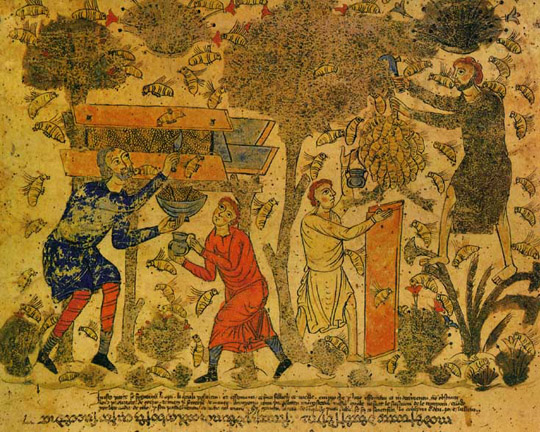
Like a Eucharistic Prayer the Exsultet is a remembrance (anamnesis) which makes the past mysteries present to us. The singer deacon begs the congregation to pray for him as he tells the story of our family history of salvation with all the foreshadowing and “types” of our redemption. So great is God’s ability to turn evil to good that the deacon dares to call Adam’s fall our “happy fault… felix culpa” since because of it we were sent the gift of our Savior. You hear of the work of bees and the shattering of chains of sin. All evil is driven away.

The constant refrain is that this is a blessed night when heavenly and earthly realities merge together and become one.

Finally, there is a humble petition that God the Father will accept our Paschal candle, our evening sacrifice of praise, and make it into one of the lights of the heavens.

This poem/hymn/prayer is too much to grasp all at once. But year by year we have the chance to hear it renewed in the heart of the Church’s greatest night. The mysteries within it do not change, but we do. Each year we are a little different. We can hear it each year with new insight and understanding.

Consider the setting.

For forty days we have done penance. We participated at the anniversary of Holy Mass and the Priesthood on Holy Thursday with the mandatum and the procession to the altar of repose, Christ in agony in Gethsemane. On Good Friday, the day with no Mass, after our humble prostration before the Crucified Lord we stood for the singing of the Passion. Now we are in a dark church. The fire was kindled and the “Light of Christ” was thrice announced. The faithful have little candles sparked to life from the single flame of the Paschal candle, the “Christ candle”, now lighted as the symbol of His resurrection. The candle is incensed and then:


2002 Missale Romanum

Exult now O ye angelic throngs of the heavens:
Exult O ye divine mysteries:
and let the saving trumpet resound for the victory of so great a King.
Let the earthly realm also be joyful, made radiant by such flashings like lightning:
and, made bright with the splendor of the eternal King,
let it perceive that it has dismissed the entire world’s gloom.
Let Mother Church rejoice as well,
adorned with the blazes of so great a light:
and let this royal hall ring with the great voices of the peoples.
Wherefore, most beloved brothers and sisters,
you here present to such a wondrous brightness of this holy light,
I beseech you, together with me
invoke the mercy of Almighty God.
Let Him who deigned to gather me in among the number of the Levites,
by no merits of mine,
while pouring forth the glory of His own light
enable me to bring to fullness the praise of this waxen candle.

Deacon: The Lord be with you!
Response: And with your spirit!
D: Raise your hearts on high!
R: We now have them present to the Lord!
D: Let us then give thanks to the Lord our God!
R: This is worthy and just!
Truly it is worthy and just
to resound forth with the whole of the heart, disposition of mind,
and by the ministry of the voice,
the invisible God the Father Almighty,
and His Only-begotten Son
our Lord Jesus Christ,
Who, on our behalf, resolved Adam’s debt to the Eternal Father
and cleansed with dutiful bloodshed the bond of the ancient crime.
For these are the Paschal holy days,
in which that true Lamb is slain,
by Whose Blood the doorposts of the faithful are consecrated.
This is the night
in which first of all You caused our forefathers,
the children of Israel brought forth from Egypt,
to pass dry shod through the Red Sea.
This is the night
which purged the darkness of sins by the illumination of the pillar.
This is the night
which today restores to grace and unites in sanctity throughout the world Christ’s believers,
separated from the vices of the world and the darkness of sins.
This is the night
in which, once the chains of death were undone,
Christ the victor arose from the nether realm.
For it would have profited us nothing to have been born,
unless it had been fitting for us to be redeemed.
O wondrous condescension of Your dutiful concern for us!
O inestimable affection of sacrificial love:
You delivered up Your Son that You might redeem the slave!
O truly needful sin of Adam,
that was blotted out by the death of Christ!
O happy fault,
that merited to have such and so great a Redeemer!
O truly blessed night,
that alone deserved to know the time and hour
in which Christ rose again from the nether world!
This is the night about which it was written:
And night shall be made as bright as day:
and night is as my brightness for me.
Therefore the sanctification of this night puts to flight all wickedness, cleanses sins,
and restores innocence to the fallen and gladness to the sorrowful.
It drives away hatreds, procures concord, and makes dominions bend.
Therefore, in this night of grace,
accept, O Holy Father, the evening sacrifice of this praise,
which Holy Church renders to You
in the solemn offering of this waxen candle
by the hands of Your ministers from the work of bees.
We are knowing now the proclamations of this column,
which glowing fire kindles in honor of God.
Which fire, although it is divided into parts,
is knowing no loss from its light being lent out.
For it is nourished by the melting streams of wax,
which the mother bee produced for the substance of this precious torch.
O truly blessed night,
in which heavenly things are joined to those of earth,
the divine to the human!
Therefore, we beseech You, O Lord,
that this waxen candle, consecrated in honor of Your name,
may continue unfailing to dispel the darkness of this night.
And once it is accepted as a placating sacrifice,
may it be mingled with the heavenly lights.
Let the morning star meet with its flame:
that very star, I say, which knows no setting:
Christ Your Son, who, having returned from the nether realm,
broke serene like the dawn upon the human race,
and now lives and reigns forever and ever.

The Exsultet (2002 Missale Romanum)

Posted in EASTER, PODCAzT, PRAYERCAzT: What Does The (Latin) Prayer Really Sound L, WDTPRS |
54 Comments