Your Easter Customs

In most cultures and families there are wonderful Easter customs.

They could be communal as bring food in baskets to church to be blessed by the priest.

They could be as simple and intimate as preparing a special meal in the family home.

What are some of your customs?

Posted in Just Too Cool |
70 Comments

Pruned, dying, and finally dead upon the threshold of the tomb

All during Lent we were being stripped down and put to a slow death.   I speak liturgically, of course.   But as Catholics our spiritual lives ought to reflect our liturgical lives and Holy Church’s liturgical seasons. 

We were liturgically eviscerated through Lent and Passiontide, Holy Week.

Now, Holy Church has experienced liturgical death.  

In the Extraordinary Form, so important for our self-understanding as Catholics, the Alleluia was lost with the pre-Lenten Sundays.

Instrumental music and flowers went on Ash Wednesday. 

On 1st Passion Sunday we were deprived of statues and images when they are draped in purple.  In the older form of Mass the “Iudica” psalm in the prayers at the foot of the altar and the Gloria Patri at the end of certain prayers was no longer said.  
 
The pruning cuts more deeply as we entered the Triduum.

After the sudden Gloria during the Mass on Holy Thursday bells were replaced with wooden noise makers. 

The Blessed Sacrament was removed from the main altar.

The altar was stripped, left bare and exposed.

Holy Water, water being so essential to life, is removed.

On Good Friday, there is no Mass.  First no water … now no food.

On Saturday, aside from somber Tenebrae – for we do not cease to pray when we are being emptied out – there is not even a liturgical action, no liturgical sound.  At Tenebrae all lights but for a single candle are snuffed out. 

It dies before night falls.

By the time we come to Saturday evening and the setting of the sun – increasing darkness until the buried sun no longer gives any illumination to the sky, we will be deprived of light itself.

It is liturgical night in the fullest sense.

As night truly falls in the physical realm, Holy Church is motionless, soundless, bereft of sound, motion, warmth, light itself. 

We are in our liturgical tomb.

Holy Church is liturgically dead.

…

The Vigil is to be celebrated after night has fallen. 

…

In the darkness a single spark will be struck from flint.

It’s bright glint will be startling in the darkness and silence.

…

The spark will spread into flames, casting greater and greater illumination as they flicker and wave, as they breathe air and consume the food of its fuel.  The flames will spread through the whole Church.  The glorious Christ Candle will take its place within the sacred space of the church building’ holy of holies, the sanctuary.

Holy Church springs to life again at the Vigil of Easter.   

The dead rise.

Posted in SESSIUNCULA |
22 Comments

Monastery of San Benedetto in Norcia – mp3s and photos

I received this from the Monastery of St. Benedict in Norcia, Italy… the birthplace of St. Benedict.

Salve! [F]rom the Benedictine Monastery of San Benedetto in Norcia.

Thanks to some generous donations from our patrons, we’ve wired up our Tenebrae services and made podcasts and mp3s of everything. There also some amazing photos from a very solemn, very Latin and very awe inspiring Tenebrae service.

We’re a young monastery, with more than a dozen vocations from all over the world (and all young guys!) but with a huge amount of talent and focus on leading the Church by following Her teaching and wisdom. Also, the monks celebrate all roman rites with great reverence.

Seeing as we start at 5:00AM, it takes a couple of minutes for the monks to "warm up". There are some sick monks in the pews– please disregard the coughing. However, you will find the later parts and especially today’s service especially beautiful.

You can see pictures and all the music at http://www.osbnorcia.org, and click "Tenebrae ’09"

Posted in Brick by Brick, Just Too Cool |
22 Comments

When Popes ATTACK! The Daily Mail on Benedict XVI’s Good Friday

The Daily Mail has a quizzical story.  Here it is with my emphases and comments.

Here is a good lesson of what happens when journalists really know not what they do.

We have drifted into a desert of godlessness (and a happy Easter to all): Pope gives Good Friday address  [In what follows, try to keep track of who actually said what…]

By Simon Caldwell
Last updated at 3:22 PM on 10th April 2009

Good Friday address: Pope Benedict will warn that religious sentiments are increasingly being held up to ridicule in the West

Pope Benedict XVI will tonight attack the rise of aggressive secularism in western societies, warning them that they risked drifting into a  ‘desert of godlessness’.  [Great idea!  But… wait… did he?]

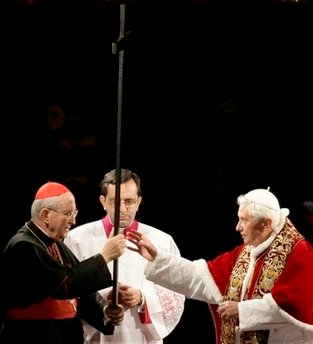
The Bavarian-born Pontiff will use his Good Friday meditations [ummm… Pope Benedict didn’t write them.] to compare deliberate attempts to purge religion from public life to the mockery of Jesus Christ by the mob as he was led out to be crucified. [That’s not what I heard Pope Benedict say at the Via Crucis.]

He [remember, it is supposed to be Pope Benedict…] will say said that ‘religious sentiments’ were increasingly ranked among the  ‘unwelcome leftovers of antiquity’ and held up to scorn and ridicule. [Even in the Church, ad intra, we can make this observation, though the tide is turning.]

‘We are shocked to see to what levels of brutality human beings can sink,’ he [who?] will tell the congregation as he meditates on the stations of the cross at an evening  ceremony at the Coliseum, Rome.

‘Jesus is humiliated in new ways even today – when things that are most  holy and profound in the faith are being trivialised, the sense of the sacred is  allowed to erode,‘ he will say.  [It all sounds great so far.  But… did Pope Benedict say or write any of this?]

‘Everything in public life risks being desacralised – persons, places,  pledges, prayers, practices, words, sacred writings, religious formulae,  symbols, ceremonies. Our life together is being increasingly  secularised.

‘Religious life grows diffident. Thus we see the most momentous matters  placed among trifles, and trivialities glorified.

‘Values and norms that held societies together and drew people to higher  ideals are laughed at and thrown overboard. Jesus continues to be  ridiculed.’

The Pope, who turns 82 later this month, will pray that Christians would  respond to the problem by growing in faith. [I bet the Pontiff did pray along with this… but wait… there’s more!]

‘May we never question or mock serious things in life like a cynic,’ he will say.

‘Allow us not to drift into the desert of godlessness. Enable us to  perceive you in the gentle breeze, see you in street corners, love you in the  unborn child.’  [Pretty good stuff!]

On the station that marks the passage in the Gospel where Jesus met the  women of Jerusalemon [A suburb of South Bend… er um.. no wait… um… no, that’s a typo.  The journalist got the name of the city JERUSALEM wrong.  How does that happen?] the way to be crucified, the Pope  will also condemn the oppression of women, saying there were ‘many societies in the world where women fail to receive a fair deal’. [O Lord, please let the English translation not say that.]

Pope Benedict XVI dries a priest’s foot during the feet washing ceremony on Holy Thursday at the Basilica of St. John Laterane [Pronounced "Lateraine", which is a church in beautiful downtown Jerusalemon…]

‘Christ must be weeping for them,’ the Pope will claim.  [He will?]

He will add: ‘There are societies too that are thoughtless about their  future. Christ must be weeping for their children.

‘Wherever there is unconcern for the future, through the overuse of  resources, the degradation of the environment, the oppression of women, the  neglect of family values, the ignoring of ethical norms, the abandonment of  religious traditions, Jesus must be telling people: "Do not weep for me, but weep for yourselves".’

The Stations of the Cross are traditionally performed by the Pope [with a whole travelling troop from The Vaticane!] at the  amphitheatre where thousands of early Christians died as martyrs during  persecutions ordered by the Roman emperors.  [Nooooo… historically not so, but let that pass for now.]

During the ceremony, the Pope will stop at each of the 14 stations – which  represent the sequence of events between Jesus’s ‘agony’ in the Gardenof Gethsemane [pronounced Gethsa-main, I think.] to his crucifixion and burial –  where he will read out a meditation. [So, far this will be the only this he said.]

The Good Friday meditations generally reflect on the evil in the world on  the day that the Church commemorates the suffering and death of  Christ.

On Easter Sunday, the Pope’s Urbi et Orbi (to the City and to the World)  message is of a completely different tone, reflecting his hope and joy in the  risen and triumphant saviour.  [Okay, the writer posted this at 3:22 PM London time, which means he probably violated the embargo.  Let’s push at another embargo also!]

[Now watch this!]

The Good Friday meditations for this year were written for Pope Benedict  by Thomas Menamparampil, the Archbishop of Guwahati, India.   [Sooo… along along it wasn’t the Pope… okaaaaay… got it.]

Many reflect on the problems faced by the Church in the Middle East and  Asia, where persecution in Iraq, for instance, has forced half of the Christian population to flee the country, and in India where  anti-Christian riots in the state of Orissa last autumn led to thousands of  families seeking sanctuary in refugee camps. [Something which would definitely sharpen the senses of the one writing the meditations.  But I am struck by the blunt way the writer accurately states that Christians were persecuted out of Iraq, and Christians are being abused in India.  He didn’t waffle on that.]

The comments on secularism refer pointedly, however, to the rise of an  intolerant form of secularism in the West, which seeks to purge traditionally  Christian societies of their religious character. [Pretty clear.]

In Britain this has led to legal battles  between employers and Christians suspended or sacked for expressing their  religious convictions or simply wearing religious jewellery such as crucifixes. [More blunt clarity.]

Publicly-funded church schools, adoption agencies and even  hospital chaplains have come under attack while the Government has given  taxpayers’ money to groups that promote atheism. [Thud.  For all the howlers here, at the very end the writer hit a googly for a sixer!]

Posted in SESSIUNCULA |
Comments Off on When Popes ATTACK! The Daily Mail on Benedict XVI’s Good Friday

during a pause

What you see when there is a pause.

eduring a pause

Posted in SESSIUNCULA |
Comments Off on during a pause

Benedict XVIs sermon for the Via Crucis at the Colosseum

Benedict XVIs sermon for the Via Crucis at the ColosseumBenedict XVIs sermon for the Via Crucis at the Colosseum.

My emphases and comments.

Dear Brothers and Sisters,

At the end of his dramatic Passion narrative, the Evangelist Saint Mark tells us: "The centurion, who stood facing him, saw that he thus breathed his last, and said: ‘Truly this man was the Son of God!’" (Mk 15:39). We cannot fail to be surprised by the profession of faith of this Roman soldier, who had been present throughout the various phases of the Crucifixion. [An interesting observation in itself.] When the darkness of night was falling on that Friday so unlike any other in history, when the sacrifice of the Cross was already consummated and the bystanders were making haste to celebrate the Jewish Passover in the usual way, these few words, wrung from the lips of a nameless commander in the Roman army, resounded through the silence that surrounded that most singular death. This Roman army officer, having witnessed the execution of one of countless condemned prisoners, was able to recognize in this crucified man the Son of God, [His experience of horror was, with grace, his advantage. He was in a sense, "disciplined" to see the difference.] who had perished in the most humiliating abandonment. His shameful end ought to have marked the definitive triumph of hatred and death over love and life. But it was not so! Hanging from the Cross on Golgotha was a man who was already dead, but that man was acknowledged to be the "Son of God" by the centurion, "on seeing that he thus breathed his last", [which suggests that he was watching] as the Evangelist specifies.

We are reminded of this soldier’s profession of faith every time we listen anew to Saint Mark’s Passion account. This evening, like the centurion, we pause to gaze on the lifeless face of the Crucified One at the conclusion of this traditional Via Crucis which, through radio and television coverage, has brought many people together from every part of the world. We have re-lived the tragic event of a man unique in the history of all times, who changed the world not by killing others but by letting himself be killed [contrast: the Centurion who kills, the Christ who is killed] as he hung from a cross. This man, seemingly one of us, who while he was being killed forgave his executioners, is the "Son of God", who, as the Apostle Paul reminds us, "did not count equality with God a thing to be grasped, but emptied himself, taking the form of a servant … he humbled himself, and became obedient unto death, even death on a cross" (Phil 2:7-8).

The anguish of the Passion of the Lord Jesus cannot fail to move to pity even the most hardened hearts, as it constitutes the climax of the revelation of God’s love for each of us. Saint John observes: "God so loved the world that he gave his only Son, that whoever believes in him should not perish, but have eternal life" (Jn 3:16). It is for love of us that Christ dies on the cross! Throughout the course of the millennia, a great multitude of men and women have been drawn deeply into this mystery and they have followed him, making in their turn, like him and with his help, a gift to others of their own lives. They are the saints and the martyrs, many of whom remain unknown to us. Even in our own time, how many people, in the silence of their daily lives, unite their sufferings with those of the Crucified One and become apostles of a true spiritual and social renewal! What would man be without Christ? Saint Augustine observes: "You would still be in a state of wretchedness, had He not shown you mercy. You would not have returned to life, had He not shared your death. You would have passed away had He not come to your aid. You would be lost, had He not come" (Discourse 185:1). So why not welcome him into our lives?

Let us pause this evening to contemplate his disfigured face: it is the face of the Man of sorrows, who took upon himself the burden of all our mortal anguish. [battered beyond the recognition of a man… yet the Centurion recognized Him] His face is reflected in that of every person who is humiliated and offended, sick and suffering, alone, abandoned and despised. Pouring out his blood, he has rescued us from the slavery of death, he has broken the solitude of our tears, he has entered into our every grief and our every anxiety.

Brothers and Sisters! As the Cross rises up on Golgotha, the eyes of our faith are already turned towards the dawning of the new Day, and we begin to taste the joy and splendour of Easter. "If we have died with Christ", writes Saint Paul, "we believe that we shall also live with Him" (Rom 6:8). In this certainty, let us continue our journey. Tomorrow, on Holy Saturday, we will watch and pray together with Mary, the Sorrowful Virgin, preparing ourselves in this way to celebrate the wonder of the Lord’s resurrection at the solemn Easter Vigil.

I wish all of you, even now, a Happy Easter in the light of the Risen Lord!

Posted in SESSIUNCULA |
4 Comments

POLL: Holy Thursday Foot Washing “mandatum”

POLL: Holy Thursday Foot Washing "mandatum"People sometimes forget that the Foot Washing rite on Holy Thursday is an option in the Novus Ordo Missale Romanum.  It can be done or excluded depending on the pastoral circumstances.

What is not an option is that, if it is done, only the feet of males should be washed.

This is clear from the rubrics in the Missale and in clarifications from the Holy See.

Nevertheless we all know that these clear rubrics and the clarifications from the Holy See are annually violated.

So, I present a poll: what did you see this year?

I am not opening up this poll so we can rehash whether or not feminine feet should or can be washed.  I am not interested in that question in this entry.  

I just want to know what you saw.

You can post descriptions in the comments, but let’s not reargue the question, has been addressed at length elsewhere.

You might add in your comments if what you saw represented a change in the practice from previous years.

Also, it may be that some body part other than feet was washed, which is entirely unliturgical.  If that was the case in what you saw, you can also check that option.

POLL CLOSED

On Holy Thursday in the Foot Washing rite you saw or took part in there were

  • Males and females or females only (44%, 1,001 Votes)
  • Males only (44%, 995 Votes)
  • neither males or females – the rite was not done (12%, 281 Votes)
  • and/or some other body part was washed (e.g., hands) (2%, 36 Votes)

Total Voters: 2,282


Posted in POLLS, SESSIUNCULA |
178 Comments

John Allen on the Notre Dame controversy: Fr. Z’s questions

My friend Mr. John L. Allen, Jr., the nearly ubiquitous fair-minded former Rome correspondent for the ultra-leftist National Catholic Reporter drills away in is Friday missive at the controversy swirling about Notre Shame University.

He makes some good points but raises some questions.

My emphases and comments.  I make more observations at the end.

Obama and Notre Dame
By John L Allen Jr
Created Apr 09, 2009

Two great annual festivals of hope, both accompanied by venerable liturgical rites, happen to fall in the same week this year: Opening Day and Easter Sunday. For a Christian and a baseball fan, there’s no better time to be alive.  [Right on!  The tomb is open and empty!  The world springs back to life!]

Emboldened by this air of new possibility, I’d like to float a hope regarding the increasingly acrimonious debate over the University of Notre Dame and its invitation to President Barack Obama to deliver this year’s commencement address. In a nutshell, my hope is that American Catholics will manage their disagreements over the Obama appearance without turning this into yet another nasty front in our version of the culture wars.

For that to happen, two virtues will need to be more in evidence than they have been so far: charity and perspective.  [Perspective isn’t in an list of virtues I know… but this isn’t supposed to be a Thomistic treatise.  Accept it and read on…]

Charity

First, let’s be clear about something: Inviting a pro-choice president of the United States to speak at the country’s premier Catholic university may be highly charged at the level of symbolism and political fallout, but that does not make its advisability a matter of dogma. There’s no heresy implied in either supporting or opposing the move, so Catholics ought to be able to disagree without casting one another as enemies of the faith.

One side believes bringing Obama to Notre Dame will open a conversation, forcing him to confront the church’s teaching on the sanctity of life. The other argues that giving Obama a platform suggests a spirit of “agree to disagree” on critical issues such as abortion and embryonic stem cell research that amounts to compromise with evil. Either side could be wrong, even disastrously so, without thereby committing apostasy. [The word "disastrously" is well chosen.  But… don’t "disastrous" stakes compel one to chose a side?]

To date, alas, this has not been the spirit of much conversation.

A poison pen e-mail currently making the rounds, for example, has a picture of a guy behind bars under the fake headline of “Jenkins arrested for impersonating a Catholic.” The reference is to Holy Cross Fr. John Jenkins, Notre Dame’s president. In slightly less acerbic form, similar charges have even come from a few bishops. Those comments should probably be chalked up to the intensity people feel about the pro-life cause, rather than a sober evaluation of Notre Dame’s leadership, because otherwise they’re a tremendous injustice both to Jenkins and to the Congregation of the Holy Cross — an order which, in my experience, doesn’t need lessons from anyone on what it means to be both faithfully Catholic and committed to the educational enterprise.  [So, those bishops were less than "sober" when they wrote their letters.  What were they?  Unhinged?  Rash?  Uncharitable?  Lacking in perspective?]

I speak as someone who taught in a Holy Cross high school in Los Angeles (also named Notre Dame), where I saw the legacy of the order’s founder, Blessed Basil Moreau, in action. [The author has a personal connection with the Holy Cross Fathers.  He is up front about it.]

In February 2006, I also happened to be at the Lateran University in Rome when Notre Dame awarded an honorary doctorate to Bishop Salvatore Fisichella, then rector of the Lateran. (Fisichella is now president of the Pontifical Academy for Life, where he plays a lead role in making the case for the unborn.) Both Jenkins and Bishop Daniel Jenky of Peoria, Ill., a Holy Cross father and a trustee at Notre Dame, delivered perhaps the most impressive treatments of Catholic higher education I’ve ever heard.  [The elements involved in the above: the "Pope’s University", the Rector Magnficus of that University, Notre Dame, Fr. Jenkin’s, Bp. Jenky.]

“The church always faces crises,” Jenkins said that day. “Our strength is to face them with reason and hope, [YES WE CAN!] grounded in the gospel; to take confidence in the truth discovered through reason; to never fear the truth; and to show charity towards all.” For his part, Jenky argued that church-run schools “should never choose between being excellent or being Catholic.” Our Catholic tradition, he said, is “so profound, so wide and so self-confident in its exploration of truth that it can dare to ask questions and promote dialogue.”  [Okay…. that’s fine.  But Pres. Obama was not invited to participate in "dialogue" at Notre Dame.  He was invited to be honored.]

One can disagree with particular judgment calls, but let’s not go down the road of questioning the Catholic identity of figures so obviously committed to the intersection of faith and reason. [But, Mr. Allen, I think the controversy which has erupted, and even the tone which has risen, both stem from the fact that that commitment it is no longer "obvious".  It should be obvious.  People are hurt and alarmed that it is not.]
 

At the same time, let’s also stipulate that one can be sincerely troubled by the honor Notre Dame appears  [I believe an "honorary doctorate" is part of the whole thing] to be bestowing upon the president without thereby becoming a flack for the Republican Party.  [Thank you.  This is NOT – at least for reasonable people – a matter of partisan politics.]

In a recent interview with The New York Times, Notre Dame ["]theologian["] Fr. Richard McBrien asserted that those unhappy with the invitation are “simply Republicans upset that Obama won the election, and they want to pick a fight.” I’m not sure how true that is sociologically — McBrien knows the personalities at Notre Dame better than I do. In principle, however, one does not have to be a disgruntled McCain voter [ehem… there are those who would disagree that Sen. McCain is the best representative of classic Republican ideals, but Allen’s point is clear] to be alarmed by rolling out the red carpet for a leader whose positions on abortion and embryonic stem cell research are clearly at odds with what the church considers basic principles of justice. [principles about which there can, for Catholics with an obvious sense of commitment, even appear to be compromised.]

Both Popes John Paul II and Benedict XVI have defined the defense of human life from conception to natural death as the towering human rights struggle of our time. Someone striving to “think with the church” would obviously have grounds for feeling wary about the Obama invitation that go well beyond lust for political payback.

What makes this such a difficult case, in fact, is precisely that both sides are upholding core Catholic values: the sanctity of life and the [wait for it] imperative of dialogue. [This is where some people are going to hear alarm bells.  It will be worth discussing in another entry the extent to which "dialogue" is an "imperative" and how to identity  the parameters of dialogue.  Without question, we must be ready always to engage in dialogue (cf. 1 Peter 3:15-16).  But dialogue has its limits (cf. Matthew 11).] Figuring out how to reconcile those values is not easy under the best of circumstances, and hasty certainties don’t help. Neither do unfounded assumptions about the motives of Catholics who reach different conclusions.  [Leaving aside the motives, I think we can still judge the actions, no?]

Perspective  [that elusive "virtue"]

In a recent essay for National Review Online, noted Catholic author George Weigel asserted that “virtually the entire sentient world” is aware of the melee surrounding Notre Dame and Obama. Unless you define the “sentient world” as the American blogosphere, however, that’s a fairly mammoth over-statement. I just spent two weeks in Cameroon, and I can report that few people there seem worked up over who’s speaking to Irish grads this spring.  [Wellllll…. Mr. Allen…. c’mon…]

This is the chronic Achilles’ heel of American Catholicism: we presume that our issues are the world’s issues, often leaving Catholics elsewhere scratching their heads about what they perceive as our insularity. [Yes… but, for Americans who are Catholic this is important.  Can we stipulate that what is important for the Catholic Church in the USA is important for the Church in the world?  We are not talking about the Church in Tobago, as wonderful as Tobago may be.]

To be sure, the debate over the Obama invite is no tempest in a teapot. The question of how to engage public figures who hold pro-choice views without seeming to endorse, or wink at, those views, is critically important. [Here is the problem.  Pres. Obama didn’t accept an invitation to debate or dialogue.  He was invited to admonish (commencement) and be honored (honorary doctorate).  I don’t think people would be upset if the President were to be part of an open and obvious event of dialogue.  The problem is that he is being honored.] At the same time, however, it’s a big, complicated world, and this is hardly the only matter deserving of American Catholic attention.  [Yes, I agree.  But we can pay attention to more than one thing at the same time.  As a matter of fact, we can analyze this particular controversy within the larger context of the Church "in the modern world".]

Here’s an illustration of the point. As it happens, Notre Dame’s commencement ceremony falls on May 17, just two days after Pope Benedict XVI will wind up his May 8-15 visit to Jordan, Israel and the Palestinian Territories. It’s arguably the pope’s most important foreign voyage to date, with a host of critical issues on the table: the future of Catholic-Muslim and Catholic-Jewish relations, the fate of shrinking Christian minorities in the Arab world, and the church’s role in promoting Middle East peace, to name just three. The United States and the American Catholic community are, or at least ought to be, major players in all those dramas. [Even though Mr. Weigel was engaging in hyperbole, what goes on in the Church in the USA really is important for the rest of the world… whether the rest of the world knows it or not.]

It would be tragic if the fracas over Notre Dame were to occlude the high stakes of this trip from American eyes. [I sympathize with what Allen is saying.  We have seen the media become distracted from important papal events by secular dust ups.  I have in mind the coverage of Pope John Paul II going black in the press in favor of the breaking scandal about Pres. Clinton and a certain intern.  But the drivers of the Catholic blogosphere (mentioned above by Mr. Allen) are certainly capable of keeping more than one ball in the air at the same time.  What the challenge is for the drovers of the Catholic blogosphere is to keep the Notre Dame dust up properly contextualized and not lose sight of other important things happening within the Church.  The Pope’s visit to the Holy Land is surely an important secular event with seclar consequences and it must be covered as such.  It is also important for the Church herself. ] Keeping the bigger picture in view [i.e., perspective] is not only a matter of justice, but I suspect it would also make the dispute over Obama and Notre Dame seem more manageable. Among other things, it could offer a reminder that what we have in common as Catholics, set against a wider frame of reference, usually looms larger than what divides us.  [I agree. Is it not therefore even more important that, our commitment as Catholics to the supremely basic right to life should be obvious?]

Thus I dare to hope that, after an Easter lull in hostilities, combatants in the Notre Dame/Obama row can return to a more charitable exchange, with a deeper sense of perspective. A cynic might contend that’s the Catholic equivalent of believing the Royals have a shot at the pennant, [?  riiiiiiight….] but this, after all, is the perennial charm of Opening Day — for a brief moment, anything seems possible.

Mr. Allen’s intention is good, but there are problems.  There are inconsistencies.

What his piece raises for me above all, however, is the question about the limits of dialogue.

Catholics must engage in dialogue.  We must be involved in the public square.  In civil discourse dialogue must have decorum.  In classical terms, dialogue must be forged in the crucible of the aptum, the "apt". 

At what point does the aptum drive one to make a whip of cords?

Some bishops have made a decision about that point.

Let’s take this in another direction.

It is helpful to look at questions or events in the Church from ad intra and ad extra perspectives, what the event or question means for the Church qua Church within her membership and what they mean for the Church engaged with the whole world.

But the Notre Dame dust up is not primarily a dialogue event with the modern world out in the secular public square.

Is this business at Notre Dame at heart not a struggle within the Church over Catholic identity?

Before we can engage the world effectively in the public square as Catholics, we have to know who we are as Catholics.

The Notre Dame controversy is inciting harshness precisely because the long-needed scrum called dialogue over Catholic identity is now being more closely engaged.

Pope Benedict, I think, has a fundamental objective in his work as a theologian and now as Supreme Pontiff.  He seeks to revitalize Catholic identity precisely so that Catholics as individuals and as a Church can contribute with effect in the public square.

Consider: Does anyone really think that President Obama will, by this experience of Notre Dame as Notre Dame presently communicates her Catholic identity to the world, be prompted in the least to reconsider his positions or engage with the Catholic Church in an exchange that is more than a sham?

The escalating debate around Notre Dame reflects a disturbing fact: Notre Dame’s committment, as a Catholic University, to very basic aspects of Catholic teaching is no longer obvious.

It is now a matter for debate.  It is now fraught with doubt.

Shouldn’t it be obvious?

Is that too much to ask from a Catholic University?

Posted in I'm just askin'..., SESSIUNCULA |
73 Comments

Bp. Bruskewitz (D. Lincoln) flays Fr. Jenkins (Notre Shame)

His Excellency Most Reverend Fabian Bruskewitz, Bishop of Lincoln had this to say to Fr. John Jenkins, President of Notre Shame University.

My emphases.

  April 3, 2009
 
The Reverend John Jenkins, C.S.C
President, University of Notre Dame
400 Main Building
Notre Dame, IN 46556

Reverend and dear Father Jenkins,
 
            Permit me to add my name as well to the long list of Bishops of the Catholic Church who are utterly appalled at your dedication to immorality and wrong-doing represented by your support for the obscenity called “The Vagina Monologues” and your absolute indifference to the murderous abortion program and beliefs of this President of the United States.  The fact that you have some sort of past connection with the State of Nebraska makes it all the more painful that the Catholic people here have to see your betrayal of the moral teachings of the Catholic Church.
 
            I can assure you of my prayers for your conversion, and for the conversion of your formerly Catholic University.  I am

                                                       Sincerely yours in Christ Jesus,
 
                                                       The Most Reverend Fabian W. Bruskewitz
                                                       Bishop of Lincoln

If only His Excellency would just let it all out…, learn to express what he really thinks.

I don’t suppose there is a opening in the "Apostolic Patriarch of North America" slot, is there?


Posted in SESSIUNCULA |
86 Comments

Benedict XVI’s sermon for Holy Thursday evening

Pope Benedict’s sermon for Holy Thursday’s Mass of the Lord’s Supper in St. John Lateran in Rome.

My emphases and comments.

Benedict XVI's sermon for Holy Thursday eveningDear Brothers and Sisters,

Qui, pridie quam pro nostra omniumque salute pateretur, hoc est hodie, accepit panem: these words we shall pray today in the Canon of the Mass. "Hoc est hodie" – the Liturgy of Holy Thursday places the word "today" into the text of the prayer, thereby emphasizing the particular dignity of this day. It was "today" that He did this: he gave himself to us for ever in the Sacrament of his Body and Blood. This "today" is first and foremost the memorial of that first Paschal event. Yet it is something more. With the Canon, we enter into this "today". Our today comes into contact with his today. He does this now. With the word "today", the Church’s Liturgy wants us to give great inner attention to the mystery of this day, to the words in which it is expressed. We therefore seek to listen in a new way to the institution narrative, in the form in which the Church has formulated it, on the basis of Scripture and in contemplation of the Lord himself.  [Remember that liturgical, sacramental time is no less real than chronological time.  Sacramental realities are real.]

The first thing to strike us is that the institution narrative is not an independent phrase, but it starts with a relative pronoun: qui pridie. This "qui" connects the entire narrative to the preceding section of the prayer, "let it become for us the body and blood of Jesus Christ, your only Son, our Lord." [The Holy Father is prying into the mystery of this day by asking What Does The Prayer Really Say?]  In this way, the institution narrative is linked to the preceding prayer, to the entire Canon, and it too becomes a prayer. By no means is it merely an interpolated narrative, nor is it a case of an authoritative self-standing text that actually interrupts the prayer. It is a prayer. And only in the course of the prayer is the priestly act of consecration accomplished, which becomes transformation, transubstantiation of our gifts of bread and wine into the Body and Blood of Christ. As she prays at this central moment, the Church is fully in tune with the event that took place in the Upper Room, when Jesus’ action is described in the words: "gratias agens benedixit – he gave you thanks and praise". In this expression, the Roman liturgy has made two words out of the one Hebrew word berakha, which is rendered in Greek with the two terms eucharistía and eulogía. The Lord gives thanks. When we thank, [Christ the High Priest is really speaking in the sacred action.] we acknowledge that a certain thing is a gift that has come from another. The Lord gives thanks, and in so doing gives back to God the bread, "fruit of the earth and work of human hands", so as to receive it anew from him. Thanksgiving becomes blessing. The offering that we have placed in God’s hands returns from him blessed and transformed. The Roman liturgy rightly interprets our praying at this sacred moment by means of the words: "through him, we ask you to accept and bless these gifts we offer you in sacrifice". All this lies hidden within the word "eucharistia".

There is another aspect of the institution narrative cited in the Roman Canon on which we should reflect this evening. The praying Church gazes upon the hands and eyes of the Lord. It is as if she wants to observe him, to perceive the form of his praying and acting in that remarkable hour, she wants to encounter the figure of Jesus even, as it were, through the senses. "He took bread in his sacred hands …" Let us look at those hands with which he healed men and women; the hands with which he blessed babies; the hands that he laid upon men; the hands that were nailed to the Cross and that forever bear the stigmata as signs of his readiness to die for love. Now we are commissioned to do what he did: to take bread in our hands so that through the Eucharistic Prayer it will be transformed. At our priestly ordination, our hands were anointed, so that they could become hands of blessing. [In this context, he stresses anointing to blessing, rather than consecration.  But above he makes the connect between the blessing which is thanksgiving which is transforming.] Let us pray to the Lord that our hands will serve more and more to bring salvation, to bring blessing, to make his goodness present!  [It might be useful to think about the Holy Father’s teaching here in terms of constitutive and invocative.]

From the introduction to the Priestly Prayer of Jesus (cf. Jn 17:1), the Canon takes these words: "Looking up to heaven, to you his almighty Father …" The Lord teaches us to raise our eyes, and especially our hearts. He teaches us to fix our gaze upwards, detaching it from the things of this world, to direct ourselves in prayer towards God and thus to raise ourselves. In a hymn from the Liturgy of the Hours, we ask the Lord to guard our eyes, so that they do not take in or cause to enter within us "vanitates" – vanities, nothings, that which is merely appearance. [Latin vanitas, that "emptiness" which is also "deception" is from vanus, when English "vain".] Let us pray that no evil will enter through our eyes, falsifying and tainting our very being. But we want to pray above all for eyes that see whatever is true, radiant and good; [interesting… to use "radiant" when we might expect "beautiful".] so that they become capable of seeing God’s presence in the world. [We must learn to recognize the workings of grace around us.] Let us pray that we will look upon the world with eyes of love, with the eyes of Jesus, recognizing our brothers and sisters who need our help, who are awaiting our word and our action.

Having given thanks and praise, the Lord then breaks the bread and gives it to the disciples. Breaking the bread is the act of the father of the family who looks after his children and gives them what they need for life. But it is also the act of hospitality with which the stranger, the guest, is received within the family and is given a share in its life. Dividing (dividere), sharing (condividere [Italian]) brings about unity. Through sharing, communion is created. In the broken bread, the Lord distributes himself. The gesture of breaking also alludes mysteriously to his death, to the love that extends even to death. He distributes himself, the true "bread for the life of the world" (cf. Jn 6:51). The nourishment that man needs in his deepest self [without which, therefore, he is not complete… and he will be restless always to have, out of balance if he does not] is communion with God himself. Giving thanks and praise, Jesus transforms the bread, he no longer gives earthly bread, but communion with himself. This transformation, though, seeks to be the start of the transformation of the world [inward to outward] – into a world of resurrection, a world of God. Yes, it is about transformation – of the new man and the new world that find their origin in the bread that is consecrated, transformed, transubstantiated.

We said that breaking the bread is an act of communion, an act of uniting through sharing. Thus, in the act itself, the intimate nature of the Eucharist is already indicated: it is agape, it is love made corporeal. [Remember the Holy Father’s first encyclical Deus caritas est.  He explains Christian love and then how that love is made concrete.] In the word "agape", the meanings of Eucharist and love intertwine. In Jesus’ act of breaking the bread, the love that is shared has attained its most radical form: Jesus allows himself to be broken as living bread. In the bread that is distributed, we recognize the mystery of the grain of wheat that dies, and so bears fruit. We recognize the new multiplication of the loaves, which derives from the dying of the grain of wheat and will continue until the end of the world. [It occurs to me that the multiplication of the loaves might be an interesting point to start from in a reflection about a environmental theology, in part against those who tend to use a zero-sum model…. but I digress…] At the same time, we see that the Eucharist can never be just a liturgical action. [It is that, of course.  It is liturgical.  But it must consequently be more: inward to outward.] It is complete only if the liturgical agape then becomes love in daily life. In Christian worship, the two things become one – experiencing the Lord’s love in the act of worship and fostering love for one’s neighbour. At this hour, we ask the Lord for the grace to learn to live the mystery of the Eucharist ever more deeply, in such a way that the transformation of the world can begin to take place. [In a consideration of "active participation" in the liturgical action, at some conclusive point his outward action must be expressed… not just in liturgical gestures and words within the church, but then in the other outward, outside the church where the inward is given outward expression.  Again the distinction of ad intra and ad extra becomes useful, ]

After the bread, Jesus takes the chalice of wine. The Roman Canon describes the chalice which the Lord gives to his disciples as "praeclarus calix" (the glorious cup), ["glorious chalice".  This will be given a far better expression in the new English translation.  In the present very deficient lame-duck translation the word praeclarus was purposely excluded.] thereby alluding to Psalm 23 [22], the Psalm which speaks of God as the Good Shepherd, the strong Shepherd. There we read these words: "You have prepared a banquet for me in the sight of my foes … My cup is overflowing" – calix praeclarus. [glorious in its overflowing-ness] The Roman Canon interprets [This is an important point in this sermon.  The Holy Father sees the Canon has being its own theological locus.  This is why, for example, he explained years ago that liturgical translation was not bound by the philological considerations of strict translation of Scripture.  Translation of liturgical texts must respect the texts themselves because they are their own theological starting point.  So, even if the arguments about the Hebrew/Aramaic background of Greek "ton pollon" were correct – and that is by no means certain, we must still translate pro multis in the Canon as "for many".] this passage from the Psalm as a prophecy that is fulfilled in the Eucharist: yes, the Lord does indeed prepare a banquet for us in the midst of the threats of this world, and he gives us the glorious chalice – the chalice of great joy, of the true feast, for which we all long – the chalice filled with the wine of his love. The chalice signifies the wedding-feast: now the "hour" has come to which the wedding-feast of Cana had mysteriously alluded. Yes indeed, the Eucharist is more than a meal, it is a wedding-feast. [overflowing glorious chalice of death which is life is nuptial] And this wedding is rooted in God’s gift of himself even to death. In the words of Jesus at the Last Supper and in the Church’s Canon, the solemn mystery of the wedding is concealed under the expression "novum Testamentum". This chalice is the new Testament – "the new Covenant in my blood", as Saint Paul presents the words of Jesus over the chalice in today’s second reading (1 Cor 11:25). The Roman Canon adds: "of the new and everlasting covenant", in order to express the indissolubility of God’s nuptial bond with humanity. The reason why older translations of the Bible do not say Covenant, but Testament, lies in the fact that this is no mere contract between two parties on the same level, but it brings into play the infinite distance between God and man. What we call the new and the ancient Covenant is not an agreement between two equal parties, but simply the gift of God who bequeaths to us his love – himself. Certainly, through this gift of his love, he transcends all distance and makes us truly his "partners" – the nuptial mystery of love is accomplished.

In order to understand profoundly what is taking place here, we must pay even greater attention to the words of the Bible and their original meaning. [philology as crow-bar] Scholars tell us that in those ancient times of which the histories of Israel’s forefathers speak, to "ratify a Covenant" means "to enter with others into a bond based on blood or to welcome the other into one’s own covenant fellowship and thus to enter into a communion of mutual rights and obligations". In this way, a real, if non-material form of consanguinity is established. The partners become in some way "brothers of the same flesh and the same bones". The covenant brings about a fellowship that means peace (cf. ThWNT II, 105-137). [QUAERITUR:] Can we now form at least an idea of what happened at the hour of the Last Supper, and what has been renewed ever since, whenever we celebrate the Eucharist? God, the living God, establishes a communion of peace with us, or to put it more strongly, he creates "consanguinity" between himself and us. [We are with/of His BLOOD] Through the incarnation of Jesus, through the outpouring of his blood, we have been drawn into an utterly real consanguinity with Jesus and thus with God himself. [sacramental reality is not less real] The blood of Jesus is his love, in which divine life and human life have become one. Let us pray to the Lord, that we may come to understand ever more deeply the greatness of this mystery. Let us pray that in our innermost selves its transforming power will increase, so that we truly acquire consanguinity with Jesus, so that we are filled with his peace and grow in communion with one another.

Now, however, a further question arises. [QUAERITUR:] In the Upper Room, Christ gives his Body and Blood to the disciples, that is, he gives himself in the totality of his person. But can he do so? He is still physically present in their midst, he is standing in front of them! The answer is: at that hour, Jesus fulfils what he had previously proclaimed in the Good Shepherd discourse: "No one takes my life from me: I lay it down of my own accord. I have power to lay it down and I have power to take it again …" (Jn 10:18). No one can take his life from him: he lays it down by his own free decision. At that hour, he anticipates the crucifixion and resurrection. What is later to be fulfilled, as it were, physically in him, he already accomplishes in anticipation, in the freedom of his love. He gives his life and he takes it again in the resurrection, so as to be able to share it for ever.  [Sacramental time is mysterious.  It is not less real than chronological time!  In fact, chronological "time" is a way of measuring change.  But the realities we are dealing with in the sacramental action of Christ through His Church’s liturgy are something more than mere historical enactments, memorials.]

Lord, today you give us your life, you give us yourself. Enter deeply within us with your love. Make us live in your "today". [Let us not slide only into our today.] Make us instruments of your peace! Amen.

Posted in SESSIUNCULA |
10 Comments