Excommunication of SSPX bishops to be lifted within days?

I already reported this here, but the intrepid and trustworthy Andrea Tornielli has this:

There will be made public in the next few days a decree with which Benedict XVI chose to cancel the excommunications of four new bishops ordained by [Archbishop] Lefebvre in 1988.  In addition to the four (Bernard Fellay, Alfonso de Gallareta, Tissier de Mallerais and Richard Williamson) there were also excommunicated the aforementioned Lefebvre, and the Brasilian bishop De Castro Mayer who participated in the ceremony.  On that occasion, after having been on the verge of an accord with the Holy See (and after having dealt with then Card. Ratzinger and having signed a protocol of understanding), [Archbishop Lefevbre] suddenly chose rupture and consecrating as four young priests as bishops carried out a schismatic act, justified by him by a necessity to assure the survival of the Fraternity of St. Pius X.  Now, with a truly magnanimous gesture, accepting the request formulated by Fellay, Benedict XVI has decided to lift the excommunication.  The excommunication which, it must be clarified, always regarded the consecrating bishops (Levebre and De Castro Mayer, both for some time deceased) and the for men consecrated, but not the Lefebvrite priests much less the their faithful.

Lord, I hope this is true.

Can we hope?

With God there are no limits, but something must be requested before it is given.

UPDATE 22 Jan 1513 GMT

Paolo Rodari has more on this.  He suggests that the day could be Sunday.  Think about it.  The Feast of the Conversion of St. Paul, closing of the Week for Christian Unity….

Benedict XVI has decided.  The decree containing the revocation of the excommunication for the schismatic Lefebvrite bishops is ready.  It will come out in the next few days, probably by this Sunday.  At the Pope’s will the President of the Pontifical Council for Legislative Texts, Archbishop Francesco Coccopalmerio drafted it and signed it.

Posted in SESSIUNCULA |
186 Comments

SSPX Bp. Williamson: ‘There were no gas chambers’

Here is an interesting piece from Ruth Gledhill of The Times:

My emphases.

Traditionalist bishop: ‘There were no gas chambers’

Bishop Richard Williamson is a hardline ultra-conservative bishop of the Society of St Pius X. He faces possible prosecution for Holocaust denial in Germany after an interview with a reporter from Stockholm TV in which he claimed that six million Jews did not die in the Holocaust, merely a few thousand, and that the gas chambers did not exist. CathCon has the translation of the Der Spiegel report. In an earlier story in the Catholic Herald,  Bishop Williamson, former Anglican and a Cambridge graduate, was exposed as endorsing the forgery, the Protocols of the Elders of Zion.

In his previous utterances which have caused repeated deep offence to the Jewish community as well as many Catholics and other Christians who have heeded the message of Christian repentance towards the Jewish community as spelled out in the documents of Vatican II and elsewhere, the Society has refused to distance itself from him. He was actually ordained by its founder, Marcel Lefebvre, and has been an important voice in the society.

There are repeated reports that Pope Benedict XVI wishes to bring the society back into the Catholic fold. After the upset in the Jewish community caused by the Good Friday prayer in the revivified Latin Mass, that would be another nail in the cross of Jewish-Catholic relations, unless some way is found of doing it without this man.

Now it looks as though Williamson might have gone too far, even for his traditionalist brethren, and that he might at last face some sort of disciplinary action from the society, most if not none of whose members do not share his views. This would then make it possible for the Pope to realise his dream of bringing the society back into the fold, without Williamson.

If he brings them back in with Williamson on board, then truly it will be a disaster. Vatican II might as well never have happened and it won’t just  be the Jewish community that would be justifiably disgusted. For many thousands of lay Catholics the world over, this could be the final proof that what the atheist bus campaign suggested was true: ‘There probably is no God.’ At least not the God that Williamson and his like believe in. Who could blame them, then, if they put traditionalist Catholic guilt aside, and get on and enjoy their lives.


In the meantime, I received this note via e-mail:

For the third time in some months, a few hours ago, well known – and usually knowledgeable spanish blogger Fernandez de la Cigoña, affirms that tomorrow [?!?] the excommunication of the FSSPX bishops will be lifted (or nullified). The post HERE. (Spanish).

Mr. Cigoña has a proven track record of good (near) vatican sources and has gotten a few many scoops; sources he cloaks under the  "Cardinal Re" signature.

Praying for seeing it confirmed and that it proves salutary to the Universal Church.

As do we all. 

As do we all.

UPDATE 22 Jan 1505 GMT

I found a video at Damian’s place.

Posted in SESSIUNCULA |
Comments Off on SSPX Bp. Williamson: ‘There were no gas chambers’

A wonderful tradition

Benedict XVI blessing lambs on St. Agnes Day.

A wonderful tradition

Posted in SESSIUNCULA |
24 Comments

A poem in winter

From the Laudator temporis acti:

Wallace Stevens, The Snow Man:

One must have a mind of winter
To regard the frost and the boughs
Of the pine-trees crusted with snow;

And have been cold a long time
To behold the junipers shagged with ice,
The spruces rough in the distant glitter

Of the January sun; and not to think
Of any misery in the sound of the wind,
In the sound of a few leaves,

Which is the sound of the land
Full of the same wind
That is blowing in the same bare place

For the listener, who listens in the snow,
And, nothing himself, beholds
Nothing that is not there and the nothing that is.


Posted in SESSIUNCULA |
4 Comments

Soaring rhetoric?

I must unburden myself.

Many people, especially in the media, have bought into the claim that President Obama is a great speaker, an elemental force of public speaking.  I beg to differ.  He reads a well-crafted speech with polish and seeming conviction.  His extemporaneous performances are rough.  No doubt he will improve in time, but he is not a good speaker without a text.

It is that American’s are so starved for good public oratory that this seems to soar?  Have our standards of education, of formation in the substance and literature of Western Civilization is so enervated that this seems elevated?

During the inauguration ceremony four soul annihilating minutes were inflicted by the poem, composed and declaimed Elizabeth Alexander.  She is a professor at Yale and a personal friend of the Obama family.

As you read it or listen here, remember that the first poet to read at an inauguration was Robert Frost.

Posted in SESSIUNCULA |
47 Comments

QUAERITUR: TLM on 25 Jan. for Conversion of Paul, not 3rd Sunday after Epiphany

From a reader… actually quite a few readers, but this e-mail is representative:

I’m wondering if you have an opinion on whether the Conversion of St. Paul can be celebrated this Sunday in the EF?  It’s not mentioned in the FSSP Ordo.  Have you heard anything about what celebration different places are planning?

Below I’ve pasted the decree from the CDW.  It doesn’t exclude the EF [or even mention it], but it’s oriented towards the OF.

Link to the decree.

CONGREGATION FOR DIVINE WORSHIP AND THE DISCIPLINE OF THE SACRAMENTS

DECREE

granting a special faculty for the celebration of the Conversion of St Paul, Apostle in the Jubilee Year bimillennium of his birth

The Apostle St Paul, who proclaimed the truth of Christ to the entire world and, after having been his persecutor, employed all means to announce the Good News to the peoples, committing himself with zeal for the unity and harmony of all Christians, has always been and is still now venerated by the faithful, especially in this particular Year, bimillennium of his birth, that the Supreme Pontiff Benedict XVI has willed to institute it as a special Jubilee Year.

Therefore, in force of the faculties attributed to this Congregation by the Supreme Pontiff, Benedict XVI, grants, in an extraordinary way, that next 25 January 2009, the Third Sunday "per annum", the singular churches can celebrate a Mass according to the formula Conversion of St Paul, Apostle, as found in the Roman Missal. In this case, the Second Reading of the Mass is taken from the Roman Lectionary for the Third Sunday "per annum", and the Creed is recited.

This concession, by special mandate of the Supreme Pontiff, is valid only for the Year 2009.

Notwithstanding anything to the contrary.

From the Congregation for Worship and the Discipline of the Sacraments, 25 January 2008, on the feast of the Conversion of St Paul, Apostle.

Cardinal Francis Arinze
Prefect

Archbishop Albert Malcolm Ranjith
Secretary

You ask if I have an opinion.  I do. 

I would say yes, the Conversion of St. Paul can be celebrated on that Sunday for the following reasons.

First, this is a special year dedicated to St. Paul.  Let that fact not be obscured.

Second, this comes from the Pope, rather than just from the Congregation.  The Congregation does not have competence in matters concerning the older, Extraordinary Form, the Holy Father’s jurisdiction is not so limited.  The Holy Father simply used that Congregation to make known his will.  I grant that he did not make this explicit.

Third, the language of the decree says "Third Sunday ‘per annum’".  The typical edition of the 1962 Missale Romanum indicates that 25 January would be in the "Tempus per annum ante Septuagesima" and it would be the Third Sunday, namely after Epiphany.  

Fourth, in the Novus Ordo calendar this last year the Solemnity of St. Joseph was transferred to 15 March because of Holy Week.  Pontifical Commission "Ecclesia Dei" stated that this applied also to the Extraordinary Form.  Given that precedent, we can guess that the decree on Conversion of Saint Paul would pertain also to the Extraordinary Form.

Fifth, it just makes sense.

I put the question to the Pontifical Commission Ecclesia Dei for a response.

I have heard nothing back.

Perhaps this isn’t important?

Judging from the number of people who have written to me with this question, I would say it is.

Posted in ASK FATHER Question Box |
35 Comments

Again, priest teaches his flock about liturgy – this guy gets it! (Part II)

At St. Mary’s in Norwalk, CT, Fr. Greg J. Markey is instructing his flock on liturgical matters.

I have written about this fellow before.  He "gets it".

We saw Part I the other day.

Let’s have a look at Part I (of two) with my emphases and comments.

Again, priest teaches his flock about liturgy - this guy gets it! (Part II)January 25, 2009           

             Part II: Yet beyond the lack of fidelity to the Vatican II liturgical norms there is still a deeper question which has only now begun to be addressed by Pope Benedict XVI: whether the liturgical reform of the Second Vatican Council that we have today was what the Fathers of the Council intended. [This is a good point.  And it is nearly a forbidden question in many circles.  The answer is, of course, "NO! What we got is nothing like what they asked for."]  Addressing the discontinuity between the Council’s idea of liturgical renewal and the final form of the Vatican II Mass, the then Cardinal Joseph Ratzinger wrote: “(I)n the place of liturgy as the fruit of development came fabricated liturgy.  We abandoned the organic, living process of growth and development over centuries, and replaced it –as in a manufacturing process– with a fabrication, a banal on-the-spot product.”

            For example, today much of what Catholics think is the Second Vatican Council liturgical reform did not in fact come from the Council: “To the ordinary churchgoer,” wrote Cardinal Ratzinger, “the two most obvious effects of the liturgical reform of the Second Vatican Council seem to be the disappearance of Latin and [even more damaging] the turning of the altars towards the people.  Those who read the relevant texts will be astonished to learn that neither is in fact found in the decrees of the Council.”   There is a long list of other changes as well that are simply not in the Vatican II documents either: removing altar rails, Communion in the hand, altar girls, etc.  

             For this reason Pope Benedict XVI’s decision to liberalize the Traditional Latin Mass (Extraordinary Form) is essential to reconnecting us with our lost tradition, and understanding what authentic worship of God is all about.  This Mass was the Mass of our forefathers, of countless saints, and which in its essence dates back to the earliest Church.  [YES!]

            Inspired by the Holy Father, I began the Extraordinary Form at the parish every Sunday over a year ago.  As your Pastor I wish more people in the parish would understand that we have been given a treasure here at St. Mary’s with this Extraordinary Form, and while the Mass is definitely growing, it is still a disappointment that more people do not recognize what this is all about.   [Sadly the case in so many places.  It is hard to draw people upwards into something more challenging.]

            If we look at the full array of Masses here at St. Mary’s, we see that there is a progressive solemnity to each of the liturgies on Sunday, with the 9:30 am Extraordinary Form representing the fullness of our liturgical patrimony.  [That is a good idea.  It is like… dare I say it… growing up in their Sunday worship.] The Ordinary Form at 4:00 pm, 7:00 pm, and the 8:00 am are done reverently, and has the fixed parts of the Mass (Kyrie, Sanctus, Agnus Dei…) sung in Latin during Advent and Lent.  The Spanish 1:15 Mass has a beautiful choir which sings the Latin Mass parts all year round.  The 11:30 am Ordinary Form of the Mass has the largest volunteer choir, with the Gloria, Credo, and Pater chanted in Latin every Sunday, and at least once a month the entire Mass is done in Latin, ad orientem (facing East).  Finally, once again as the fullness of our liturgical patrimony, we have the Solemn High Extraordinary Form of the Mass, with a professional schola singing the Mass parts in Gregorian chant and renaissance polyphony, and a full set of servers.  [If Fr. Markey needs another assistant….]

            I encourage people to come and attend the 9:30 am Extraordinary Form so that they will experience what is in my opinion is the fullness of Catholic worship, and which communicates the Sacred to a higher degree than the other forms.  The Ordinary Mass is a simpler version of this more ancient form, yet points to this fuller expression of worship.  [I have written many times about the TLM being the "grown-up" Mass.  More and more I think this is true.]

            I ask you to attend a few times because it sometimes takes a little while to appreciate its subtly, beauty and order.  Even if you prefer the Ordinary Form of the Mass, your attendance at the Extraordinary Form will at least help you understand our history and the Ordinary Form better.

            With all of the liturgical growth here at the parish over the past five years I hope that these two Pastor’s columns would help people to understand the big picture of why I am making these decisions.  It is not my own personal whim which motivates me, but my desire to have our parish think and worship with the mind and heart of the Church.

            Furthermore I think it more than a coincidence that the crisis in the liturgy over the past forty years coincided with so many other ecclesial crises:  [as our worship goes… so goes the rest of our Catholic lives.  Change our prayer, you change our belief and who we think we are before God.] the radical decline in priestly and religious vocations, the shrinking and closing of Catholic schools, the breakdown of the family and the growth of the culture of death, the painful clergy scandals, etc.   The Mass is the heart and source of our faith.  If is the Mass is deformed and weak, then so is the rest of the body. [yes] As Pope Benedict XVI has written, “I am convinced that the crisis in the Church that we are experiencing today is, to a large extent, due to the disintegration of the liturgy.” [Tell it, Reverend!]

            In conclusion, nothing will affect a renewal in the Church and in the culture more than a renewal in the liturgy.   The Mass not only expresses what we believe, it shapes what we believe.  Come, open yourself to what the Holy Spirit is doing at this point in history, and worship our Lord in the coming year in spirit and truth.

Sincerely in Christ,

Fr. Greg J. Markey
Pastor

Again, WDTPRS praises Fr. Markey for his sound insights and bold work.

Posted in Brick by Brick, SUMMORUM PONTIFICUM |
69 Comments

21 January: St. Agnes, virgin and martyr

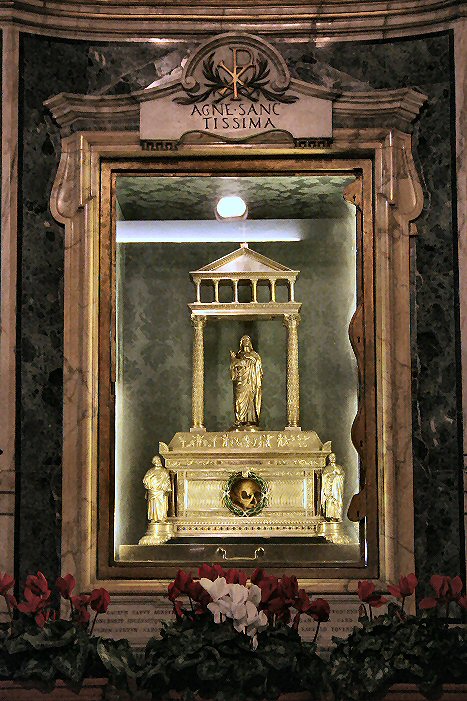
21 January: St. Agnes, virgin and martyrBehold the skull of Agnes.

The dies natalis ("birthday into heaven") of Agnes was recorded in the register of the depositio martyrum as 21 January.

St. Agnes was slain probably during the reign of the Emperor Diocletian in 304. Some say she died during the time of the Emperor Valerian (+260). The little girl was buried by her parents in praediolo suo, on their property along the Via Nomentana where there was already a cemetery. This cemetery expanded rapidly after that, because many wanted to be buried near the grave of the famous martyr. The ancient cemetery grew in stages between the Basilica which Constantina, daughter of Constantine and Fausta began over her tomb from 337-350 and the small round Basilica of Constantia (Constantine’s daughter). There was an acrostic inscription from that time in verses about the dedication of the temple to Agnes:

Constantina deum venerans Christoque dicata
Omnibus impensis devota mente paratis
Numine divino multum Christoque iuvante
Sacravit templum victricis virginis Agnes…

You get the idea.

The Basilica of St. Agnes was reconstructed towards the end of the 5th c. by Pope Symmachus (+514). Honorius I (+638) rebuilt it as a basilica with three naves, adding a wonderful fresco of Agnes. It was worked on again in the 16th c. by St. Pius V and in the 19t21 January: St. Agnes, virgin and martyrh by Bl. Pope Pius IX. Excavations in 1901 uncovered the silver sarcophagus made by Pius V for St. Agnes together with St. Emerentiana. It contained the headless body of a young girl.  Zadock gave us a photo of the miraclous protection of Bl. Pius IX when once at the Basilica there was a near disastrous cave-in/collapse and no one was injured.

While Agnes’s body is in her tomb on the Via Nomentana, her skull is now at the place of her supposed martyrdom at the Piazza Navona in Rome’s heart. It is a fitting place to venerate a saint so much in the heart of the Roman people even today. It is not unusual for people to name their children Agnes in honor of this great virgin martyr, whose name is pronounced in the Roman Canon. The skull was bequeathed to that church at the Piazza by Pope Leo XIII who took it from the treasury of the Sancta Sanctorum. The Piazza itself was in ancient times the Stadium of Domitian (+96) a place of terror and blood for early Christians, far more than the Colloseum ever was. The Piazza is thus called also the "Circo Agonale" and the name of the saint’s church Sant’Agnese in Agone. "Navona" is a corruption of "Agonale", from Greek agon referring to the athletic contests of the ancient world. St. Paul used the athlete’s struggle as an image of the Christian life of suffering, perseverance, and final victory even through the shedding of blood. Early Christian tombs often have wavy lines carved im the front, representing an iron instrument called a strigil, used by athletes to scrape dirt and oil from the bodies after contests. Victory palm branches are still used in the iconography of saints, as well as wreathes of laurels.

We know about St. Agnes from St. Jerome, and especially St. Augustine’s Sermons 273, 286 and 354. St. Ambrose wrote about Agnes in de virginibus 1,2,5-9 written in 377 as did Prudentius in hymn 14 of the Peristephanon written in 405. Ambrose has a wonderful hymn about Agnes (no. 8), used now in the Roman Church for Lauds and Vespers of her feast. The Ambrosian account differs somewhat from others. For Ambrose, Agnes died from beheading. Prudentius has her first exposed to shame in a brothel and then beheaded.

Here is the text of the hymn from the Liturgia horarum for the "Office of Readings" with a brutally literal translation.

Igne divini radians amoris
corporis sexum superavit Agnes,
et super carnem potuere carnis
claustra pudicae.

Shining with the fire of divine love
Agnes overcame the gender of her body,
and the undefiled enclosures of the flesh
prevailed over flesh.

Spiritum celsae capiunt cohortes
candidum, caeli super astra tollunt;
iungitur Sponsi thalamis pudica
sponsa beatis.

The heavenly host took up her brilliant white spirit,
and the heavens lifted it above the stars;
the chaste bride is united to the
blessed bride chambers of the Spouse.

Virgo, nunc nostrae miserere sortis
et, tuum quisquis celebrat tropaeum,
impetret sibi veniam reatus
atque salutem.

O virgin, now have pity on our lot,
and, whoever celebrates your victory day,
let him earnestly pray for forgiveness of guilt
and salvation for himself.

Redde pacatum populo precanti
principem caeli dominumque terrae
donet ut pacem pius et quietae
tempora vitae.

Give back to this praying people
the Prince of heaven and Lord of the earth,
that he, merciful, may grant us peace
and times of tranquil living.

Laudibus mitem celebremus Agnum,
casta quem sponsum sibi legit Agnes,
astra qui caeli moderatur atque
cuncta gubernat. Amen.

Let us celebrate with praises the gentle Lamb,
whom chaste Agnes binds to herself as Spouse,
he who governs the stars of heaven
and guides all things. Amen.

We can note a couple things from this prayer. First, the reference to fire probably a description of Agnes’s death related in a metrical panegyric of Pope Damasus about how Agnes endured martyrdom by fire. On the other hand, St. Ambrose, when speaking of her death, speaks of martyrdom by the sword.

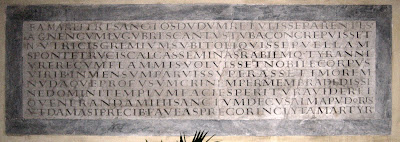
21 January: St. Agnes, virgin and martyrPope St. Damasus composed a panegyric, an elogia, inscribed in gorgeous letters on marble (designed and executed by Dionysius Philocalus) in honor of Roman saints, including Agnes.  This was the period when the Roman shifted from Greek to Latin.  Damasus was also trying to make a social statement with these great inscriptions, set up at various places about the City.   The panegyic of St. Agnes was placed in the cemetery near the saint’s tomb, but through the ages it was lost. Amazingly, it was at last rediscovered in 1728 inside the basilica, whole and complete: it had been used upside down, fortunately as a paving stone!

Now it is affixed to the wall in the corridor descending to the narthex. Its discovery was a find of vast importance (thanks to Zadok for the photo of the inscription).

FAMA REFERT SANCTOS DUDUM RETULISSE PARENTES
AGNEN CUM LUGUBRES CANTUS TUBA CONCREPUISSET
NUTRICIS GREMIUM SUBITO LIQUISSE PUELLAM
SPONTE TRUCIS CALCASSE MINAS RABIEMQUE TYRANNI
URERE CUM FLAMMIS VOLUISSET NOBILE CORPUS
VIRIBUS INMENSUM PARVIS SUPERASSE TIMOREM
NUDAQUE PROFUSUM CRINEM PER MEMBRA DEDISSE
NE DOMINI TEMPLUM FACIES PERITURA VIDERET
O VENERANDA MIHI SANCTUM DECUS ALMA PUDORIS
UT DAMASI PRECIBUS FAVEAS PRECOR INCLYTA MARTYR

21 January: St. Agnes, virgin and martyrIt is told that one day the holy parents recounted that Agnes, when the trumpet had sounded its sad tunes, suddenly left the lap of her nurse while still a little girl and willingly trod upon the rage and the threats of the cruel tyrant. Though he desired to burn the noble body in the flames, with her little forces she overcame immense fear and, gave her loosened hair to cover her naked limbs, lest mortal eye might see the temple of the Lord. O one worthy of my veneration, holy glory of modesty, I pray you, O illustrious martyr, deign to give ear to the prayers of Damasus.

Damasus used the sources available. There were the stories told by her parents, the 4th edict of Diocletian against Christians in 304 (lugubres cantus tuba concrepuisset). Agnes did what she did of her own free will (sponte). Note the reference to the body as temple of God (1 Cor 3:16 and 2 Cor 6:16).

St. Agnes of Rome, has two churches in Rome.  She has two feast days in the Roman calendar.  Since the reform of the calendar, who now has only one day, alas.

During excavations at the Basilica on the Via Nomentana in 1901 the silver sarcophagus made by St. Pius V for St. Agnes and St. Emerentiana was uncovered.

It was found to contain the headless body of a young girl.

Posted in SESSIUNCULA |
12 Comments

Sen. Kennedy -convulsions – hospitalized

During the inaugural luncheon, Sen. Edward Kennedy (D-MA) had a series of seizures at his table and was taken to the hospital. 

Posted in SESSIUNCULA |
Comments Off on Sen. Kennedy -convulsions – hospitalized

The 1st Presidential Proclamation

From the White House blog… the first Presidential Proclamation:

Tuesday, January 20th, 2009 at 12:01 pm
A National Day of Renewal and Reconciliation

Moments ago, in his first official act since taking the oath of office, President Barack Obama issued a proclamation, calling on Americans to serve one another and our common purpose on this National Day of Renewal and Reconciliation. Check it out below, or read it on the WhiteHouse.gov proclamations page.

    NATIONAL DAY OF RENEWAL AND RECONCILIATION, 2009

    – – – – – – –

    BY THE PRESIDENT OF THE UNITED STATES OF AMERICA

    A PROCLAMATION

    As I take the sacred oath of the highest office in the land, I am humbled by the responsibility placed upon my shoulders, renewed by the courage and decency of the American people, and fortified by my faith in an awesome God.

    We are in the midst of a season of trial. Our Nation is being tested, and our people know great uncertainty. Yet the story of America is one of renewal in the face of adversity, reconciliation in a time of discord, and we know that there is a purpose for everything under heaven.

    On this Inauguration Day, we are reminded that we are heirs to over two centuries of American democracy, and that this legacy is not simply a birthright — it is a glorious burden. Now it falls to us to come together as a people to carry it forward once more.

    So in the words of President Abraham Lincoln, let us remember that: "The mystic chords of memory, stretching from every battlefield and patriot grave to every living heart and hearthstone all over this broad land, will yet swell the chorus of the Union, when again touched, as surely they will be, by the better angels of our nature."

    NOW, THEREFORE, I, BARACK OBAMA, President of the United States of America, by the authority vested in me by the Constitution and laws of the United States, do hereby proclaim January 20, 2009, a National Day of Renewal and Reconciliation, and call upon all of our citizens to serve one another and the common purpose of remaking this Nation for our new century.

    IN WITNESS WHEREOF, I have hereunto set my hand this twentieth day of January, in the year of our Lord two thousand nine, and of the Independence of the United States of America the two hundred and thirty-third.

Posted in SESSIUNCULA |
Comments Off on The 1st Presidential Proclamation