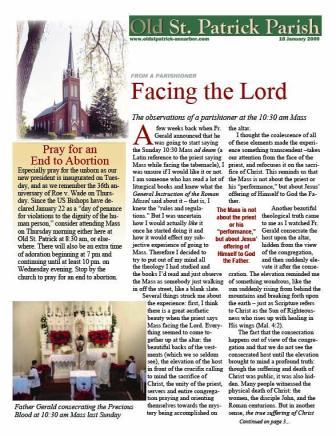
Subsequent to my posting about the initiative of Fr. Gerald Gawronski at Old St. Patrick’s in Ann Arbor, MI to "re-orient" his parish worship.
 In their parish bulletin the decision to celebrate ad orientem versus was discussed. In this, it seems parishioner, not the pastor, is commenting.
My emphases and comments.
A few weeks back when Fr. Gerald announced that he was going to start saying the Sunday 10:30 Mass ad deum (a Latin reference to the priest saying Mass while facing the tabernacle), I was unsure if I would like it or not. I am someone who has read a lot of liturgical books and knew what the General Instruction of the Roman Missal said about it – that is, I knew the “rules and regulations.” But I was uncertain how I would actually like it once he started doing it and how it would effect my subjective experience of going to Mass. Therefore I decided to try to put out of my mind all the theology I had studied and the books I’d read and just observe the Mass as somebody just walking in off the street, like a blank slate.
Several things struck me about the experience: [1] first, I think there is a great aesthetic beauty when the priest says Mass facing the Lord. Everything seemed to come together up at the altar: the beautiful backs of the vestments (which we so seldom see), the elevation of the host in front of the crucifix calling to mind the sacrifice of Christ, the unity of the priest, servers and entire congregation praying and orienting themselves towards the mystery being accomplished on the altar. [This is not an inconsiderable point. And it opens up the deeper realization of just how well the Roman liturgy was worked out and, of course, based on experience of centuries. Holy Church is the greatest expert on humanity there has ever been. There is the "psychology" of the liturgical experience to consider also: what impact does it have? The Roman liturgy is unsurpassed in this sphere. When it is simply carried out, as the books indicate, it has tremendous power.]
I thought the coalescence of all of these elements made the experience something transcendent – takes our attention from the face of the priest, and refocuses it on the sacrifice of Christ. This reminds us that the Mass is not about the priest or his “performance,” but about Jesus’ offering of Himself to God the Father. [The point of liturgy is to create an encounter with mystery. If liturgy doesn’t do that, it has failed.]
[2] Another beautiful theological truth came to me as I watched Fr. Gerald consecrate the host upon the altar, hidden from the view of the congregation, and then suddenly elevate it after the consecration. The elevation reminded me of something wondrous, like the sun suddenly rising from behind the mountains and breaking forth upon the earth – just as Scripture refers to Christ as the Sun of Righteousness who rises up with healing in His wings (Mal. 4:2). [Each Rite has the genius of denying to the participants some aspect of their senses. At various times people may not see or may not hear certain things. This is part of the "psychological" impact of the rite. It supports that encounter with mystery precisely in those heightened moments of the sacred action as described by the writer.]
The fact that the consecration happens out of view of the congregation and that we do not see the consecrated host until the elevation brought to mind a profound truth: though the suffering and death of Christ was public, it was also hidden. Many people witnessed the physical death of Christ: the women, the disciple John, and the Roman centurions. But in another sense, the true suffering of Christ was veiled. Nobody can possibly get a glimpse into the agony He endured from bearing the sins of the world, from enduring the total rejection of love and the desolation that came with it. No human being can ever comprehend this suffering. [mystery] This is what I got out of the Mass: the consecration happening in secret, veiled like the interior agony of Our Lord at His death, but then followed by the elevation before all the people, just as He was lifted up upon the cross for the whole world to gaze upon.
In the end, I found that I lost nothing by experiencing Mass said with the priest facing the altar, but that my experience was greatly enriched. It made Mass a more beautiful and edifying experience, and refocused my attention on the sacrifice being carried out on the altar, which in the end is what the whole liturgy is about: divine love offering itself for the salvation of mankind. As far as I’m concerned, anything that can bring this home to me more firmly is a welcome addition. I mentioned this because I think it is good for us all to discuss it. I was talking with Fr. Gerald the other day in the Church and he asked me what I thought about the Mass being said this way, and this article is my response. What do you think about it? Please let Father Gerald know. He is available to talk about it.
I would be interested to know the responses.
When Pope Benedict issued Summorum Pontificum I stated in the press and in interviews, in my articles and on this blog, that it would exert a "gravitational pull" on the way the Novus Ordo was celebrated.
I also said that Summorum Pontificum would affect the whole Church because it was such a gift to priests, especially to young priests. As priests learned about the older forms – and in this case the older, or more tradtional celebration of Holy Mass ad orientem they would come to a new understanding of who they were at the altar and what they were doing. In turn, this would impact an entire parish.
Pope Benedict’s writings on celebration ad orientem are much better known now that he is Pope. He has drawn attention to the proper orientation of Holy Mass through the so-called "Benedictine arrangement" of the altar, which is really just a transitional arrangement on the way to actually ad orientem worship. Summorum Pontificum has also helped to reinforce the sense of continuity we must have in our worship when using the Novus Ordo.
This was not just a "brick by brick" event, I think. It may have been "block by block" in Ann Arbor.

 The following prayer was composed by John Carroll, Archbishop of Baltimore, in 1791. He was the first bishop appointed for the United States in 1789 by Pope Pius VI. He was made the first archbishop when his see of Baltimore was elevated to the status of an archdiocese.


 January 18, 2009



 mibethda on Pope Leo XIV airplane interview: remarks about relaxing Traditional Latin Mass restrictions: “The prime rationale underlying Traditionis Custodes and the restriction of the Vetus Ordo Missae as declared by Pope Francis, Cardinal…”




























