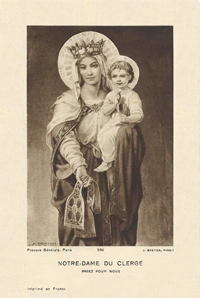
A big biretta tip o{]:¬) to Good Jesuit Bad Jesuit for this great photo:

This great picture is from a Polish Jesuit blog entitled, A Pilgrims Story see the picture (here)

A big biretta tip o{]:¬) to Good Jesuit Bad Jesuit for this great photo:
This great picture is from a Polish Jesuit blog entitled, A Pilgrims Story see the picture (here)
This is a must read from CNA:
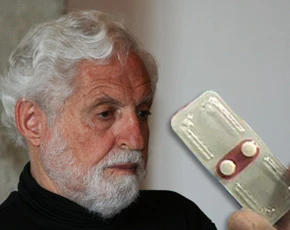
Vienna, Jan 11, 2009 / 02:10 am (CNA).- The chemist who made a key discovery leading to the invention of the birth control pill has written a commentary calling demographic decline in Europe a “horror scenario” and a “catastrophe” brought on in part by the pill’s invention.
Mr. Carl Djerassi, now 85 years old, was one of three researchers whose formulation of the synthetic progestagen Norethisterone marked a key step in the creation of the first oral contraceptive pill, the Guardian reports.
In a personal commentary in the Austrian newspaper Der Standard, Djerassi said his invention is partly to blame for demographic imbalance in Europe. On the continent, he argued, there is now “no connection at all between sexuality and reproduction.”
“This divide in Catholic Austria, a country which has on average 1.4 children per family, is now complete,” he wrote.
Djerassi described families who had decided against reproduction as “wanting to enjoy their schnitzels while leaving the rest of the world to get on with it.”
The fall in the birth rate, he claimed, was an “epidemic” far worse but less highlighted than obesity. In his view, young Austrians who fail to procreate are committing national suicide.
If it is not possible to reverse the demographic decline, an “intelligent immigration policy” will be necessary, Djerassi said.
According to the Guardian, Archbishop of Vienna Cardinal Christoph Schonborn told Austrian TV that Pope Paul VI had predicted the pill would cause a dramatic fall in the birth rate.
“Somebody above suspicion like Carl Djerassi … is saying that each family has to produce three children to maintain population levels, but we’re far away from that,” the cardinal said.
From a priest reader:
Fr. Z,
Your refrain ‘brick by brick’ has struck a cord with me. A reader recently sent in that he/she noticed the priest purifying his hands after the distribution of Holy Communion. I had started doing this some time ago, maybe a year? It was something I saw a few bishops doing at the College Seminary I attended. The reader asked if it was in the near future that the priest might begin to hold his thumb and forefinger together after the Consecration. Well, it took some practice to be able to life the chalice, how to flip pages and such; but I started to do this at private Masses that I said (as there are four priests for the three daily Masses where I reside). It got to the point where it was habitual to do just that, and now it is a regular part of my celebration of the Holy Eucharist. To me, it is a constant reminder of what I am doing as I celebrate. I hope to learn the Classical Form soon, when I can find time! Thanks for all your work. God Bless!
This is the sort of message that lifts my day!
I mostly use the post-Conciliar Liturgia horarum or Liturgy of the Hours for my office during the week.
So here I am on the road and we have a change of volumes, from 1 to 3. On the Novus Ordo side of the Roman Rite it’s now Monday of the 1st Week of Lesser Meatloaf Time … er um… Ordinary Time.
What to do? Wait to say all of my office when I get home?
I’ve done that before, I guess.
Use Universalis?
That’ll do in a pinch.
"But wait!", quoth I. "I have the app iBreviary on my iPhone!"
The application iBreviary is an ingenious little program that lives on your iPhone, giving you the option to look at the post-Conciliar Liturgy of the Hours in different langauges, including Latin.
I don’t use English. I just don’t. Italian… yah… okay… sometimes. But when your Latin is very strong, why use anything but Latin?
There are still some glitches in iBreviary, some typos and hang ups (at least for me) when you switch languages. It doesn’t automatically update to the present day when you open it, and must manually refresh from your last use. It needs a couple additional, smaller, fonts. But someone could say the office with this program on his gadget.
There is the cool-factor of having this on a phone. I prefer a book, frankly. But in a pinch, like now… it suits me well.
There is a page for the readings for Mass, but not in Latin. There is a page for "Prays", by which they really mean "Prayers"… I hope you like Italian.
This is a good initiative and the creators, the incredibly persistent don Paolo Padrini, has made a good go of it. Some work needs yet to be done, but if you have an iPhone you might find this quite useful.
I did this morning.
The Vatican’s Pontifical Council for Social Communication seems to think this app is alright.
The application costs Euro 0.79 or $0.99, and upgrades will be free.
 Several people alerted me to this interesting note posted by our friends at Rorate, a blog I look at every day, who seem always to be on top of this sort of thing.
FSSPX [This is the SSPX] Celebrates Mass at Amiens – in the Cathedral!
Having spent 63 Sundays celebrating Mass in the streets after being evicted from their chapel of 23 years in November of 2007, the FSSPX community of Amiens, France was invited into the Cathedral on Sunday to offer Mass at the altar of St. Joseph. The charitable gesture was made by the pastor of the Cathedral as the outdoor temperature dipped to 14ºF (-10ºC) creating a hazardous icy condition at the usual Mass site in front of church of St. Germain. The community thanked the pastor for his kindness.
Although the pastor’s motives are being debated in some quarters, let us pray that this is the start of a camaraderie between the local diocese and the FSSPX that will culminate in the finding of a permanent home for them in Amiens.
Amiens, des catholiques à la rue (photos)
Brique sur brique, mes amis.
I hope earnestly that the priests and followers of the SSPX were cordial and charming to everyone at the Cathedral.
Samples:
Look full to you?
Nice side altar…
From a reader:
Due to an emergency, my family couldn’t attend Mass on Sunday morning and thus had to attend on Sunday evening at a very "progressive" local parish. At the Mass, the priest omitted the Creed. I realize that on the Baptism of our Lord, the Creed is often replaced by a renewal of Baptismal vows, but that isn’t what happened; there was no Creed or renewal at all. I hadn’t been to this Church in years because the last time I went, the priest replaced the Creed with a poem, "The Woman’s Creed" ("I believe in God, the Father and Mother…"). I went back this time because I was over a barrel and had no other options to fulfill my obligation; plus I had heard things had improved. Wrong.
So:
1. Is Mass valid in such a case? and
2. What’s a guy to do? Up and leave the Mass? I did so with the “Woman’s Creed” incident since I had other options for my obligation, but this time I stayed because it was that or no Sunday Mass at all. Should I report this guy to the Archdiocese (Baltimore) or is that just vindictive? In any case, I prayed for him.
Sigh. Please remember those of us suffering in the Premier See; you are the virtual lifeline to orthodoxy for a lot of us here.
1) Mass is valid. Also, you fulfilled your obligation.
2) What to do? Go somewhere else, or else grit your teeth and bear it.
If you were going to the parish with any frequency and this was going on each time you went, then you might have to act. A question to the priest would be in order. After that a note to the diocesan bishop would have to follow.
However, since you were there once, you should probably assume that that priest in a moment of distraction simply forgot to do the Creed. It happens.
From a priest reader:
I have a question either for you, or if you choose to publish it on your blog, for anyone who can answer it.
In the 3 parishes I’ve been assigned to in my 10+ years of Priesthood, I’ve noticed that many women who receive Holy Communion in the hand seem to turn their rings around, so that, when they come to me with their hands poised to receive, the jewels of their rings face their palms. Any idea what’s behind that? I’m sure it has nothing to do with any rubrics, but I’m wondering if there’s any tradition behind doing so (something like "turning the rings to "decorate" the place where the Host will be placed). The parishes I’ve served in are in three different parts of New Jersey, so I’m sure it’s not a regional, geographic thing.
I have never noticed this, since I am not usually at a parish where any great number of folks receive in the hand.
My first reaction is that the women are turning their rings around so that they don’t catch on things, snag clothing, etc. I doubt very much it has anything to do with "decorating" their hands for Communion.
Perhaps some ladies will chime in… unless explaining this violates the Secret Rules and Tactics that are constantly being discussed in those unending strategy meetings going on in the "powder rooms" to which they always seem to withdraw in pairs or small groups.
From a reader:
I have been watching the papal liturgies on EWTN for several years. I recently noticed that when the Pope Benedict is wearing the pallium he SEEMS to be missing a pin/nail on the red cross over his right shoulder.
I can’t believe that the MC has forgotten this detail for several recent celebrations nor can I believe that, if lost, that a spare doesn’t exist.Therefore, I am wondering if there is some kind of symbolism here that I don’t understand. Can you briefly, I know that you are very busy, tell me why the pin is missing on the papal pallium?
Frankly, I hadn’t noticed.
Anyone?

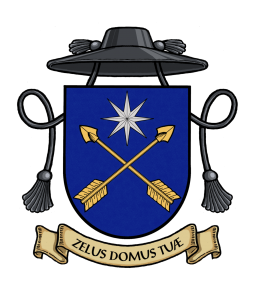
Coat of Arms by D Burkart
 mibethda on Pope Leo XIV airplane interview: remarks about relaxing Traditional Latin Mass restrictions: “The prime rationale underlying Traditionis Custodes and the restriction of the Vetus Ordo Missae as declared by Pope Francis, Cardinal…”
 on Pope Leo XIV airplane interview: remarks about relaxing Traditional Latin Mass restrictions: “I’m not sure why people are hanging their hat on the “not now” preface. It’s the exact same formula he…”
 on CQ CQ CQ – EWTN shut down its shortwave radio service on 31 October. Understandable, but I have some reservations.: “When I was flying everywhere in the world 25 years ago I always took my Sony short wave radio with…”
 on Pope Leo XIV airplane interview: remarks about relaxing Traditional Latin Mass restrictions: “I agree, strongly, with Abp Lefebvre that there was something about the Missal as molded over the years by SRC…”
 on Pope Leo XIV airplane interview: remarks about relaxing Traditional Latin Mass restrictions: “It is important to digest the pope’s initial answer of “No, not right now.” That is not an answer one…”
 on Pope Leo XIV airplane interview: remarks about relaxing Traditional Latin Mass restrictions: “It’s really remarkable the extent to which the Holy Father has swallowed the “party line” about TLM folks being divisive…”
 on Pope Leo XIV airplane interview: remarks about relaxing Traditional Latin Mass restrictions: “Frosty, not frothy. There’s a remark to be made about beer there as well.”
 on Pope Leo XIV airplane interview: remarks about relaxing Traditional Latin Mass restrictions: “Father, I wonder why you are translating an answer from Italian that he gave in English? Because, having watched the…”

A Daily Prayer for Priests





They find you a pro-life agent in your area who commits to giving a portion of the fee to a pro-life group!

PLEASE subscribe via PayPal if it is useful. Zelle and Wise are better, but PayPal is convenient.
A monthly subscription donation means I have steady income I can plan on. I put you my list of benefactors for whom I pray and for whom I often say Holy Mass.
In view of the rapidly changing challenges I now face, I would like to add more $10/month subscribers. Will you please help?
For a one time donation...



Help Monks in Wyoming (coffee – UPDATED LINK) and Norcia (beer) and the wonderful "Soap Sisters" of Summit, NJ!

Please follow me on Twitter!






Visits tracked by Statcounter
since Sat., 25 Nov. 2006:
 Vienna, Jan 11, 2009 / 02:10 am (CNA).- The chemist who made a key discovery leading to the invention of the birth control pill has written a commentary calling demographic decline in Europe a “horror scenario” and a “catastrophe” brought on in part by the pill’s invention.