3 Jan – Quadrantid meteor shower and SpaceRadio!

From Space Weather:

FIRST METEORS OF 2009:  The annual Quadrantid meteor shower peaks on Jan. 3rd when Earth enters a stream of debris from shattered comet 2003 EH1. The timing of the encounter favors observers in western North America and across the Pacific Ocean who could see dozens to hundreds of meteors during the dark hours before sunrise this Saturday morning. Visit http://spaceweather.com for a sky map and more information.

SOMETHING NEW: For the new year, Spaceweather.com is pleased to announce a new service: Space Weather Radio, broadcasting live "sounds from space" around the clock.  Today you can listen to the Air Force Space Surveillance Radar in Texas.  When a meteor passes over the facility–ping!–there is an audible echo. (Activity should be high during the Quadrantid meteor shower this weekend.)  In the near future we’ll be adding broadcasts of solar radio bursts and VLF signals from the ionosphere. The streams are punctuated by Daily Space Weather Updates from Dr. Tony Phillips.  Click here to begin listening:  http://SpaceweatherRadio.com

Posted in SESSIUNCULA |
3 Comments

Paris – 4 January TLM at St Eugène—Ste Cécile – Card. Vingt-Trois

From a reader:

Some readers may be interested in the news that Cardinal Vingt-Trois, the Archbishop of Paris, will celebrate Mass in the Extraordinary Rite at the Parish Church of St Eugène—Ste Cécile, Paris, on Sunday, 4th January 2009 (the feast of Ste Geneviève, patroness of the city). The occasion will be a farewell to Mgr Batut, the curé and friend of the TLM, who is to be ordained Auxiliary Bishop of Lyon.

Posted in Brick by Brick |
17 Comments

A sane priest in Indianapolis: the Sign of Peace is optional

A reader alerted me to the comments of Msgr. Joseph Schaedel, of the Archdiocese of Indianapolis, to his parishioners at Holy Rosary Church. 

Among other things, Msgr. Schaedel discusses the Sign of Peace.

Here is an excerpt from his Christmas bulletin.

They merit the WDTPRS touch, with my emphases and comments.

…

Some people have asked me about the Sign of Peace. They note that in most cases we omit the line, “Let us offer each other the Sign of Peace … ” during Masses in the Ordinary Form. Dozens of people have thanked for me this. One person inquired as to why. No one complained. And, the fact is that everyone is always free to “offer the Sign of Peace” to their neighbor. [I haven’t met many people who really like the Sign of Peace.  Many really don’t like and most just tolerate it.]

Here is the “why” part: Like many things in the celebration of Mass in the Ordinary Form, the Sign of Peace is optional. Several things are optional in “the English Mass.”  Other optional things are the ringing of the bells by the altar servers, the use of the paten at Holy Communion,  girls serving as altar servers, the priest facing the congregation, extraordinary Ministers of Holy Communion, even using a language other than Latin.  [Excellent!]

All of these things — and even more — are optional. They always have been. Yet, as we all know, some of these things have been pushed down our throats as if they had been the dying wishes of Christ written down by an apostolic liturgy committee on Calvary. [LOL!] Not so! And our current Holy Father, Benedict XVI, is finally helping us sort these things out.

From the beginning of the renewal of the Sacred Liturgy, some people have simply never liked the Sign of Peace — or at least the Sign of Peace where it was placed during Mass. It’s a grand thought: making peace with our neighbors before we approach the altar for Holy Communion. Yet, too often it turns into a free-for-all disturbing the solemnity of the moments just before receiving Holy Communion. Some people resemble politicians in heat prior to Election Day.

A few people object to the Sign of Peace for health reasons.  They watch their fellow worshippers cough or blow noses into their hands during Mass; then offer the same hands to shake at the Sign of Peace. In some places, where a flu or virus epidemic has been rampant diocesan officials have asked priests to eliminate the Sign of Peace for obvious reasons until health officials gave the green light.

Personally, I don’t have strong feelings one way or the other. [I do.  GET RID OF IT.] When I learned how to offer Mass in the seminary, we were taught to offer the Sign of Peace. No big deal. However, over the years, I began to see how it could get out of hand. I also began to omit it at daily Masses when the crowd was sparse and spread all over. If they were so interested in offering a sign of peace or friendship to another, I reasoned that they should have been willing to sit within twenty feet of one another.

At the moment, the whole concept of the Sign of Peace and if or where it should be situated during the Mass is under study at the Vatican. They will likely make a revision.  So, I thought: Heck, if the pope is not sure where and when it should be part of the Mass, who am I to worry about it?

If the priest-celebrant does not say, “Let us offer each other the Sign of Peace,” feel free to offer that sign of peace to those around you if you wish. No one says you cannot. If this causes you undue anxiety, sleepless nights, or a loss of Faith, I know a couple good therapists.

I feel sorry for those reading this pastor’s letter who expected a theological treatise on the true meaning of Christmas and the Incarnation.  No, it’s just the usual ramblings of the old monsignor at the Italian Parish.  Please excuse his attempts at being witty.  And, yes, he does have a serious thought from time to time.

Be sure to look at the bulletin also for his comments on the restoration of their church.  One of this comments about a woman who didn’t like their restoration:

I did meet someone last weekend who does not like the restoration. I forget what all she was griping about; but this person had nothing good to say about our church restoration. I quickly showed her one part of the church that has been beautifully restored in hopes that she would like it: the door.

I love this guy!

Give us, O Lord, more priests like this.
 

Posted in SESSIUNCULA |
170 Comments

Cistercians in Sparta, WI – saving the world

From a reader:

This morning at Spring Bank Abbey, [Sparta, WI] the Conventual Mass for the Solemnity of Mary the Mother of God was celebrated ad orientem, which will now be the normative manner for saying Mass at the abbey. (The Mass was solemn Latin in the ordinary form using the Cistercian Graduale.)

There are still many kinks and questions to address pertaining to the rank of feasts, the customs of the ordinary form v. surviving Cistercian usages, the size of our community, and the layout of our oratory. The draft customary will certainly see much fleshing-out and many amendments over the coming months, but Fr. Prior thought that today was the appropriate day to begin to face God together, it being the first of the year and a solemnity of Mary.

I thought that you and your readers might be interested.

I’ve attached a photo and there are more here.

Here is a shot.

Cistercians in Sparta, WI - saving the world


This is, IMO, the sort of thing which will help to save the world.

Cistercians in Sparta, WI - saving the world


Posted in Brick by Brick |
22 Comments

Tweet

Don’t forget Twitter!

@fatherz

Posted in SESSIUNCULA |
12 Comments

WDTPRS – 1 January – Octave of Christmas (1962MR)

What Does the Prayer Really Say?  1 January – The Octave of Christmas (1962 Missale Romanum)

During the Octave of the Nativity Holy Church helps us to rest in the mystery of the Lord’s Birth, His future Sacrifice, and the Divine Motherhood of Mary.  Our Church is the greatest expert in humanity there has ever been.  Octaves reflect her care that we have time to benefit more deeply from our encounter with mystery.  

Historically this day commemorates the moment when the Lord, without obligation, submitted to the Law of the Old Covenant and underwent the rite of circumcision, by which males became members of the People of God. This was the symbolic separation of the newly born member of God’s people from the old man and our sinful impulses. He was formally given His sacred Name.  Until 1960 and Bl. Pope John XXIII’s reform, this was known as the Feast of the Circumcision, and the day retains the powerful echo of the first moment the Lord shed Blood during His earthly life.  But today is also an ancient Marian feast.  Mary is the Mother of the divine Person, Jesus, not just the mother of His human nature. Mary is the Mother of God. The Circumcision also focuses us on the role of Mary in the Lord’s Sacrifice on Calvary.  At His Presentation in the temple and Circumcision, Mary with solemn joy and knowledge of future sorrow, formally offered the Lord to the Father.

I found a useful comment on the blog of my friend Fr. Ray Blake, the distinguished pastor of St. Mary Magdalene in Brighton, England.  Let’s have a bit of it on this beautiful feast day, as a lens for our feast.

Pelagianism: I hate it, but it is very British. It is really a variant of Arianism which says God did not truly become Man, because Jesus was not truly God. Pelagianism denies the action of Grace in the world; man is saved by his own goodness and efforts, rather than by God.  It is what we do, rather than what God does that matters, therefore the value of the sacraments is the psychological effect they have in our lives, rather than the direct intervention of God. It denies the power of Grace, of the role of the Blessed Virgin, of miracles, of the power of prayer: Pelagians above all would deny the role of the Holy Spirit, of His act of sanctification. Wherever there is attempt to place man at the heart of the faith, there we should expect to find Pelagianism.  Pelagianism expects Man to be strong rather God’s grace to be powerful. Catholicism, or as we could call it, mainstream Christianity, acknowledges mankind is weak and wholly dependent on those things God gives him.

Signs of the Pelagian: The Church is a human construct and there is nothing or little of Grace about it. The Liturgy and prayer is about how it makes us feel. Feelings rather than Grace are important. Revelation is not a given, something given for today and all time, but something of that past that depends on our interpretation. Ultimately, Pelagianism says God is irrelevant to society and to the individual. Pelagians tend to have a poor view of mankind, what you see is what you get, because there is no room for Grace. It is also elitist, insofar as it values a human being by his goodness, his talents, his skills, his willpower.

Devotion to the Blessed Virgin is the destroyer of Pelagianism. Her whole being was about saying yes to Grace. Being the Mather of God she became the source of Grace. Her life shows the effects and power of Grace.

I will add to Fr. Blake’s observations two other marks of the Pelagian: their penchant for defending the lame-duck ICEL translations and a resistance to the norms of Liturgiam authenticam.

We turn now to the orations for today’s Holy Mass, beginning with our …

COLLECT (1962MR):
Deus, qui salutis aeternae, beatae Mariae virginitate fecunda,
humano generi praemia praestitisti:
tribue, quaesumus; ut ipsam pro nobis intercedere sentiamus,
per quam meruimus auctorem vitae suscipere.

This prayer survived in the Novus Ordo as the Collect for the Solemnity of Mary Mother of God. It is ancient, of course.  It was in the pre-Conciliar Missal and, slightly different, in the Gelasian Sacramentary for the Assumption of Mary on 15 August (xviii Kalendas Septembris).   This Collect is used on other occasions as well.  For example, in the older form of the Divine Office, the Breviarium Romanum, it is prayed after singing the Marian antiphon Alma Redemptoris Mater following Compline from the 1st Vespers of Christmas until the Vespers of the Purification.

Now, please forgive me, I must include the laughably deficient lame-duck version from…

ICEL (1973 translation of the 1970MR):
God our Father,
may we always profit by the prayers
of the Virgin Mother Mary,
for you bring us life and salvation
through Jesus Christ her Son…

LITERAL TRANSLATION:
O God, who by the fruitful virginity of Blessed Mary
bestowed upon the human race the rewards of eternal salvation,
grant, we beg, that we may perceive her interceding for us,
through whom we merited to receive Your Son, the author of life.

As I said before, the Circumcision resounds deeply throughout this Mass.  The Roman Station for today is the ancient basilica dedicated to Mary, S. Maria in Trastevere.  However, our knowledge of history reminds us that the Station used to be in even more ancient times the basilica S. Maria ad martyres, the other name of the Pantheon in the heart of Rome.  The “rewards of eternal salvation” were won only through the shedding of the Son of Mary’s Blood. 

The wood of the crib, the knife of the Circumcision foretell the Cross, the nails and the lance.

In the paradoxical phrase “fruitful virginity” we approach the heart of our Christian faith.  God draws everything from nothingness.  He brought water from the rock in the desert, children to barren crones, great victories to tiny armies, a shepherd boy to a throne, healing to wounds.  He brings life from physical and spiritual death.  Fecunda virginitas encapsulates other elements of the prayer: “author of life”… “rewards of eternal salvation”.   

We move to the silent Secret. 

The wine about to be changed into the Precious Blood, gleams in the chalice on the altar, the unbroken Host waits upon the white linen.  This Secret was also prayed on Septuagesima Sunday.  You will find this oration also in your own trusty copies of the 9th century Liber Sacramentorum Augustodunensis and the 8th century Engolismensis.  I couldn’t find it in the post-Conciliar editions of the Missale Romanum.  

SECRET (1962MR):
Muneribus nostris, quaesumus, Domine,
precibusque susceptis:
et caelestibus nos munda mysteriis,
et clementer exaudi.

The first part of the prayer is an ablative absolute. In the second part there is a standard et…et construction.  The prayer is terse, elegant.

Mundo means “to make clean”, especially from sin, in ecclesiastical Latin texts.

LITERAL TRANSLATION:
Our gifts and prayers having been received,
we beseech You, O Lord:
both cleanse us by these heavenly mysteries,
and mercifully hark to us.

In the Collect Mary, the fruitful virgin, focuses us on our dependence on God, origin and goal of all being.  Now we show humble confidence that God is attending to our actions. We focus on the means by which we will be cleansed from the filth of our sins, namely, the Sacrifice of Jesus, Incarnate Word, about to be renewed upon the altar.  The grace is all His.  The filth is all ours.  

The Postcommunion is an ancient prayer, found in various old versions of the Gelasian, including the Engolismensis and Gellonensis for the feast of St. Stephen, Pope and Martyr, during August, with changes of course, as well as during the 4th week after Pentecost.

POSTCOMMUNIO (1962MR):
Haec nos communio, Domine, purget a crimine:
et, intercedente beata Virgine Dei Genetrice Maria,
caelestis remedii faciat esse consortes.

In the Lewis & Short Dictionary we find that crimen is “a judicial decision, verdict, judgment; hence, like the Greek krima, of the subject of such a decision, and with particular reference either to the accuser or to the accused”.  This is related to the Latin verb cerno, “to separate, distinguish by the senses; to perceive”, etc. Think of the word “discrimination”, the ability to discern and decide between things.  In the Latin liturgical dictionary I call Blaise/Dumas we find that crimen is a “crime” or “sin” especially original sin.  When we start deciding things apart from God’s plan and His image written into our beings, we get mired in the filth of our sins.

A TRANSLATION (The Daily Missal and Liturgical Manual – Baronius Press)
May this Communion, O Lord, cleanse us from guilt:
and through the intercession of the blessed Virgin Mary,
Mother of God, make us sharers of the heavenly remedy.

Communion is to be received in the state of grace. Many should be communing only spiritually and not also physically. It is appropriate that, in this moment of joyful awe at transcendence, we should recall our need for cleansing.  On our own, we are nothing.  We get into terrible trouble.  With Christ, “God with us”, Emmanuel we are made clean and whole and given more than we lost by our own devices.  The “yes” of Mary, her joy in the Birth of the Lord, her fidelity in the Presentation, her standing by the Cross all redirect us back to the source of our cleansing, the remedy for our self-inflicted wounds.

Seek His cleansing.

Octaves are mysterious times. During a liturgical octave time is “suspended”.  A lifetime is insufficient, and eternity will not suffice to contemplate the mystery the Nativity.  Happily we have these several days and not merely one to focus our minds and hearts.  When we settle into the mystery, if rest in it for a while patiently we are more likely to allow God to direct our minds.  

During this Octave, we must – in this time of uncertainty, on this threshold of what likely will be a harder year – give our thoughts to the magnificence of the Lord’s condescension in taking our human nature into that indestructible bond with His divinity in order to save us from our sins and teach us more fully who we are.  We can learn from Our Blessed Mother how to contemplate the Lord.  We learn about our dependence on Him and our own inadequacy, beautiful as we are as God’s images, a little less than angels, crowned in glory and honor (cf. Ps. 8:6).  Our Mother constantly directs our gaze to the only source of saving grace.

Posted in Christmas and Epiphany, WDTPRS |
29 Comments

WDTPRS – 1 Jan – Mary, the Mother of God (2002MR)

The prayers for the Solemnity of Mary Mother of God in the 2002MR.

COLLECT (2002MR)
Deus, qui salutis aeternae, beatae Mariae virginitate fecunda,
humano generi praemia praestitisti,
tribue, quaesumus, ut ipsam pro nobis intercedere sentiamus,
per quam meruimus Filium tuum auctorem vitae suscipere.

LITERAL TRANSLATION
O God, who by the fruitful virginity of Blessed Mary
bestowed upon the human race the rewards of eternal salvation,
grant, we beg, that we may perceive her interceding for us,
through whom we merited to receive Your Son, the author of life.

This prayer was in the pre-Conciliar Missal and, slightly different, in the Gelasian Sacramentary for the Assumption of Mary on 15 August (xviii Kalendas Septembris). 

Now, please forgive me, but I must include the laughably deficient lame-duck version from…

ICEL (1973 translation of the 1970MR):
God our Father,
may we always profit by the prayers
of the Virgin Mother Mary,
for you bring us life and salvation
through Jesus Christ her Son…

Let’s now move on to the so-called “Prayer over the gifts”.   This following prayer was not in the pre-Conciliar Missal, but it does have an antecedent in the ancient Veronese Sacramentary within the body of prayers for September in what appear to be a collection of prayers for the ordination of bishops (“in natale episcoporum”).

SUPER OBLATA (2002MR)
Deus, qui bona cuncta inchoas benignus et perficis,
da nobis, de sollemnitate sanctae Dei Genetricis laetantibus,
sicut de initiis tuae gratiae gloriamur,
ita de perfectione gaudere.

The super useful Lewis & Short Dictionary gives us a fascinating piece of information about initium.  Along with “a beginning, commencement” it also means – this is so cool – “secret sacred rites, sacred mysteries, to which only the initiated were admitted”.  

ICEL (1973 translation of the 1970MR):
God our Father,
we celebrate at this season
the beginning of our salvation.
On the feast of Mary, the Mother of God,
we ask that our salvation
will be brought to its fulfillment.

A lot is going on herein this elegant Latin prayer.  First, the priest acknowledges that all good things have their beginning in God.  We are His instruments, truly involved, but He is the one who brings them to a good completion: He perfects them through us.  The sicut…ita construction sets up a proportional relationship between the two clauses.  Just so, we ask God 1) to grant to us to rejoice in the fact of God bringing good things to completion and perfection and, moreover, 2) to grant that we in like manner may revel in the mysterious things He set in motion to begin with. 

Furthermore, the context of this prayer is a) the Christmas Octave feast of the Mother of God, focused on Mary’s maternity of the divine Person Jesus Christ and also of His Church, us, the members of Christ’s Body and, moreover, b) the raising up to God of the good fruits of the earth God gave us and we worked with our efforts, and His imminent transformation of them through the priest’s words and actions.  God begins every good thing.  He uses us who cooperate with His plan, and He perfects all things for our benefit and His glory. 

Notice the de…de…de, all three of which point to the causes of our joy: i) the solemn feast of and fact of Mary’s divine Motherhood, ii) the mysterious gifts (even this Mass itself – initia) accruing to the initiated (baptized and in the state of grace) from God’s free gifts, iii) their perfection/completion.   It is super hard to convey the impact of this prayer in English without getting really wordy.

LITERAL TRANSLATION
O God, who kindly begin all good things and bring them to completion,
grant us, now rejoicing over the solemnity of the Holy Mother of God,
so to delight about perfect completion,
as we are glorying about the initiatives of Your grace.

We are coming to the ending of Holy Mass.  Those who were able to do so received Holy Communion.  There follow a time for reflection and perhaps exaltation of the soul in song.  

It has been years since we looked at Post communion prayers, so let’s review what they are.  The context of Mass for the Post communionem has a structure similar to contexts of the Collect and Super oblata.  In each case there is movement from one place to another in the church: the entrance procession, offertory procession, and the procession for Communion.  In each case a choir or schola traditionally sings a psalm with antiphon (see what you lose when you lose Gregorian chant?).  In each case the priest makes introductory silent prayers: the “prayers before the altar” in the older form of Mass, the hushed prayers (audible in the Novus Ordo) while preparing the paten and chalice, and finally the orisons he softly recites while purifying the sacred vessels after Communion.  In each case the pattern of song and prayer conclude with the priest’s audible prayer, always introduced with an invitation of Oremus… “Let us pray” (and in the traditional form of Mass with the 1962MR the courteous and elegant greeting Dominus vobiscum preceding each invitation).  The pattern is present in proclaiming the Gospel: the priest or deacon’s silent prayer for grace and worthiness, the procession with the Evangelarium, the greeting, reading, and sermon, the invitation to pray the so-called “prayers of the faithful”, followed by the concluding prayer by the priest.  The structure is the same in all four instances.  

In fact, St. Augustine of Hippo (+430) distinguished four sections of the Mass, the last of which after Communion was called the gratiarum actio, the “thanksgiving” (cf. ep. 149,16).  In contrast to the Eastern rites (and unlike this column sometimes) the Roman Rite is characterized by concise, spare language.  However, for many centuries until the Novus Ordo the Latin Rite’s Mass had a double closing consisting of prayers of thanksgiving and of blessing.  Happily these post Post Communion blessing prayers have been reinstated to the 2002 edition of the Missale Romanum during the season of Lent after an absence of some thirty years… which restoration makes me wonder how “upset” people in the pews will get from such a radical change!  After all, the addition of a prayer makes Mass longer!  And sputter for heaven’s sake, those blessing prayers were conspicuously absent from Mass for a venerable three whole decades, an out-and-out tradition!  But I digress….   

The style and structure of our Latin Post communionem prayers is virtually the same as that of the Collect and the old Secret or Super oblata.  These are prayers of petition addressed to God the Father through the Son (per Dominum nostrum).   They focus on our gratitude to the Father for all His blessings, especially the continual gift of His Son in Holy Communion.  So, the Post communion thanksgiving embraces the Communion of all the faithful, laity and priest together.  This was so even in the centuries when people received Communion rarely during the year.

So, at this point in our New Year’s Day Mass, in honor of the Mother of God, the priest, who during Mass is Christ the Head of the Body, speaks for the whole Body, the Church, raising prayers of thanks to the Father for the fact of and effects of the Eucharist, singing:

POST COMMUNION (2002MR)
Sumpsimus, Domine, laeti sacramenta caelestia:
praesta, quaesumus,
ut ad vitam nobis proficient sempiternam,
qui beatam semper Virginem Mariam
Filii tui Genetricem et Ecclesiae Matrem
profiteri gloriamur.

LITERAL TRANSLATION
O Lord, we happy ones have consumed the heavenly sacraments:
grant, we beseech You,
that they may be advantageous unto eternal life for us
who exalt to profess blessed Mary ever Virgin,
Mother of Your Son and Mother of the Church.

This is based on a prayer in the ancient Gelasian Sacramentary but it was not in an edition of the Roman Missal before the Council.  An odd thing about this prayer is that it has a colon at the end of the first line.  Colons were often an indication for how to sing the prayers, though they were expunged the editions after the Council.  

ICEL (1973 translation of the 1970MR):
Father,
as we proclaim the Virgin Mary
to be the mother of Christ and the mother of the Church,
may our communion with her Son
bring us to salvation.

Posted in Christmas and Epiphany, WDTPRS |
19 Comments

New Year’s greetings to you all!

I wish all of you joy, peace and graces for the new year of salvation 2009!

Posted in SESSIUNCULA |
40 Comments

WDTPRS on the finalist list for Weblog Awards

Our WDTPRS project is on the finalist list for the Weblog Awards this year.

Voting begins on 5 January.

Let’s keep our Catholic blogs in the forefront of this new means of social communication!

Posted in SESSIUNCULA |
7 Comments

Holy Father’s 1st Vespers live

Earlier today I streamed the Vatican Radio audio feed of the Holy Father’s 1st Vespers from the Vatican Basilica. 

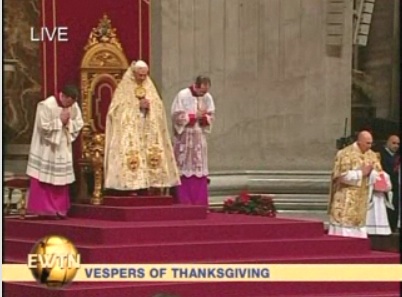
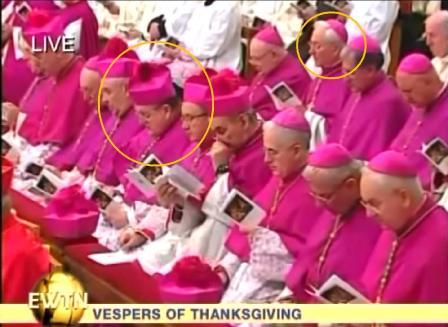
I couldn’t access CTV for the live feed without such interference and to capture images.  Our friends at NLM, the liturgical eye-candy specialists, picked up some pics from the EWTN feed.  Here is one.

Holy Father's 1st Vespers live

I have a few more images now.

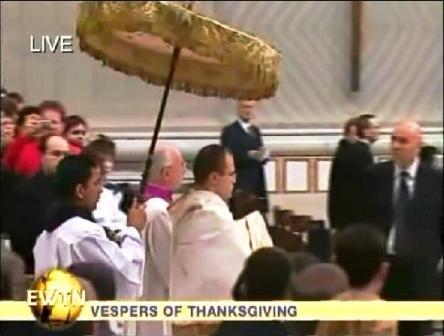
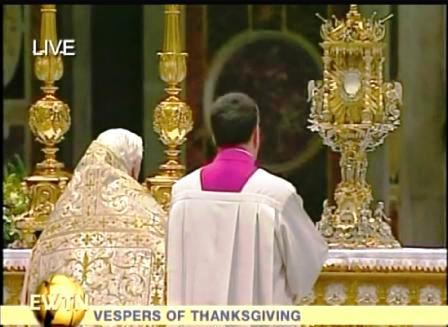
I like the use of the ombrellino to bring the Blessed Sacrament to the altar.

Holy Father's 1st Vespers live

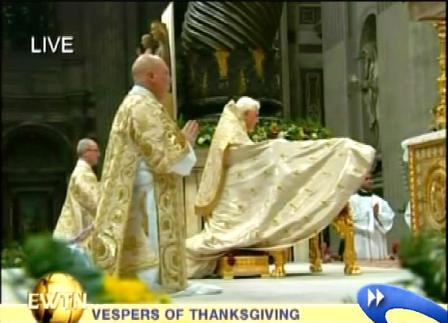
This is how you drape a cope when kneeling at the bench.  Copes should also be closed in front, over the knees, when seated.

Holy Father's 1st Vespers live

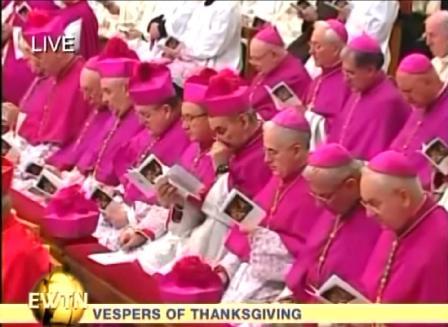
More and more we are seeing birettas on prelates.  Here are some curial bishops and archbishops.

Holy Father's 1st Vespers live

Among them the great Archbp. Burke, Prefect of the Segnatura and, in back, a former papal MC.

Holy Father's 1st Vespers live

Adoration of the Blessed Sacrament.

Holy Father's 1st Vespers live

Some bullet points of the Roman Pontiff’s sermon pronounced in Italian:

  • 1st Vespers of the Marian feast.
  • O admirabile commercium, the antiphon for the first psalm.  "Wondrous exchange".  In the Te Deum we sing "Tu, ad liberandum suscepturus hominem, non horruisti Virginis uterum"
  • Tonight we are invited to gaze at Mary who received Christ in her heart and brought Him to the light of the world.
  • Theotokos.  Mary is known as Mother of God from antiquity.  The Church affirms this belief.
  • Thanksgiving for the year placed in the hands of Mary.  This is shared with those present, from city and ecclesiastical government and the faithful present.
  • Ask forgiveness for our poor use of time.
  • We must know how to give thanks every day, for only in Christ is the light of the mystery of man. (Gaudium et spes 22).
  • Christ’s presence is a gift to be shared by all.  Initiatives of charity.  Educate people in hope.
  • The uncertainty of our day.  Mary leads us to Christ.  Vocations of parents.
  • Concern for the city of Rome, a hedonistic mentality.  There is a growing need for evangelization.
  • Young people: don’t be afraid!  Don’t fear the task the Lord has entrusted to you.  The Holy Spirit will help you bear witness to the joy of faith and the beauty of being Christian.
  • "The world falls into ruin and everyone is thinking of himself."
  • The maternal presence of Mary assures us that God will never abandon us.

<!–ustream feed–>

Posted in SESSIUNCULA |
24 Comments