American Bishops respond to Nancy Pelosi (D-CA)

What do the American bishops have to say as a body about Speak Pelosi’s remarks?

Bishops respond to House Speaker Pelosi’s misrepresentation of Church teaching against abortion

WASHINGTON–Cardinal Justin F. Rigali, chairman of the U.S. Bishops’ Committee on Pro-Life Activities, and Bishop William E. Lori, chairman of the U.S. Bishops’ Committee on Doctrine, have issued the following statement:

In the course of a “Meet the Press” interview on abortion and other public issues on August 24, House Speaker Nancy Pelosi misrepresented the history and nature of the authentic teaching of the Catholic Church against abortion.

In fact, the Catechism of the Catholic Church teaches, "Since the first century the Church has affirmed the moral evil of every procured abortion. This teaching has not changed and remains unchangeable. Direct abortion, that is to say, abortion willed either as an end or a means, is gravely contrary to the moral law." (No. 2271)

In the Middle Ages, uninformed and inadequate theories about embryology led some theologians to speculate that specifically human life capable of receiving an immortal soul may not exist until a few weeks into pregnancy. While in canon law these theories led to a distinction in penalties between very early and later abortions, the Church’s moral teaching never justified or permitted abortion at any stage of development.  [This is something that bears repetition: even though theologians in centuries past were working from scientific knowledge less advanced than that of today, through the history of the Church abortion has never been condoned.]

These mistaken biological theories became obsolete over 150 years ago when scientists discovered that a new human individual comes into being from the union of sperm and egg at fertilization. In keeping with this modern understanding, the Church teaches that from the time of conception (fertilization), each member of the human species must be given the full respect due to a human person, beginning with respect for the fundamental right to life.

More information on the Church’s teaching on this issue can be found in our brochure "The Catholic Church is a Pro-Life Church".  PDF  Text

Posted in SESSIUNCULA |
10 Comments

Washington’s Archbp. Wuerl responds to Speaker Pelosi (D-CA)

His Excellency Donald W. Wuerl responds to Speaker Pelosi:

Archbishop Wuerl on the Church’s Constant Teaching on Abortion

August 25, 2008

The following statement is from Washington Archbishop Donald W. Wuerl:

On Meet the Press this past Sunday, August 23, 2008, Speaker of the House Nancy Pelosi made statements regarding the teaching of the Catholic Church, human life and abortion that were incorrect.

Speaker Pelosi responded to a question on when life begins by mentioning she was Catholic. She went on to say, “And what I know is, over the centuries, the doctors of the Church have not been able to make that definition…” After Mr. Tom Brokaw, the interviewer, pointed out that the Catholic Church feels strongly that life begins at conception, she replied, “I understand. And this is like maybe 50 years or something like that. So again, over the history of the church, this is an issue of controversy.”

We respect the right of elected officials such as Speaker Pelosi to address matters of public policy that are before them, but the interpretation of Catholic faith has rightfully been entrusted to the Catholic bishops. Given this responsibility to teach, it is important to make this correction for the record.

The Catechism of the Catholic Church is clear: the current teaching of the Catholic Church on human life and abortion is the same teaching as it was 2,000 years ago. The Catechism reads:

“Human life must be respected and protected absolutely from the moment of conception…Since the first century the Church has affirmed the moral evil of every procured abortion. This teaching has not changed and remains unchangeable. Direct abortion, that is to say, abortion willed either as an end or a means, is gravely contrary to the moral law.” (Catechism, 2270-2271)

The Catechism goes on to quote the Didache, a treatise that dates to the first century: “’You shall not kill the embryo by abortion and shall not cause the newborn to perish.’”

From the beginning, the Catholic Church has respected the dignity of all human life from the moment of conception to natural death.

Contact:
Susan Gibbs
Director of Communications
301-853-4517
gibbss@adw.org 

Posted in SESSIUNCULA |
6 Comments

NY’s Card. Egan responds to Rep. Pelosi

His Eminence Edward Card. Egan of New York has issued a press release in response to Speak Nancy Pelosi’s (D-CA) remarks on Meet The Press last Sunday.

Let’s look with my emphases and comments.

Statement on Remarks by Speaker Pelosi

August 26, 2008

FOR IMMEDIATE RELEASE: August 26, 2008

STATEMENT OF HIS EMINENCE, EDWARD CARDINAL EGAN CONCERNING REMARKS MADE BY THE SPEAKER OF THE HOUSE OF REPRESENTATIVES

Like many other citizens of this nation, I was shocked to learn that the Speaker of the House of Representatives of the United States of America would make the kind of statements that were made to Mr. Tom Brokaw of NBC-TV on Sunday, August 24, 2008. What the Speaker had to say about theologians and their positions regarding abortion was not only misinformed; it was also, and especially, utterly incredible in this day and age. [Indeed, "utterly incredible"… in the sense that no one who said what she says can credibly claim to have either studied what the Church says or can claim to be an ardent Catholic.  We simply cannot believe her.]

We are blessed in the 21st century with crystal-clear photographs and action films of the living realities within their pregnant mothers. No one with the slightest measure of integrity or honor [whew] could fail to know what these marvelous beings manifestly, clearly, and obviously are, as they smile and wave into the world outside the womb. In simplest terms, they are human beings with an inalienable right to live, a right that the Speaker of the House of Representatives is bound to defend at all costs for the most basic of ethical reasons. They are not parts of their mothers, and what they are depends not at all upon the opinions of theologians of any faith. Anyone who dares to defend that they may be legitimately killed because another human being “chooses” to do so or for any other equally ridiculous reason should not be providing leadership in a civilized democracy worthy of the name.  [Exactly.]

Edward Cardinal Egan

Archbishop of New York

WDTPRS Kudos to Card. Egan!

Posted in SESSIUNCULA |
29 Comments

26 Aug: St. Melchisedech

In your handy copy of the 2004 Martyrologium Romanum you find that today is the … well… read it yourself:

1. Commemoratio sancti Melchisedech, regis Salem et sacerdotis Dei Altissimi, qui Abraham benedicens salutavit a victoria regressum, Domino sanctum sacrificum, immaculatam hostiam, offerns, atque in praefiguratione Christi rex pacis et iustitiae interpretatus est et, licet genealogiae expers, sacerdos in aeternum.


I bet you readers can come up with your own perfect renderings of this entry.

Posted in SESSIUNCULA |
12 Comments

Looking for Latin-upon-Avon: teacher needed

I have been a fierce proponent of training in Latin for men who would be priests of the Latin Church. 

However, over the years I have somewhat modified by views.

I haven’t changed my mind that men in seminary need to study Latin, and intensely.

Rather, by the time they get to major seminary, it may be too late.

Latin must be integrated into our Catholic school curricula from an early age.

So, I perk up my ears when I hear about Latin being taught, whether in Catholic or public schools. 

With a tip of the biretta I share a post I found rather interesting from over at rogueclassicism, which I check daily.

Take a look at this, with my emphases and comments.

From the Enterprise:

The school system will no longer offer courses in Latin, credited with boosting English language mastery and SAT scores, unless the district finds a full-time Latin teacher to hire, school officials said. “We did look for a Latin teacher, but we were unsuccessful,” school Superintendent Margaret Frieswyk told the School Committee Monday. Latin teacher Brendan Jones resigned in June to pursue graduate studies. Avon hired him back as a part-timer to teach second year Latin courses, Frieswyk said. She said the Middle High School would continue to offer Spanish and French [mostly irrelevant] classes, but no first year Latin courses unless the district finds a full-time teacher, preferably someone certified to teach Latin and Spanish. [So, they must be able to teach both.] Students continue to be very interested in Spanish classes, and French holds its own as an academic language, she said. If Avon discontinues Latin, Frieswyk said the school district would consider adding another foreign language, possibly German or Chinese Mandarin, [Excellent!  Kids who get trained up in languages such as Chinese, Arabic or Farsi will have a great advantage in the future.] but not Russian. Students studying Chinese Mandarin in the Whitman-Hanson and Hingham school districts seem to be having a very difficult time learning the language,  [No…. surely not!] she said. Avon would also consider adding Portuguese or Cape Verdean or Haitian Creole, she said. “We’ll continue to look for a Latin teacher,” Frieswyk said. “Latin is a course I wanted to preserve and I have worked to do that.”

Avon Middle High School’s webpage with info on who to apply to is here …


Posted in SESSIUNCULA |
32 Comments

Archbp. Chaput (RC-Denver) vs. Speaker Pelosi (D-CA)

From Catholic News Agency.  My emphases and comments:

Archbp. Chaput (RC-Denver) vs. Speaker Pelosi (D-CA)Denver archbishop slams Pelosi on Church teachings and abortion

Rep. Nancy Pelosi / Archbishop Chaput

.- In a statement eloquently titled “On the Separation of Sense and State,” [God Bless this worthy bishop, if for that phrase alone!] the Archbishop of Denver, Charles J. Chaput, O.F.M. Cap., and his Auxiliary Bishop James D. Conley harshly criticized Speaker of the House Nancy Pelosi, for giving a confusing view of the Catholic Church’s teaching on abortion, during a Sunday interview on NBC’s “Meet the Press.” [Read and watch it here.]

“Catholic public leaders inconvenienced by the abortion debate” –says the statement- “tend to take a hard line in talking about the ‘separation of Church and state.’  But their idea of separation often seems to work one way.” 

“In fact, some officials also seem comfortable in the role of theologian. [Nailed it.]  And that warrants some interest, not as a ‘political’ issue, but as a matter of accuracy and justice.”

Archbishop Chaput’s statement recognizes Pelosi as “a gifted public servant of strong convictions and many professional skills” but adds that “regrettably, knowledge of Catholic history and teaching does not seem to be one of them.”  [regrettably… but with deadly consequences for some!]

During the Meet the Press interview on August 24, Pelosi responded to a question about when human life begins by saying that “as an ardent, practicing Catholic, this is an issue that I have studied for a long time.  And what I know is over the centuries, the doctors of the church have not been able to make that definition . . . St. Augustine said at three months.  We don’t know. The point is, is that it shouldn’t have an impact on the woman’s right to choose.”

The Archdiocese of Denver argues that since Speaker Pelosi claims to have studied the issue “for a long time,” “she must know very well one of the premier works on the subject, Jesuit John Connery’s Abortion: The Development of the Roman Catholic Perspective (Loyola, 1977). [Step into my ring, and you get what’s coming to you.]

The statement recall’s Connery’s conclusion: “The Christian tradition from the earliest days reveals a firm antiabortion attitude . . . The condemnation of abortion did not depend on and was not limited in any way by theories regarding the time of fetal animation. [Which is what Pelosi’s ever-so-informed observations were based on.]  Even during the many centuries when Church penal and penitential practice was based on the theory of delayed animation, the condemnation of abortion was never affected by it.  Whatever one would want to hold about the time of animation, or when the fetus became a human being in the strict sense of the term, abortion from the time of conception was considered wrong, and the time of animation was never looked on as a moral dividing line between permissible and impermissible abortion.”  [Everyone: memorize this.  Be prepared to repeat that and name the author.  I just put it on my wish list.]

The Archdiocese’s statement also quotes “the blunter words of the great Lutheran pastor Dietrich Bonhoeffer.”

Bonhoeffer, a strong critic and later victim of the Nazi regime in his native Germany wrote that “the destruction of the embryo in the mother’s womb is a violation of the right to live which God has bestowed on this nascent life. To raise the question whether we are here concerned already with a human being or not is merely to confuse the issue. The simple fact is that God certainly intended to create a human being and that this nascent human being has been deliberately deprived of his life. And that is nothing but murder.”  [Is it possible to name a dead Lutheran pastor as bishop somewhere in the USA, such as in Washington?  No?  Okay.]

Archbishop Chaput’s statement continues, explaining that, “ardent, practicing Catholics [I love this.  Keep repeating that!  You can hear the stiletto sliding across a rib.] will quickly learn from the historical record that from apostolic times, the Christian tradition overwhelmingly held that abortion was grievously evil.  In the absence of modern medical knowledge, some of the Early Fathers held that abortion was homicide; others that it was tantamount to homicide; and various scholars theorized about when and how the unborn child might be animated or ‘ensouled.’  But none diminished the unique evil of abortion as an attack on life itself, and the early Church closely associated abortion with infanticide. [Which some candidates apparently don’t have a problem with… but I digress.]  In short, from the beginning, the believing Christian community held that abortion was always, gravely wrong.”

Archbishop Chaput also highlighted that “we now know with biological certainty [Note the distinction.] exactly when human life begins.  Thus, today’s religious alibis for abortion and a so-called ‘right to choose’ are nothing more than that – alibis that break radically with historic Christian and Catholic belief.”

“Abortion kills an unborn, developing human life.  It is always gravely evil, and so are the evasions employed to justify it.  [Archbp. Chaput just called Pelosi’s MTP statement "evil".] Catholics who make excuses for it – whether they’re famous or not – fool only themselves and abuse the fidelity [Archbp. Chaput just said that she committed the sin of public scandal.] of those Catholics who do sincerely seek to follow the Gospel and live their Catholic faith,” the statement adds.

Finally Archbishop Chaput recalls that “the duty of the state and its officials is to serve the common good, which is always rooted in moral truth.  A proper understanding of the ‘separation of Church and state’ does not imply a separation of faith from political life.  [Exactly.  We must fight those who want to push faith to the margins of the public square.] But of course, it’s always important to know what our faith actually teaches.”

Read the full statement here. 


Mega WDTPRS kudos to Archbp. Chaput. 

Huzzah!

Posted in SESSIUNCULA |
51 Comments

More on boys “playing Mass”

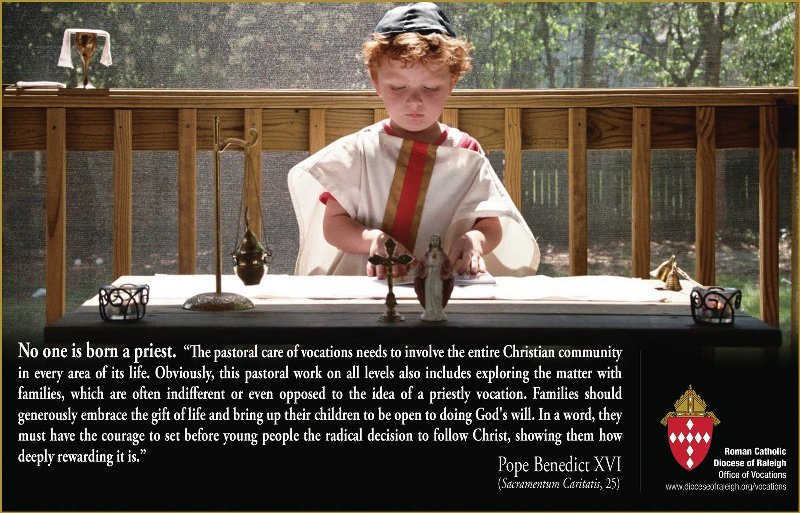
More on boys "playing Mass"Some people were a bit concerned about the vocations poster from the Diocese of Raleigh depicting a young boy " "playing" priest and celebrating Mass.   Frankly, I find nothing wrong with that.  There seems nothing irreverent about what he is doing.

I think that is the important thing: what children might do, might not be perfect, it might be clumsy, etc., but it should be done with their level of reverence.

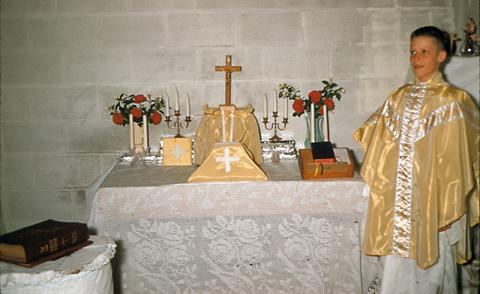
To this end, I received by e-mail a photo from 1958 of a boy "playing Mass".

Here it is:

July 1958.
My mother made the vestments –complete set; everything!
I’m looking for the slide of the purple vestments.
I remember my grandmother expressing concern that this playing at Mass might not be appropriate. I do remember her advising that we if we going to play Mass we should do so "reverently" and not "playfully".

More on boys "playing Mass"

More on boys "playing Mass"

Posted in SESSIUNCULA |
55 Comments

An ancient Roman poet vs. some Catholic politicians

In the light of what I have been reading about a certain politician and his unwillingness to vote to defend the rights of babies who survive abortion attempts and manage to be born anyway,

… and in light of what I have read and heard of a certain American elected official claiming to be Catholic but, incredibly, stating that the Church hasn’t decided when human life begins, …

… I want to repost something I put on the blog some months ago…

… for the benefit of new WDTPRS readers.

________________

Today I step out of my patristicist shoes and take off my theologian’s cap, to become for a moment what I started out as lo those many years ago: a classicist.

TV representations of ancient Rome often give you the impression of unbridled license and unchecked immorality.  In fact, the ancient Romans were, just like all normal people, rather conservative in their views.   They were, as a matter of fact, rather negative about abortion.  Yes, it is true that there was infanticide at times, as in many cultures, but I suspect that was mostly among the very wealthy.

In any event, the ancient poet Ovid has something to say about abortion.  Here are two of his elegies from the Amores (not my translation) which say something about the attitudes of common people.

I find these two poems provocative and moving.

Keep in mind that Ovid is one of those Neoteric poets, men who rejected the very long, epic style of poem, in favor of shorter, snapshots.  They also like to use lots of fancy references and hints to other places and people: sort of like post-modernists do when they write.

In this first elegy, a frightened Ovid is relieved that his mistress "Corinna" survived an abortion, from which she nearly died.  My emphases.

Book II Elegy XIII: The Abortion

Corinna lies there exhausted in danger of her life,
after rashly destroying the burden of an unborn child.
I should be angry: she took that great risk
and hid it from me: but anger’s quelled by fear.
All the same it’s me by whom she conceived – or I think so:
I often take things for facts that only might be.
Isis, of Paraetonium, and the joyful fields of Canopus,
you who protect Memphis, and palmy Pharos,
and the land where the swift Nile spreads in its wide delta,
its waters flowing through seven mouths to the sea,
by your sistrum I pray, by the sacred head of Anubis –
so may Osiris love your holy rites for ever,
and the slow serpent glide about your altar,
and the horned Apis follow your procession!
Turn your face towards us, and spare both in one!
Then you will grant life to her, and she to me.

Often she’s taken pains to attend your special days,
when Gallic laurel crowns your worshippers.
And you, Ilythia, who pity girls struggling in labour,
whose hidden child strains their reluctant body,
be gentle with her and hear my prayers!
It’s proper for you to demand gifts for yourself.
I myself, in white, will burn incense on your smoking altars,
I myself will lay at your feet the gifts I vowed.
I’ll add an inscription: ‘Naso, for saving Corinna!’
Make that occasion soon, for the inscription and the gifts.
If it’s still possible to warn you, girl, in such a state of fear,
let it be enough for you to have fought this one battle!

Abortion also scares, and scars, men.

At the time Ovid was writing, some Egyptian mystery religions were big in Rome.  Thus all the references to slithering.  But there is no self-deception about the poet’s own feelings. 

In this poem, de-Nile is just a river in Egypt.
 
Were Ovid a Catholic, he might be writing about lighting a candle or having Masses said. 

Some things are universal, aren’t they?

Ovid had the amazing ability, perhaps unlike any other Latin poet we have, of turning out verse afer verse of gorgeous flowing words.  Simply amazing talent.

The next poem also concerns abortion, but this time we see revealed something of the attitudes of the masses.  Read carefully and note also the comparison he uses.

Book II Elegy XIV: Against Abortion

Where’s the joy in a girl being free from fighting wars,
unwilling to follow the army and their shields,
if without battle she suffers wounds from her own weapons,
and arms unsure hands to her own doom?
Whoever first taught the destruction of a tender foetus,
deserved to die by her own warlike methods.

No doubt you’d chance your arm in that dismal arena
just to keep your belly free of wrinkles with your crime?
If the same practice had pleased mothers of old,
Humanity would have been destroyed by that violation.
and we’d need a creator again for each of our peoples
to throw the stones that made us onto the empty earth.
Who would have shattered the wealth of Priam, if Thetis,
the sea goddess, had refused to carry her rightful burden?

If Ilia had murdered the twins in her swollen womb,
the founder of my mistress’s City would have been lost.
If Venus had desecrated her belly, pregnant with Aeneas,
Earth would have been bereft of future Caesars.
You too, with your beauty still to be born, would have died,
if your mother had tried what you have done:
I myself would be better to die making love
than have been denied the light of day by my mother.

Why rob the loaded vine of burgeoning grapes,
or pluck the unripe apple with cruel hand?
Let things mature themselves – grow without being forced:
life is a prize that’s worth a little waiting.
Why submit your womb to probing instruments,
or give lethal poison to what is not yet born?
Medea is blamed for sprinkling the blood of her children,
and Itys, slain by his mother, is lamented with tears:
both cruel parents, yet both had bitter reason
to shed blood, revenge on a husband.
Say, what Tereus, what Jason incites you
to pierce your troubled body with your hand?
No tiger in its Armenian lair would do it,
no lioness would dare destroy her foetus.
But tender girls do it, though not un-punished:
often she who kills her child, dies herself.
She dies, and is carried to the pyre with loosened hair,
and whoever looks on cries out: ‘She deserved it!’
But let these words vanish on the ethereal breeze,
and let my imprecations have no weight!
You gods, prosper her: let her first sin go, in safety,
and be satisfied: you can punish her second crime!

What an amazing poem.  The poet’s rage and sorrow are nearly palpable.

Who knows what Einsteins or St. Francis of Assisis have been killed before birth?

Doesn’t this also say something about the poet’s sense of the role of women in society, in life?

He seems to be saying that women are, by their very nature, deeply connected to giving life, not taking it.  Thus, Ovid uses military imagery and then references the animal kingdom.  "Not even lionesses do this!"  

The masses of people who see the funeral of the girl who dies from the abortion are also enraged. 

Every once in a while it is good to turn to different times and cultures for a reality check.

________________

It strikes me that Ovid would be a more acceptable candidate, from this point of view at least, than some whom we have elected to high public office and who are candidates now.
 

Posted in SESSIUNCULA |
11 Comments

NatRev: Lopez on Pelosi’s gaffs on the beginning of life

Kathryn Jean Lopez of National Review had interesting observations about Speaker Pelosi’s Meet The Press inept pontifications.

What Makes a Speaker Catholic?
Buying into Pelosi’s personal church.

By Kathryn Jean Lopez

Denver — “If you’re Catholic and you disagree with your Church. What do you do? You change your mind.”

So said Archbishop Charles J. Chaput, [Hurray!] archbishop of the Catholic archdiocese of Denver, at the Cathedral Basilica of the Immaculate Conception at 6:30 Mass on Sunday night, as the Democratic Convention was set to begin.

His comments — part of his homily during the Mass — came hours after Speaker of the House Nancy Pelosi, describing herself as an “ardent practicing Catholic,” announced that when life begins “shouldn’t have an impact on a woman’s right to choose.” She explained that “over the history of the church, this is an issue of controversy.” Ignoring both embryology and the Vatican, [Yes… good point about the embryology: this is to say that the embryo does not develop into a giraffe or three-toed sloth.] she insisted on giving the impression that abortion is somehow an open, undecided question in the Roman Catholic Church.  [Which is nothing more than a lie.  She knows better.  She lied.]

But, as Chaput, author of the new book Render Unto Caesar: Serving the Nation by Living Our Catholic Beliefs in Political Life, explained in an interview with National Review Online last week, “Abortion always, deliberately kills an innocent unborn child. Nobody can honestly claim to be a faithful Catholic and then support a false ‘right’ to abortion; it’s just an elegant way of evading the brutality of what abortion actually does.” He explained, “Abortion is never morally justified.”

The archbishop’s guidance echoes The Catechism of the Catholic Church, which states that “Human life must be respected and protected absolutely from the moment of conception. From the first moment of his existence, a human being must be recognized as having the rights of a person — among which is the inviolable right of every innocent being to life.”

“Since the first century the Church has affirmed the moral evil of every procured abortion. This teaching has not changed and remains unchangeable. Direct abortion, that is to say, abortion willed either as an end or a means, is gravely contrary to the moral law,” it continues.

Further, it cites Vatican instruction: “The inalienable rights of the person must be recognized and respected by civil society and the political authority. These human rights depend neither on single individuals nor on parents; nor do they represent a concession made by society and the state; they belong to human nature and are inherent in the person by virtue of the creative act from which the person took his origin. Among such fundamental rights one should mention in this regard every human being’s right to life and physical integrity from the moment of conception until death.”

It’s a far cry from Nancy Pelosi’s catechism which would make Roe v. Wade a sacred doctrine. [Exactly my point in my own fisk of the transcript.  Pelosi makes Roe v Wade the point of reference, rather than the Magisterium.] The ruling, she said, has “very clear distinctions.” She doesn’t make those distinctions clear (nor does the Court — contrary to popular mythical belief, the Court does not ban third trimester abortions, for instance), because she really can square the circle she’s trying to; she simply can’t make the case that an “ardent practicing Catholic” can believe that abortion is a perfectly fine decision [Right.] that a “woman has to make with her doctor and her god.”

The issue of abortion is not the only significant issue Pelosi is in disagreement with her church on. In a book edited by Robert F. Kennedy Jr.’s daughter Kerry Kennedy, Nancy Pelosi contributes an essay in which she announces:

    My granddaughter was getting ready for her First Communion. Around the time of the swearing-in, we were all just lying on the bed, after the tea or something, and she said to her mother, “I want to explain to Mimi” — that’s me — “that it is the body and blood of Christ. When we go to church, it is the body and blood of Christ.” So her mother, in the interest of trying to simplify, said “Yes, the host and the wine represent the body and blood of Christ.” And my granddaughter said, “Not represent. Is, it is the body and blood of Christ.” My granddaughter was buying into it, okay. But it is hard. Every Sunday for me it’s hard. Christ had died, Christ is risen, Christ will come again. Now think of it, we say that every week. Do I really believe he’s coming again? Yes, I believe he’s coming again. Christ died, Christ is risen, Chirst will come again. This is my body, this is my blood. They’re asking a lot. In my era, we didn’t question any of it.  [Congresswoman Pelosi, kindly review John 6.]

If you believe Christ is coming again and died for our sins to give us eternal life, “they’re” not asking all that much.

If you’re not Catholic, her frustration probably sounds reasonable — which may be part of the reason you’re not Catholic. But if you’re truly Catholic, that is, if you “buy into” what the Catholic Church teaches, then you believe in the Real Presence, which is at the very heart of the Church. Otherwise, as Archbishop Chaput put it Sunday, “you’re not Catholic.” [That’s it in a nutshell.] Preaching from the Gospel for the 21st Sunday in Ordinary Time, from Matthew (16:13-20), Chaput echoed Christ’s question to His Apostles: “Who do you say that I am?” Chaput replied: “You are the Messiah, the Son of the Living God.” One has to “say it and let our lives be driven by it.” Our personal, professional, communal, and political lives, Chaput was careful to spell out. “If you can’t,” he said, “you’re not Catholic.”  [This is important.  Faith must not be relegated to soley the realm of the private.  It must inform every aspect of your life.  But for decades now, since the infamous Kennedy speach in Dallas, since the evil teaching of Fr. Drinan, since the more modern application of both by Mario Cuomo, Catholic politicians have been given "permission" to buy into the broader efforts to marginalize the Catholic voice from the public square.]

Like Democratic vice-presidential nominee Joseph Biden, presidential nominee John Kerry before him, nearly every Kennedy who has ever ran for office, and countless other “Catholic” Democrats, Pelosi doesn’t shy away from using her Catholicism on the campaign trail and in her political life. As these politicians court “the Catholic vote,” faithful Catholics need to consider their moral responsibilities in the voting booth and hold accountable those politicians who support and defend a candidate who, for example, has refused to oppose infanticide.

In her book, Know Your Power, Nancy Pelosi sounds sincere when she insists, “Growing up Catholic had an enormous impact on me — greater, I am certain, than growing up in a political family.” I believe she is sincere. It seems to mean a lot to her that she represents San Francisco, “the City of St. Francis.” In her book, she cites his prayer on peace and love. She loves peace and love. But that’s not enough to be Catholic.

Perhaps Pelosi has not had the gift of a Sunday teacher as clear as Archbishop Chaput in her life. Perhaps Pelosi has been given mixed signals by churchmen. Perhaps Pelosi truly believes she can write her own way without effectively removing herself from the Catholic Church. That possibility underscores the need for more forthright priests and bishops like Chaput — for the benefit of the Nancy Pelosis and Joe Bidens of the world, as well as every last Catholic vote they court.

As Chaput put it to NRO last week: “Our faith should shape our lives, including our political choices. Of course, that demands that we actually study and deepen our Catholic faith. The Catholic faith isn’t a set of clothes that we can tailor to a personal fit. We don’t “invent” our faith, and we don’t “own” it. If we really want to be Catholic, then we’ll live by Catholic teaching. Otherwise we’re just fooling ourselves and abusing the belief of other Catholics who really do try to practice what the Church teaches.”

Sometimes “Catholic” isn’t all that Catholic. Sometimes, on Meet the Press, or on a convention stage — from which Nancy Pelosi will speak tonight here in Denver — it’s just another strategic rhetorical device. Don’t be fooled. And whether you’re voting or campaigning, don’t lose your soul to the soul of a party.

— Kathryn Jean Lopez is the editor of National Review Online.

 Excellent!  Well done.

Posted in SESSIUNCULA |
27 Comments

Hosts made from genetically-modified wheat

This interesting article from the Irish Independent raises questions.. though not many:

Eucharist from [Genetically-Modified] wheat ‘contravenes canon law’

By JEROME REILLY

Sunday August 24 2008

Genetically-modified (GM) wheat may not be be suitable under canon law to be used to make hosts for the Catholic sacrament of the Eucharist, it’s been claimed.  [Who is doing the claiming?]

Fr Sean McDonagh, a Columban priest and well-known commentator on environmental issues, questions whether the Congregation of the Doctrine of the Faith which oversees Catholic doctrine could ever sanction GM wheat.  [Notice that this is all conjecture: "questions" "could".] Writing in Intercom, a publication of the Irish Catholic Bishops’ Conference, Fr McDonagh cites the example that gluten-free hosts are outlawed for use in communion [as invalid matter] — even though it can endanger the health of those suffering from coeliac disease, which is a bowel disorder. Low gluten hosts are permitted.

"Crops which have been genetically engineered to date include maize, soya beans, canola (derived from rapeseed) and potatoes. Many biotech companies would like to genetically engineer wheat. If this is pushed through, the question will arise as to whether GM wheat can be used in the Eucharist?"

Fr McDonagh quotes from Canon Law 924, section two, which stipulates: "the bread must be wheaten only, and recently made, so that there is no danger of corruption."

But he says that genetically-engineered wheat is not "made solely from wheat" because of protein added to make it resistant to a weed killer. "For example, people who suffer coeliac disease are unable to absorb gluten, a protein found in wheat. Eating even small amounts of wheat can make them ill.  [HUH?  He keeps coming back to the issue of gluten.  Gluten free hosts have had… ehem… the gluten removed.  It is not there because it was taken away.  Genetically-modified wheat has gluten, as is normal, and some other things added genetically.  Are scientists trying the genetically engineer "wheat" that has no gluten?  That would be invalid matter.]

"In recent decades, it has been possible to extract the gluten from wheaten bread so that people can eat bread without endangering their health. Despite the fact that gluten-wheat poses a health threat, which can often be serious, the Congregation of the Doctrine of the Faith stated in a reply in 1982 that, ‘the local Ordinary could not permit a priest to consecrate special gluten-free hosts for the communion of coeliacs’," writes Fr McDonagh.  [Notice how he confuses the health issue with what is required for validity.  It is as if he is saying: "People can get sick from hosts, therefore the Church should change its (divinely instituted) teaching that only wheat hosts are valid matter for the Eucharist.  Right… that’s gonna happen.]

Fr McDoangh says that the then Cardinal Ratzinger, now Pope Benedict, addressed the subject in 1994 when he was prefect of the Congregation for the Doctrine of the Faith.

The statement from the Holy Office said: "Special hosts, quibus glutinum ablatum est (from which gluten has been removed), are invalid matter for the celebration of the Eucharist".  [Again… has anyone been trying to engineer wheat without gluten?]

The statement added that low-gluten hosts are valid matter, provided that they contain the amount of gluten sufficient to obtain the confection of bread and that the procedure for making such hosts is not such as to alter the nature of the substance of the bread.

"Given the centrality of the celebration of the Eucharist in the life of the priest, candidates for the priesthood who are affected by coeliac disease or suffer from alcoholism or similar conditions may not be admitted to holy orders," the statement added.

Fr McDonagh believes that this statement from the Holy Office has ramifications for the use of GM-modified wheat in the Sacrament which is central to the Catholic faith.

"Genetically-engineered wheat will have an added protein which will make it tolerant to the herbicide of a biotech company.  [Did you get that?  "Added" protein?  "Added"?]

"This raises questions whether it is lawful to use GM wheat as matter for the Eucharist. [Nooo…. I don’t think so.]  If, notwithstanding a pressing health need, the Congregation of the Doctrine of the Faith refused to sanction gluten-free hosts as valid matter for the Eucharist because a protein has been extracted from the wheat, how can it sanction genetically-engineered wheat which has an added protein designed to make it resistant to a weed killer?"  [He doesn’t seem to get the difference between added and extracted.]

Four years ago biotech-giant Monsanto announced it had decided to shelve plans to introduce its controversial genetically-engineered Roundup Ready wheat. Genetic modification is considered more difficult for wheat than for other crops like maize and soya beans and its widespread use may be years away.

– JEROME REILLY

Posted in SESSIUNCULA |
41 Comments