QUAERITUR: TLM servers and kissing stuff

QUAERITUR: TLM servers and kissing stuffA question was received:

Dear Fr. Z,

I am an altar server at a TLM since last month. I read in a liturgical manual written by a priest of the FSSP that when the server handles the cruets to the priest, he should kiss them before and after receiving them back. So I began doing it. But recently I read that this is a pre-1962 practice. So should it be done?


After consulting Trimeloni, [US HERE – UK HERE] which is a reprint pertaining to the 1962 edition of the Missale Romanum, I confirmed (not that I needed to) that the server kisses things when giving them to and receiving them from the priest.

(p. 421 – #445.5)  At the beginning of Mass the server kisses the hand and then the biretta.  (The he goes and puts the Missale on the stand, etc.)

(p. 423 – #447.1) He kisses the cruet and gives it to the priest, and kisses it when receiving it back.  Both wine and water cruets.  He doesn’t kiss the priest’s hand.

(p. 424 – #448.5) At the end of Mass he kisses the biretta and gives it to the priest, kissing his hand as he does so.  Be SURE, of course, to make sure the middle “point” of the biretta is offered to the priest’s hand.

If the priest saying the TLM would prefer that you not do this, don’t worry about it.  But in 1962 that was the custom.

Posted in ASK FATHER Question Box, Liturgy Science Theatre 3000 | Tagged , ,
36 Comments

Pope invited to visit China

A friend sent this story from the AP:

Beijing bishop urges pope to visit China

Wed Aug 20, 4:27 PM ET

The Beijing bishop appointed by China‘s state-controlled Catholic Church said in an interview Wednesday that he hopes Pope Benedict XVI will visit his country and that relations with the Vatican are improving.

"We strongly hope that Benedict XVI will make a trip to China," Joseph Li Shan told Italy’s RAI state TV. "Relations with the Vatican are constantly improving. We can say that there are big developments."

Li is well-regarded by the Vatican and his installation last year was seen as a positive sign in the long-standing dispute between China and the Holy See over who should appoint bishops.

The officially atheist government dislikes groups that operate outside Communist Party control [no kidding] and has refused to yield authority over bishop’s appointments, while the Vatican is loath to concede its traditional right to appoint church leaders.

Both sides have searched for a compromise in recent years, with many bishops being first named by China but then later asking for and receiving the Vatican’s approval — as church officials said was the case with Li.

Strains with the Vatican date to 1952 when the Communists, just three years in power, demanded Chinese Catholics cut ties to Rome. Banned for much of the 1960s and ’70s when all religion was outlawed, the church has made a rapid recovery in the past 20 years, boasting about 12 million to 15 million followers.

Many of China’s Catholics however worship in congregations outside the state-approved church and often are arrested or harassed.

But in Wednesday’s interview, Li, whose comments were translated into Italian, said that "the problem of clandestine Catholics does not exist."

Benedict sent a special letter to Catholics in China last year, praising the underground church, but also urging the faithful to reconcile with followers of the official church.

The pope has made the improvement of relations with Beijing a priority of his papacy.

Posted in SESSIUNCULA |
8 Comments

How do I get to be one of these?

I just learned that the Romanian Orthodox have the title for priests:

Great Ecclesiarch

WOW! 

We need titles like this!


Posted in SESSIUNCULA |
22 Comments

L’OssRom: Knights Templar were innocent

There was an interesting article in L’Osservatore Romano today, in Italian, about the Knights Templar.  Alas, their articles scroll off and soon become unavailable.

The Times picked up this story.  I don’t have the energy or time to translate the L’Osservatore article, so this will serve in a pinch.

From Times Online
August 21, 2008
Vatican scholar: prayer proves Knights Templar not heretical
Richard Owen in Rome

The Vatican has for the first time published the prayer the Knights Templar composed when "unjustly imprisoned", in which they appealed to the Virgin Mary to persuade "our enemies" to abandon "calumnies and lies" and revert to "truth and charity".

L’Osservatore Romano, the Vatican newspaper, said the prayer was further proof that the order, which was dissolved in the fourteenth century, was not heretical. The knights were innocent of the charges against them, which included the accusation that they worshipped idols such as a "monstrous statue, half man and half goat".

The L’Osservatore Romano article, by Barbara Frale, the Vatican Secret Archives scholar who has made a special study of the knights, said it was untrue that the knights were guilty of "decadence, heresy and immoral practices".

The move follows legal action by the alleged heirs of Knights Templar to force the Vatican to restore the reputation of the disgraced order and acknowledge that assets worth some 80 million pounds were confiscated.  [I think we can, however, avoid falling into a post hoc ergo propter hoc conclusion.]

The Association of the Sovereign Order of the Temple of Christ, based in Spain, says that when the order was dissolved by Pope Clement V in 1307, over 9000 properties, farms and and commercial ventures belonging to knights were seized by the Church.

It is not however demanding that they be handed back, only that the order be "rehabilitated". A British branch also claiming descent from the Knights Templar and based in Hertfordshire has called for a papal apology for the persecution of the order. 

The Knights Templar were founded at the time of the First Crusade in the eleventh century to protect Christians making the pilgrimage to Jerusalem. The Order was endorsed by the Vatican, but when Acre fell in 1291 and the Crusaders lost their hold on the Holy Land support faded, amid growing envy of the order’s fortune in property and banking, and rumours about its corrupt and arcane secret ceremonies.

Whispers said novices had to deny Christ three times, spit on the cross, strip naked and kiss their superior on the buttocks, navel, and lips and submit to sodomy. King Philip IV of France, who coveted the order’s wealth, arrested its leaders and put pressure on Clement V to dissolve it. Several knights, including the Grand Master, Jacques de Molay, were burned at the stake.

However Dr Frale said the arrests by Philip IV were "absolutely illegal". She said "legends and inventions" about the knights had been perpetuated by "fantasies" such as Dan Brown’s The Da Vinci Code and – "though of a different literary calibre" [That’s for sure!] – Umberto Eco’s Foucault’s Pendulum.

She said that in 1312 Pope Clement had declared that the Templars were not heretics, and had explained that he had only dissolved the order to prevent Philip IV from "opening up a schism in the Church". She said proof of the Templars’ fidelity to the Pope and Christian dogma lay in the prayer they had composed during their long imprisonment.

It was "beautiful and moving" and "full of poetry", Dr Frale said, but "incredibly has never been studied".The prayer is addressed to "Holy Mary, mother of God", the "consolation of those who hope", and "humbly implores" her to obtain freedom for the order "through the intercession of the angels, archangels, prophets, evangelists, apostles, martyrs, confessors and virgins". It adds that the Virgin Mary knows that "our enemies" have spread "calumnies and lies" about the order, and pleads with her to make them "return to truth and charity".

Last October the Vatican launched a scheme to market limited reproductions of Processus Contra Templarios (Papal Inquiry into the Trial of the Templars), also known as the Chinon document, which Dr Frale discovered in the Vatican archives in 2003 after realising that it had been wrongly catalogued.

She said the parchment proved Clement V had accepted the Templars were not guilty of heresy. Their initiation ceremony involved spitting on the Cross, but this was to brace them for having to do so if captured by Muslim forces.

Posted in SESSIUNCULA |
30 Comments

QUAERITUR: If priest denies Communion when I kneel

I got this by e-mail:

Dear Father,

Last week during a trip to ________, I went to the _______ Cathedral, and attempted to receive communion kneeling, but as I knelt the priest gave me a sigh, at first ignored me, and then said "Get up! Get up!" I was tempted to argue, but desiring to keep peace during the Mass, I stood and received standing. I feel inspired to write or call him. I was wondering if you had any advice on how I should handle this.

In Christ,

I respond with this….

Pray for this man.

Pray that he be very relieved that no one report him either to the local bishop or to the Congregation for Divine Worship and Discipline of the Sacraments.

He would have violated your rights, seriously and publicly.

Pray that he have some change of heart before his scandalous behavior becomes matter of world wide discussion. 

I will help in that regard, btw.

And pray that God may grant you mercy if you have even slightly exaggerated your story.

Posted in ASK FATHER Question Box, SESSIUNCULA |
25 Comments

More sorrow in Leeds

A truly sad situation in the Archdiocese of Leeds.

Six parishes were to be suppressed, but now they are simply to be "closed".

The local ordinary now forbids Mass to be offered in them.

This includes the church where the TLM was celebrated.

Ugly business to be sure.

One can understand the distress of the lay people.

One can understand if no one is paying the bills at those parishes too.

There is often a great deal under the surface that doesn’t get out in media reports, but this remains a real puzzle… a sad puzzle.

Posted in SESSIUNCULA |
Comments Off on More sorrow in Leeds

QUAERITUR: broadcast/recorded Mass when you can’t attend

I received a question by e-mail:

Dear Father Z,

It’s commonly accepted that shut-ins and invalids who are unable to go to church can fulfill their Sunday obligation by watching a live Mass on TV. It’s that "live" part that is the reason for my writing.

My problem concerns traveling (in my case, required business travel which I’m doing as I write this) and not being able to get to Mass due to scheduling conflicts with airlines, etc. Nor being able to understand the local language anyway since the universal language is no longer used. In those cases, rather than miss it altogether (an "excused absence"?) do you think watching a prerecorded Mass on a TV or PC could count as an honest effort and be just as valid as the live Mass for the invalids? I would use an EF recording, of course, and substitute the correct Propers from my missal for the ones on the video.

First, I appreciate your desire to fulfill your obligations regarding Mass on the necessary days.

However, I need to disabuse you, and everyone else reading this, about a what you say is "commonly accepted".


People do not fulfill their Sunday or Holy Day Obligations to attend Mass by watching a recording or transmission of a Mass, regardless if they are shut-ins or not.

If people are impeded from attending Holy Mass for a serious reason, for example they are invalids or they are ill, or even if they are terrified of slipping and falling on the ice during winter, they are excused their obligation.

God does not ask of us what is not possible.

So, watching Mass on TV, etc., can be a holy and pious thing to do, but it does not fulfill the obligation strictly speaking.

As far as traveling is concerned, there are certainly those situations when, for example, you are in a strange place and finding a Mass in the narrow period of time allowed would be a serious difficulty.  In those cases, you are excused your obligation. 

Of course God cannot be fooled.  If you have 8 hours and the church is next to your hotel, and there are three Masses scheduled during that time, you might not have a very good excuse.  I suppose if the Mass is being celebrated in Swahili, and you are psychologically terrified of hearing the Swahili language for some reason, that could be a mitigating factor.  So would the sure knowledge that the dopey priest and his weird staff have scheduled liturgical abuses sure to infuriate you to the point of near occasion of mortal sin.   But I digress.

If people are seriously impeded from attending Mass, their obligation is mitigated.  It is good to want to watch something, and I applaud that.  But let’s understand what is happening.  Language like "just as valid" doesn’t apply.

Posted in ASK FATHER Question Box |
68 Comments

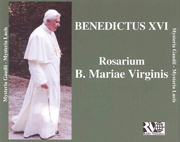
Benedict XVI: CD’s of the Rosary in Latin

Vatican Radio has issued a 4 CD set of the Holy Father Pope Benedict XVI reciting the Rosary.

In Latin.

Benedict XVI: CD's of the Rosary in Latin

I don’t have any practical ordering information yet.

Posted in SESSIUNCULA |
71 Comments

Archbp. Burke on a global problem: marginalizing faith in the “private” sphere

When H.E. Most Rev. Raymond Burke was shifted from the Archdiocese of St. Louis to be Prefect of the Apostolic Segnatura, many people asked me if this was a matter of promoveatur ut amoveatur, that is, to get him out of the way before the November elections in the USA.

I said "No.".

This is in from CNA:

Catholics who support abortion should not receive Communion, says Archbishop Burke

Archbp. Burke on a global problem: marginalizing faith in the "private" sphere
Archbishop Raymond Burke

.- The prefect of the Apostolic Signature, Archbishop Raymond Burke, said this week that Catholics, especially politicians who publically defend abortion, should not receive Communion, and that ministers of Communion should be responsibly charitable in denying it to them if they ask for it, “until they have reformed their lives.”

In an interview with the magazine, Radici Christiane, Archbishop Burke pointed out that there is often a lack of reverence at Mass when receiving Communion.  “Receiving the Body and Blood of Christ unworthily is a sacrilege,” he warned.  “If it is done deliberately in mortal sin it is a sacrilege.”  [When is the last time you heard a bishop speak publicly of sacrilege?]

To illustrate his point, he referred to “public officials who, with knowledge and consent, uphold actions that are against the Divine and Eternal moral law. For example, if they support abortion, which entails the taking of innocent and defenseless human lives.  A person who commits sin in this way should be publicly admonished in such a way as to not receive Communion until he or she has reformed his life,” the archbishop said.

“If a person who has been admonished persists in public mortal sin and attempts to receive Communion, the minister of the Eucharist has the obligation to deny it to him. Why? Above all, for the salvation of that person, preventing him from committing a sacrilege,” he added.

“We must avoid giving people the impression that one can be in a state of mortal sin and receive the Eucharist,” the archbishop continued.  “Secondly, there could be another form of scandal, [This is a very important point.] consisting of leading people to think that the public act that this person is doing, which until now everyone believed was a serious sin, is really not that serious –  if the Church allows him or her to receive Communion.”

“If we have a public figure who is openly and deliberately upholding abortion rights and receiving the Eucharist, what will the average person think? He or she could come to believe that it up to a certain point it is okay to do away with an innocent life in the mother’s womb,” he warned.

Archbishop Burke also noted that when a bishop or a Church leader prevents an abortion supporter from receiving Communion, “it is not with the intention of interfering in public life but rather in the spiritual state of the politician or public official who, if Catholic, should follow the divine law in the public sphere as well.”

“Therefore, it is simply ridiculous and wrong to try to silence a pastor, accusing him of interfering in politics so that he cannot do good to the soul of a member of his flock,” he stated.

It is “simply wrong” to think that the faith must be reduced to the private sphere and eliminated from public life, Archbishop Burke said, encouraging Catholics “to bear witness to our faith not only in private in our homes but also in our public lives with others in order to bear strong witness to Christ.”


The comment about faith and the private sphere is important.

Pope Benedict, in what I call his Marshall Plan to revive Catholic identity, is working to help Catholics rediscovered who they are and what they believe so that they can also have something vigorous and useful to contribute in the public square.  Catholics have been driven from the public square in the past.  There is great pressure to reduce Christian faith merely to the realm of the private, as if anyone who "believes" must shelve their beliefs before acting and speaking in the public square.

But human beings cannot be so subdivided.

We cannot be forced to leave aside in human affairs that which is fundamental to our human identity.

At the time His Excellency was promoted to Prefect, I made the observation that his voice will now be heard in the more or less daily business of the Curia, since he will soon be a member of many dicasteries which consult on a regular basis.   Archbp. Burke clearly is in close harmony with the aims of the Holy Father.  He will be an important collaborator.

Furthermore, his comments need not be interpreted as being aimed at any particular American politician.

These same issues are being fought out in the whole world.  Italian lefies are constantly screeching about this.  Remember, too, the kerfuffle caused when Pope Benedict on the airplane to Brasil spoke about the Mexican Catholic pols who supported abortion.

This is a global problem.
Posted in SESSIUNCULA |
45 Comments

QUAERITUR: Resources for explain Mass and things to children

I think you readers can help with this one.


Dear Father Zuhlsdorf,

I am a cradle Catholic with three children, we have a family rule that on the way home from Mass the children can ask me questions about the mass itself, the readings, homily etc rather than asking during the mass when we should be paying attention and worshipping.  However as they get older the questions they ask me are more involved and regard the symbolism used and other more theological questions. Some of these I can answer easily, and others stump me. This makes me want to learn more both for myself and for them. I strongly believe my vocation as their mother is to teach them in their faith.

I went to my local Catholic book store but they did not have the type of book I was looking for so I am wondering if you can recommend to me a good book that teaches about the Mass and why we use the symbols and so on that we do. Our Parish Priest and Deacon are very happy to answer questions, but I would like to be able to learn more about this and answer my children’s questions when they arise on the way home from Mass rather than making them wait to as Father the next week.

That’s a nice practice, getting the kids to ask about Mass and the preaching.  That would help them pay attention.  Well done!

And now you are up against a wall.

I think there could be different sets of reading material divided in a couple ways.

First, things for you or for your children… we don’t know their ages.

Second, things about the older form of Mass or about the Novus Ordo… we don’t know which you attend.

So, folks, how about chiming in with suggestions for these possible permutations!

Posted in ASK FATHER Question Box |
37 Comments