I posted the text of the Holy Father’s address for his arrival at WYD in Sydney, but it strikes me that we could give it more attention.
I also finally had a moment to process the audio of the address.
Here is the Pope’s address, which you can follow by listening and reading, with my emphases and comments.
I include the reading of the Gospel just before, though I cut out the long pauses.
I cut from the audio and text the brief comments the Pope made in languages other than English.
Friends, there is a lot going on in this piece. Benedict XVI has some starting points when he works as a theologian. I will try here to help you think theologically along with the Pope, drilling into how he works though questions, how he gets to conclusions. He methodology in preaching is very linear. He is trying to get you to think along with him, not just listen, to receive actively and not merely hear him passively.
As you listen and read, maybe you will have your own insights. Here are mine.
Dear Young People,
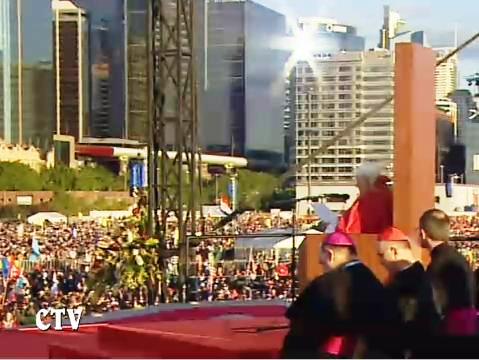
What a delight it is to greet you here at Barangaroo, on the shores of the magnificent Sydney harbour, with its famous bridge and Opera House. Many of you are local, from the outback or the dynamic multicultural communities of Australian cities. Others of you have come from the scattered islands of Oceania, and others still from Asia, the Middle East, Africa and the Americas. Some of you, indeed, have come from as far as I have, Europe! Wherever we are from, we are here at last in Sydney. And together we stand in our world as God’s family, disciples of Christ, empowered by his Spirit to be witnesses of his love and truth for everyone! [At Pentecost the Holy Spirit infused "dynamism" into the Church and from many divided nations made one Body of Christ, the Church. It seems a constitutive element of the Church to be simultaneously diverse and unified. There will therefore be a "exchange" between the Church in unity and the Church in multiplicity, between Church and the world, between the Church and cultures. Provided that logical priority is given to what the Church in her unity has to offer, this is healthy, indeed, necessary. That is authentic inculturation.]
 I wish firstly to thank the Aboriginal Elders who welcomed me prior to my boarding the boat at Rose Bay. I am deeply moved to stand on your land, knowing the suffering and injustices it has borne, but aware too of the healing and hope that are now at work, rightly bringing pride to all Australian citizens. To the young indigenous – Aboriginal and Torres Strait Islanders – and the Tokelauans, I express my thanks for your stirring welcome. Through you, I send heartfelt greetings to your peoples.
Cardinal Pell and Archbishop Wilson, I thank you for your warm words of welcome. I know that your sentiments resonate in the hearts of the young gathered here this evening, and so I thank you all. Standing before me I see a vibrant image of the universal Church. The variety of nations and cultures from which you hail shows that indeed Christ’s Good News is for everyone; it has reached the ends of the earth. Yet I know too that a good number of you are still seeking a spiritual homeland. Some of you, most welcome among us, are not Catholic or Christian. Others of you perhaps hover at the edge of parish and Church life. To you I wish to offer encouragement: step forward into Christ’s loving embrace; recognize the Church as your home. No one need remain on the outside, for from the day of Pentecost the Church has been one and universal. [Excellent. Never underestimate the power of a direct invitation! Rememebr that in your own dealings with people seeking healing and hope, perhaps fallen away from the Church or looking in with nose pressed against the stained glass.]
This evening I wish also to include those who are not present among us. I am thinking especially of the sick or mentally ill, young people in prison, those struggling on the margins of our societies, and those who for whatever reason feel alienated from the Church. To them I say: Jesus is close to you! Feel his healing embrace, his compassion and mercy!
Almost two thousand years ago, the Apostles, gathered in the upper room together with Mary and some faithful women, were filled with the Holy Spirit (cf. Acts 1:14; 2:4). [Here is that Pentecost event again.] At that extraordinary moment, which gave birth to the Church, the confusion and fear that had gripped Christ’s disciples were transformed into a vigorous conviction and sense of purpose. [He seems to be talking about disciples (or non-believers as well) in the modern world as well, feeling confusion and fear, not knowing to whom to turn.] They felt impelled to speak of their encounter with the risen Jesus whom they had come to call affectionately, the Lord. [Curious. In many ways, "Lord", brings the image of "King of Fearful Majesty" and "the Just Judge" and "uncreated Creator". Here Benedict uses Lord with affection. Surely this is the fruit of one who has a true relationship with Christ, who need not fear in his conscience because he is upright, well-disposed and confessed, who is aware of his sonship. There need by no contrast between affection and reverential fear.] In many ways, the Apostles were ordinary. None could claim to be the perfect disciple. They failed to recognize Christ (cf. Lk 24:13-32), felt ashamed of their own ambition (cf. Lk 22:24-27), and had even denied him (cf. Lk 22:54-62). Yet, when empowered by the Holy Spirit, they were transfixed by the truth [A good phrase. I wonder if Benedict isn’t setting up a dichotomy here: truth in Christ; confusion in the world without Christ; truth with affection and confusion with terror.] of Christ’s Gospel and inspired to proclaim it fearlessly. Emboldened, they exclaimed: repent, be baptized, receive the Holy Spirit (cf. Acts 2:37-38)! Grounded in the Apostles’ teaching, in fellowship, and in the breaking of the bread and prayer [liturgy] (cf. Acts 2:42), the young Christian community moved forward to oppose the perversity in the culture around them (cf. Acts 2:40), to care for one another (cf. Acts 2:44-47), to defend their belief in Jesus in the face of hostility (cf Acts 4:33), and to heal the sick (cf. Acts 5:12-16). [Interesting. Not just to defend the faith (which is what the Pope did for years and does now) but also heal. This isn’t just a fortress mentality of the Church against the hostile world with its confusion and terror and perversion, but rather a dynamic mode of relating outward, into the world to heal, not simply to resist its influence.] And in obedience to Christ’s own command, they set forth, bearing witness to the greatest story ever: that God has become one of us, that the divine has entered human history in order to transform it, and that we are called to immerse ourselves in Christ’s saving love which triumphs over evil and death. Saint Paul, in his famous speech to the Areopagus, introduced the message in this way: "God gives everything – including life and breath – to everyone … so that all nations might seek God and, by feeling their way towards him, succeed in finding him. In fact he is not far from any of us, since it is in him that we live and move and have our being" (Acts 17: 25-28).
And ever since, men and women have set out to tell the same story, witnessing to Christ’s truth and love, and contributing to the Church’s mission. Today, we think of those pioneering Priests, Sisters and Brothers who came to these shores, and to other parts of the Pacific, from Ireland, France, Britain and elsewhere in Europe. The great majority were young – some still in their late teens – and when they bade farewell to their parents, brothers and sisters, and friends, they knew they were unlikely ever to return home. Their whole lives were a selfless Christian witness. They became the humble but tenacious builders of so much of the social and spiritual heritage which still today brings goodness, compassion and purpose to these nations. And they went on to inspire another generation. We think immediately of the faith which sustained Blessed Mary MacKillop in her sheer determination to educate especially the poor, and Blessed Peter To Rot in his steadfast resolution that community leadership must always include the Gospel. Think also of your own grandparents and parents, your first teachers in faith. They too have made countless sacrifices of time and energy, out of love for you. Supported by your parish priests and teachers, they have the task, not always easy but greatly satisfying, of guiding you towards all that is good and true, through their own witness – their teaching and living of our Christian faith. [He is presenting a noble vision of vocation. Young people will rise to any challenge, provided first that they are challenged with something that makes a difference. Well done.]
Today, it is my turn. [The personal touch. This is what I call "leaving a tip", something beyond what you owe because of your position or what you have received.] For some of us, it might seem like we have come to the end of the world! [I nice use of the idea of being in Australia. But he is really, probably, also talking about something very different.] For people of your age, however, any flight is an exciting prospect. But for me, this one was somewhat daunting! [Because he is old and traveling is unattractive and difficult.] Yet the views afforded of our planet from the air were truly wondrous. The sparkle of the Mediterranean, the grandeur of the north African desert, the lushness of Asia’s forestation, the vastness of the Pacific Ocean, the horizon upon which the sun rose and set, and the majestic splendour of Australia’s natural beauty which I have been able to enjoy these last couple of days; these all evoke a profound sense of awe. It is as though one catches glimpses of the Genesis creation story – light and darkness, the sun and the moon, the waters, the earth, and living creatures; all of which are "good" in God’s eyes (cf. Gen 1:1 – 2:4). Immersed in such beauty, who could not echo the words of the Psalmist in praise of the Creator: "how majestic is your name in all the earth?" (Ps 8:1). [This is a constant concern in Papa Ratzinger’s theological starting points. He has distinguish three figures who attempted the unbind the necessary Hellenistic components from Christian thought by attacking the proper understanding of creation. For Benedict, God providentially guided the world to the fullness of time so that Hellenic philosophy could provide the right categories to express what Christianity needed to express. He identifies two sets of three stages of the attempted destruction of this synthesis embodied forming a kind of destructive or corrosive double-helix attacking the roots of Christianity. The first set: Giordano Bruno, Galileo and Martin Luther. The second set: Hegel, Harnack, and the rise of Asian and African nationalism. Note also that Benedict mentions Paul’s address to the Athenians at the Aereopagus. The attack can come in different directions, religion can deny philosophy (faith can deny reason) and philosophy can deny faith. Benedict talks about these different violations of human freedom in, for example, his first Message for the World Day of Peace and in his Regensburg Address. I think this is central to Papa Ratzinger’s thought. Now he applies it to a "theological environmentalism" or "theology of ecology."]
And there is more – something hardly perceivable from the sky – men and women, made in nothing less than God’s own image and likeness (cf. Gen 1:26). At the heart of the marvel of creation are you and I, the human family "crowned with glory and honour" (Ps 8:5). How astounding! With the Psalmist we whisper: "what is man that you are mindful of him?" (Ps 8:4). And drawn into silence, into a spirit of thanksgiving, into the power of holiness, we ponder. [We are so small compared to the rest of creation, but man is at the summit of material creation! We are material creation’s stewards.]
What do we discover? Perhaps reluctantly we come to acknowledge that there are also scars which mark the surface of our earth: erosion, deforestation, the squandering of the world’s mineral and ocean resources in order to fuel an insatiable consumption. Some of you come from island nations whose very existence is threatened by rising water levels; others from nations suffering the effects of devastating drought. God’s wondrous creation is sometimes experienced as almost hostile to its stewards, [there it is…] even something dangerous. How can what is "good" appear so threatening?
And there is more. What of man, the apex of God’s creation? [and again… Do you see how Benedict sets up his ideas first? He leads your mind in the right direction and then he fleshes out your thought with the proper terms. Brilliant pedagogy. You can follow him so well that you can almost anticipate what he will say next. This is one reason why people flock to hear Benedict speak in even larger numbers for his audiences than for John Paul II. Benedict is very linear. John Paul was very circular.] Every day we encounter the genius of human achievement. [Okay… here is "human achievement". Where will he go with this? Will he later remind us that we, part of creation, are God’s achievement? That God also has His own achievement? That there is a hierarchy of creation? Let’s find out.] From advances in medical sciences and the wise application of technology, to the creativity reflected in the arts, the quality and enjoyment of people’s lives in many ways are steadily rising. Among yourselves there is a readiness to take up the plentiful opportunities offered to you. Some of you excel in studies, sport, music, or dance and drama, others of you have a keen sense of social justice and ethics, and many of you take up service and voluntary work. All of us, young and old, have those moments when the innate goodness of the human person [Remember, Luther’s and the Protestant view is that man is corrupt and in conflict with a corrupt creation from which we must be liberated by the "alien" merits of Christ.] – perhaps glimpsed in the gesture of a little child or an adult’s readiness to forgive – fills us with profound joy and gratitude. [Simple examples to combat the view that man is corrupt and that we are in total conflict with the rest of creation.]
Yet such moments do not last. So again, we ponder. And we discover that not only the natural but also the social environment – the habitat we fashion for ourselves – has its scars; [Interesting. He is using "habitat" in a way that does not exclude man’s intimate involvement. Rather! Man shapes the habitat. But we can get it wrong. Also, there is a structure, individual and society made up of individuals. Original sin affects both.] wounds indicating that something is amiss. [The word "wounds" is code to contrast Catholic thought, genuine Christian theological anthropology, with the Protestant view of total corruption.] Here too, in our personal lives and in our communities, we can encounter a hostility, something dangerous; a poison which threatens to corrode what is good, reshape who we are, and distort the purpose for which we have been created. [Not just Original Sin, but the Enemy.] Examples abound, as you yourselves know. Among the more prevalent are alcohol and drug abuse, and the exaltation of violence and sexual degradation, often presented through television and the internet as entertainment. I ask myself, could anyone standing face to face with people who actually do suffer violence and sexual exploitation "explain" that these tragedies, portrayed in virtual form, are considered merely "entertainment"? [The mystery of sin. Mysterium iniquitatis was, I believe, used by John Paul to explain evils such as war and exploitation, suffering and sin.]
There is also something sinister which stems from the fact that freedom and tolerance are so often separated from truth. [Relativism.] This is fuelled by the notion, widely held today, that there are no absolute truths to guide our lives. Relativism, [there it is] by indiscriminately giving [equal] value to practically everything, [remember: there is a hierarchy of goods in creation] has made "experience" all-important. ["Well, that might be true for you"…] Yet, experiences, detached from any consideration of what is good or true, can lead, not to genuine freedom, but to moral or intellectual confusion, to a lowering of standards, to a loss of self-respect, and even to despair.
Dear friends, life is not governed by chance; it is not random. [There is a design in creation and our lives.] Your very existence has been willed by God, blessed and given a purpose (cf. Gen 1:28)! Life is not just a succession of events or experiences, helpful though many of them are. It is a search for the true, the good and the beautiful. It is to this end that we make our choices; it is for this that we exercise our freedom; it is in this – in truth, in goodness, and in beauty – that we find happiness and joy. Do not be fooled by those who see you as just another consumer in a market of undifferentiated possibilities, where choice itself becomes the good, novelty usurps beauty, and subjective experience displaces truth. [Excellent. In talking to young people I often warn them about how some people will try to turn them into chumps, to be manipulated and violate their freedom and dignity.]
Christ offers more! Indeed he offers everything! Only he who is the Truth can be the Way and hence also the Life. Thus the "way" which the Apostles brought to the ends of the earth is life in Christ. This is the life of the Church. And the entrance to this life, to the Christian way, is Baptism. [At this point he simply and perfectly states the case. He has presented the prevaling world view, which produces confusion and fear. Now he simply states the answer.]
This evening I wish therefore to recall briefly something of our understanding of Baptism before tomorrow considering the Holy Spirit. On the day of your Baptism, God drew you into his holiness (cf. 2 Pet 1:4). You were adopted as a son or daughter of the Father. You were incorporated into Christ. You were made a dwelling place of his Spirit (cf. 1 Cor 6:19). Baptism is neither an achievement, nor a reward. It is a grace; it is God’s work. [It is not what we do, but what God gives and we receive.] Indeed, towards the conclusion of your Baptism, the priest turned to your parents and those gathered and, calling you by your name said: "you have become a new creation" (Rite of Baptism, 99).
Dear friends, in your homes, schools and universities, in your places of work and recreation, remember that you are a new creation! [You have a greater responsibility, and therefore challenge.] Not only do you stand before the Creator in awe, rejoicing at his works, you also realize that the sure foundation of humanity’s solidarity lies in the common origin of every person, the high-point of God’s creative design for the world. As Christians you stand in this world knowing that God has a human face – Jesus Christ – the "way" who satisfies all human yearning, and the "life" to which we are called to bear witness, walking always in his light (cf. ibid., 100).
The task of witness is not easy. There are many today who claim that God should be left on the sidelines, and that religion and faith, while fine for individuals, should either be excluded from the public forum altogether or included only in the pursuit of limited pragmatic goals. This secularist vision seeks to explain human life and shape society with little or no reference to the Creator. It presents itself as neutral, impartial and inclusive of everyone. But in reality, like every ideology, secularism imposes a world-view. If God is irrelevant to public life, then society will be shaped in a godless image, and debate and policy concerning the public good will be driven more by consequences than by principles grounded in truth. [A key summary, I think. On this blog and in my talks and articles, I have argued that Pope Benedict as a larger plan, a Benedictine Marshall Plan to reinvigorate Catholic identity. If we don’t know who we are and what we believe (liturgy is central to this) then we have nothing to offer to the world at larger, to contribute to the public square. Thus, the Church’s voice winds up ever more marginalized. We must reclaim our Catholic Christian identity in order to fulfill our Christ given, commanded, mission in the whole world (as Benedict mentioned earlier).]
Yet experience shows that turning our back on the Creator’s plan provokes a disorder which has inevitable repercussions on the rest of the created order (cf. 1990 World Day of Peace Message, 5). When God is eclipsed, [A nature term, but theological, something block out light, a clear view.] our ability to recognize the natural order, purpose, and the "good" begins to wane. What was ostensibly promoted as human ingenuity soon manifests itself as folly, greed and selfish exploitation. And so we have become more and more aware of our need for humility before the delicate complexity of God’s world. [Not just humility before God’s design for each of us, but God’s design for society (remember: "habitat") and also material creation. Papa is linking the environment to our individual conscience before God and His plan.]
But what of our social environment? [Part of the habitat we shape according to God’s design.] Are we equally alert to the signs of turning our back on the moral structure with which God has endowed humanity (cf. 2007 World Day of Peace Message, 8)? [Natural law is written into our being.] Do we recognize that the innate dignity of every individual rests on his or her deepest identity – as image of the Creator – and therefore that human rights are universal, based on the natural law, and not something dependent upon negotiation or patronage, let alone compromise? And so we are led to reflect on what place the poor and the elderly, immigrants and the voiceless, have in our societies. How can it be that domestic violence torments so many mothers and children? How can it be that the most wondrous and sacred human space – the womb – has become a place of unutterable violence? [In this Pope Benedict is very much drawing into the present WYD conclusions also of John Paul II and his theology of the person, rooted in a proper Christocentric anthropology.]
My dear friends, God’s creation is one and it is good. [There it is! Creation is "one": we can’t separate individual, social groups, and creation. And there must not be conflict between them.] The concerns for non-violence, sustainable development, justice and peace, and care for our environment are of vital importance for humanity. They cannot, however, be understood apart from a profound reflection upon the innate dignity of every human life from conception to natural death: [He connects the dignity of human life and ecology as part and parcel of a Christian view of creation.] a dignity conferred by God himself and thus inviolable. Our world has grown weary [Can a "world" grow "weary"? Not unless you see the world in the way that Benedict is explaining, namely, that there must not be a conflict between man, society, and creation. All of creation "groans" when man sins, when societies have unjust structures, and when the environment is scarred.] of greed, exploitation and division, of the tedium of false idols and piecemeal responses, and the pain of false promises. [What might that part mean? I wonder if he isn’t in some way criticizing shallow environmentalism as well as shallow notions of social justice?] Our hearts and minds are yearning for a vision of life where love endures, where gifts are shared, where unity is built, where freedom finds meaning in truth, and where identity is found in respectful communion. This is the work of the Holy Spirit! This is the hope held out by the Gospel of Jesus Christ. It is to bear witness to this reality that you were created anew at Baptism and strengthened through the gifts of the Spirit at Confirmation. [I bet Papa will talk about the Sacrament of Confirmation sometime soon.] Let this be the message that you bring from Sydney to the world!
Folks, there is always a lot going on in the Pope’s addresses and sermons. But these big events bring out the fruits of Papa‘s intense labor and years of theological reflection.

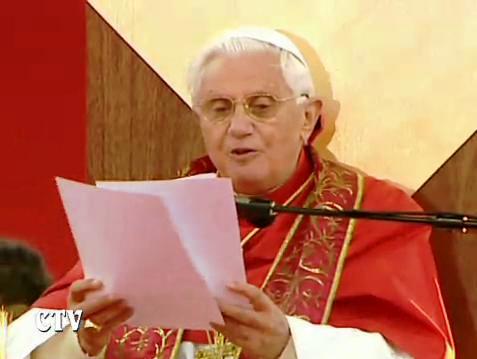 I wish firstly to thank the Aboriginal Elders who welcomed me prior to my boarding the boat at Rose Bay. I am deeply moved to stand on your land, knowing the suffering and injustices it has borne, but aware too of the healing and hope that are now at work, rightly bringing pride to all Australian citizens. To the young indigenous – Aboriginal and Torres Strait Islanders – and the Tokelauans, I express my thanks for your stirring welcome. Through you, I send heartfelt greetings to your peoples.
 Almost two thousand years ago, the Apostles, gathered in the upper room together with Mary and some faithful women, were filled with the Holy Spirit (cf. Acts 1:14; 2:4). [Here is that Pentecost event again.] At that extraordinary moment, which gave birth to the Church, the confusion and fear that had gripped Christ’s disciples were transformed into a vigorous conviction and sense of purpose. [He seems to be talking about disciples (or non-believers as well) in the modern world as well, feeling confusion and fear, not knowing to whom to turn.] They felt impelled to speak of their encounter with the risen Jesus whom they had come to call affectionately, the Lord. [Curious. In many ways, "Lord", brings the image of "King of Fearful Majesty" and "the Just Judge" and "uncreated Creator". Here Benedict uses Lord with affection. Surely this is the fruit of one who has a true relationship with Christ, who need not fear in his conscience because he is upright, well-disposed and confessed, who is aware of his sonship. There need by no contrast between affection and reverential fear.] In many ways, the Apostles were ordinary. None could claim to be the perfect disciple. They failed to recognize Christ (cf. Lk 24:13-32), felt ashamed of their own ambition (cf. Lk 22:24-27), and had even denied him (cf. Lk 22:54-62). Yet, when empowered by the Holy Spirit, they were transfixed by the truth [A good phrase. I wonder if Benedict isn’t setting up a dichotomy here: truth in Christ; confusion in the world without Christ; truth with affection and confusion with terror.] of Christ’s Gospel and inspired to proclaim it fearlessly. Emboldened, they exclaimed: repent, be baptized, receive the Holy Spirit (cf. Acts 2:37-38)! Grounded in the Apostles’ teaching, in fellowship, and in the breaking of the bread and prayer [liturgy] (cf. Acts 2:42), the young Christian community moved forward to oppose the perversity in the culture around them (cf. Acts 2:40), to care for one another (cf. Acts 2:44-47), to defend their belief in Jesus in the face of hostility (cf Acts 4:33), and to heal the sick (cf. Acts 5:12-16). [Interesting. Not just to defend the faith (which is what the Pope did for years and does now) but also heal. This isn’t just a fortress mentality of the Church against the hostile world with its confusion and terror and perversion, but rather a dynamic mode of relating outward, into the world to heal, not simply to resist its influence.] And in obedience to Christ’s own command, they set forth, bearing witness to the greatest story ever: that God has become one of us, that the divine has entered human history in order to transform it, and that we are called to immerse ourselves in Christ’s saving love which triumphs over evil and death. Saint Paul, in his famous speech to the Areopagus, introduced the message in this way: "God gives everything – including life and breath – to everyone … so that all nations might seek God and, by feeling their way towards him, succeed in finding him. In fact he is not far from any of us, since it is in him that we live and move and have our being" (Acts 17: 25-28).
 Today, it is my turn. [The personal touch. This is what I call "leaving a tip", something beyond what you owe because of your position or what you have received.] For some of us, it might seem like we have come to the end of the world! [I nice use of the idea of being in Australia. But he is really, probably, also talking about something very different.] For people of your age, however, any flight is an exciting prospect. But for me, this one was somewhat daunting! [Because he is old and traveling is unattractive and difficult.] Yet the views afforded of our planet from the air were truly wondrous. The sparkle of the Mediterranean, the grandeur of the north African desert, the lushness of Asia’s forestation, the vastness of the Pacific Ocean, the horizon upon which the sun rose and set, and the majestic splendour of Australia’s natural beauty which I have been able to enjoy these last couple of days; these all evoke a profound sense of awe. It is as though one catches glimpses of the Genesis creation story – light and darkness, the sun and the moon, the waters, the earth, and living creatures; all of which are "good" in God’s eyes (cf. Gen 1:1 – 2:4). Immersed in such beauty, who could not echo the words of the Psalmist in praise of the Creator: "how majestic is your name in all the earth?" (Ps 8:1). [This is a constant concern in Papa Ratzinger’s theological starting points. He has distinguish three figures who attempted the unbind the necessary Hellenistic components from Christian thought by attacking the proper understanding of creation. For Benedict, God providentially guided the world to the fullness of time so that Hellenic philosophy could provide the right categories to express what Christianity needed to express. He identifies two sets of three stages of the attempted destruction of this synthesis embodied forming a kind of destructive or corrosive double-helix attacking the roots of Christianity. The first set: Giordano Bruno, Galileo and Martin Luther. The second set: Hegel, Harnack, and the rise of Asian and African nationalism. Note also that Benedict mentions Paul’s address to the Athenians at the Aereopagus. The attack can come in different directions, religion can deny philosophy (faith can deny reason) and philosophy can deny faith. Benedict talks about these different violations of human freedom in, for example, his first Message for the World Day of Peace and in his Regensburg Address. I think this is central to Papa Ratzinger’s thought. Now he applies it to a "theological environmentalism" or "theology of ecology."]
 Dear friends, life is not governed by chance; it is not random. [There is a design in creation and our lives.] Your very existence has been willed by God, blessed and given a purpose (cf. Gen 1:28)! Life is not just a succession of events or experiences, helpful though many of them are. It is a search for the true, the good and the beautiful. It is to this end that we make our choices; it is for this that we exercise our freedom; it is in this – in truth, in goodness, and in beauty – that we find happiness and joy. Do not be fooled by those who see you as just another consumer in a market of undifferentiated possibilities, where choice itself becomes the good, novelty usurps beauty, and subjective experience displaces truth. [Excellent. In talking to young people I often warn them about how some people will try to turn them into chumps, to be manipulated and violate their freedom and dignity.]
 The task of witness is not easy. There are many today who claim that God should be left on the sidelines, and that religion and faith, while fine for individuals, should either be excluded from the public forum altogether or included only in the pursuit of limited pragmatic goals. This secularist vision seeks to explain human life and shape society with little or no reference to the Creator. It presents itself as neutral, impartial and inclusive of everyone. But in reality, like every ideology, secularism imposes a world-view. If God is irrelevant to public life, then society will be shaped in a godless image, and debate and policy concerning the public good will be driven more by consequences than by principles grounded in truth. [A key summary, I think. On this blog and in my talks and articles, I have argued that Pope Benedict as a larger plan, a Benedictine Marshall Plan to reinvigorate Catholic identity. If we don’t know who we are and what we believe (liturgy is central to this) then we have nothing to offer to the world at larger, to contribute to the public square. Thus, the Church’s voice winds up ever more marginalized. We must reclaim our Catholic Christian identity in order to fulfill our Christ given, commanded, mission in the whole world (as Benedict mentioned earlier).]
 My dear friends, God’s creation is one and it is good. [There it is! Creation is "one": we can’t separate individual, social groups, and creation. And there must not be conflict between them.] The concerns for non-violence, sustainable development, justice and peace, and care for our environment are of vital importance for humanity. They cannot, however, be understood apart from a profound reflection upon the innate dignity of every human life from conception to natural death: [He connects the dignity of human life and ecology as part and parcel of a Christian view of creation.] a dignity conferred by God himself and thus inviolable. Our world has grown weary [Can a "world" grow "weary"? Not unless you see the world in the way that Benedict is explaining, namely, that there must not be a conflict between man, society, and creation. All of creation "groans" when man sins, when societies have unjust structures, and when the environment is scarred.] of greed, exploitation and division, of the tedium of false idols and piecemeal responses, and the pain of false promises. [What might that part mean? I wonder if he isn’t in some way criticizing shallow environmentalism as well as shallow notions of social justice?] Our hearts and minds are yearning for a vision of life where love endures, where gifts are shared, where unity is built, where freedom finds meaning in truth, and where identity is found in respectful communion. This is the work of the Holy Spirit! This is the hope held out by the Gospel of Jesus Christ. It is to bear witness to this reality that you were created anew at Baptism and strengthened through the gifts of the Spirit at Confirmation. [I bet Papa will talk about the Sacrament of Confirmation sometime soon.] Let this be the message that you bring from Sydney to the world!
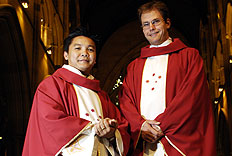
 In March, the Saint Bede Studio was contacted by the
 Archdiocese of Sydney with a request to submit designs for sets of vestments for the Papal Mass in Saint Mary’s Cathedral, Sydney, Saturday, 19th July. Designs were prepared for vestments decorated in three different styles: the Gothic Revival; Carolingian; and according to the traditions of Rome. These designs were then submitted by the Archdiocese of Sydney to the Prefect of Pontifical Ceremonies, Monsignor Guido Marini, who selected the design for vestments ornamented in the Roman style.


 ) kept at the Sens Cathedral. The lappets of this mitre are also embroidered with scrollwork and bear the Papal coat of arms. The embroidery of the mitre was carried out splendidly by Fullerton Design Embroidery (Lithgow NSW). [NB: The Pope’s coat-or-arms has the tiara and not a mitre!]



 waalaw on Daily Rome Shot 1119: “1. . . . . . Q-e3+ If: 2. K-f1 . . R-g1# So: 2. K-e1 . . R-g1+ 3.…”




























