NLM reports about a good book coming out in English

NLM reports about a good book coming out in EnglishThere is a good post over at NLM I want to reinforce. 

NLM, which I am always happy to link, is making the observation that a book published the the Libreria Editrice Vaticana is going to be coming out in English. 

The book is Il Concilio Ecumenico Vaticano II. Contrappunto per la sua storia (The Ecumenical Council of Vatican II: A Counterpoint to Its History).  It will be published by the University of Scranton Press.

Here is a bit from NLM:

In this study, Marchetto critiques the so-called Bologna School which he says has done well in "monopolizing and imposing one interpretation" of the Second Vatican Council, presenting it as a kind of "Copernican revolution, the passing to… another Catholicism". He further critiques their interpretation of the Council as an event or "spirit", rather than looking at the Council through the lens of its official documents. It is in this historical context that Marchetto argues for the hermeneutic of continuity and against the hermeneutic of rupture.

I wrote about the "School of Bologna" here at WDTPRS about a year ago. You might also want to check Sandro Magister’s site about this.

Dissenting from prevailing "School of Bologna" interpretation of the Council, and also from the hermeneutic of rupture promoted by those "new theology" thinkers who split off into the Concilium/Rahnerian camp, Bp. Agostino Marchetto’s book offers a healthier perspective. 

He challenges the dominant school of thought, and properly so.

I had many opportunities to speak with the author, with whom I lived for a few years, about the reception of the Council.  Bp. Marchetto, a fine gentleman, kindly inscribed my copy.  When it comes out in English, you would not make a mistake to read it.

Posted in SESSIUNCULA |
21 Comments

WYD is underway – videos

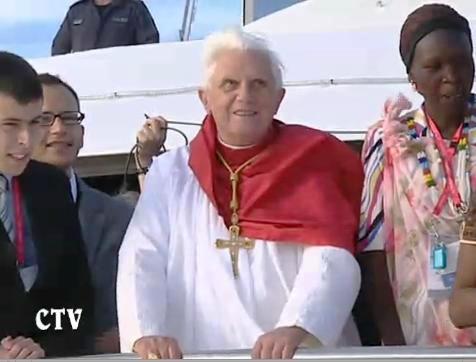
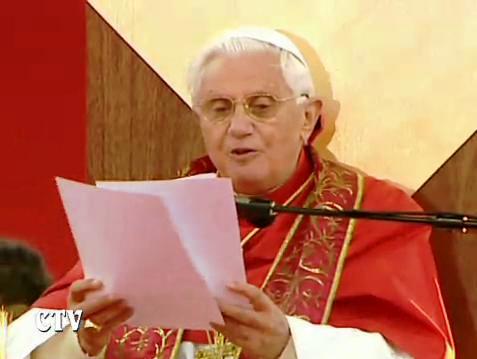
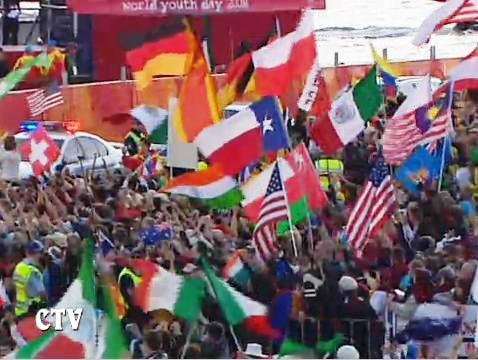
The Holy Father traveled by boat from his brief retreat to his first even of WYD.

Here are video clips of news stories in Italian and English:

I didn’t see any coverage on the website of CNN or the Italian Corriere della sera.  Fox News had a head line farther down on the front page, but focusing on the environment and the story got a few seconds in a brief video spot.

In the meantime, here is a truly dopey SBS piece.  Notice the incongruity between the images and the voice over.  I love the comment about reverent worship in song while kids are singing La Marseillaise.

(This video is no longer available.)

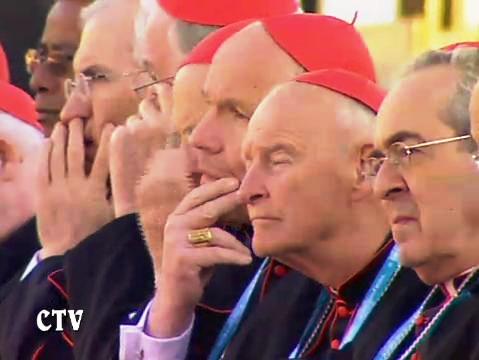
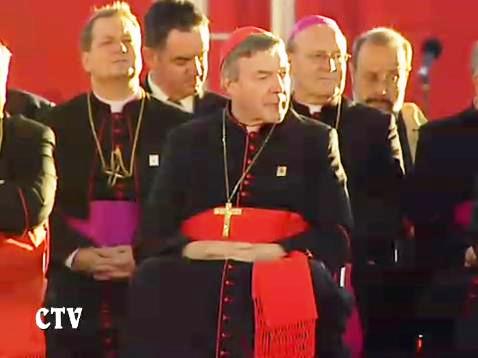
An SBS spot on Card. Pell’s Mass.  Note the comment that it seemed more like a rock concert than a Mass.  Hmmm.  Fair?

(This video is no longer available.)

Some highlights of Card. Pell’s Mass the other day.

(This video is no longer available.)


Posted in SESSIUNCULA |
24 Comments

Praying for the dead

I clicked on Fox News to see if the late Tony Snow’s funeral is being covered.

The Mass will be at the National Shrine of the Immaculate Conception in Washington, DC.

I was struck be the lead up to the coverage.

All the talking heads were chatting about "remembering" Tony, and "eulogizing" him, and "paying respect", etc.

Folks, the purpose of a funeral Mass is the pray for the person who died.

I am not saying that the Mass itself will be lacking.  It has not started yet.  I am not saying that every TV wonk or anchor must have a Catholic understanding of Holy Mass for the dead. 

This experience simply spurred me to stress this point for you readers, some of whom may have never heard these things before.

Funerals are not canonizations.  They are not simply moments to "celebrate a person’s life" or "remember the good times".

The purpose of a funeral, of a Mass, is to intercede with God will forgive the temporal punishment due to sin the deceased may not have had the opportunity to do penance for while alive.

We are praying for God’s mercy, not that God look on us all and celestially opine "Boy, they’re all just wonderful as they are!"

Do not forget to pray for the dead.

Alas, decades of banal translations and white vestments, sentimentality and truly lousy theology have distorted the perception of the Catholic faith and priests about what funeral Masses are for.

Posted in SESSIUNCULA |
67 Comments

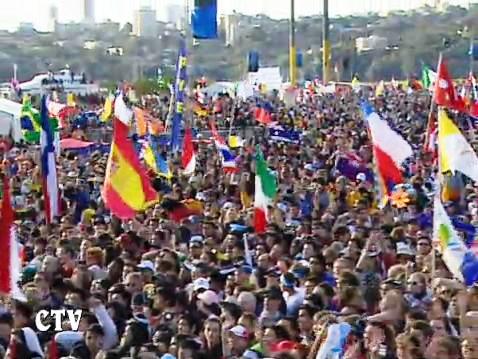
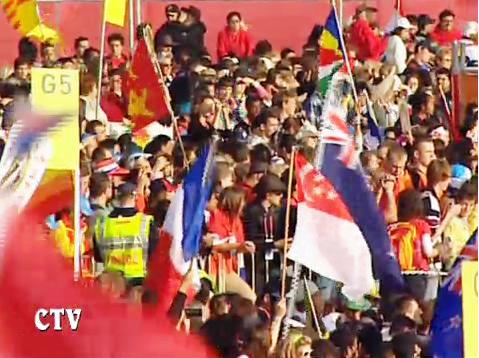
Benedict enters Sydney – live

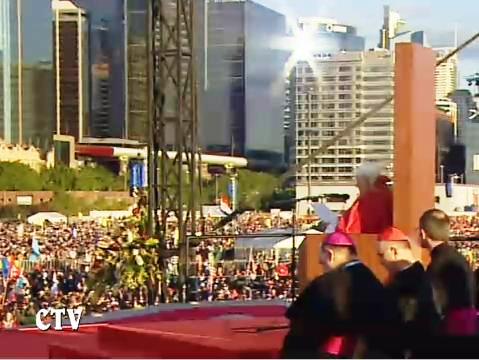
Live, right now, the Holy Father is on the boat in Sydney harbour.

Benedict enters Sydney - live

Benedict enters Sydney - live

Benedict enters Sydney - live

Benedict enters Sydney - live

Benedict enters Sydney - live

Benedict enters Sydney - live

Benedict enters Sydney - live

Benedict enters Sydney - live

Benedict enters Sydney - live

Benedict enters Sydney - live

Benedict enters Sydney - live

Benedict enters Sydney - live

Benedict enters Sydney - live

Benedict enters Sydney - live

Benedict enters Sydney - live

Benedict enters Sydney - live

Benedict enters Sydney - live

Benedict enters Sydney - live

Benedict enters Sydney - live

Benedict enters Sydney - live

I have been updating this live… but it is nearly time to get some sleep!

Benedict enters Sydney - live

Benedict enters Sydney - live

Benedict enters Sydney - live

Benedict enters Sydney - live

Benedict enters Sydney - live

Benedict enters Sydney - live

Benedict enters Sydney - live

Benedict enters Sydney - live

Benedict enters Sydney - live

Benedict enters Sydney - live

Benedict enters Sydney - live

Benedict enters Sydney - live

Benedict enters Sydney - live

Benedict enters Sydney - live

Benedict enters Sydney - live

Benedict enters Sydney - live

Benedict enters Sydney - live

Benedict enters Sydney - live

Benedict enters Sydney - live

Benedict enters Sydney - live

Benedict enters Sydney - live

Benedict enters Sydney - live

Benedict enters Sydney - live

Benedict enters Sydney - live

Benedict enters Sydney - live

Benedict enters Sydney - live

Benedict enters Sydney - live

Benedict enters Sydney - live

Benedict enters Sydney - live

Dear Young People,

What a delight it is to greet you here at Barangaroo, on the shores of the magnificent Sydney harbour, with its famous bridge and Opera House. Many of you are local, from the outback or the dynamic multicultural communities of Australian cities. Others of you have come from the scattered islands of Oceania, and others still from Asia, the Middle East, Africa and the Americas. Some of you, indeed, have come from as far as I have, Europe! Wherever we are from, we are here at last in Sydney. And together we stand in our world as God’s family, disciples of Christ, empowered by his Spirit to be witnesses of his love and truth for everyone!

I wish firstly to thank the Aboriginal Elders who welcomed me prior to my boarding the boat at Rose Bay. I am deeply moved to stand on your land, knowing the suffering and injustices it has borne, but aware too of the healing and hope that are now at work, rightly bringing pride to all Australian citizens. To the young indigenous – Aboriginal and Torres Strait Islanders – and the Tokelauans, I express my thanks for your stirring welcome. Through you, I send heartfelt greetings to your peoples.

Cardinal Pell and Archbishop Wilson, I thank you for your warm words of welcome. I know that your sentiments resonate in the hearts of the young gathered here this evening, and so I thank you all. Standing before me I see a vibrant image of the universal Church. The variety of nations and cultures from which you hail shows that indeed Christ’s Good News is for everyone; it has reached the ends of the earth. Yet I know too that a good number of you are still seeking a spiritual homeland. Some of you, most welcome among us, are not Catholic or Christian. Others of you perhaps hover at the edge of parish and Church life. To you I wish to offer encouragement: step forward into Christ’s loving embrace; recognize the Church as your home. No one need remain on the outside, for from the day of Pentecost the Church has been one and universal.

This evening I wish also to include those who are not present among us. I am thinking especially of the sick or mentally ill, young people in prison, those struggling on the margins of our societies, and those who for whatever reason feel alienated from the Church. To them I say: Jesus is close to you! Feel his healing embrace, his compassion and mercy!

Almost two thousand years ago, the Apostles, gathered in the upper room together with Mary and some faithful women, were filled with the Holy Spirit (cf. Acts 1:14; 2:4). At that extraordinary moment, which gave birth to the Church, the confusion and fear that had gripped Christ’s disciples were transformed into a vigorous conviction and sense of purpose. They felt impelled to speak of their encounter with the risen Jesus whom they had come to call affectionately, the Lord. In many ways, the Apostles were ordinary. None could claim to be the perfect disciple. They failed to recognize Christ (cf. Lk 24:13-32), felt ashamed of their own ambition (cf. Lk 22:24-27), and had even denied him (cf. Lk 22:54-62). Yet, when empowered by the Holy Spirit, they were transfixed by the truth of Christ’s Gospel and inspired to proclaim it fearlessly. Emboldened, they exclaimed: repent, be baptized, receive the Holy Spirit (cf. Acts 2:37-38)! Grounded in the Apostles’ teaching, in fellowship, and in the breaking of the bread and prayer (cf. Acts 2:42), the young Christian community moved forward to oppose the perversity in the culture around them (cf. Acts 2:40), to care for one another (cf. Acts 2:44-47), to defend their belief in Jesus in the face of hostility (cf Acts 4:33), and to heal the sick (cf. Acts 5:12-16). And in obedience to Christ’s own command, they set forth, bearing witness to the greatest story ever: that God has become one of us, that the divine has entered human history in order to transform it, and that we are called to immerse ourselves in Christ’s saving love which triumphs over evil and death. Saint Paul, in his famous speech to the Areopagus, introduced the message in this way: "God gives everything – including life and breath – to everyone … so that all nations might seek God and, by feeling their way towards him, succeed in finding him. In fact he is not far from any of us, since it is in him that we live and move and have our being" (Acts 17: 25-28).

And ever since, men and women have set out to tell the same story, witnessing to Christ’s truth and love, and contributing to the Church’s mission. Today, we think of those pioneering Priests, Sisters and Brothers who came to these shores, and to other parts of the Pacific, from Ireland, France, Britain and elsewhere in Europe. The great majority were young – some still in their late teens – and when they bade farewell to their parents, brothers and sisters, and friends, they knew they were unlikely ever to return home. Their whole lives were a selfless Christian witness. They became the humble but tenacious builders of so much of the social and spiritual heritage which still today brings goodness, compassion and purpose to these nations. And they went on to inspire another generation. We think immediately of the faith which sustained Blessed Mary MacKillop in her sheer determination to educate especially the poor, and Blessed Peter To Rot in his steadfast resolution that community leadership must always include the Gospel. Think also of your own grandparents and parents, your first teachers in faith. They too have made countless sacrifices of time and energy, out of love for you. Supported by your parish priests and teachers, they have the task, not always easy but greatly satisfying, of guiding you towards all that is good and true, through their own witness – their teaching and living of our Christian faith.

Today, it is my turn. For some of us, it might seem like we have come to the end of the world! For people of your age, however, any flight is an exciting prospect. But for me, this one was somewhat daunting! Yet the views afforded of our planet from the air were truly wondrous. The sparkle of the Mediterranean, the grandeur of the north African desert, the lushness of Asia’s forestation, the vastness of the Pacific Ocean, the horizon upon which the sun rose and set, and the majestic splendour of Australia’s natural beauty which I have been able to enjoy these last couple of days; these all evoke a profound sense of awe. It is as though one catches glimpses of the Genesis creation story – light and darkness, the sun and the moon, the waters, the earth, and living creatures; all of which are "good" in God’s eyes (cf. Gen 1:1 – 2:4). Immersed in such beauty, who could not echo the words of the Psalmist in praise of the Creator: "how majestic is your name in all the earth?" (Ps 8:1).

And there is more – something hardly perceivable from the sky – men and women, made in nothing less than God’s own image and likeness (cf. Gen 1:26). At the heart of the marvel of creation are you and I, the human family "crowned with glory and honour" (Ps 8:5). How astounding! With the Psalmist we whisper: "what is man that you are mindful of him?" (Ps 8:4). And drawn into silence, into a spirit of thanksgiving, into the power of holiness, we ponder.

What do we discover? Perhaps reluctantly we come to acknowledge that there are also scars which mark the surface of our earth: erosion, deforestation, the squandering of the world’s mineral and ocean resources in order to fuel an insatiable consumption. Some of you come from island nations whose very existence is threatened by rising water levels; others from nations suffering the effects of devastating drought. God’s wondrous creation is sometimes experienced as almost hostile to its stewards, even something dangerous. How can what is "good" appear so threatening?

And there is more. What of man, the apex of God’s creation? Every day we encounter the genius of human achievement. From advances in medical sciences and the wise application of technology, to the creativity reflected in the arts, the quality and enjoyment of people’s lives in many ways are steadily rising. Among yourselves there is a readiness to take up the plentiful opportunities offered to you. Some of you excel in studies, sport, music, or dance and drama, others of you have a keen sense of social justice and ethics, and many of you take up service and voluntary work. All of us, young and old, have those moments when the innate goodness of the human person – perhaps glimpsed in the gesture of a little child or an adult’s readiness to forgive – fills us with profound joy and gratitude.

Yet such moments do not last. So again, we ponder. And we discover that not only the natural but also the social environment – the habitat we fashion for ourselves – has its scars; wounds indicating that something is amiss. Here too, in our personal lives and in our communities, we can encounter a hostility, something dangerous; a poison which threatens to corrode what is good, reshape who we are, and distort the purpose for which we have been created. Examples abound, as you yourselves know. Among the more prevalent are alcohol and drug abuse, and the exaltation of violence and sexual degradation, often presented through television and the internet as entertainment. I ask myself, could anyone standing face to face with people who actually do suffer violence and sexual exploitation "explain" that these tragedies, portrayed in virtual form, are considered merely "entertainment"?

There is also something sinister which stems from the fact that freedom and tolerance are so often separated from truth. This is fuelled by the notion, widely held today, that there are no absolute truths to guide our lives. Relativism, by indiscriminately giving value to practically everything, has made "experience" all-important. Yet, experiences, detached from any consideration of what is good or true, can lead, not to genuine freedom, but to moral or intellectual confusion, to a lowering of standards, to a loss of self-respect, and even to despair.

Dear friends, life is not governed by chance; it is not random. Your very existence has been willed by God, blessed and given a purpose (cf. Gen 1:28)! Life is not just a succession of events or experiences, helpful though many of them are. It is a search for the true, the good and the beautiful. It is to this end that we make our choices; it is for this that we exercise our freedom; it is in this – in truth, in goodness, and in beauty – that we find happiness and joy. Do not be fooled by those who see you as just another consumer in a market of undifferentiated possibilities, where choice itself becomes the good, novelty usurps beauty, and subjective experience displaces truth.

Christ offers more! Indeed he offers everything! Only he who is the Truth can be the Way and hence also the Life. Thus the "way" which the Apostles brought to the ends of the earth is life in Christ. This is the life of the Church. And the entrance to this life, to the Christian way, is Baptism.

This evening I wish therefore to recall briefly something of our understanding of Baptism before tomorrow considering the Holy Spirit. On the day of your Baptism, God drew you into his holiness (cf. 2 Pet 1:4). You were adopted as a son or daughter of the Father. You were incorporated into Christ. You were made a dwelling place of his Spirit (cf. 1 Cor 6:19). Baptism is neither an achievement, nor a reward. It is a grace; it is God’s work. Indeed, towards the conclusion of your Baptism, the priest turned to your parents and those gathered and, calling you by your name said: "you have become a new creation" (Rite of Baptism, 99).

Dear friends, in your homes, schools and universities, in your places of work and recreation, remember that you are a new creation! Not only do you stand before the Creator in awe, rejoicing at his works, you also realize that the sure foundation of humanity’s solidarity lies in the common origin of every person, the high-point of God’s creative design for the world. As Christians you stand in this world knowing that God has a human face – Jesus Christ – the "way" who satisfies all human yearning, and the "life" to which we are called to bear witness, walking always in his light (cf. ibid., 100).

The task of witness is not easy. There are many today who claim that God should be left on the sidelines, and that religion and faith, while fine for individuals, should either be excluded from the public forum altogether or included only in the pursuit of limited pragmatic goals. This secularist vision seeks to explain human life and shape society with little or no reference to the Creator. It presents itself as neutral, impartial and inclusive of everyone. But in reality, like every ideology, secularism imposes a world-view. If God is irrelevant to public life, then society will be shaped in a godless image, and debate and policy concerning the public good will be driven more by consequences than by principles grounded in truth.

Yet experience shows that turning our back on the Creator’s plan provokes a disorder which has inevitable repercussions on the rest of the created order (cf. 1990 World Day of Peace Message, 5). When God is eclipsed, our ability to recognize the natural order, purpose, and the "good" begins to wane. What was ostensibly promoted as human ingenuity soon manifests itself as folly, greed and selfish exploitation. And so we have become more and more aware of our need for humility before the delicate complexity of God’s world.

But what of our social environment? Are we equally alert to the signs of turning our back on the moral structure with which God has endowed humanity (cf. 2007 World Day of Peace Message, 8)? Do we recognize that the innate dignity of every individual rests on his or her deepest identity – as image of the Creator – and therefore that human rights are universal, based on the natural law, and not something dependent upon negotiation or patronage, let alone compromise? And so we are led to reflect on what place the poor and the elderly, immigrants and the voiceless, have in our societies. How can it be that domestic violence torments so many mothers and children? How can it be that the most wondrous and sacred human space – the womb – has become a place of unutterable violence?

My dear friends, God’s creation is one and it is good. The concerns for non-violence, sustainable development, justice and peace, and care for our environment are of vital importance for humanity. They cannot, however, be understood apart from a profound reflection upon the innate dignity of every human life from conception to natural death: a dignity conferred by God himself and thus inviolable. Our world has grown weary of greed, exploitation and division, of the tedium of false idols and piecemeal responses, and the pain of false promises. Our hearts and minds are yearning for a vision of life where love endures, where gifts are shared, where unity is built, where freedom finds meaning in truth, and where identity is found in respectful communion. This is the work of the Holy Spirit! This is the hope held out by the Gospel of Jesus Christ. It is to bear witness to this reality that you were created anew at Baptism and strengthened through the gifts of the Spirit at Confirmation. Let this be the message that you bring from Sydney to the world!

Mi rivolgo ora con affetto ai giovani di lingua italiana. Cari amici, anche questa volta avete risposto numerosi al mio invito, nonostante le difficoltà dovute alla distanza. Vi ringrazio, e voglio salutare anche i vostri coetanei che dall’Italia sono spiritualmente uniti a noi. Vi invito a vivere con grande impegno interiore queste giornate: aprite il cuore al dono dello Spirito Santo, per essere rafforzati nella fede e nella capacità di rendere testimonianza al Signore risorto. Arrivederci!

Chers jeunes francophones, poussés par le désir d’approfondir votre foi, vous êtes venus des extrémités de la terre pour vivre à Sydney l’expérience unique et communautaire d’une rencontre privilégiée avec le Seigneur. C’est l’Esprit Saint qui vous a rassemblés ici. Puisse-t-Il vous permettre de expérimenter sa présence dans votre cœur et vous pousser à rendre témoignage avec ardeur de Jésus-Christ mort et ressuscité pour vous!

Liebe Freunde, die ihr mich in meiner Muttersprache versteht, von Herzen grüße ich euch alle. Erweist euch überall als freudige Zeugen der frohmachenden Botschaft Jesu! Sprecht mutig von eurem Glauben, auch wenn ihr zuweilen auf Widerspruch stößt und das Kreuz der Ablehnung erfährt. Der Herr, der für uns ein größeres Kreuz getragen hat, wird euch beistehen. Gott schenke euch eine gute, gesegnete Zeit hier in Australien.

Queridos jóvenes de lengua española, la misión de ser testigos del Señor en todos los lugares de la tierra es una apasionante tarea, que exige acoger su Palabra e identificarse con Él, compartiendo con los demás la alegría de haber encontrado al verdadero amigo que nunca defrauda. Que este reto agrande vuestra generosidad. Un saludo muy cordial a todos.

Queridos amigos dos vários países de língua oficial portuguesa, bem-vindos a Sidney! A todos saúdo com afecto: os de perto e os de longe. Lá, na vossa Pátria, tereis ouvido Jesus segredar-vos: «Sereis minhas testemunhas… até aos confins do mundo» (Act 1, 8). A viagem mais ou menos longa que enfrentastes para chegar até aqui, à Austrália ou – de seu nome cristão completo – «Terra Austral do Espírito Santo», não deixou em vós a sensação de terdes chegado aos confins do mundo? Pois bem! É com grande alegria que o Papa vos acolhe para vos confirmar como testemunhas de Jesus, por Ele acreditadas com o dom do seu próprio Espírito.
Posted in SESSIUNCULA |
44 Comments

Consecration of Old St. Patrick’s in KC, MO

Consecration of Old St. Patrick’s in KC, MO

The actual consecration, by Bp. Robert Finn, will take place on 25 October.

Posted in What Fr. Z is up to |
1 Comment

A parish church altar restoration and ad orientem worship

WDTPRS reader Fr. Fr. Dennis Duvelius of St. Louis Church in Batesville, Indiana sent me some fine photos.

Priests – take notice.
It can be done.
Before:

A parish church altar restoration and ad orientem worship

After:

A parish church altar restoration and ad orientem worship

And the result!

A parish church altar restoration and ad orientem worship

Posted in SESSIUNCULA |
43 Comments

Another step toward what we know must eventually come

Another step toward the persecution.
My emphases and comments.


FAITH UNDER FIRE
Major U.S. city officially condemns Catholic Church
Instructs members to defy ‘Holy Office of Inquisition’

Posted: July 15, 2008

Another step toward what we know must eventually come
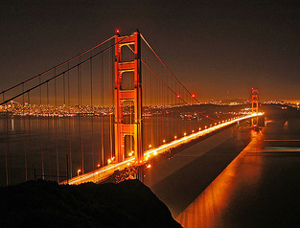
San Francisco’s Golden Gate Bridge

A San Francisco city and county board resolution that officially labeled the Catholic church’s moral teachings on homosexuality as "insulting to all San Franciscans," "hateful," "defamatory," "insensitive" and "ignorant" will be challenged tomorrow in court for violating the Constitution’s prohibition of government hostility toward religion.

Resolution 168-08, passed unanimously by the City and County of San Francisco Board of Supervisors two years ago, also accused the Vatican of being a "foreign country" meddling with and attempting to "negatively influence (San Francisco’s) existing and established customs."

It said of the church’s teaching on homosexuality, "Such hateful and discriminatory rhetoric is both insulting and callous, and shows a level of insensitivity and ignorance which has seldom been encountered by this Board of Supervisors."

As WND reported, Resolution 168-08 was an official response to the Catholic Church’s ban on adoption placements into homosexual couple households, issued by Cardinal William Levada of the Congregation for the Doctrine of the Faith at the Vatican.

The board’s resolution urged the city’s local archbishop and the Catholic Charities of the Archdiocese of San Francisco to defy the Vatican’s instructions, concluding with a spiteful reminder that the church authority that issued the ban was known 100 years ago as "The Holy Office of the Inquisition."

The resolution also took a shot at Levada, the former archbishop of San Francisco, saying, "Cardinal Levada is a decidedly unqualified representative of his former home city, and of the people of San Francisco and the values they hold dear."

The anti-Catholic diatribe had been challenged in U.S. District Court on similar grounds, but District Judge Marilyn Hall Patel ruled in favor of the city, saying, in essence, the church started it.

She wrote in her decision, "The Congregation of the Doctrine of the Faith provoked this debate, indeed may have invited entanglement" for instructing Catholic politicians on how to vote. This court does not find that our case law requires political bodies to remain silent in the face of provocation."

She ruled that the city’s proclamation was not entangling the government in church affairs, since the resolution was a non-binding, non-regulatory announcement.

Since no law was enacted, she ruled, city officials – even in their official capacity as representatives of the government – can say what they want.

"It is merely the exercise of free speech rights by duly elected office holders," she wrote. [Ohhhh… I think it’s a little more than that now.]

Richard Thompson, president and chief counsel of the Thomas More Law Center, which is appealing the District Court decision on behalf of the Catholic League for Religious and Civil Rights and two Catholic residents of San Francisco, disagrees with Patel’s decision.

"Sadly, the ruling itself clearly exhibited hostility toward the Catholic Church," he said in a statement. "The judge in her written decision held that the Church ‘provoked the debate’ by publicly expressing its moral teaching, and that by passing the resolution the City responded ‘responsibly’ to all of the ‘terrible’ things the Church was saying."  [You wouldn’t want the Church to have free speech.]

Thomas More attorney Robert Muise will present oral arguments in the case tomorrow morning in the Ninth Circuit Court of Appeals.  [Imagine.  The 9th Circuit. What a joke.]

"Our Constitution plainly forbids hostility toward any religion, including the Catholic faith," he said.

"In total disregard for the Constitution, homosexual activists in positions of authority in San Francisco have abused their authority as government officials and misused the instruments of the government to attack the Catholic Church. Their egregious abuse of power has now the backing of a lower federal court. … Unfortunately, all too often we see a double standard being applied in Establishment Clause cases," Muise said.

Thomas More attorneys argued in the District Court case that the "anti-Catholic resolution sends a clear message" that Catholics are "outsiders, not full members of the political community." [That’s it.]

The cultural, and now political, straight-arm to adherents of the Christian faith in San Francisco has been increasingly public in the last two years. Just one week after the anti-Catholic resolution was passed, the San Francisco Board issued a similar resolution against a mostly evangelical group.

Following a gathering of 25,000 teens at San Francisco’s AT&T Park as part of Ron Luce’s Teen Mania "Battle Cry for a Generation" rally against the sexualization of America’s youth culture by advertisers and media, the board spoke out formally again.

According to the San Francisco Chronicle, the Board of Supervisors unanimously passed a resolution condemning the "act of provocation" by what it termed an "anti-gay," "anti-choice" organization that aimed to "negatively influence the politics of America’s most tolerant and progressive city."

Openly homosexual California Assemblyman Mark Leno told protesters of the teen rally that though such religious people may be few, "they’re loud, they’re obnoxious, they’re disgusting, and they should get out of San Francisco."  [Nice!  They should also rename the city, to get rid of the last taint of Christianity.  Then we can put up a wall.]

The Chronicle also reported a San Francisco protester against the evangelical youth rally carried a sign that may sum up the sentiment: "I moved here to get away from people like you."

The Thomas More Law Center hopes the Ninth Circuit Court of Appeals will decide in the case of Resolution 1680-08 that even if a large portion of the community is at odds with a religion’s views on homosexuality, the government cannot be used as a weapon to condemn religious faith.  [Just watch.]

Currently, as WND has reported, Colorado and Michigan are tackling the question of whether the Bible itself can be vilified as "hate speech" for it’s condemnation of homosexuality, and Canada has developed human rights commissions, which have decided people cannot express opposition to homosexuality without fear of government reprisal.

Another step toward what we know must eventually come.

Posted in SESSIUNCULA |
112 Comments

What is Pope Benedict thinking about Anglicans?

The Anglican question is very hot right now, in fact, probably radioactive.

I have received perhaps a hundred e-mails in the last couple of days, with links, articles and requests for me to comment.

It strikes me that there is a lot of misinformation going about in the Catholic press and blogosphere about Pope Benedict’s thoughts about the fractures in the Anglican communion and whether or not His Holiness thinks they should approach Rome in a spirit of unity.

I think we have to be very careful and ask a lot of questions right now. 

Let’s start with this.

Does the Pope want them to swim the Tiber or not?

CNS Rome correspondent put a question to Pope Benedict on the papal airplane as they flew to Australia.

Q: While you are in Australia, the bishops of the Anglican Communion, which is very widespread also in Australia, are meeting in Lambeth Palace. One of the main arguments will be possible ways to consolidate communion between the provinces and to find a way to ensure that one or more provinces do not take initiatives that others see as contrary to the Gospel and tradition.

Is there the risk of a fragmentation of the Anglican Communion and the possibility that some will ask to be received into the Catholic Church. What is your hope for the Lambeth Conference and for the archbishop of Canterbury?

Benedict XVI: My essential contribution can only be prayer and with my prayer I will be very close to the Anglican bishops meeting in Lambeth Conference.

We cannot and must not intervene immediately [!] in their discussions, we respect their own responsibility and it is our hope that schisms and new breaks can be avoided, and that a responsible solution will be found given our times, but also in fidelity to the Gospel. These two things must go together.

Christianity is always contemporary and lives in this world, in a certain time, but it renders present in this time the message of Jesus Christ and, hence, offers a true contribution for this time only be being faithful — in a mature and creative way — but faithful to the message of Christ.

We hope, and I personally pray, that together they will find the way of the Gospel for our day. This is my wish for the archbishop of Canterbury: That the Anglican Communion in communion with the Gospel of Christ and the Word of the Lord will find the answers to the present challenges.

Some things must be said here.

First, we really don’t know what this means.  I repeat: We can’t learn from this what Pope Benedict really thinks about the possibility of Anglicans coming to Rome, en masse or as individuals. 

Pope Benedict is going to have a horror of schisms.  He is steeped in Augustine, who abhorred schism, in Bonaventure, who abhorred disunity, and in more recent Communio theologians such as Henri De Lubac, who wrote of the mystery of Christ being a mystery of unity.  Christ, for Benedict, unifies.  I don’t think we would be going out too far on a limb to ask Papa Ratzinger: are divisions in non-Catholic communions themselves profoundly non-Christian?  Even if some divided group tends toward unity with Holy Mother Church, the Catholic Church?   So, is Benedict thinking that it would be better to draw in a larger and more unified group than bring in stragglers?

At the same time, His Holiness is a realist.  Does he, or anyone else for that matter, really think that the Anglicans as a body are going to get their act together and then tend toward Rome?  It seems to me far more likely that they would get their act together and confirm their more Protestant roots by becoming something like Methodists.

Another question: Given the way the Church of England is still so deeply interwoven with English society, wouldn’t the very notion of the Church of England, as a body, coming to Papism more than a little fantastical?  Could the Holy Father really a large group of Anglicans would formally swim? 

What has Pope Benedict said to other groups who are in dialogue with Rome?  I have in mind what Card. Castrillon Hoyos (President of the Pont. Comm. Ecclesia Dei) said about the SSPX.  He said that he would rather see them come back to Holy Church as a group, though Rome would of course never refuse individuals.  Is some ecclesiological idea of Pope Benedict at the back of such a statement?  It would be better to reconcile a group with Rome and then have them preserve their identity in some way rather than have them simply dissolve into the larger Church?

His Eminence Walter Card. Kasper is at Lambeth, backed up by two other Cardinals, the English speaking Card. Diaz (the "Red Pope" of Propaganda Fidei) and the locum tenens Card. Murphy-O’Connor.  All along Card. Kasper has been doing his job in conveying the position of the Holy See.  He has stated clearly that if the Anglicans go down this loony Protestant, in the deepest sense anti-ecclesial path of ordaining women as bishops, then the warmth of the (relatively stagnant) ARCIC will take on an arctic chill.  Can we imagine that Pope Benedict isn’t behind that message?  Of course he is. 

Practically speaking, would it be better to try to dialogue with various splinter groups, or will a more unified body?  I’m just asking.

Finally, as we wander through this hall of mirrors which is Catholic-Anglican dialogue, edge up to the murky swamp which is Anglicanism, can we really imagine that these folks who are opining on the question of Anglicans defecting to Rome are entirely disinterested? 

Could some of them perhaps be pretty frightened of an influx of conservative, liturgically high church, clerics entering English Catholic dioceses and, because of the necessity of numbers, being made parish priests? 

Would that explain their dash to interpret Pope Benedict’s words on the airplane that he (incredibly) would be against people coming into unity with the Church of Rome? 

Would the Bishop of Rome really be against people being in unity with his person? 

So, perhaps some people writing about Pope Benedict’s words are self-interested?  

Are they seeking to derail closer unity? 

What would scare people, on either side, about high church Anglicans suddenly becoming part of the fabric of the Catholic Church in England?

I’m just asking.

We need a little time to go back and look at Papa Ratzinger’s thought on Anglicans – remember how interested he has been in Card. Newman, whose cause is moving forward.  His thought may be different in his life as theologian, then Prefect, now Pontiff.

I’m just asking some questions here.

Posted in SESSIUNCULA |
25 Comments

Video of Pope Benedict with critters

Pope Benedict with some Aussie critters.

And I don’t mean the young people who … well.. you get it.

Posted in SESSIUNCULA |
15 Comments

A momentary pause

It is humbling to see the various places whence some of you readers are coming.

In the top few slots just a couple minutes ago I saw:

Newcastle Upon Tyne
Pago Pago
Sheboygan, Wisconsin
Te Kauwhata
Dublin
Renningen, Baden-Wurttemberg
Tokyo
Bismarck, North Dakota
Ituna, Saskatchewan
Stockholm, Stockholms Lan
Natchitoches, Louisiana
Tielt, West-Vlaanderen
Dallas, Texas

Make you wonder… no?

Posted in SESSIUNCULA |
47 Comments